McFarland and Auburn had very similar histories, as both were based in Indiana and both had worked in the carriage trade before switching to horseless carriages. While Auburn would gain fame via its Boattail Speedster and its association with the Auburn Cord Duesenberg conglomerate, McFarland's niche was on the exclusive, large, and luxurious automotive landscape. A pair of McFarlands would place within the top five at the Indianapolis Labor Day races in 1910, just a year after they were founded. At the inaugural Indianapolis 500 race in 1911, a McFarlan led the race for a brief time after the pace car pulled off the track, and although it would finish the race, it did not place.
Knickerbocker Cabriolet
Chassis #: 23016
View info and historyMcFarland manufactured carriages from the mid-1850s until 1909, when Harry McFarland created his first automobile. Although they quickly found success with racing, that was not the company's main focus, rather they specialized in building limited quantities of high-end automobiles, clothed with coachwork created in-house. 1924 was the company's peak year of production, and just 278 cars of all models and body styles were built. McFarlan of Connersville, Indiana, manufactured automobiles from 1910 through 1928. Production often hovered around 150 to 200 automobiles annually and was always powered by at least six cylinders. Wheelbase sizes initially measured 120 inches before growing to 132- and 1936 inches by the mid-1910s, peaking at 141 inches.The Twin-Valve Six model was introduced in 1921 and featured 18 spark plugs, triple ignition, and developed one-hundred and twenty horsepower. Demonstrating their engineering prowess, the engine was built in-house. A Single-Valve model was introduced in 1924 that was less powerful but also less expensive. Although it was priced several thousand dollars less than its larger and more powerful siblings, sales were slow and the model was axed by 1926. Another attempt was made to break into the lower-cost price segment with a range of models powered by Lycoming straight-8 engines. Although sales were better than the Single Valve models, it was too little too late. Both Harry McFarlan and his long-time associate Burt Barrows passed away in 1928, followed closely by the demise of the McFarlan company. The assets and facilities were acquired by Errett Lobban Cord who would use them to construct his new Duesenberg Model J.
Touring
Chassis #: 23061
View info and historyA number of celebrities owned a McFarlan, including Jack Dempsey, Al Capone, Fatty Arbuckle, and Paul Whiteman.
by Daniel Vaughan | Sep 2022
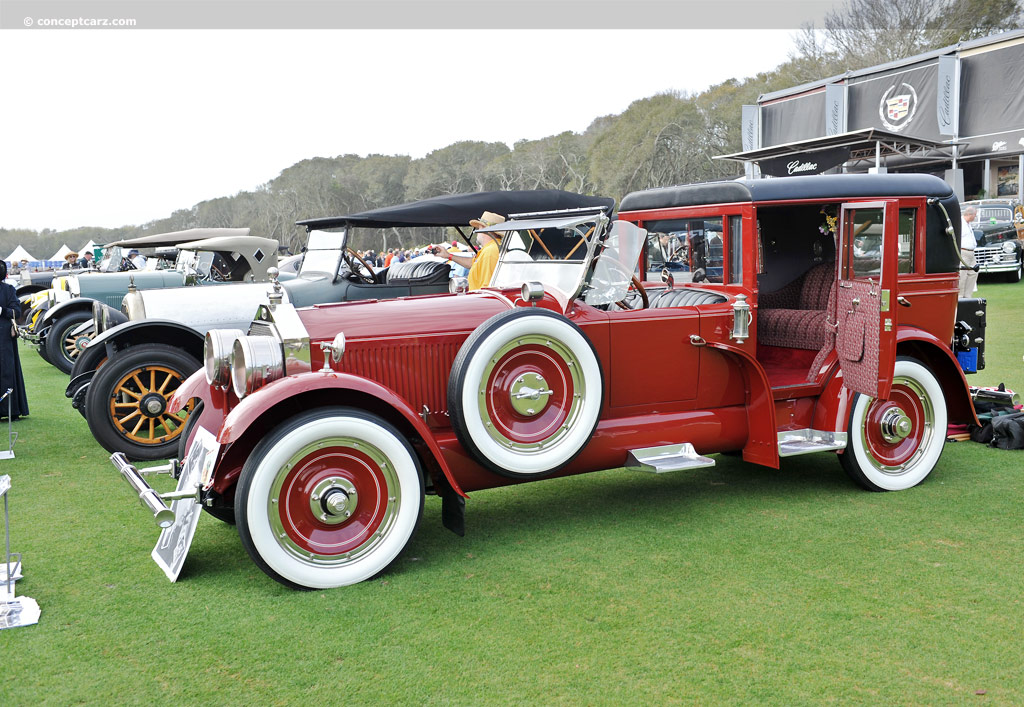
Knickerbocker Cabriolet
Chassis #: 23016
View info and history

Touring
Chassis #: 23061
View info and history
by Daniel Vaughan | Sep 2022
Related Reading : McFarlan Twin-Valve Six History
Like many other automakers, the McFarlan Company began in the carriage industry. They got their start in the mid-1850s and produced their first automobile, created by Harry McFarlan in 1909. The reputation grew the following year considerably, as a pair of McFarlans finished the Indianapolis Labor Day races in the top five in both heats. The McFarlan automobiles were built in limited quantities....
Continue Reading >>
Continue Reading >>


1923 McFarlan Twin-Valve Six Vehicle Profiles


Recent Vehicle Additions


Performance and Specification Comparison
Price Comparison
Twin-Valve Six Specification Comparison by Year
Year
Production
Wheelbase
Engine
Prices
Related Automotive News

1932 Duesenberg J Figoni Sports Torpedo Named Best of Show at the 71st Pebble Beach Concours d'Elegance
2022 Charitable Donations Surpass %242.67 Million
A unique Duesenberg reprised its early role as Concours winner by taking the top prize at the Pebble Beach Concours dElegance.
This year, 40 classic cars from 18 countries and 33 states pulled...

Trump Charlotte Concours d'Elegance
The third annual Trump National Concours dElegance was held near the shores of Lake Norman on the nationally ranked and world-renowned Trump National Golf Club-Charlotte. The location has been named one of the most spectacular and exciting courses...

2018 Boca Raton Concours
Guy Lewis and the Howard Hughes Rolls-Royce
The Boca Raton Concours experienced a growth spurt this year. Fueled by ACD Citrus Tour participants and a juried group from the AACA, the field grew by 25 per cent. And there were more celebrities....

Pair of Historic Duesenbergs Emerge From Five Decades of Single Ownership for RM Sotheby's Hershey Sale
Fall tradition RM Sothebys readies for 10th anniversary Hershey, Pennsylvania sale, October 6-7
Headline attractions Mexican Model J Duesenberg and Model AY Phaeton Prototype come to market after more than 50 years in single-family ownershi...