Concept Cars Home
Image Left 2011 CamaroImage Left 2011 Camaro Neiman Marcus EditionImage Left 2011 Camaro HPE700 LS9Image Left 2011 Camaro Synergy SeriesImage Left 2011 Camaro XM Accessory Appearance PackageImage Left 2011 Camaro SSX Track Car Concept
 
Image credits: © Chevrolet. GM Corp

2012 Chevrolet Camaro SS Pace Car news, pictures, and information

Chevrolet Racing Revs Up Breast Cancer Fight

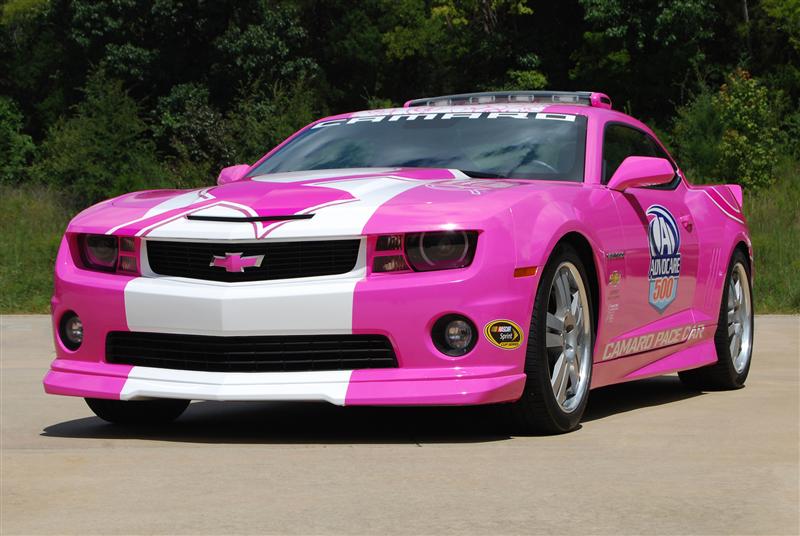
Brand to donate $200 per caution lap during AdvoCare 500 paced by pink Camaro SS

Chevrolet Racing will renew the brand's fight against breast cancer this weekend at Atlanta Motor Speedway where every lap run under the caution flag will lead to a $200 contribution by Chevrolet to the American Cancer Society's Making Strides Against Breast Cancer initiative.

'For our 100th birthday in 2011, Chevrolet began its support of the American Cancer Society, and the generous response from our dealers, employees and customers told us we needed to help the Society fight for more birthdays,' said Don Johnson, vice president of Chevrolet Sales and Service. 'At Chevy, we believe everyday heroes can accomplish extraordinary things, and it is in this spirit that we work to achieve a world without breast cancer.'

On Friday, 30 breast cancer survivors and their guests will spend the day at Atlanta Motor Speedway and participate in Chevrolet Camaro SS pace car rides around the historic track wîth Team Chevy NASCAR Sprint Cup Series driver Jamie McMurray and four-time NASCAR Camping World Truck Series Champion Ron Hornaday Jr. NASCAR Nationwide Series driver Danica Patrick also will visit wîth survivors for photos and autographs.

On Sunday, Chevy will donate $200 for every caution lap run during the NASCAR Sprint Cup Series AdvoCare 500, paced by the pink Camaro SS featuring the Making Strides Against Breast Cancer logo. In 2011, 64 caution laps at Atlanta generated $12,800 for the American Cancer Society.

October is National Breast Cancer Awareness Month. In September, Chevrolet will announce additional brand, dealer, employee and consumer activities in support of the American Cancer Society and Making Strikes Against Breast Cancer.

'Last year, contributions of more than $900,000 supported the American Cancer Society's mission to save lives by helping people stay well and get well, by finding cures and by fighting back against this disease,' said Roshini George, national vice president of health promotions for the American Cancer Society. 'As we approach National Breast Cancer Awareness month in October, we want thank the Chevrolet family for its support and remind everyone to take the steps that make a difference in our fight against breast cancer.'

Founded in 1911 in Detroit, Chevrolet is now one of the world's largest car brands, doing business in more than 140 countries and selling more than four million cars and trucks a year. Chevrolet provides customers wîth fuel-efficient vehicles that feature spirited performance, expressive design, and high quality. More information on Chevrolet models can be found at www.chevrolet.com.

Source - Chevrolet
The Chevrolet Camaro was introduced in 1967 as a compact car specifically built to provide competition for the highly popular Ford Mustang. This pony car was built atop of the same F-Body platform as the Pontiac Firebird, which had a similar production lifespan of 1967 through 2002.

During the preproduction stages of the Chevrolet Camaro, General Motors codenamed the vehicle 'Panther'. The name 'Camaro' was decided upon before production began. The word 'Camaro' in French is slang for 'friend' but in pony-car slang, the name means 'Mustang killer'.

During its production lifespan, there were four generations produced. The first generation lasted from 1967 through 1969. The second generation lasted from 1972 through 1981. The third generation lasted from 1982 through 1992. The fourth generation lasted from 1993 through 2002. The fifth generation is believed to begin production in 2007; a concept was shown at the 2006 Detroit Auto Show.

When the car was introduced in 1967, it was available in two bodystyles, a coupe and convertible. It shared many mechanics with the Chevrolet Nova and built atop a unibody chassis. The base engine was a 3.7 liter inline-six cylinder capable of producing 140 horsepower. Power was sent to the rear wheels courtesy of a Saginaw three-speed manual gearbox. A Muncie four-speed manual and a two-speed PowerGlide automatic were offered as optional equipment. Near the end of 1967, a Turbo Hydra-Matic 350 became available on the SS396. In 1969 the TH350 was offered on the Camaro as optional equipment, in place of the PowerGlide which was no longer offered. 14 inch wheels were standard.

To compete in the pony-car arena, General Motors offered a 5.7 liter eight-cylinder engine in 1967 that produced nearly 300 horsepower.

The Camaro was highly customizable, with over seventy factory and forty dealer options available. the z28 option was not mentioned in the sales literature so many buyers were unaware of its existence. Due to the lack of press about the Z28 option, only 602 examples were produced. The package included many performance enhancements such as a 4.9 liter small-block engine, front disc brakes, Muncie 4-speed gearbox, suspension improvements, 15 inch Rallye wheels, and power steering. The aesthetics of the vehicle were segregated from the other Camaro's with racing stripes being placed on the hood. The Z28 package was offered by GM specifically to comply with the Sports Car Club of America (SCCA) Trans Am racing series that required an engine size of five-liters or less. Also, the vehicle must be sold to the general public.

The SS (Super Sport) package included many performance and aesthetic upgrades and was popular with more than 34400 examples created. Under the hood was a 5.7 liter eight-cylinder engine with a 6.5 liter big-block offered as optional equipment in 1968. On the grille, horn button, and gas cap were SS badging. Non-functional air-inlets adorned the front hood.

The RS (Rally Sport) package was basically a cosmetic upgrade. The headlights were hidden, the taillights received minor alterations, and the exterior rocker trim was revised. RS badging could be seen throughout the vehicle. This was the most popular option ordered in 1967 with over 64840 examples produced.

The RS and SS packages could be ordered together, creating the RS/SS Camaro. The combination included both the aesthetics of the RS and the performance of the SS. A Camaro RS/SS convertible with a 6.5 liter engine paced the Indianapolis 500 race in 1967.

With over 220900 examples produced in 1967, the Camaro proved to General Motors that the public was starved for small, performance, pony-cars.

In 1968 the Camaro received minor aesthetic and mechanical improvements. Side market lights were added, the grille became more pointed, and the taillights were now segregated. The side vent windows were removed. Performance was improved slightly by the staggering of the shock absorbers. On some of the models, the single-leafs were replaced by multi-leaf springs.

Buyers became aware of the Z28 package in 1968 and ordered nearly 7200 examples. The RS continued to be the most popular option with 40977 examples produced. The SS accounted for 27884 of the 235147 total Camaro's produced in 1968.

For 1969 the Camaro became safer and faster. General Motors mandated that the Camaro could not come from the factory with engines larger than 6.6 liters. To bypass this rule dealerships such as Yenko Chevrolet, Dana Chevrolet, and Nickey Chevrolet offered the Camaro with the 7 liter, big-block, L-27 corvette engine producing 425 horsepower. These performance options became so popular that in 1969 Chevrolet began offering two Central Office Production Orders (COPO) options, numbers 9560 and 9561. The COPO 9561 option included the L-72 Corvette engine. In total, there were 1015 Camaros equipped with the L-72 Corvette engine.

The COPO 9560 option included a 7-liter, big-block, ZL-1 engine. The engine was constructed of aluminum to help reduce the overall weight. The engine was reported to have produced around 430 gross horsepower but in reality it was closer to 550. With only 69 examples produced it is one of the rarest and fastest of all Chevrolet Camaros.

Most of the 1969 Chevrolet Camaro mechanics remained unchanged. The aesthetics was a different story. The grille was redesigned and the headlights now sat farther back adding to the aggressive features of the car. Newly reshaped door, rear quarter panel, and rear valence gave the 1969 Camaro a smooth, low, and wide stance. The production of the 1969 Camaro, which continued into December of 1969, was the final year for the first generation Camaro.

The second generation Camaro began production near the middle of 1970. The body had been redesigned and the suspension was greatly improved. The rest of the mechanics remained mostly unchanged from the prior years. The biggest change was the base engine, which was now a 4.1 liter inline-six capable of producing 155 horsepower. There was no convertible option offered, only a 2+2 coupe configuration.

The big-block eight-cylinder had been bored to 402 cubic-inches but still retained its 396 badging. The Rally Sport, Super Sport, and Z28 packages were still available. The Z28 now featured a 5.7 liter engine that produced 360 horsepower.

1972 was not a good year for the Camaro. For 174 days production ceased at GM's assembly plant in Ohio due to a UAW strike. This resulted in 1100 Camaro's failing to meet 1973 Federal bumper safety standards. In total, only 68,656 examples were production. Less than a thousand were the SS package so General Motors decided to no longer offer the package after 1972. This meant the big-block 396 cubic-inch engine was no longer offered.

The Camaro, much like the rest of the industry, had to adapt to new government and insurance safety and emission regulations. This meant new safety features like larger bumpers needed to be affixed to the car that could protect the vehicle and its occupants at certain speeds. Engines were detuned to comply with safety and emission concerns. The cars became safer but their performance was seriously crippled. This was true for the Camaro in 1973 when its highest producing engine was a 350 cubic-inch V-8 that produced 245 horsepower.

New for 1973 was an LT option which included impact-absorbing bumpers. The Camaro grew in size in 1974 due to a forward sloping grille and new aluminum bumpers. Rectangular bumpers replaced the round taillight designs. Sales of the Z28 package continued to decline so the decision was made to discontinue the option after 1974.

Horsepower was measured in NET rather than gross rating beginning in 1975. This meant that the reported horsepower was much lower than in prior years. The 350 cubic-inch V8 was now rated at about 155 horsepower.

In 1977 the Z28 was re-introduced in an effort to revitalize the muscle-car persona of the Camaro. The base Camaro's were outfitted with air-conditioning and an automatic transmission. A Borg-Warner Super T-10 four-speed manual gearbox could be ordered as optional equipment.

1978 marked the first year for the T-top option on a Camaro. The Camaro was given larger taillights and new bumpers.

As vehicles became safer, they became slower. The public shifted from wanting performance to luxury. Oil embargos and rising fuel costs had made the engines smaller but more fuel efficient. For 1979 the LT package was replaced with a luxurious Berlinetta that included special wheels, paint, emblems, and interior.

1979 was a very strong year for Camaro sales with 282,571 examples being sold.

1980 and 1981 saw very few changes. The hood scope on the Z-28 was revised to help siphon air to the engine.

In 1981 sales were down considerable to just over 126,000. This would be the final year for the second generation Camaro.

In 1982 General Motors introduced the third generation of the Camaro. The vehicle was stylish and versatile, earning the coveted Motor Trend magazine's Car of the Year. Both aesthetically and mechanically, the vehicle was improved. The suspension was upgraded making it more capable in the corners and at speed.

This was the first year the Camaro was equipped with a factory fuel-injected engine. A four-speed automatic gearbox replaced the three-speed unit. A five-speed manual gearbox was also available. Due to rising concerns of oil shortage, a four-cylinder engine was offered for part of 1982.

6000 examples of the Z28 Camaro were sold to commemorate the return of the pony-car to the Indianapolis 500. The special-edition vehicles were painted in two-tone silver and blue paint with orange pin-striping.

To honor the International Race of Champions, Chevrolet introduced the IROC-Z in 1985. The package included an improved suspension, decal package, and a 305 cubic-inch L98 Tuned Port Injection system borrowed from the Corvette. The IROC-Z was featured on Car and Driver magazine's Ten Best List for 1985.

The L69 small-block engine was offered from 1983 through 1986. The LB9 small-block was introduced in 1985; the L98 small-block was introduced in 1987; the LO3 was introduced in 1988. The LB9, L98, and LO3 stayed in production until 1992.

1992 was the final year for the third generation Camaro. 1993 marked the beginning of the fourth generation which persisted until 2002.

New technology and material made the fourth generation greatly improved over the prior years. Weight was reduced with the use of plastic body panels sitting atop a steel space frame. Performance was increased thanks in part to a better suspension system. In 1993 Chevrolet offered the LT1 eight-cylinder engine, which had been in production for a year on the Corvette, on the Camaro. A six-speed manual gearbox was offered with the LT1 engine.

The Camaro returned to the Indianapolis 500 as the honorary pace car in 1993. To commemorate this historic accomplishment, Chevrolet offered a limited quantity of special edition Camaro's, painted in a black and white color scheme.

The design and mechanics remained mostly unchanged over the next few years. Minor revisions were made to comply with newly introduced emission standards. Mechanical changes were made to correct problems that had been found throughout the years.

In 1996 the RS package and the SS package were re-introduced. The RS was an appearance option for the six-cylinder Camaro's while the SS was both an appearance and performance package for the eight-cylinder cars.

1997 marked the 30th anniversary of the Camaro. A 30th Anniversary Package was offered to honor this accomplishment. The vehicles were painted white with orange stripes. 100 of the Anniversary Camaros were given the LT4 engine with 330 horsepower; a thirty-eight thousand dollar price tag accompanied the vehicle.

The interior of the Camaro was modernized in 1997 and again in 1998, although the 1998 improvements were minor in comparison to what transpired the prior year.

The body design was drastically changed in 1998, mainly in the front. Round headlights replaced the square design. The headlights were flush, inline with the rest of the body. A new grille and bumper were used, both positioned a little differently to mimic the headlight changes. A new powerful, lightweight, all-aluminum LS1 power-plant retired the LT1 unit. The OHV LS1 was borrowed from the Corvette and slightly detuned to produce just over 300 horsepower. To handle this extra power, the disc brakes were enlarged and the suspension was upgraded.

Total production for 1998 was 48490. This was disappointing for General Motors, especially with the newly revised body and powerful options. The lowest production year for the Camaro occurred in 2001 with just over 29000 examples being produced. This was due to low sales and production ceasing early to begin work on the 35th Anniversary 2002 cars.

2002 marked the final year for production of the fifth generation Camaro. The styling and mechanics were unmodified, carrying the same design from 1999.

A special 35th Anniversary Edition was offered and could be ordered on all trim levels and packages. The 35th Anniversary SS Camaro could only be ordered as a convertible or with T-Tops. Around 3000 examples of the 35th Anniversary Edition were created. Total production for the year was just over 42,000.

On August 27th, 2002 production ceased. The Camaro had accomplished its goal, to provide competition for the Ford Mustang and other compact, low-priced, sports cars. Outfitted with large, Corvette engines, matted to effective gearboxes and given great suspension and brakes, the Camaro was truly a performance machine that was capable and fun to drive. It was fairly practical with room for more than two passengers. It was economical with sticker-prices in the range that many could afford. The production of the Camaro has ceased, but its future has not yet been written. Expect to see this legendary vehicle on the roadways in the near future.

By Daniel Vaughan | May 2011
For more information and related vehicles, click here

DODGE, TRAVIS PASTRANA TEAM UP AGAIN IN GLOBAL RALLYCROSS
• Pastrana Racing to Field Two Dodge Dart Rallycross Cars for 2013 Season
April 9, 2013 , Auburn Hills, Mich. - Dodge and SRT Motorsports today announced they're teaming up with action sports legend Travis Pastrana again for a second season of competition in the Global Rallycross Championship (GRC) Series. Building on the strong relationship created last year, Pastrana Racing will now field two Dodge Dart race cars for 2013. Bryce Menzies will drive the second Dart. The duo ...[Read more...]
INFINITI U.S. SALES UP NINE PERCENT IN MARCH
Infiniti today reported U.S. sales of 11,103 units in March, up 9.0 percent from 10,185 units a year earlier. For the year, Infiniti has sold 27,376 vehicles, up 4.4 percent versus 2012. Contributing to Infiniti's increase in March were its luxury crossovers and sport utility vehicles, which were up 50.9 percent. The Infiniti JX 7-passenger luxury crossover, which launched exactly one year ago, had sales of 2,633 units in March, an increase of 387 percent over prior year. 'March was a grea...[Read more...]
CHEVROLET TOP PERFORMANCE BRAND ON TRACK AND STREET
Reinforcing the brand's success on the street and track, Chevrolet today showcased its new line of performance cars – including the all-new Camaro Z28, Corvette Stingray and SS Performance Sedan – at the New York International Auto Show. In 2012, Chevrolet accounted for one of four performance cars sold in the United States, and secured the Manufacturer's championships in NASCAR, ALMS, IndyCar, and Grand Am. Chevrolet the winningest name in motorsports for 2012 Chevrolet last yea...[Read more...]
Allgaier Looks For Different Ending To Road America Finish At Sargento 200
Even though he has made only two starts at the legendary four-mile road course, it was last season's race at Road America that will forever be ingrained upon the memory of Justin Allgaier. After the 2011 event was extended past its original distance of 50 laps, Allgaier found himself in the lead during the final green-white-checkered finish attempt, hoping he had enough fuel to get him to the checkered flag. Unfortunately, the caution flag was waved half way to the white flag, thus ending the ra...[Read more...]
Nationwide Series Team Haulers To Road America
On Thursday, June 21, NASCAR Nationwide Series team haulers will gather at Times Printing Company in Random Lake, Wisconsin prior to their convoy to Road America for the Sargento 200 Presented by Menards. Last year's hauler parade drew hundreds of NASCAR fans and an impressive welcome was also extended between residents of Random Lake and Elkhart Lake Wisconsin, as fans lined the route to cheer and wave hello to the passing convoy. Times Printing and Road America expect even greater hauler parti...[Read more...]

Arrow Right 2012 Chevrolet models
Chevrolet Avalanche
Chevrolet Camaro
Chevrolet Camaro 45th Anniversary Edition
Chevrolet Camaro Hot Wheels Edition
Chevrolet Camaro ZL1
Chevrolet Caprice PPV
Chevrolet Captiva
Chevrolet Colorado
Chevrolet COPO Camaro
Chevrolet Corvette
Chevrolet Corvette Centennial Edition
Chevrolet Corvette Daytona Prototype
Chevrolet Corvette Z06
Chevrolet Corvette ZR1
Chevrolet Cruze
Chevrolet Cruze Station Wagon
Chevrolet Cruze Upscale Concept
Chevrolet Equinox
Chevrolet Express
Chevrolet Guy Fieri Corvette
Chevrolet Impala
Chevrolet Impala PPV
Chevrolet Inferno Orange COPO Camaro
Chevrolet Malibu
Chevrolet Pink Camaro Pace Car
Chevrolet Silverado
Chevrolet Silverado HD
Chevrolet Sonic
Chevrolet Sonic Z-Spec Accessories
Chevrolet Suburban
Chevrolet Tahoe
Chevrolet Tahoe Police Special Service Vehicle
Chevrolet Tahoe Police Vehicle
Chevrolet Tony Stewart Camaro ZL1
Chevrolet Traverse
2012 Chevrolet Concepts
Chevrolet Camaro 1LE Concept
Chevrolet Camaro 67 Hot Wheels Concept
Chevrolet Camaro Red Zone Concept
Chevrolet Camaro ZL1 Carbon Concept
Chevrolet Code 130R Concept
Chevrolet Concept TRU 140S
Chevrolet Corvette Carlisle Blue Grand Sport Concept
Chevrolet Corvette Z06 Ron Fellows Tribute
Chevrolet Sonic Z-Spec Concept

Similar Automakers
CadillacChrysler
DodgeFord
GMCHummer
JeepLincoln
MercuryPontiac
Saturn
Similarly Sized Vehicles from 2012
Acura NSX Concept
Aston Martin DBS Carbon Edition
Aston Martin DBS Ultimate
Aston Martin Virage Dragon 88
Audi A6 Allroad Quattro
Audi Q5
Audi R8
Audi R8
Audi R8 e-tron
Audi R8 Exclusive Selection Editions

 
Chevrolet: 2011-2020
Similar Automakers
Chevrolet History
Other models by Chevrolet
Manufacturer Website

Chevrolet
Monthly Sales FiguresVolume
April 2013172,460 
March 2013173,859 
February 2013158,541 
January 2013137,304 
December 2012167,091 
November 2012128,867 
October 2012135,305 
September 2012149,801 
August 2012169,978 
July 2012138,942 
June 2012180,098 
May 2012177,943 
(More Details)

 
150
210
Astro
Avalanche
Aveo
Bel Air
Biscayne
C10 / K10
Camaro
Cameo
Caprice
Cavalier
Chevelle
Citation
Cobalt
Colorado
Corvair
Corvette
Corvette GTP
Cruze
Deluxe Series
El Camino
El Morocco
Equinox
Express
Fleetline
HHR
Impala
Kingswood
Malibu
Metro
Model 3100
Model H
Monte Carlo
Monza
Nova
Prizm
RPO B2K Twin Turbo
S-10
Series 490
Series C
Series L
Silverado
Sonic
Spark
Special Series
SS
SSR
Styleline
Suburban
Tahoe
Tracker
TrailBlazer
Traverse
Uplander
Vega
Venture

Image Left 2011 CamaroImage Left 2011 Camaro Neiman Marcus EditionImage Left 2011 Camaro HPE700 LS9Image Left 2011 Camaro Synergy SeriesImage Left 2011 Camaro XM Accessory Appearance PackageImage Left 2011 Camaro SSX Track Car Concept
© 1998-2012. All rights reserved. The material may not be published, broadcast, rewritten, or redistributed.