
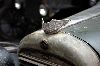
Image credit: © conceptcarz.com (Reproduction Or reuse prohibited).
1926 Nash Series 230 Special Six Navigation
Charles J. Nash was born in 1864 and his early years were very traumatic, as he was abandoned by his parents at the age of six. He became indentured to a Michigan farmer where he was legally bound to stay until he turned 21. He ran away at age twelve and learned how to be a carpenter. He later worked in a grocery story and by the early 1890s was hired by the Flint Road Car Company, a firm owned by William C. Durant.
Even with such a difficult background, Charles would grow to become one of the most influential and successful individuals in the automobile industry. His talents were admired by the Durant-Dort Carriage Company and he was appointed manager in 1895. Fifteen years later he was running Buick. In 1912 he was president of General Motors. A disagreement in 1916 had Charles leaving Durant and resigned from GM. He moved to Kenosha, Wisconsin, and purchased the Thomas J. Jeffery Company with the help of a business partner. The T.J. Jeffery Company was the producers of the venerable Rambler and the Jeffery; the purchase of this company was $9 million.
In the same year of the purchase, the first Nash automobile was introduced to the world. By 1919 Nash was selling 27,000 cars a year. A year later the company ventured into the luxury car segment by offering a LeFayette V8 priced at $5,000 and would later prove to be a financial loss for the company. The other models in the Nash Company were selling well and Nash remained highly profitable and productive. They produced over 50,000 cars in 1923 and had a net profit of $9.3 million.
In 1925 the company introduced the Ajax which sold for $995. The following year the name was changed to the Nash Light Six. One of the most key debut's for the Nash company occurred in 1930 when they introduced the dual-ignition overhead-valve inline eight which was initially rated at 100 horsepower.
The Great Depression was a difficult time for the entire industry; Nash weathered in good financial shape and by 1937 enjoyed its best sales year of the decade with 85,949 cars sold. The company continued to introduce new technology and features, outfitting their cars with popular options, and appealing to a very wide audience of buyers. They offered cars with an innovative heating and defrosting system, but the big news was the introduction of the unit body construction in 1941.
During the Second World War, the company supported the war time efforts by building Pratt & Whitney aircraft engines. In the post war era, the company was strong and in good financial footing. Sad news came on June 6th of 1948 when Charles Nash's life had come to an end. His journey was one that began in poverty and progressed into one of the titans of the 20th century in the dynamic auto industry.
1926 Nash Series 230 Special Six
In 1926 Nash introduced new engines for their top-of-the-line vehicle, the Advanced Six and their mid-priced Special Six. The Special had the same displacement as the prior year but now featured seven main bearings which was a design typically reserved for large and expensive vehicles.
The Seaman Body Corporation of Milwaukee, Wisconsin, a furniture maker-turned-coachbuilder, was responsibly for creating the Nash bodies. Their other clients included Case, Chalmers, Hudson, Oakland and Packard. The Nash Company soon became their largest client in the late teens. To guarantee that the Seaman Body Corporation would focus most of their attention on the Nash Company and to ensure Nash received an adequate supply of bodies, Charles Nash purchased a controlling interest in the body company in 1919.
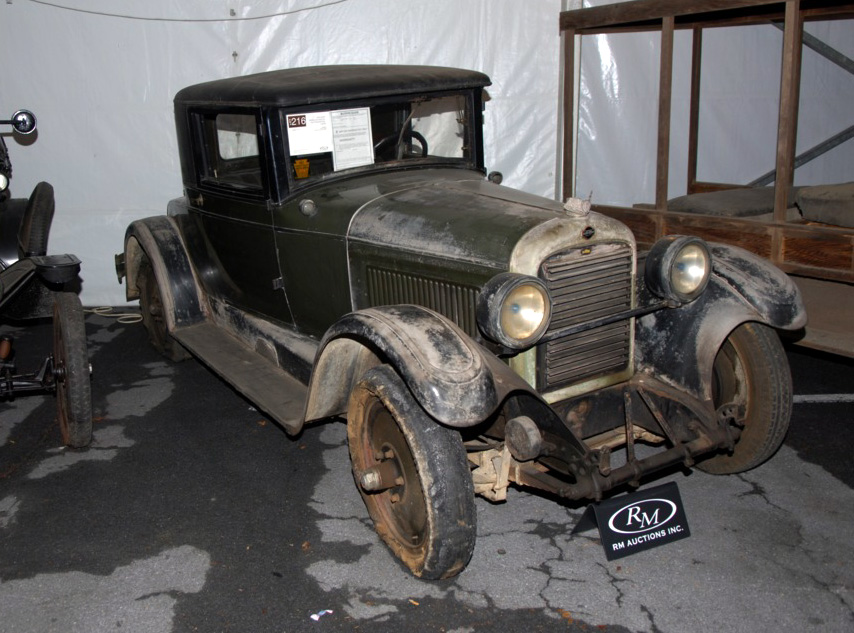
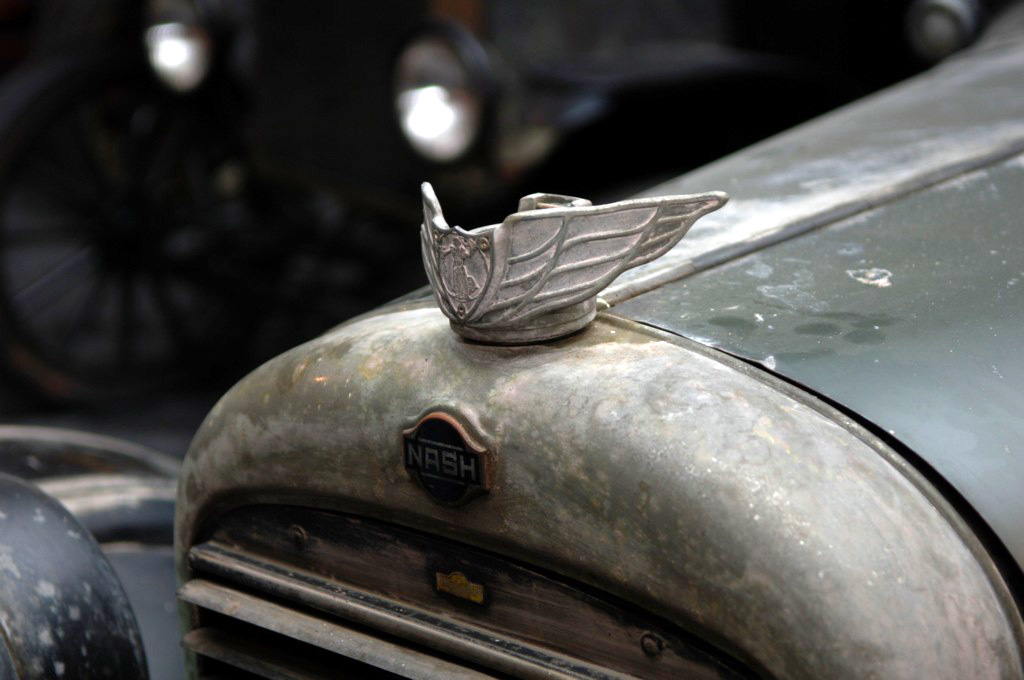
This Nash Special Six is painted in dark green and is very close to the color of black. The body is straight, though somewhat deteriorated over time. The doors function properly, the glass is solid, and there are cold-weather accessories such as in-floor heater and a 'Vernay Shutter' adjustable louver winterfront on the radiator. The radiator cap is missing, as is the fuel tank, there are dings and dents throughout the vehicle mostly centered on the fenders, the leather seats are in fair condition, and the exterior nickel trim has weathered. The odometer reads 17,203 miles and it was last inspected in Pennsylvania in 1932.
This Series 230 Special Six was offered for sale at the Vintage Motor Cars sale at Hershey, PA presented by RM Auctions. It was estimated to sell for $5,000 - $10,000 and offered without reserve. The lot was sold for a high bid of $4,950.
This car is powered by a six-cylinder overhead valve engine that displaces 207.4 cubic-inches and produces 47 horsepower. There is a three-speed manual transmission and four-wheel mechanical brakes. The 112.5-inch wheelbase is held in place by a solid front axle and a live rear axle, both with semi-elliptic leaf springs.By Daniel Vaughan | Dec 2007
Even with such a difficult background, Charles would grow to become one of the most influential and successful individuals in the automobile industry. His talents were admired by the Durant-Dort Carriage Company and he was appointed manager in 1895. Fifteen years later he was running Buick. In 1912 he was president of General Motors. A disagreement in 1916 had Charles leaving Durant and resigned from GM. He moved to Kenosha, Wisconsin, and purchased the Thomas J. Jeffery Company with the help of a business partner. The T.J. Jeffery Company was the producers of the venerable Rambler and the Jeffery; the purchase of this company was $9 million.
In the same year of the purchase, the first Nash automobile was introduced to the world. By 1919 Nash was selling 27,000 cars a year. A year later the company ventured into the luxury car segment by offering a LeFayette V8 priced at $5,000 and would later prove to be a financial loss for the company. The other models in the Nash Company were selling well and Nash remained highly profitable and productive. They produced over 50,000 cars in 1923 and had a net profit of $9.3 million.
In 1925 the company introduced the Ajax which sold for $995. The following year the name was changed to the Nash Light Six. One of the most key debut's for the Nash company occurred in 1930 when they introduced the dual-ignition overhead-valve inline eight which was initially rated at 100 horsepower.
The Great Depression was a difficult time for the entire industry; Nash weathered in good financial shape and by 1937 enjoyed its best sales year of the decade with 85,949 cars sold. The company continued to introduce new technology and features, outfitting their cars with popular options, and appealing to a very wide audience of buyers. They offered cars with an innovative heating and defrosting system, but the big news was the introduction of the unit body construction in 1941.
During the Second World War, the company supported the war time efforts by building Pratt & Whitney aircraft engines. In the post war era, the company was strong and in good financial footing. Sad news came on June 6th of 1948 when Charles Nash's life had come to an end. His journey was one that began in poverty and progressed into one of the titans of the 20th century in the dynamic auto industry.
1926 Nash Series 230 Special Six
In 1926 Nash introduced new engines for their top-of-the-line vehicle, the Advanced Six and their mid-priced Special Six. The Special had the same displacement as the prior year but now featured seven main bearings which was a design typically reserved for large and expensive vehicles.
The Seaman Body Corporation of Milwaukee, Wisconsin, a furniture maker-turned-coachbuilder, was responsibly for creating the Nash bodies. Their other clients included Case, Chalmers, Hudson, Oakland and Packard. The Nash Company soon became their largest client in the late teens. To guarantee that the Seaman Body Corporation would focus most of their attention on the Nash Company and to ensure Nash received an adequate supply of bodies, Charles Nash purchased a controlling interest in the body company in 1919.
This Nash Special Six is painted in dark green and is very close to the color of black. The body is straight, though somewhat deteriorated over time. The doors function properly, the glass is solid, and there are cold-weather accessories such as in-floor heater and a 'Vernay Shutter' adjustable louver winterfront on the radiator. The radiator cap is missing, as is the fuel tank, there are dings and dents throughout the vehicle mostly centered on the fenders, the leather seats are in fair condition, and the exterior nickel trim has weathered. The odometer reads 17,203 miles and it was last inspected in Pennsylvania in 1932.
This Series 230 Special Six was offered for sale at the Vintage Motor Cars sale at Hershey, PA presented by RM Auctions. It was estimated to sell for $5,000 - $10,000 and offered without reserve. The lot was sold for a high bid of $4,950.
This car is powered by a six-cylinder overhead valve engine that displaces 207.4 cubic-inches and produces 47 horsepower. There is a three-speed manual transmission and four-wheel mechanical brakes. The 112.5-inch wheelbase is held in place by a solid front axle and a live rear axle, both with semi-elliptic leaf springs.By Daniel Vaughan | Dec 2007
2007 Vintage Motor Cars at Hershey
Pre-Auction Estimates :
USD $5,000-USD $10,000
Sale Price :
USD $4,950
Recent Sales of the Nash Series 230 Special Six
(Data based on Model Year 1926 sales)
| 1926 Nash Series 230 Special Six Sold for USD$4,950 2007 Vintage Motor Cars at Hershey |   |
Nash Series 230 Special Sixs That Failed To Sell At Auction
1926 Nash Series 230 Special Six's that have appeared at auction but did not sell.
| Vehicle | Chassis | Event | High Bid | Est. Low | Est. High |
|---|
Vehicles With Comparable Market Values
Similar sales to the $4,950 range.
| 1920 Chevrolet Speedster Chassis#:az202535 Sold for $4,950 2025 Mecum : Houston | |
| 1961 Austin-Healey Vanden Plas Princess Limousine Chassis#:vdm414918 Sold for $4,950 2025 Mecum : Houston | |
| 1995 Chevrolet Corvette Convertible Chassis#:1g1yy32p9s5104248 Sold for $4,950 2025 Mecum : Houston | |
| 1994 Mercedes-Benz E320 Sedan Chassis#:wdbea32e3rc122519 Sold for $4,950 2025 Mecum : Glendale | |
| 2006 Subaru Outback Limited Chassis#:4s4bp62c167328330 Sold for $4,950 2025 Mecum : Glendale | |
| 2005 Lexus SC430 Convertible Chassis#:jthfn48yx50067935 Sold for $4,950 2025 Mecum : Glendale | |
| 2007 BMW Z4 Convertible Chassis#:4usbu33577lw71173 Sold for $4,950 2025 Mecum : Glendale | |
| 1967 Harley-Davidson SS 250 Sprint Chassis#:67ss13789 Sold for $4,950 2025 Mecum : Glendale | |
| 'Sleeping Beauty' by RIOCAM Sold for $4,800 2025 RM Sothebys : ModaMiami | |
| 1992 Chevrolet Corvette Coupe Chassis#:1g1yy23p7n5119859 Sold for $4,950 2025 Mecum : Kissimmee | |
| 1985 Cushman Pickup Chassis#:8984548510 Sold for $4,950 2025 Mecum : Kissimmee | |
| 1965 Volkswagen Bugatti Replica Chassis#:255056104 Sold for $4,950 2025 Mecum : Kissimmee | |
| 1949 Ford Tudor Chassis#:98ha126157 Sold for $4,950 2025 Mecum : Kissimmee | |
| 1953 Ford Customline Chassis#:b3ag141580 Sold for $4,950 2025 Mecum : Kissimmee | |
| 2013 Chevrolet Volt Chassis#:1g1rd6e43du121803 Sold for $4,950 2025 Mecum : Kissimmee | |
| 2003 CHEVROLET MONTE CARLO CUSTOM COUPE Chassis#:2G1WW12E139352076 Sold for $4,730 2025 Barrett-Jackson : Scottsdale | |
| 1959 HARLEY-DAVIDSON HUMMER MOTORCYCLE Chassis#:59ST3047 Sold for $4,950 2025 Barrett-Jackson : Scottsdale | |
| 1986 VOLKSWAGEN CABRIOLET Chassis#:WVWCA0154GK007214 Sold for $4,950 2025 Barrett-Jackson : Scottsdale | |
| 1984 HONDA Z50R MINIBIKE Chassis#:JH2AB0202ES504967 Sold for $5,170 2025 Barrett-Jackson : Scottsdale | |
| 1929 Ford Model A Street Rod Chassis#:a711601 Sold for $4,950 2024 Mecum : Kansas City |
1926 Nash Series 230 Special Six
• Additional valuation insight and sales data• History
• Specifications
• Image gallery
1926 Nash Series 230 Special Six Vehicle Profiles
