1938 Packard Formal Town Car Art-Carved Hearse
1938 Packard Formal Town Car Art-Carved Hearse Navigation
1938 Packard Formal Town Car Art-Carved Hearse Model Years


Towncar Hearse
Coachwork: A.J. Miller Co.
A Miller Custom Art-Carved Hearse
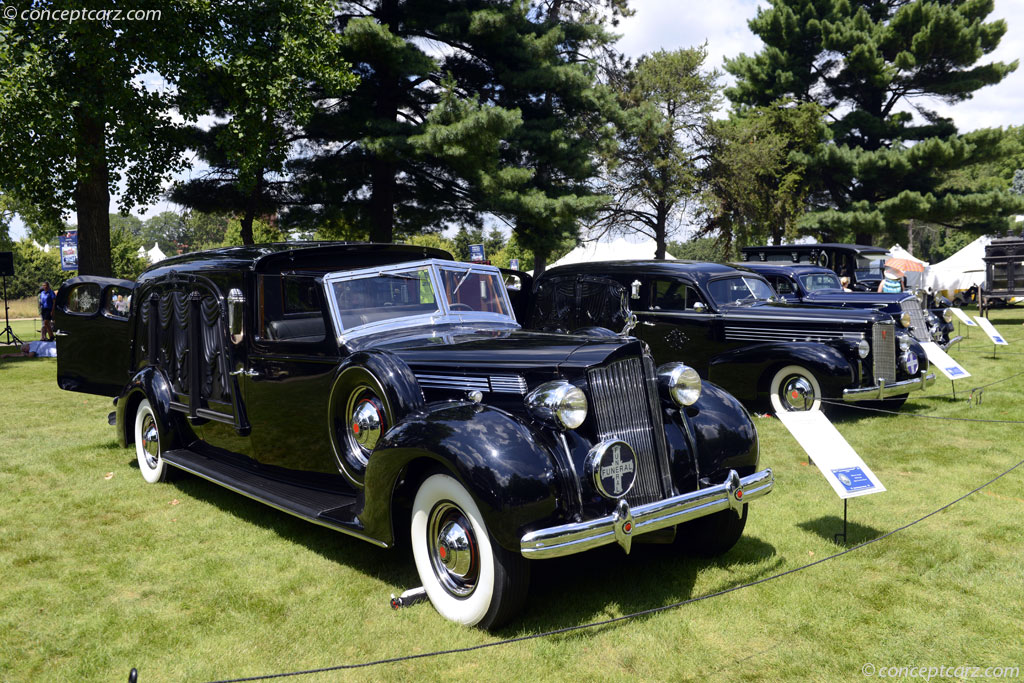
It's difficult to believe this unique Packard hearse was a last-ditch attempt by the A.J. Miller Co. to convince Packard to continue their business relationship - and it failed.In 1938, Packard Motor Co. signed a new, exclusive agreement with Henney Motor Co. to provide chassis for hearses, effectively ending a decade-long agreement with Miller. In response. A.J. Miller Co. of Bellefontaine, Ohio, created an elegant, one-of-a-kind professional car on a 1938 Packard Eight chassis. The side panels were painstakingly hand-carved from wood and are perfectly matched. The interior is reminiscent of a cathedral, with arches lining the sides. A 4.6-liter straight-8 engine moves the 4,200-pound hearse with ease. The Packard is rear-wheel drive and the driver uses a three-speed manual transmission on the floor. The 282 cubic-inch engine produces 120 horsepower.
Miller presented the hearse to Packard officials to demonstrate what they could create in custom body building but Packard chose to end its relationship with Miller. Miller continued to produce professional cars for years on General Motors' bodies. Packard went out of business in 1958.
 The one-and-only 1938 Miller-Packard hearse is owned by William C. Peoples of Marietta, Ohio, who owns Cawley and Peoples Funeral Home. The hearse is still used on special occasions, perhaps carrying a car enthusiast to a final rest in style.Source - National Packard Museum
The Packard Twelve was produced from 1933 to 1939 with over 35,000 examples produced. It is considered by many to be one of the finest automobiles produced by Packard and one of the most significant creations of the classic car era. The long and flowing front hood hid a 445 cubic-inch side-valve twelve-cylinder engine that was refined, powerful, smooth, and quiet. The engine was originally destined for a front-wheel drive project which eventually proved to have weaknesses. That and the anticipated development cost were too much to be practical so Packard decided to scrap the idea. Cadillac had introduced their 16-cylinder engine and other marques such as Pierce-Arrow were improving the performance of their offerings. Packard was feeling the pressure and decided to place the engine into the Deluxe Eight Chassis and dubbed it the Twin Six. The name was in honor of Packard's achievement fifteen years earlier when they introduced their first 12-cylinder engine. By 1933 the name was changed to Twelve to be in line with the rest of the Packard models.Most of the Packard production Twelve's received factory bodies. Only a handful received custom coachwork by such greats as LeBaron and Dietrich.
1936 was the final year for 17-inch wire wheels and double-blade bumpers with hydraulic dampers.
By Daniel Vaughan | Apr 2008
In 1935 Packard introduced more horsepower and mechanical improvements. The suspension became more plush and comfortable while the steering became easier to operate. The cars were designed and built as one unit including the fenders, running boards, hood, and body.
By Daniel Vaughan | Apr 2008
- 1938 Packard Formal Town Car Art-Carved Hearse Menu
- Article
- Image gallery
- Valuation
- Specifications
- Profiles


1938 Packard Formal Town Car Art-Carved Hearse Vehicle Profiles
Recent Vehicle Additions


Performance and Specification Comparison
Twelve Sixteenth Series Specification Comparison by Year
Year
Production
Wheelbase
Engine
Prices
Related Automotive News

New Go-Anywhere Trail And Active Models Take Ford Transit Range Into New Territory
Ford announces new Trail and Active Transit variants that deliver distinctive design, surprising capability and legendary Transit toughness
Intelligent All-Wheel Drive for bold, rugged, capable Transit Trail and mechanical limited-slip differential...

'Storie Alfa Romeo' Episode 8: Design, Sportiness And Innovation - The 156 Was An Authentically Successful Alfa Romeo
A million people in dealerships at its launch and over 680,000 sales overall establish the 156 as one of greatest Alfa Romeo success stories
It rapidly won over customers and critics, winning the Car of the Year award in 1998
The 156 was an ext...

Mazda At 100 | The Rotary Concept Cars
Mazdas defy convention engineering ingenuity ensured success with the rotary engine
Rotary production cars produced by Mazda from 1967 to 2012, with 57 years of concept cars.
Mazda rotary engine technology is suited to use as an EV supporting ran...

Ford Mustang's 10-Speed Auto Transmission Now Available On Transit
Ford Transit with advanced 10-speed automatic transmission now in production for heavy-duty rear-wheel drive applications
Available with 170PS 2.0-litre EcoBlue diesel, efficient new gearbox offers outstanding durability, refined performance and hi...

Aston Martin DB5 Production Resumes After 55 Years As Build Work Begins On DB5 Goldfinger Continuation Cars
Aston Martin DB5 production resumes after 55 years as build work begins on DB5 Goldfinger Continuation cars at Aston Martin Works
More than half a century after the last new DB5 left Aston Martins Newport Pagnell factory, work is again und...