1947 Nash Ambassador

1947 Nash Ambassador Navigation

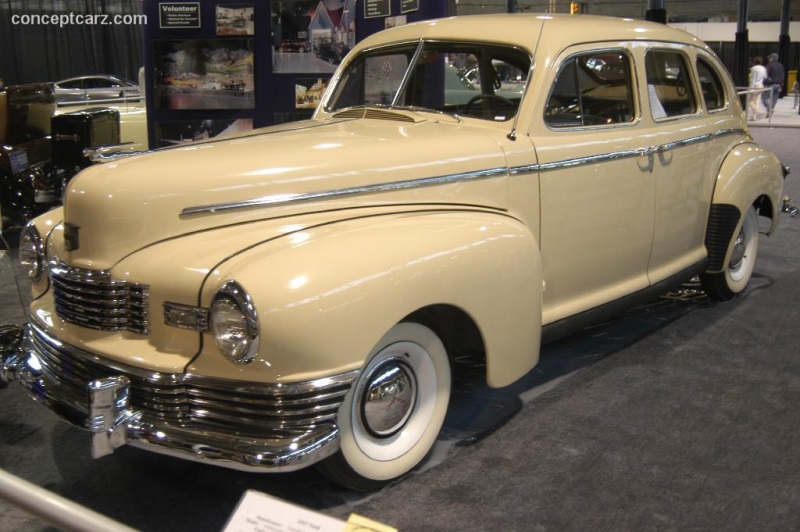
Charles W. Nash was a former President of General Motors who wanted to build his own cars. He and a partner purchased the Thomas B. Jeffery Company of Kenosha, the maker of the Rambler of the early 1900s, in 1916. The Nash, Rambler, and Ambassador names would remain entwined through many decades and corporate mergers. For 1947 Nash sold 113,115 cars, good for 10th places in sales. The company also paced the Indianapolis 500 for the first and only time, with a four-door Ambassador sedan. (concept carz) Nash became part of the new American Motors Corporation in 1954. The Nash nameplate ended with the 1957 models.Source - AACA Museum

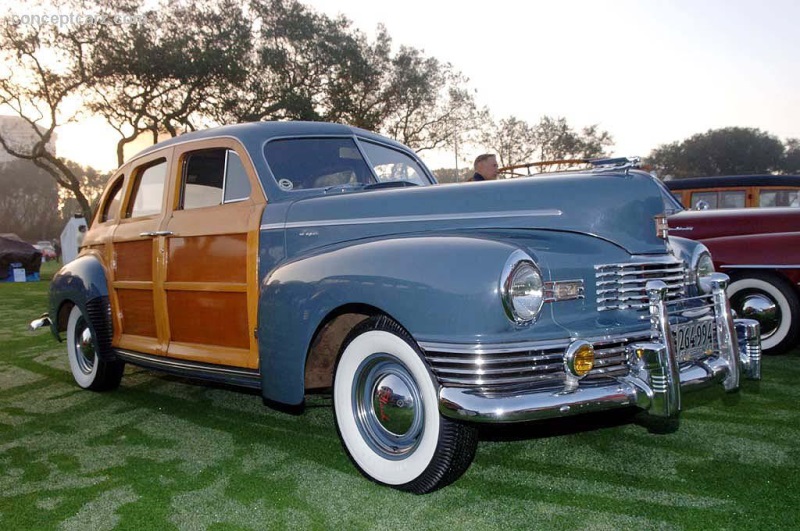
Suburban


Suburban


Suburban
Chassis #: RE72874
Sold for $82,500 at 2018 RM Sothebys : Hershey.
Nash Motors introduced a wood-paneled version of their popular Ambassador called the Suburban in the post-war era. They were given mahogany and ash paneling supplied by Mitchell-Bentley of Owosso, Michigan. The coachwork was based on the 'slipstream' sedan, a 1940s streamlined design. They were built as an image-building halo model and came loaded with options such as 'cruising Gear' overdrive, a trend-setting 'Weather-Eye' heater, and a remote control Zenith radio, which enabled the driver to change stations at the touch of their toe.The Suburban was built in limited quantities between 1946 and 1948, with exactly 1,000 examples built. In 1947, 595 Suburbans were built. It is believed that fewer than 20 examples are known to remain.This finely restored example has a history that dates back to the 1970s, when it was in the possession of Darrel Hagen of Puyallup, Washington. In late 1977, Kim Norback of Sebastopol, California purchased the car from Mr. Hagen and performed a light mechanical restoration.
The car was purchased in 1984 by Linn Davis of Sunland, California and sold it to Nash collector Jerry McIntosh of Tucker, Georgia, two years later. Mr. McIntosh advertised the car for sale in the Spring of 1992. It was purchased by James Fritts and a show-quality restoration soon followed. Work began in 1995 and was completed in March of 199. It was finished in Strato Blue with red interior, a correct 1947 Nash color.
By Daniel Vaughan | Feb 2013
The Nash Ambassador was produced from 1932 through 1957. When Nash merged with Hudson Motors in 1954, the Ambassador name was continued, though it was now known as the AMC Ambassador. The name persisted until 1974.The Ambassador was Nash's top-of-the-line offering when first introduced. These vehicles were outfitted with fine upholstery and luxury amenities. The base price was set at $2,090. In 1929 Nash offered a nine-passenger limousine which became their most expensive vehicle at the time, displacing the title from the Ambassador. The limousine held this title until 1934. In 1930 the Nash was given an eight-cylinder engine, replacing the previous six-cylinder unit. By 1932 the Nash Ambassador Eight had become its own model range offered in a variety of body styles and riding on either a 133-inch or 142-inch wheelbase. Their reputation for quality and durability continued. The early 1930's was a difficult time for almost every automobile manufacturer. The Great Depression bankrupted most companies. GM and Nash were the only companies to make a profit in 1932.
Nash acquired the Kelvinator Corporation in 1937. George W. Mason was chosen by Charlie Nash to become the President of the newly formed Nash-Kelvinator Corporation. This was the same year that coupes and convertibles were returned to the Ambassador line-up. In 1941 all Nash automobiles were Ambassadors and offered in a variety of body styles. Short and long wheelbase sizes were available. From 1942 through 1945, the production of Nash automobiles, and all other vehicles, was suspended during the World War II efforts. When production resumed the Nash Ambassador was no longer offered. The new top-of-the-line offering was now the Ambassador Six.The Ambassador was giving styling improvements to attract new buyers in the post-war era. They featured enclosed front wheels, luxurious amenities, and aerodynamic styling. The Nash was restyled again in 1952. It would last until 1957 when the company merged with Hudson and became known as AMC. The wrap-around windshield design and new front-end ensemble were but a few of the changes. The wheel cover hiding the front wheels was shortened, revealing more of the tires. The buyer had the opportunity to purchase the car with an eight-cylinder engine. The V8 was a Packard unit and was mated to an Ultra-Matic automatic gearbox, also of Packard's design.Pininfarina was commissioned to create a version of the Ambassador for 1952. The resulting product was known as the Golden Anniversary Pininfarina Nash.
When the Nash-Kelvinator Corporation formed with Hudson Motors in January of 1954 they formed the American Motor Corporation, more commonly known as AMC. During this time, the sales from the Rambler provided the most income for the company. Sales of the Ambassador, however, were not very favorable. The Hudson and Nash brand name was no longer used after 1958. The Rambler would continue as a standalone make of American Motors. The public associated the Rambler name with 'compact' and 'economy'. Senior management decided that the Ambassador name, having a long tradition, would continue to persist, though it would ride on the coattails of the Rambler popularity. The Ambassador of 1958, marketed as the Ambassador V8 by Rambler, shared the basic design of the Rebel V8 and the Rambler Six. On the front of the car, though a little confusing, was the name Rambler Ambassador. The Ambassador was long and wide, riding on a 117-inch wheelbase. It was offered as a four-door sedan, four-door hardtop sedan, four-door pillared station wagon, and hardtop station wagon. Trim levels were available which allowed a level of uniqueness. The 'Super' trim level, for example, featured painted side trim. The 'Custom' trim level was given silver anodized aluminum panels on sedans and vinyl wood-grain panels on station wagons. After 1960 the Ambassador was no longer offered with the hardtop station wagon or hardtop sedan. Edmund Anderson restyled the front end of the Ambassador in 1961, giving it a new front-end ensemble consisting of the redesigned grille, fenders, and headlights. This was done to distinguish the car from the rest of the vehicles on the road at the time and to further distance itself from the lower-priced Rambler series. Unfortunately, the public did not agree with the design, and sales reflected their discontent. For 1962 the Ambassador and the rest of the AMC line-up were restyled. The Ambassador now lay on a 112-inch wheelbase. Changes followed throughout the next few years, including minor trim changes and options. The AMC philosophy that the public wanted smaller, economical cars still influenced their vehicles and design. But by 1965 this idea was beginning to fade as AMC was beginning to believe that they could move up-market and take on the larger auto-makers in the mainstream market. The first step in convincing the public that they could compete was to phase out the Rambler, their symbol of compact and economy. The Ambassador was re-badged as a product of AMC, rather than bearing the Rambler name. There were three trim levels available on the Ambassador, the 880, 990, and DPL. In 1967 AMC introduced the restyled Ambassador which now sat on a long, 118-inch wheelbase and was targeted at the luxury car segment. 1260 examples of the convertible were offered; this would be its final year. The gamble to move into a new market was not a success and ushered in financial difficulties for American Motors. The company struggled to improve its products and regain firm financial footing. In 1968 AMC became the first automaker to make air conditioning standard in their cars. The work done by their Kelvinator division had aided in making this milestone a reality. This separated their products from what other manufacturers were offering. Rolls-Royce was the only other marque to offer their products with AC as standard equipment. Ordering the cars without AC was still an option; it was seen as a 'delete option' and the buyer would be given a credit to the base price. The Ambassador was restyled in 1969. Part of that re-design was a longer, 122-inch wheelbase. This allowed for larger engines under the hood and more interior room for its occupants. The trunk room expanded and now could accommodate much more luggage. Minor changes followed in the following years, though AMC stuck with its philosophy of 'Timeless Design' rather than incremental improvements.In 1972 they did something to reinforce their commitment to quality - they introduced the 'Buyer Protection Plan.' This not only guaranteed the buyer of a quality product, but motivated AMC to re-examine its design, development, and production methods. AMC introduced new quality controls into their processes and demanded higher quality from their suppliers. Engineering improvements were implemented. The US Government had been introducing new regulations. The public and insurance agencies were demanding safety improvements in all vehicles. Part of these concerns was the ever-increasing muscle cars which were becoming lighter and faster. This, compounded with the impending Arab Oil Embargo of the early 1970's sent auto manufacturers scrambling to introduce compact and fuel-efficient vehicles. The Ambassador found itself in the unpopular spectrum of the market. Its large V8 engines were not kind at the fuel pump. A new Ambassador had been in the works for a number of years and in 1973 was introduced as a 1974 model. It was available only as a four-door sedan and station wagon. The two-door hardtop had ceased in 1973. The Ambassador was even bigger than before, growing by seven inches. Part of this growth was due to the new safety features, such as the five-mph bumpers. The interior was redesigned, a larger fuel tank was added, and sound insulation was installed to control exterior noise.When the fuel crisis was in full swing, the sales of the Ambassador plummeted. By June of 1974, the Ambassador's name was discontinued. It had been in service for 42 years.
By Daniel Vaughan | Dec 2006
In 1934 the Nash was offered only in four-door sedan body styles. The following year a two-door sedan was added to the model lineup. The Ambassador Eight now rested upon a 125-inch wheelbase.
In an effort to stimulate sales, the 1956 and 1957 Nash automobiles were offered in a variety of two- and three-tone color schemes. For 1957 the headlights came equipped in 'quad' headlight configuration. They were the first cars to have this feature.
By Daniel Vaughan | Dec 2006
The name 'Ambassador' was used to designate a senior line of Nash Motors automobiles, a product of American Motors Corporation. The Ambassador was a high trim option on Nash's senior models from 1927 until 1931. During the 1927 model year, a five passenger sedan version of the Nash's 267 model, the advance Six automobile with a trimmed four door was introduced, and it was the most expensive vehicle in the lineup. Both upholstery and other trim items upgrades were featured on the Ambassador for the base price of $2,090. Its top competition was a nine-passenger limo that was carried through the 1931 model year. Eventually, the nine-passenger limo bypassed the Ambassador and was recognized as the most expensive vehicle for that year. Until 1930, the Ambassador remained in the Advanced Six range before the model was moved to the Nash Twin Ignition Eight model. The following year, a less unique and complex model, the '890' model designation replaced the Twin Ignition Eight name. It wasn't until 1932 when the Ambassador was established as the stand-alone model range under which the 'Advanced Eight' model was placed.
The model range of the Nash Ambassador began to expand and was no longer just a luxurious and well-appointed sedan, but also a coupe, convertible sedan, and limousine. The final listing was sold at a pricy $6,600. From 1932 through 1935, the Ambassador had only been offered with Nash's line eight. The '36 Ambassador added Nash's largest inline-six in addition. Also this year, a variety of body styles were deleted while Nash instead focused all of its limited resources on two-door convertibles, coupes, and sedans through the 1942 model year.Nash acquired the Kelvinator Corporation in 1937 as part of a deal that allowed Nash's handpicked successor, George W. Mason, to become the President of the all-new Nash-Kelvinator Corporation.A shorter hood and shorter front fenders were featured on the 1939 Ambassador to further differentiate the pricier Ambassador Eight from the less expensive Six model. All Nash vehicles became Ambassadors for the 1941 model year and now rode on either long or short wheelbases. The first popular automobile built utilizing unitized body/frame construction was the Nash Ambassador 600. For the 1942 model year, the model arrangement remained the same.The Ambassador designation held constant on Nash's most luxurious models from 1949 through 1957. Featuring an Airflyte body style, the Ambassador is fondly remembered by enthusiasts for its enclosed front wheels. The 1949-1951 Ambassadors featured fully reclining seats that would earn its reputation of being 'the make-out automobile of choice for teenagers in the 1950s'. Believing that sellers would be leaning towards more compact vehicles following World War II, Mason decided to focus on a product range that would eventually become the Nash Rambler. For 1952, the Nash Ambassador received is a final significant update that would continue onto 1954 with virtually no more changes. The Ambassador featured Nash's highly popular Weather Eye ventilation system which could also be coupled with Nash's advanced AC unit. An inexpensive, compact, Nash's AC unit fits under the hood and could either circulate fresh or recycled air. Hudson Motors and Nash-Kelvinator joined together in January of 1954 to become American Motors. Now Ramblers were sold that carried either the 'Nash' or 'Hudson' badging. This was the sale that would power the company's bottom line. Unfortunately at this time, the Ambassadors sales plummeted.
By Jessica Donaldson
The Ambassador rode on a 142-inch wheelbase, and with such amazing features, these models earned the nickname 'Kenosha Duesenburgs', due to their quality, styling, durability, and speed. A second 1932 series was introduced by Nash that included engineering updates to all models. During 1932, only General Motors and Nash were the only automobile manufacturers to produce a profit this year.
In the summer of 1957, the final Nash Ambassador rolled off the Kenosha, Wisconsin production line. The name continued to exist though under Rambler and AMC brands up until 1974.
- 1947 Nash Ambassador Menu
- Article
- Image gallery
- Valuation
- Specifications
- Profiles
- Production figures
Nash
Similar Automakers
Similarly Priced Vehicles


1947 Nash Ambassador Vehicle Profiles


Recent Vehicle Additions


Performance and Specification Comparison
Price Comparison
Ambassador Specification Comparison by Year
Year
Production
Wheelbase
Engine
Prices
Related Automotive News

2014 Pagani Huayra Headlines Garage X Collection of High-Performance Vehicles All Selling With No Reserve During the 2025 Scottsdale Auction
Barrett-Jackson, The Worlds Greatest Collector Car Auctions, will sell the Garage X Collection during the 2025 Scottsdale Auction, Jan. 18-26 at WestWorld of Scottsdale. Headlining the Garage X Collection is the stunning and ultra exclusive mid-engine...

The only two 1937 Miller-Gulf Race Cars in existence and a spectacular 1932 Auburn 12-160A Boattail Speedster head the grid of preliminary consignments for Worldwide's 54th Annual Collector Car Auction and Show in Indiana
Consignments are rolling in for the 54th Annual Collector Car Auction and Show in Auburn, Indiana, as Worldwide Auctioneers gears up for another Labor Day weekend automotive extravaganza at home in the original Classic Car Capital of...

1934 Duesenberg J-531 and 2017 Cadillac DPi-V.R Named Best in Show at The Amelia's 27th Annual Event
A 1934 Duesenberg J-531 and a 2017 Cadillac DPi-V.R were crowned this years Best in Show winners on March 6, 2022, at The Amelia Concours dElegance -- its 27th annual event. Marking the inaugural year under Hagertys stewardship, the 2022...

High-Performance Audi S8 To Debut At Los Angeles Auto Show, 2020 A8 Model Line Expanded
All-new 2020 S8 joins model line blending S model performance with the comfort of a long-wheelbase
2020 A8 luxury sedan receives 4.0-liter V8 engine offering with elevated torque and more usable power
Audi continues committment to electrification...

Mercedes-AMG Combines Performance SUV With V8 Expertise
Mercedes-AMG GLC 63 4MATIC and GLC 63 4MATIC Coupé
Affalterbach. Back in 1999, with the ML 55, Mercedes-AMG set a milestone – not just in its own 50-year history. For the combination of high-performance engine in the skin of an SUV opened...