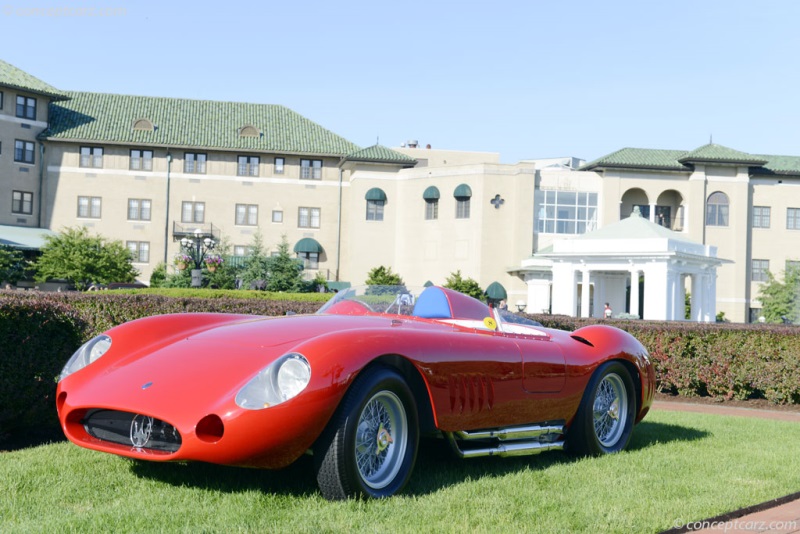
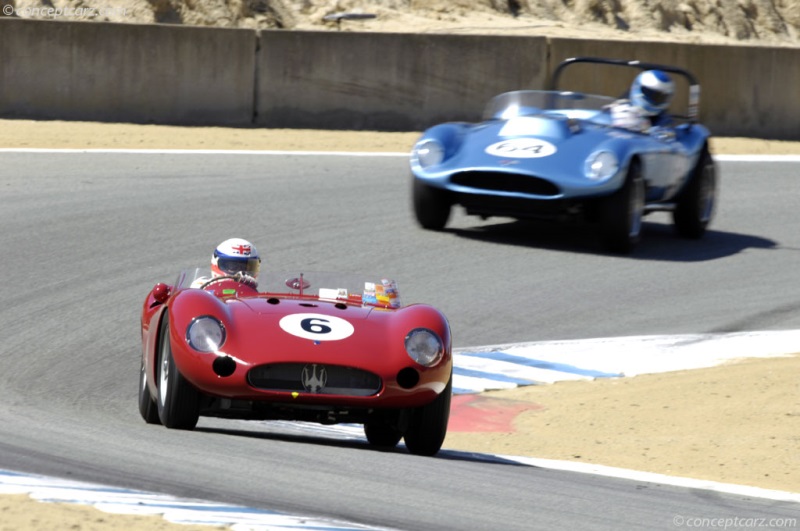
1956 300S |
1957 Maserati 300 S news, pictures, and information | ||
| Tweet | ||
Body by the Italian Fantuzzi. Side-by-side with the Formula One effort, the Maserati Factory competed in the international sports car championship with the 300S. This model, one of 27 known examples built from 1955-1958, shared the same engine, driveline and running gear as the 250F Grand Prix car. Considered to be a much better handling car than its Ferrari Competitors of the day the 300S was a coveted ride for the best drivers who won races all over Europe.
![]() | ![]() | ![]() | Spyder Designer: Fantuzzi Chassis Num: 3072 Engine Num: 3055 |
This 1957 Maserati 300S with engine number 3055 is powered by a six-cylinder engine capable of producing 280 horsepower. It has a four-speed manual gearbox and Dunlop tires. It was the factory team car in 1957. It finished fourth overall in the 1957 Mille Miglia while being driven by Scarletti. It finished 15th overall in the 1000km of Nurburgring, driven by Scarletti, Bennier, and Hermann. It failed to finish at LeMans and the Venezuela Grand Prix.
The car was sold in 1958 and sent to Brazil. It was found there in 1972 and returned to the United Kingdom. Since that time, it has been vintage raced in both the UK and the United States.
By Daniel Vaughan | Jun 2007
In 1953, the FIA started a World Sportscar Championship, similar to the Grand Prix and Formula 1 World Championship which began in 1950. The series featured many of the historic and prestigious races that were known through Grand Prix and Formula 1 racing like LeMans and the Mille Miglia.
Maserati decided to enter the series but had little experience with large displacement engines; their largest engine up to that point had powered the A6GCS which was 2-liters in size. The 250S was experimented with during the 1954 season ultimately resulting in the 300S. The 250F engine had proven to be powerful but due to its high compression ratio made it very unreliable in long races.
The 300S had about the same power as the 250F but with a lower compression ratio. It was a straight 6-cylinder engine with dual overhead cams and twin ignition. The chassis was similar to the A6 GCS but was fitted with a DeDion type rear axle and a four-speed manual gearbox mounted transversely. The body was comprised of aluminum in roadster configuration, courtesy of Fantuzzi. The total weight was around 780 kg's, and with the 260 horsepower engine was capable of carrying the 300S to a top speed of about 180 mph.
The 300S was ready in time for the 1955 season. It proved to be powerful and had superb handling but it was unreliable. The 1955 season was a growing season for the 300S, with many mechanical and aerodynamic enhancements being incorporated. A longer nose body was fitted to improve aerodynamics.
By 1956 the 300S was ready; behind the wheel could be found Stirling Moss, Carroll Shelby, Jean Behra, Schell and Taruffi. The first major victory for the 300S was at the Nurburgring 1000 KM race. Throughout the rest of the season, it continued to provide Maserati with commercial and sporting success. It captured a second place finish in the World Championship behind a very strong Ferrari team.
For the 1957 it continued to be raced, but foreshadowed by the newly developed 450S. An accident at the Mille Miglia created a campaign against sports car racing. European racers and manufacturers began racing heavily in the United States because there were less restrictions.
In 1958 new rules limited the displacement of engines to three-liters in sports car racing which made the 450S obsolete. Maserati withdrew from racing.
During the production run lasting from 1955 through 1958, twenty-eight examples were produced. Many still exist and are often raced at historic events.
By Daniel Vaughan | Jun 2006
Maserati decided to enter the series but had little experience with large displacement engines; their largest engine up to that point had powered the A6GCS which was 2-liters in size. The 250S was experimented with during the 1954 season ultimately resulting in the 300S. The 250F engine had proven to be powerful but due to its high compression ratio made it very unreliable in long races.
The 300S had about the same power as the 250F but with a lower compression ratio. It was a straight 6-cylinder engine with dual overhead cams and twin ignition. The chassis was similar to the A6 GCS but was fitted with a DeDion type rear axle and a four-speed manual gearbox mounted transversely. The body was comprised of aluminum in roadster configuration, courtesy of Fantuzzi. The total weight was around 780 kg's, and with the 260 horsepower engine was capable of carrying the 300S to a top speed of about 180 mph.
The 300S was ready in time for the 1955 season. It proved to be powerful and had superb handling but it was unreliable. The 1955 season was a growing season for the 300S, with many mechanical and aerodynamic enhancements being incorporated. A longer nose body was fitted to improve aerodynamics.
By 1956 the 300S was ready; behind the wheel could be found Stirling Moss, Carroll Shelby, Jean Behra, Schell and Taruffi. The first major victory for the 300S was at the Nurburgring 1000 KM race. Throughout the rest of the season, it continued to provide Maserati with commercial and sporting success. It captured a second place finish in the World Championship behind a very strong Ferrari team.
For the 1957 it continued to be raced, but foreshadowed by the newly developed 450S. An accident at the Mille Miglia created a campaign against sports car racing. European racers and manufacturers began racing heavily in the United States because there were less restrictions.
In 1958 new rules limited the displacement of engines to three-liters in sports car racing which made the 450S obsolete. Maserati withdrew from racing.
During the production run lasting from 1955 through 1958, twenty-eight examples were produced. Many still exist and are often raced at historic events.
By Daniel Vaughan | Jun 2006
| Mercedes-Benz Classic: Topics for 2013 | |
![]() | The main topics: • The tradition of the Mercedes-Benz S-Class • Mercedes-Benz Silver Arrows in the 1930s • Originals – authentic vehicles tell authentic stories • Classic vehicles kept in perfect condition with Mercedes-Benz Genuine Parts Important anniversaries: January 75 years ago – on 28 January 1938: With a flying start, Rudolf Caracciola achieved a speed of 432.7 km/h over one kilometre on the Frankfurt–Darmstadt motorway. This is the highest speed ever ach...[Read more...] |
| 1951 Italian Grand Prix: Promising Result Left Unfilfilled | |
![]() | In 1957, at the Italian Grand Prix, Andre Simon, almost as usual, would share a drive with Ottorino Volonterio and would finish his final Formula One grand prix in 11th place. And while the fact Simon would have to share his drive with another would not be all that surprising to many, it would be a far cry from what many believed would be the case after the 1951 Italian Grand Prix. Andre Simon had made an impressive debut at the 1949 24 Hours of Le Mans, which gained the attention of Amedee G...[Read more...] |
| 1956 24 Hours of Le Mans: The Rise of Two Counts | |
![]() | The 1955 24 Hours of Le Mans would end up being the darkest day in all of motorsport when Pierre Levegh launched off the back of Lance Macklin's Austin-Healey and crashed into a barrier sending large portions of the car flying through the air acting like guillotines to the record crowd crammed along the main straight. It would be estimated that more than eighty would lose their life as a result, scores more would be severely injured. Yet, despite the graphic horror of the event the race would co...[Read more...] |
| 1957 Italian Grand Prix: A True Nobleman Stands Amongst Two of F1's Most Noble | |
![]() | The sea of spectators overwhelming the circuit would be a truly awe-inspiring sight to behold. The vast majority of this horde was there to celebrate the car adorned in red finishing in the top three. The car's driver, a true royal, would stand amongst the crowd as if standing amongst adoring and loving subjects. For the first time in his career, Wolfgang von Trips would be able to count himself amongst the elite of Formula One. Wolfgang von Trips had been born into a noble German family in ...[Read more...] |
| 1958 Moroccan Grand Prix: British All the Way | |
![]() | After years of frustration, and well past his life-expectancy, Mike Hawthorn would be on the verge of his first World Championship. This was more than likely Hawthorn's last and best hope at a World Championship title. Just one last race, and a fellow Brit, would separate Hawthorn from his World Championship. Emotionally, Hawthorn was done. The last few seasons had seen Hawthorn fail to experience anywhere near the level of success he had even in his rookie year of 1952. In 1952, with an unde...[Read more...] |
1957
Maserati
models |
| Maserati 150 S |
| Maserati 200 SI |
| Maserati 250F |
| Maserati 3500 GT |
| Maserati 450 S |
| Maserati 450S Costin-Zagato Coupe | 1957 Maserati Concepts |
| Maserati 150 GT |
| Similar Automakers | |
| Aston Martin | Bentley |
| Bugatti | Devon |
| Ferrari | GTA |
| Koenigsegg | Lamborghini |
| Lotus | Maybach |
| McLaren | Porsche |
| Rolls-Royce | Spyker |
| Tesla | |
| Similarly Sized Vehicles from 1957 |
| Alfa Romeo Giulietta |
| Devin MG Special |
| Ferrari 801 |
| Fiat 1100 Turismo Veloce |
| Fiat 600 Multipla |
| Maserati 200 SI |
| MG MGA |
| Maserati: 1951-1960 |
| Similar Automakers |
| Maserati History |
| Other models by Maserati |
| Manufacturer Website |
| |||||||||||||||||||||||||||||||||||||||||
| 150S 200 Si 228 250 250F | 300S 3500 GT 430 450 4CL | 5000 GT 6CM 8CM 8CTF A6 | Bi-Turbo Birdcage Bora Coupe Coupe / Spyder | Ghibli GranCabrio GranTurismo Indy Khamsin | MC12 Merak Mexico Mistral Quattroporte | Sebring |
1956 300S |


1956 300S


1957