Concept Cars Home
Image Left 1971 312PB
 

Image credits: © Ferrari.

1972 Ferrari 312 PB news, pictures, and information

Spider
Chassis Num: 0892
 
High bid of $1,600,000 at 2004 RM Auctions. (did not sell)
The 312 PB was loosely based on the 1969 312 P V-12. It was to race in the international manufacturers' championship. Between 1971 and 1973, Ferrari produced eleven 312 PBs and they were ultimately the most successful Ferrari sports racing cars ever built.

Powered by 450-horsepower, three-litre, twin overhead cam, water-cooled, flat twelve-cylinder engine and carrying a five-speed gear box, the 312 PB had a top speed approaching 200 mph. The engine could turn up to 11,800 rpms and the whole package weighed in at a svelte 1,300 pounds.

After an initially disappointing 1971 season, the refined 1972 312 PBs dominated. Campaigned by some of the world's best drivers, they won every race in which they were entered. They ran again in 1973, but were less successful, because of new and increasing competition, Ferrari left sports car racing in 1974, to compete in Formula One.

Designed and built to compete in the international endurance series, the 312 PB was arguably the most successful sports racing car that Ferrari ever built. From 1971 to 1973, there were eleven 312PBs built. Powered by a 3-liter, flat 12-cylinder Formula One engine that produced 450 horsepower at 11,800 RPM, and weighing under 1,300 pounds, they were a serious threat to the competition. In 1973, the 312 PBs being driven by some of the world's best drivers, would bring home the championship by winning every race they entered. This is the tenth of twelve 312 PBs built for the 1972 season and it raced at Daytona and Watkins Glen that year, and in the Targa Florio and at LeMans in 1973. Its drivers included Brian Redman, Ronnie Peterson, Tim Schenken, Arturo Merzario, Nino Vacarella, and Jacky Ickx. Powered by a 3-liter, flat-12 Formula I engine delivering around 450 horsepower, these cars won every race they entered in 1973, and unsurprisingly, Ferrari won the championship.

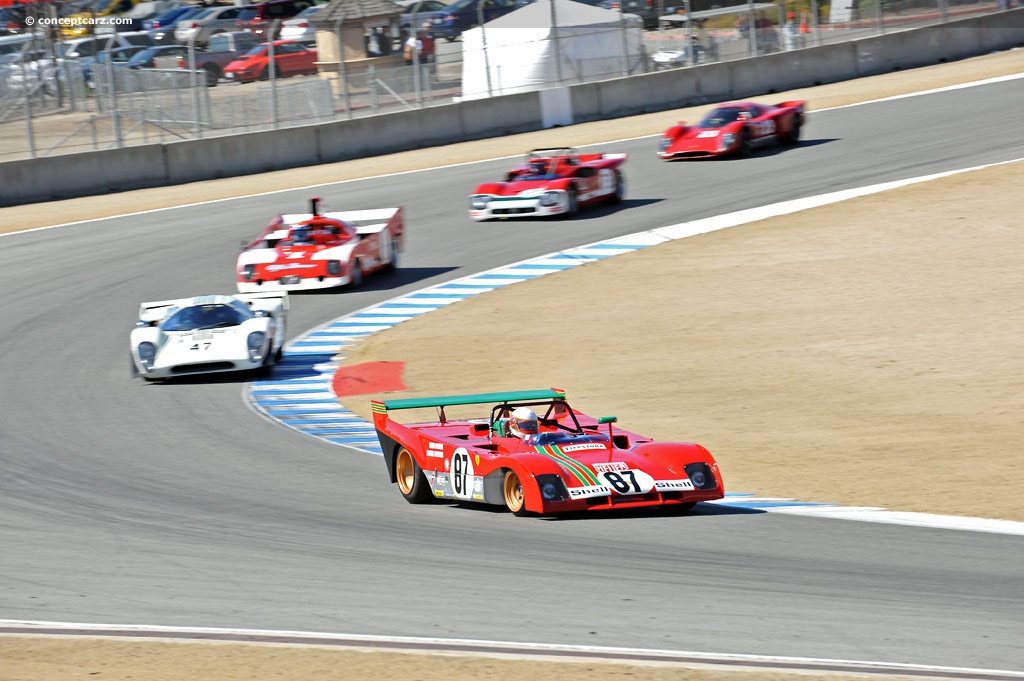
- July 1972 Raced at Watkins Glen by Brian Redmond and Arturo Merzario Race #87
- April 15, 1973 raced at the 1000 KMs of Dijon-Prenois, France by Jackie Ickx and Brian Redmond car #3
- June 1973 Raced at the Forty-First annual LeMans 24 Hours by Tim Schenken and Carlos Reutemann, Race #17
- July 12-14, 2002 Driven at the Festival of Speed at Goodwood, England by Jackie Ickx, Race #72
- July 19th, 2005 sold to Steven Read, Berkeley, CA.
- Engine is a 3-liter/Boxer 12-cylinder with 500 horsepower at 11,500 RPM.
Race cars are typically competitive for only a single season; sometimes they can last longer than that but most of the time they are outpaced the following year or become obsolete due to changes in racing regulations. This was true for Ferrari's sports prototypes at the end of the 1967 season, which were unqualified to race in 1968 due to new rules imposed by the FIA (Federation International d'Automobile). Ferrari turned their attention to Formula One but had little success during the 1969 season. Disappointed, the team re-focused their sights on prototype racing to contest the 3-liter prototype category. Their F1 cars had a similar displacement which meant they had experience and thus, the logical choice.

For the 1969 season, Ferrari introduced their 312 P with a 48-valve engine similar to their F1 cars. It made its competition debut at the Sebring 12 Hours where it was piloted by Amon and Mario Andretti. It qualified on pole and ended the race in second overall and first in class. This would be the vehicle's best performance, as reliability issues would plague it during its short lifespan. It was used on half of the season, and later replaced by a five-liter 512 S. The 512S proved to have the speed necessary to win, but it lacked the reliability to be an outright contender.

Once again, Ferrari switched canceled the project before it had time to fully mature and focused their efforts on a new racer. The remaining 512S were sold to privateers. The new car was a three-liter prototype utilizing the newly developed V12 engine designed by Mauro Forghieri. It had a 180-degree angle which gave an exterior design similar to that of a boxer engine. In reality, it was a very flat V-engine meaning the pistons move in unison rather than in opposition to one another.

The racing debut of the engine was made in a 312 B Formula 1 racer. The 'B' represented the Forghieri V12 engine, though it was not a boxer engine. The Ferrari 312 P of 1971 through 1973, later known as the 312PB, was powered by the Forghieri engine which rested in an aluminum semi-monocoque, similar to the F1 car. In other words, it was basically a full body Formula One car. It had a five-speed gearbox, vented disc brakes, and weighed around 660 kilograms. The 460 horsepower engine was mounted mid-ship and sent power to the rear wheels.

The 312PB made its inaugural debut at the Brands Hatch 1000km race in April of 1971. The car was immediately competitive and proved its potential by finishing second behind an Alfa Romeo 33/3. This would be one of the few highlights for the car during the 1971 season.

For 1972, things shifted in Ferrari's favor, as FIA rule changes abandoned the 5-liter sports car class. Only the 3-liter prototypes were able to run in the World Sports Car Championship. During the 1971 season, and during the offseason, the car was continually modified and its shortcomings were identified and fixed. Horsepower was increased from an initial 450 to 460. Experimentations and testing were done with aerodynamics resulting in a very refined racer. Next, Ferrari worked on the cockpit, specifically the driver's selection. They hired the best and most talented drivers such as Brian Redman, Arthuro Merzario, Jacky Ickx, Tim Schenken, Mario Andretti and Ronny Peterson to help guarantee another manufacture's championship.

The testing, tuning, planning, and acquired talent paid off almost immediately. The opening race of the championship was at the Buenos Aires 1000km race and the 312PB driven by Schenken and Peterson emerged in first place. This was the 312PB's first World Championship victory which was soon followed by many others, as Ferrari won all championship races that season, except for the 24 Hours of LeMans. The reason it did not win LeMans that year, is because it was not entered. The team felt its talents were best suited for 1000km races and not an endurance racer capable of competing a full 24 hours. Ferrari would end the season with 160 points and the Manufacturers Championship Title.

The 1972 season had been a phenomenal year for Ferrari. The 312 PB had been very reliable and very fast. For 1973, the car's wheelbase was slightly enlarged and the engine was tuned for an additional 15 horsepower. Sadly, the 312 PB took only one victory in 1973, and that was at the 1000km of Monza in April. Reliability issues and increasing competition kept the 312PB from having another dominant season. When the 1973 season came to a close, Ferrari withdrew from sports car racing.

By Daniel Vaughan | Feb 2008
For more information and related vehicles, click here

1969 United States Grand Prix: The Rise of Rindt
If there was one racer in the Formula One paddock that drivers and spectators alike believed should have scored his first victory before the start of the 1969 season it would almost unanimously be Jochen Rindt. Fast and flamboyant, the Austrian exhibited car control that enthralled just about everyone it seemed, except perhaps the cars themselves. Constantly undercut by poor reliability, it seemed Rindt was to forever suffer under such an oppressive weight. However, at the 1969 United States Gra...[Read more...]
1982 Austrian Grand Prix: de Angelis Flying Through the Thin Air
It is almost impossible to predict events and just how momentous they just might be. This would certainly be the case with the 1982 Austrian Grand Prix, a truly special and memorable moment in Formula One history. Heading into the Austrian Grand Prix in 1982 Formula One was in a bit of trouble and desperately needed a lift. All throughout the paddock there were teams that needed some good news. And then there would be others that needed some good news in order to be able to weather a storm co...[Read more...]
Firestone Returns As Presenting Sponsor of RRDC Evening With Brian Redman in Long Beach
The Firestone brand will return as presenting sponsor of the Road Racing Drivers Club's fifth annual West Coast banquet honoring auto racing's most influential leaders. This year, on Thursday, April 18, prior to the running of the Toyota Grand Prix of Long Beach, the 'RRDC Evening with Brian Redman presented by Firestone' will highlight the career of one of the sport's most popular, talented and successful race-car drivers. This is the Firestone brand's fourth straight year as a supporter of the...[Read more...]
1955 Tourist Trophy: One Last Victory
The tragedy at Le Mans on the 11th of June, 1955 would dramatically affect motor racing. For one of the manufacturers involved, Mercedes-Benz, it would be a confirmation of what it had already come to believe. Toward the end of the 1955 season it was known Mercedes-Benz would withdraw from all motor racing having achieved just about everything possible in Formula One and sportscars. However, on the 18th of September, there would be one last race in which the mighty Silver Arrows would be gunning...[Read more...]
1968 Belgian Grand Prix: A First for McLaren
McLaren and Formula One are truly synonymous. Over the course of its history, McLaren has completed 714 races and have garnered no less than 178 victories. But while McLaren and victory in Formula One are an almost certainty, the very first would be anything but a complete surprise. In December of 1959, Jack Brabham would be leading the way in his Cooper T51 with Bruce McLaren following along not all that far behind. The final lap of the United States Grand Prix held at Sebring, Florida has j...[Read more...]

Arrow Right 1972 Ferrari models
Ferrari 246 Dino
Ferrari 365 GT4
Ferrari 365 GTB/4
Ferrari 365 GTB/4 Competizione
Ferrari 365 GTB/4 Shooting Brake
Ferrari 365 GTC/4
Ferrari 365 GTS/4
Ferrari 365 GTS/4 Michelotti NART
Ferrari Sparling Special

Similar Automakers
Aston MartinBentley
BugattiDevon
GTAKoenigsegg
LamborghiniLotus
MaseratiMaybach
McLarenPorsche
Rolls-RoyceSpyker
Tesla
Similarly Sized Vehicles from 1972
Alfa Romeo 33/3
Alfa Romeo TT33
Austin-Healey Sprite
BMW Turbo Concept
Chevrolet Camaro
Ford Mustang
Ford Mustang Boss
Lamborghini Espada 400 GTE
Maserati Boomerang
McLaren M16B

 
Ferrari: 1971-1980
Similar Automakers
Other models by Ferrari

Related Articles and Event Coverage
Rolex Monterey Motorsports Reunion
58th Annual Pebble Beach Concours d'Elegance
Amelia Island Concours d'Elegance
2006 Amelia Island Concours d'Elegance


156
166
166 F2
195
196
212
246
250 GT
250 Monza
250 Testarossa
275
288
308
312
328
330
333 SP
335
342 America
348
360
365
375
400
410
410 S
456
458
500 F2
500 Superfast
500 TR
512
512 BB/LM
550
553
575
599
612 Scaglietti
625
California
Dino
Enzo
F12berlinetta
F355
F40
F430
F430 GTC
F50
FF
LaFerrari
Mondial
Mondial 500
Testarossa
Type 340

Image Left 1971 312PB
© 1998-2012. All rights reserved. The material may not be published, broadcast, rewritten, or redistributed.