1932 Bugatti Type 55 news, pictures, and information | ||
| Tweet | ||
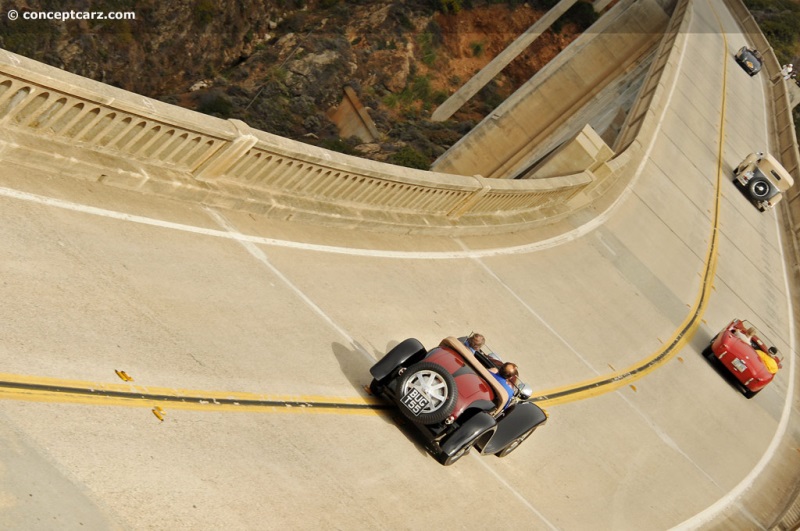
![]() | ![]() | ![]() | Roadster Chassis Num: 55270 |
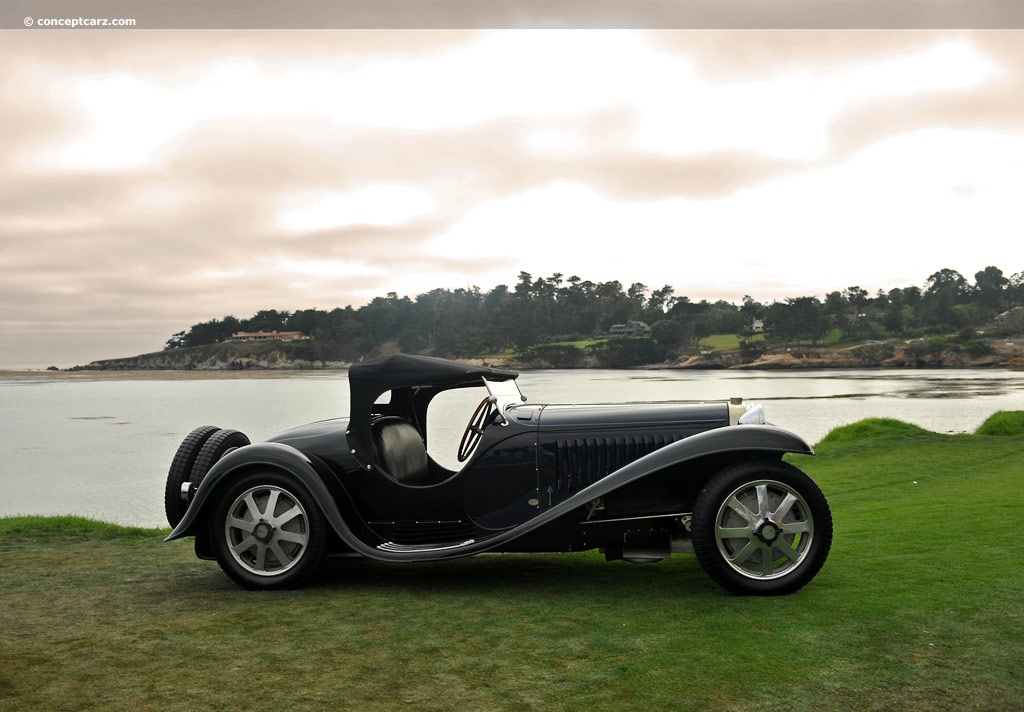
This Type 55 Bugatti was one of only 38 examples produced from 1932 through 1935.
The car is powered by a 2.3 liter (2262 cc) straight eight-cylinder engine a Roots-Type supercharger. The 2-valve DOHC unit produced 130 horsepower and can rev to 5000 RPM. The transmission is a manual four-speed and the vehicle sits on a 108.3 inch wheelbase and weighs 1800 lbs.
The car has participated in numerous shows and events since restoration in 1993.
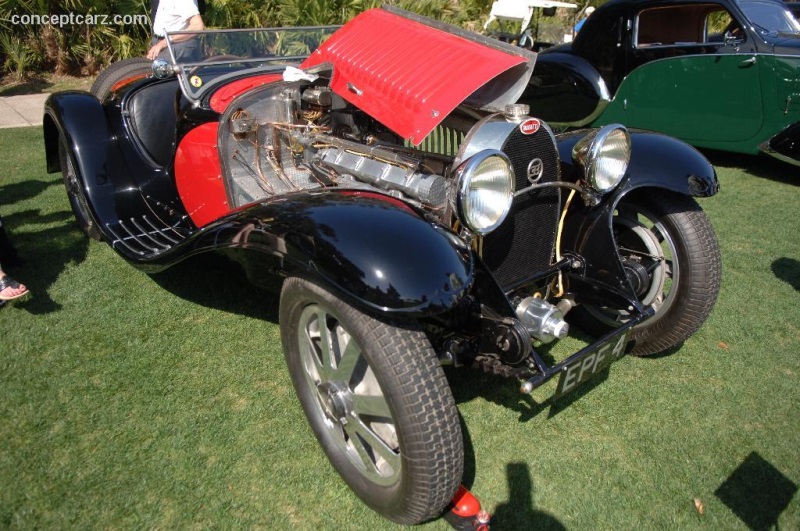
![]() | ![]() | ![]() | Roadster Chassis Num: 55201 Engine Num: 1 |
| Sold for $1,760,000 at 2008 Gooding & Company. | |||
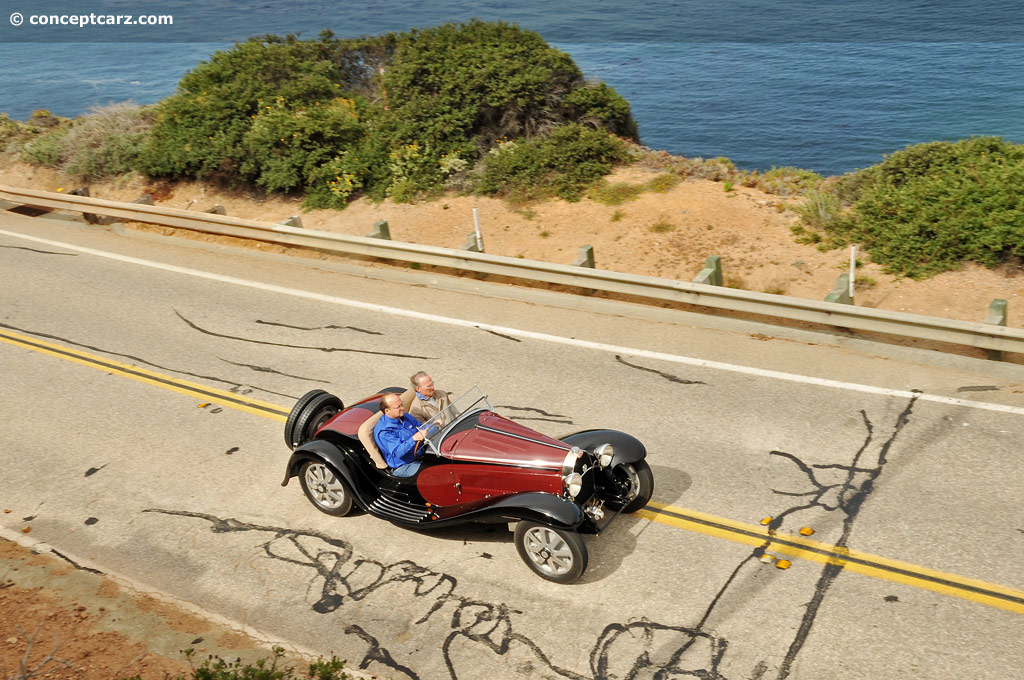
In 1951, the car was imported from France to the United States by Otto Zipper. Recorded owners include Odabashian, Dr. R. Vann and Mrs. Bowers. In 1960, Edsel Pfabe purchased the car from Mrs. Bowers for the sum of $1,200. At this point in the cars history, it was not running, and was partially assembled and may have even been without its coachwork.
In June of 1963, the car was sold to Dr. Peter and Susan Williamson, and the ongoing restoration was continued. A re-creation of the Jean Bugatti Roadster body was made for the car, which it still wears today. The restoration was completed around 1964 and finished in cream with black fenders and body accents, a red coach-line and a brown leather interior. The car rides on eight-spoke alloy wheels with integral brake drums, Marchal headlights and a raked folding windshield.
This is the first Type 55 built, one of only 38 Type 55s produced, has its original engine and chassis, and one of the most coveted prewar sports cars. In 2008, this Type 55 Roadster was offered for sale at the Gooding & Company auction held in Pebble Beach, California. It was estimated to sell for $1,400,000 - $2,100,000 and offered without reserve. As bidding came to a close, the lot had been sold for $$1,760,000, including buyer's premium.
By Daniel Vaughan | Mar 2009
![]() | ![]() | ![]() | Roadster |
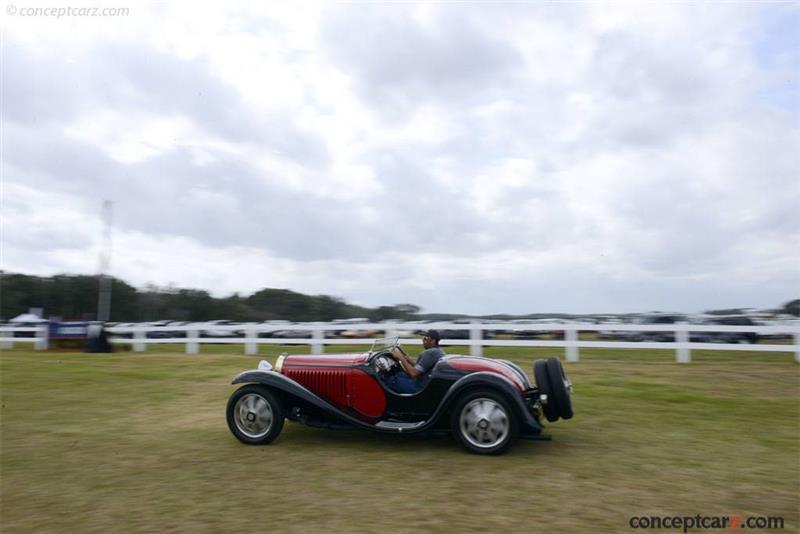
This car was delivered new to Madame Saquier of Paris and after restoration was owned by Ralph Lauren until 2003. Its present owner purchased the car from Bill Ainscough in 2005.
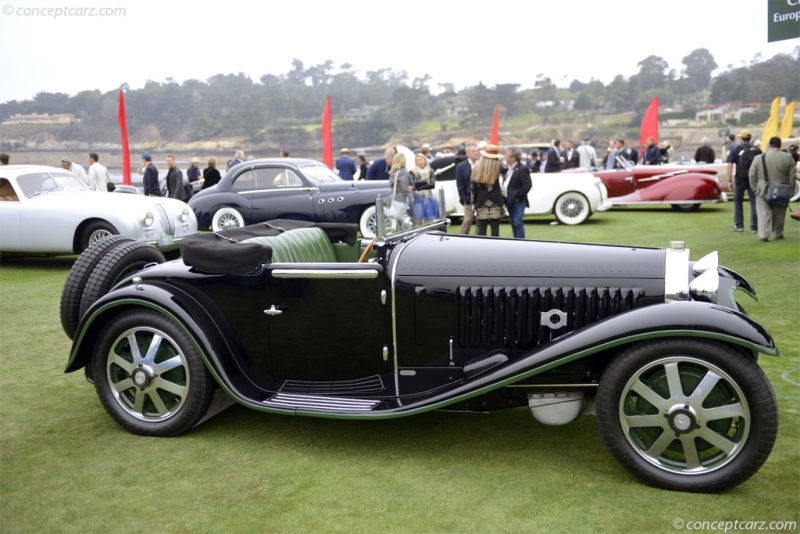
![]() | ![]() | ![]() | Cabriolet Coachwork: Billeter & Cartier Chassis Num: 55206 Engine Num: 6 |
The Type 43 was replaced in 1931 with the new Type 55. The Type 47's twin-cam eight-cylinder engine was used to power Type 55. They had cast aluminum wheels from the Type 51, with brake setup and gearbox from the Type 49. Performance was impressive, with zero-to-sixty taking just 10 seconds.
By 933, Bugatti had built just 38 examples of the Type 55. Jean Bugatti designed two factory bodies: a roadster and a coupe known as the 'Faux cabriolet.' 14 examples received the works coupe body and only one factory cabriolet was built. The 14 remaining cars received coachwork from other coachbuilders. 11 were bodied by Vanvooren or Gangloff and the remaining three by other outside firms.
One owner of original owners of the Type 55 was Dr. Jacques Kocher. By 1938 he had owned at least 14 Bugattis. He had purchased a Type 35, a Type 37, a Type 44, two Type 43s, three Type 57s, a Type 57C, the 1936 Paris Show Type 57S Atalante, a Type 50 Profilee and a Type 57C Atalante. On February 2nd, 1932, chassis 55206 was offered to him. It was given engine number 6 and invoiced on March 4th of 1932 who took delivery of the chassis from Dache & Pic. Dache & Pic was a small Bugatti agency in Valence and sold about two dozen Bugattis in the 1930s.
Upon delivery, Dr. Kocher commissioned Billeter & Cartier (a Lyon-based coachbuilder) to build a special two-seat cabriolet. Much of their work had been for the Rochet-Schneider brand cars, which were also based in Lyon. Billeter & Cartier bodied a number of five-liter Bugatti chassis and at least one Type 46S chassis.
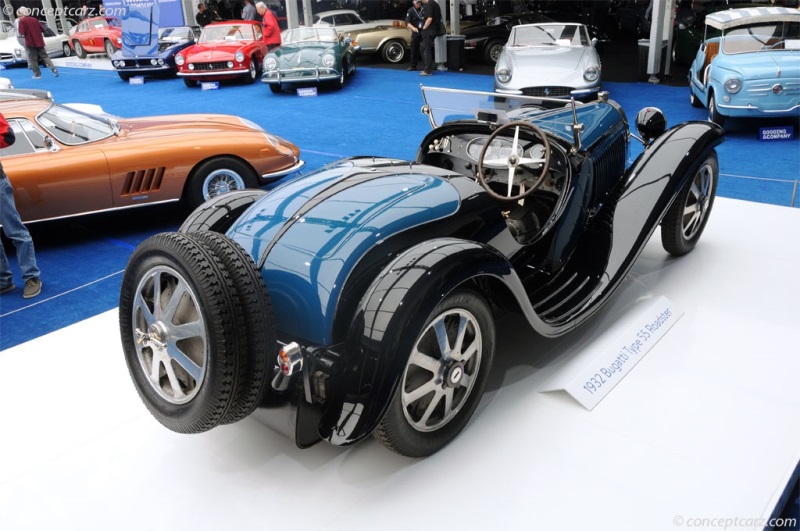
The coachwork was completed in roughly six weeks. The Cabriolet body featured long, sweeping fenders similar to that of the Super Sport Roadster and dual rear spares. It also had outside exhausts, the only Type 55 with this specification. It also was given a fold-flat windscreen that opened forward when vertical, as well as roll-up windows. It also was given plated irons on top, plated accents on both doors an plated strips on the rear deck for additional baggage. The inside was finished in black with a dark green leather interior. The interior was offset by green accents along the fenders, a green leather top boot and green painted wheels with a polished surface.
This Bugatti Type 55 is the only Bugatti known to be specified with the brake drum and wheel castings predominately painted.
The Type 55 was used regularly, even competing in the 1933 Rallye des Alpes. In January of 1935, the Type 55 was purchased by Emile Sambuc, who had owned several other Bugattis. Mr. Sambuc retained the Type 55 for two years before replacing it with a new Type 57 Gangloff. Laurent Biancotto of Marseille purchased the Bugatti and kept it for an additional two years. In November of 1938, the car was sold to Marseille resident Alexandre Oliva. On June 2, 1939, the Cabriolet was registered by Department du Nord as '3252 MD 6' to Paul Lefevre in the town of Lille. In 1947, the car passed to another Lille resident Pierre Gerard. On April 21 of 1949, the Type 55 was re-registered as '7626 NB 1' in the name of Ghislain Gengembre, who kept the car until his death.
The next owner was Yves Garnier who purchased it in 1970. Mr. Garnier rebuilt 55206 entirely by himself and in 1978 he bought a spare engine (no. 36, ex-55236) from M. Mulnard. During the restoration the original crankshaft was replaced with the original crank of engine number 36. The work took more than a decade to complete and was finally finished around 1980. In 1987 the car was purchased by German dealer Hans Bitterwolf who in turn sold the car to Peter Agg, then living in Sussex, England. During Mr. Agg's ownership, the car received further restoration including a new paint scheme of black wings with a blue body and grayish-beige interior. It was later brought to the US by Mr. Agg, where it participated in several major events including the Colorado Grand. After Mr. Agg's seven-year ownership, ownership passed to Ruedi Schmid of Basel, Switzerland, who retained the car for 16 years. Mr. Schmid drove the car in the 1998 Klausen Hillclimb and the 1994 International Bugatti Rally.
In 2007, the car was given a significant mechanical overhaul which included the installation of a new Brineton cylinder block. A year later, the car participated in the Bugatti Owner's Club Prescott Garden Party.
The current owner purchased the car from Mr. Schmid in November of 2010. A thorough restoration soon followed. The car retains its original frame in addition to its brass chassis tag mounted to the original aluminum bulkhead. The original lower crankcase is stamped 'No. 6'. The upper crankcase bears the assembly number '72', which is believed to originate from factory service of the car after some sort of crankshaft failure. The original supercharger and the original gearbox are stamped '6'.
This is one of the most (if not the most) original Type 55s in existence. The Billeter & Cartier coachwork is original and solid. Body no. 2238 is stamped on several panels and timbers. Original interior fabric materials were found. The interior and exterior finishes were matched to original specifications.
In January of 2012, the car was Bugatti's sold exhibit at Retromobile in Paris. It was displayed in its original black and green livery.
Powering the car is a 2262cc dual overhead cam inline 8-cylinder engine fitted with a single Zenith 48K Updraft Triple-Diffuser carburetor. With the assistance of the Roots-Type supercharger, it produces 135 horsepower. There is a four-speed non-synchromesh manual gearbox and four-wheel mechanical drum brakes.
In 2012, the car was offered for sale at the Pebble Beach auction presented by Gooding & Company. The car was estimated to sell for $5,000,000 - $6,500,000. Unfortunately, a buyer willing to satisfy its reserve was not found. It would leave the auction unsold.
By Daniel Vaughan | Nov 2012
Bugatti had a long and lengthy history when it came time to produce the Type 55. Their resume included extremely successful race cars and elegant and sophisticated road going vehicles. In the racing department, the minimalist Type 35 was a very competitive car that racked up many impressive victories. It was, like so many other Bugatti's, available with either a naturally aspirated engine or with the addition of a supercharger. In the early 1930s, a new car was needed to keep Bugatti at the front of its game and to comply with new racing regulations.
Bugatti had been very successful in creating great racing machines and using the lessons learned to create performance-minded road-going cars. In other words, the technology that worked on the track often made it into the production vehicles. This continual growth and constant evolution aided in the marque's success both on and off the track.
Bugatti had been working on the Type 47 and its Grand Prix sibling Type 45 when the French Grand Prix was ended in 1928, effectively canceling these projects. Much time and attention had gone into designing these machines. The deep-section rail frame for the Type 47 Grand Sport was designed to house a three-liter U-16 engine. The chassis frame, with its widely spaced rear springs and long rear-axle trailing arms, was strong enough to house a larger engine, which it did with the Type 54 Grand Prix. The engine was a 4.9-liter unit straight-eight. Jean Bugatti continued his previously successful endeavors by offering a de-tuned version of the Grand Prix car for road-going purposes.
The Type 55 was given the Type 47/54 chassis and a lower compression Type 51 Grand Prix engine. A very attractive, Jean-Bugatti designed, two-seater coachwork was created for the Type 55, along with a similarly styled coupe body coachwork.
Production of the Type 55 began in 1932 and continued until 1935 with a total of 38 examples created. 23 examples were completed during its first year of production. The straight-eight engine had cast-iron block and head, dual overhead camshafts, Zenith carburetor, Roots-type supercharger, and displaced 2262cc. There was a four-speed manual gearbox, cable-operated drum brakes at all four corners, and live axle suspension.
In 2008, this Type 46 Sports Saloon was offered for sale at the Gooding & Company Auction held in Pebble Beach, California. It was estimated to sell for $650,000 - $850,000 and offered without reserve. The lot was sold for $440,000, including buyer's premium.
By Daniel Vaughan | Mar 2009
Bugatti had been very successful in creating great racing machines and using the lessons learned to create performance-minded road-going cars. In other words, the technology that worked on the track often made it into the production vehicles. This continual growth and constant evolution aided in the marque's success both on and off the track.
Bugatti had been working on the Type 47 and its Grand Prix sibling Type 45 when the French Grand Prix was ended in 1928, effectively canceling these projects. Much time and attention had gone into designing these machines. The deep-section rail frame for the Type 47 Grand Sport was designed to house a three-liter U-16 engine. The chassis frame, with its widely spaced rear springs and long rear-axle trailing arms, was strong enough to house a larger engine, which it did with the Type 54 Grand Prix. The engine was a 4.9-liter unit straight-eight. Jean Bugatti continued his previously successful endeavors by offering a de-tuned version of the Grand Prix car for road-going purposes.
The Type 55 was given the Type 47/54 chassis and a lower compression Type 51 Grand Prix engine. A very attractive, Jean-Bugatti designed, two-seater coachwork was created for the Type 55, along with a similarly styled coupe body coachwork.
Production of the Type 55 began in 1932 and continued until 1935 with a total of 38 examples created. 23 examples were completed during its first year of production. The straight-eight engine had cast-iron block and head, dual overhead camshafts, Zenith carburetor, Roots-type supercharger, and displaced 2262cc. There was a four-speed manual gearbox, cable-operated drum brakes at all four corners, and live axle suspension.
In 2008, this Type 46 Sports Saloon was offered for sale at the Gooding & Company Auction held in Pebble Beach, California. It was estimated to sell for $650,000 - $850,000 and offered without reserve. The lot was sold for $440,000, including buyer's premium.
By Daniel Vaughan | Mar 2009
Despite what every adolescent boy in America may tell you, the awe-inspiring Veyron was not Bugatti's first car. Nor was it Bugatti's first tribute to speed, excess, and unbridled wealth.
The 16-cylinder, quad-turbo Veyron was conceived under Bugatti's current Volkswagen ownership. Before the German takeover, the Italians had some fun with Bugatti as well. For a few years during the early 1990's, an Italy-based Bugatti produced the EB110 supercar with as many turbos and as much presence as the Veyron, albeit with a paltry 12 cylinders.
The Veyron and EB110 represent the whole of Bugatti's recent history. Between 1956 and 1991, no new Bugattis were produced.
That fact may say more about the Bugatti legend than anything else. Here was a company that could vanish for 35 years and then come back, under foreign rule no less, to build the fastest, most exotic machines on the planet. Only an absolutely exhilarating past could have inspired the inception of these modern Bugatti vehicles, and from 1909 through 1956 the French marque founded by Ettore Bugatti had just that.
Though marvelous excesses like the 12.8-liter Royale had most in common with the extravagant Bugattis of today, the company also had the power to produce less glitzy cars in the name of tasteful perfection. One such work was the Type 55 produced from 1932 through 1935.
One of the best sports cars of its time, the Type 55 was an incredible piece of engineering. Sharing its chassis with the Type 54 and its basic engine design with the Type 51, it was a terrific performer on road and track.
The detuned Type 51 engine found in the Type 55 was a dual overhead cam inline eight displacing 2262cc. Fed by a Zenith carburetor, the engine featured a roots supercharger that helped bring power output up to 130hp. In a car that weighed as little as 1,800lbs, that kind of power proved ample for rapid motoring. The cast alloy rear wheels were driven through a four speed transmission.
Only 38 Type 55 chassis were produced. Close to half of these were fitted with roadster or coupe coachwork by Ettore's son, Jean Bugatti. These bodies reinforced the Type 55's image as a sports car, and established the car as one of the best sculpted vehicles ever produced.
Jean Bugatti was undeniably talented. The work he did for his father resulted in some of the most stunning and gorgeous cars in automotive history. While he may be best remembered for the drastically curvaceous lines of some of the Type 57 bodies, Jean Bugatti's Type 55 coachwork was brilliant in its own right.
The Super Sport roadster especially was a lovely design. Perfectly proportioned and with just enough curvature, it was tasteful elegance at its best. The delicate front fenders swept down to form short running boards which then leapt up quickly to form rear fenders that fell in tight circles around the rear wheels. The stately Bugatti grille stood proudly up front, situated between carefully placed headlights. The long nose, with louvers on its sides, hinted at the car's potent powerhouse as the short tail, bedecked with twin spare tires, finished the declaration of the car's sporting intentions.
With its speed and style, the Type 55 fit perfectly with Bugatti's history as an independent carmaker. It was as enjoyable to drive as it was to look at, and its price tag and small production ensured that it would only fall into the hands of a fortunate few. The Type 55 helped establish a story incredible enough to compel a new generation of aficionados to dust off three and a half stagnant decades and bring back one of the most phenomenal names to ever grace an automobile.
Sources:
'Bugatti Type 55.' The Bugatti Trust 29 Mar 2009 http://www.bugatti-trust.co.uk/bugatti-cars/bugatti-55.shtml.
'Bugatti Type 55 1932-1935.' Auto Evolution 29 Mar 2009 http://www.autoevolution.com/cars/bugatti-type-55-1932.html.
'Lot 147: Bugatti Type 55 Super Sport Roadster: Collectors' Sports & Grand Touring Motor Cars, Bonhams (10th May 2008).' Motorbase 29 Mar 2009 http://www.motorbase.com/auctionlot/by-id/266674516/.
Wise, David Burgess. 'Bugatti, Germany, France, 1909-1956; Italy, 1991 to 1994.'The New Illustrated Encyclopedia of Automobiles. 2000.By Evan Acuña
The 16-cylinder, quad-turbo Veyron was conceived under Bugatti's current Volkswagen ownership. Before the German takeover, the Italians had some fun with Bugatti as well. For a few years during the early 1990's, an Italy-based Bugatti produced the EB110 supercar with as many turbos and as much presence as the Veyron, albeit with a paltry 12 cylinders.
The Veyron and EB110 represent the whole of Bugatti's recent history. Between 1956 and 1991, no new Bugattis were produced.
That fact may say more about the Bugatti legend than anything else. Here was a company that could vanish for 35 years and then come back, under foreign rule no less, to build the fastest, most exotic machines on the planet. Only an absolutely exhilarating past could have inspired the inception of these modern Bugatti vehicles, and from 1909 through 1956 the French marque founded by Ettore Bugatti had just that.
Though marvelous excesses like the 12.8-liter Royale had most in common with the extravagant Bugattis of today, the company also had the power to produce less glitzy cars in the name of tasteful perfection. One such work was the Type 55 produced from 1932 through 1935.
One of the best sports cars of its time, the Type 55 was an incredible piece of engineering. Sharing its chassis with the Type 54 and its basic engine design with the Type 51, it was a terrific performer on road and track.
The detuned Type 51 engine found in the Type 55 was a dual overhead cam inline eight displacing 2262cc. Fed by a Zenith carburetor, the engine featured a roots supercharger that helped bring power output up to 130hp. In a car that weighed as little as 1,800lbs, that kind of power proved ample for rapid motoring. The cast alloy rear wheels were driven through a four speed transmission.
Only 38 Type 55 chassis were produced. Close to half of these were fitted with roadster or coupe coachwork by Ettore's son, Jean Bugatti. These bodies reinforced the Type 55's image as a sports car, and established the car as one of the best sculpted vehicles ever produced.
Jean Bugatti was undeniably talented. The work he did for his father resulted in some of the most stunning and gorgeous cars in automotive history. While he may be best remembered for the drastically curvaceous lines of some of the Type 57 bodies, Jean Bugatti's Type 55 coachwork was brilliant in its own right.
The Super Sport roadster especially was a lovely design. Perfectly proportioned and with just enough curvature, it was tasteful elegance at its best. The delicate front fenders swept down to form short running boards which then leapt up quickly to form rear fenders that fell in tight circles around the rear wheels. The stately Bugatti grille stood proudly up front, situated between carefully placed headlights. The long nose, with louvers on its sides, hinted at the car's potent powerhouse as the short tail, bedecked with twin spare tires, finished the declaration of the car's sporting intentions.
With its speed and style, the Type 55 fit perfectly with Bugatti's history as an independent carmaker. It was as enjoyable to drive as it was to look at, and its price tag and small production ensured that it would only fall into the hands of a fortunate few. The Type 55 helped establish a story incredible enough to compel a new generation of aficionados to dust off three and a half stagnant decades and bring back one of the most phenomenal names to ever grace an automobile.
Sources:
'Bugatti Type 55.' The Bugatti Trust 29 Mar 2009 http://www.bugatti-trust.co.uk/bugatti-cars/bugatti-55.shtml.
'Bugatti Type 55 1932-1935.' Auto Evolution 29 Mar 2009 http://www.autoevolution.com/cars/bugatti-type-55-1932.html.
'Lot 147: Bugatti Type 55 Super Sport Roadster: Collectors' Sports & Grand Touring Motor Cars, Bonhams (10th May 2008).' Motorbase 29 Mar 2009 http://www.motorbase.com/auctionlot/by-id/266674516/.
Wise, David Burgess. 'Bugatti, Germany, France, 1909-1956; Italy, 1991 to 1994.'The New Illustrated Encyclopedia of Automobiles. 2000.By Evan Acuña
| VOLKSWAGEN BEETLE TURBO AND JETTA GLI RECEIVE POWER BOOST | |
| - New EA888 Gen 3 engine, produced in Silao, Mexico, makes its U.S. debut - Engine offers 10 hp increase over previous Gen 2 powerplant - Beetle models have a manufacturer estimated fuel economy improvement of up to eight percent on the combined cycle - Beetle R-Line® coupe will be priced from $30,135 with the six-speed manual transmission Herndon, VA - The Volkswagen Beetle Turbo, Beetle Turbo Convertible, and the Jetta GLI receive a number of running changes to 2013 model year car...[Read more...] | |
| Auctions America's 2013 Auburn Spring Event Offers Ultimate Collector Car Weekend | |
![]() | • Auctions America presents the first of two annual Auburn sales, May 9 – 11 at historic Auburn Auction Park in Auburn, Indiana • Multi-day sale lifts gavel on 600 quality collector cars and an assortment of memorabilia • Notable early highlights include selection of Hudsons from the respected John Soneff Collection • Weekend also features inaugural Antique Automobile Club of America Central Division National Spring Meet, and an extensive car corral and swap meet presented by Carlisle Events...[Read more...] |
| Concorso d'Eleganza Villa D'Este 2013: Classic Weekend On Lake Como | |
![]() | On the weekend of 24 – 26 May 2013, the spectacular grounds of the Grand Hotel Villa d'Este and Villa Erba in Cernobbio on Lake Como will once again be transformed into a unique stage for the most beautiful automobiles and motorcycles from the past and the most extravagant concept cars of the present day. First held at the same location in 1929, the Concorso d'Eleganza Villa d'Este today ranks as the most traditional show of its kind in the world. It lays on an extensive programme throughout the...[Read more...] |
| Vicari Auction Hits $3.4 Million At Biloxi Event | |
![]() | Rare 1969 M Code Corvette is Top Sale at $152,000 The Vicari Auction Company announces total sales for their 16th annual Biloxi Auction reached $3.4 million, excluding buyer's premium. More than 300 vehicles crossed the block during the event, which took place Oct. 12-13, 2012, at the Mississippi Coast Coliseum & Convention Center in Biloxi, Miss. 'We strive to create an entertaining and customer-focused environment for collector car enthusiasts, and this year's record-break...[Read more...] |
| JAGUAR LAND ROVER REPORTS U.S. SALES FOR SEPTEMBER 2012 | |
| •Jaguar Land Rover North America U.S. sales increase 20 percent for September; best September since 2007 •Land Rover sales increase 33 percent for September driven by sales of Range Rover Sport and Range Rover Evoque •Jaguar begins dealership delivery of XJ 3.0 Liter V6 in October and XJ All Wheel Drive in December. (MAHWAH, NJ) - October 2, 2012 – Jaguar Land Rover North America today reported September 2012 U.S. sales: Land Rover sales for the month were 3,636 up 33 percent from ...[Read more...] | |
1932
Bugatti
models |
| Bugatti Type 46 |
| Bugatti Type 46S |
| Bugatti Type 50 |
| Bugatti Type 51 |
| Similar Automakers | |
| Aston Martin | Bentley |
| Devon | Ferrari |
| GTA | Koenigsegg |
| Lamborghini | Lotus |
| Maserati | Maybach |
| McLaren | Porsche |
| Rolls-Royce | Spyker |
| Tesla | |
| Bugatti: 1931-1940 |
| Similar Automakers |
| Bugatti History |
| Other models by Bugatti |
| Manufacturer Website |
| Related Articles and Event Coverage |
| Pebble Beach Concours d'Elegance |
| Gooding and Company - Pebble Beach Auction |
| Pebble Beach Concours d'Elegance |
| Gooding & Company |
| 2006 Amelia Island Concours d'Elegance |
| 8-Liter EB110 Royale | Type 101 Type 13 Type 23 | Type 35 Type 37 Type 38 | Type 39 and Type 39A Type 40 Type 46 | Type 50 Type 51 Type 55 | Type 57 Type 59 Veyron |


1932