Concept Cars Home
1955 A6G/54 2000 Image Right
 

1954 Maserati A6GCS/53 news, pictures, and information

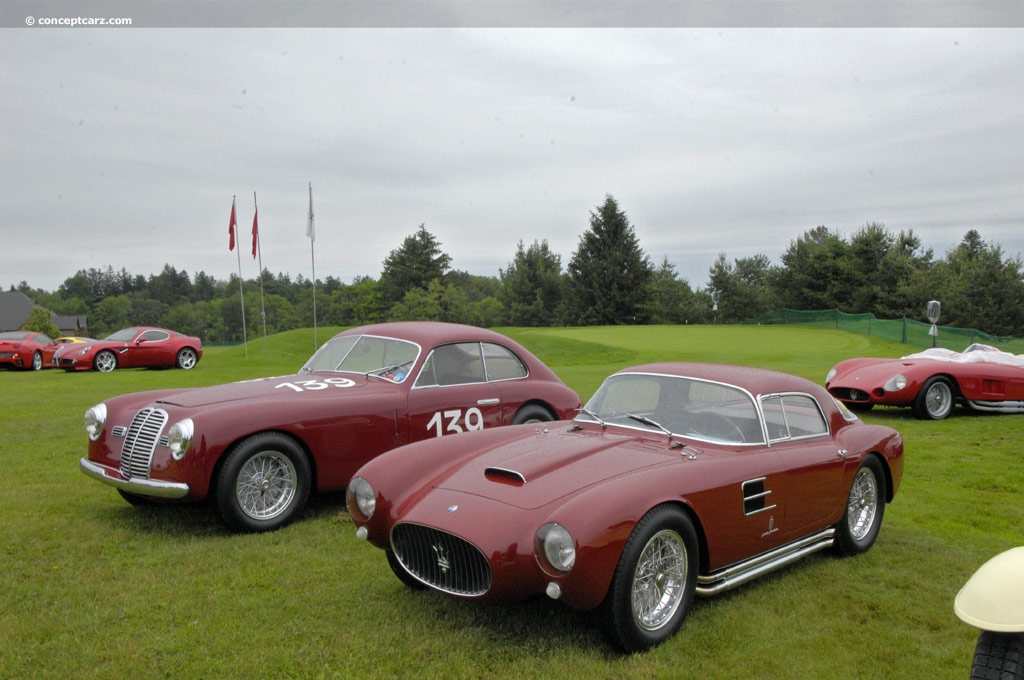
The Maserati Tipo A6GCS Series II included six specially bodied cars. Four were coupes created by Pininfarina. One was a spyder created by Vignale and the other was also a spyder, created by Frua.

Chassis number 2049 was a Vignale Spyder and constructed in 1953. It was reboided by Scaglietti in 1955, also in Spyder configuration.

Chassis number 2054 was a Frua Spyder built in 1953. There is little information on this vehicle, other than the where-abouts of the chassis is unknown. The body, however, was transplanted on a Triumph chassis. It was offered for sale in 1999.

Chassis numbers 2056, 2057, 2059, and 2060 are all Pininfarina Coupes. #2056 was build in 1953 but crashed by Garvina during the Giro di Sicilia race in 1954. The co-driver was killed. It was sent back to the factory but work was never completed on the car. In 1991, De Tomaso commissioned the car to be repaired. It was sold to Panini in 1996.

Chassis number 2057 was constructed in 1954 and was on display at the Turin show, finished in two-tone blue colors. It was rebodied as a spyder in 1955 and was issued a new chassis number at the time, #2086. The body was acquired by Franco Lombardi in 1977 who had the car restored on chassis number 2070.

Chassis number 2059 was shown at the Paris Salon in 1954 where it was finished in red with white stripes. It was later painted white shortly after the show and given an A6GCM engine. It passed through a few owners and was shown at the Pebble Beach Concours in 1999 in unrestored condition. Since that time, it has undergone a complete restoration and is in the possession of Erich Traber.

The final vehicle, chassis number 2060 was constructed in 1954 and was painted red with a blue stripe. Fiandri later converted the car to a spyder configuration. The original body was used for chassis number 2089 and is currently owned by Boris Subbotin.

By Daniel Vaughan | Jan 2007
Berlinetta
Designer: Pininfarina
Chassis Num: 2089
Engine Num: 2060
 
With a spyder body by Fantuzzi, number 2089 was a private entry in both the 1955 and 1956 Mille Miglia races, finishing 1st in Class (4th overall) and 2nd in Class (56th overall) respectively. Owned and driven by Francesco Giardini, it also competed at other venues in period, such as LeMans, Monza, and the Targa Florio. It is powered by a 2-liter twin cam 6-cylinder engine. In 1959 the car was rebuilt at the Maserati factory in a GT configuration with its present Pininfarina coupe body. It won the Art Center College of Design Award at Pebble Beach in 2005.
Berlinetta
Designer: Pininfarina
Chassis Num: 2089
Engine Num: 2060
 
The Maserati brothers - Aflieri, Bindo, Carloe, Ettore, Ernesto and Mario - began by building race cars in Italy in the 1920s. They won early and often, including the Targa Florio in 1926 in their first race with a new car. In 1937, Omer Orsi took control of Maserati, though the brothers stayed on until 1947 when they left to found OSCA.

Maserati introduced the A6GCS in 1953. Overseeing its design and development was Gioachino Columbo who joined the firm in 1952. Primarily intended to be a sports racer, it was powered by a potent 1995cc twin-cam six-cylinder engine, tubular chassis, independent front suspension and rigid rear axle. While most were delivered as a Fantuzzi Barchetta, a handful had Frua, Vignale, and Pinin Farina coachwork.

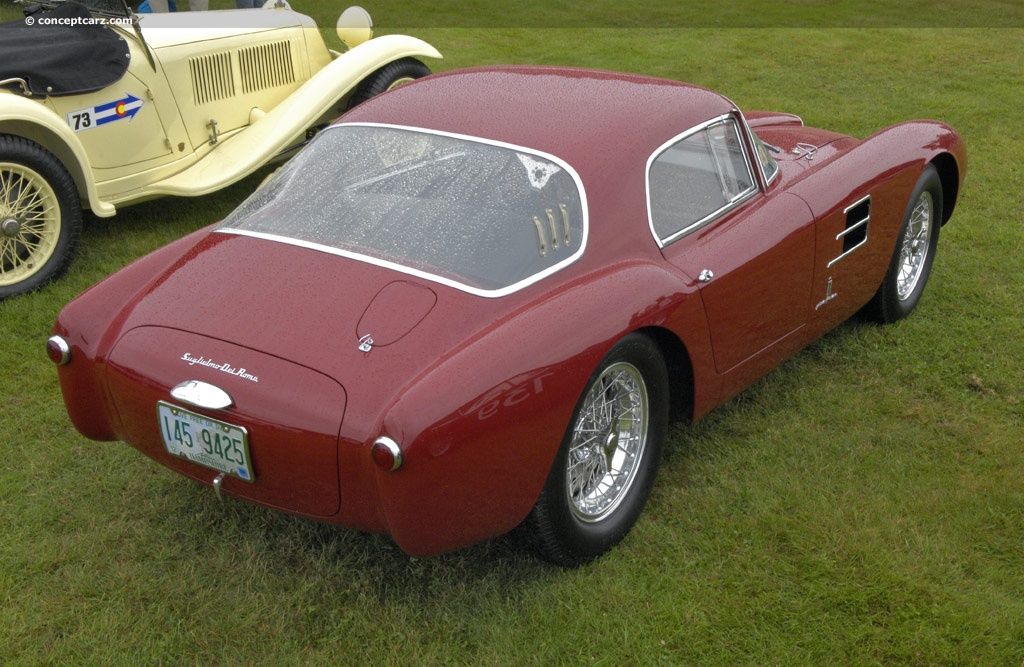
Guglielmo Dei was the Maserati distributor in Rome, Italy. In addition, he operated the Centro Sud racing school. He was known for having many special cars built for his Rome distributorship. He ordered four of Maserati's successful A6GCS racing chassis and sent them to coachbuilder Pinin Farina to design and build competition Berlinettas.

This car is the fourth built in-series, all of which were different. It is believed to have been the 1955 Paris Auto Salon show car. It sports many unique features including a canted elliptical grille opening with concave grille bars and 'Frenched' headlights typical of Pinin farina competition cars of the time.
The Maserati A6G/2000 was produced from 1954 through 1957 with around 60 examples being created, many receiving custom bodywork from prestigious coachbuilders such as Zagato, Pinin Farina, Vignale, and others.

Even though the company was not in financial difficulty, the Maserati brothers sold their shares of the company to the Orsi family from Modena in 1937. The headquarters were moved from Bologna to Modena. When they sold the company, the brothers had agreed to stay with Maserati for another ten years performing duties as chief engineers. In 1948, after their ten year agreement was satisfied, they left the company and formed OSCA.

With the chief engineers gone, the company was positioned for failure, but the company did have a strong history and more importantly, they had a newly developed straight six engine, courtesy of the Maserati brothers. The engine produced by Maserati brothers was nothing spectacular; the 1.5-liter power-plant produced 65 horsepower. It was, however, a good starting point and would prove to be very tunable in the years to come. The primary intention for the engine was competition, but Orsi understood that money needed to be made, so that it could be spent. So Orsi commissioned a sports road car that could be produced for exclusive clientele.

In 1947 Maserti introduced the A6 with custom coachwork by Pinin Farina. Under the hood was the 1.5-liter single overhead camshaft engine matted to a four-speed gearbox. The steel tubular frame was suspended by a live rear axle and a front wishbone suspension. Even though Pinin Farina is noted for their elegant styling, their design of the A6 was not well received. Coupled with the poor performance, the vehicle was not well received.

Modifications were performed on the engine resulting in an increase to 2 liters and 100 horsepower. Three updated versions of the A6 were displayed at the 1951 Paris Motorshow. The Berlina body styles were created by Pinin Farina and were the standard style; the Spider variants were created by Frua; and the Coupe was courtesy of Vignale. With all the mechanical improvements and bodystyle options available, the two-liter A6 was poised for success. With only 16 examples created, the A6 proved it needed more work.

The famous Gioacchino Colombo, known for his work with Ferrari, joined Maserati in 1953. His first task was to modify the A6GCM to include a DOHC valve train, dual-spark ignition, and more. Horsepower rose to nearly 200. The success of Maserati in racing was heightened with the new engine and new drivers such as Fangio, Gonzalez, Marimon, Bonetto and de Graffenried. Fangio had won the 1953 Italian Grand prix driving a Ferrari.

The third iteration of the A6 occurred in 1954, dubbed the A6G/54. This was the same year for the introduction of the Maserati 250F, which, in the hands of the capable Fangio won the Argentine Grand Prix on its debut. The A6G/54 was outfitted with a competitive engine and wonderful styling from Frua and Zagato. Production lasted until 1954 with multiple types of body styles being created. One of the most memorable bodystyles were the 19 lightweight Zagato bodies which could often be seen at race tracks. All of the Zagato hand-formed body styles were unique, even the interior.

The A6G/54 was replaced by the 3500 GT. The A6 endured many growing pains but by the final iteration, the A6 variants were respectable and stylish machines. With the mechanical prowess of Colombo and the driving talent of Fangio and others, Maserati could continue to provide competition on the race track. While back at home, the A6 provided the bread-and-butter to continue racing and further development.

By Daniel Vaughan | Dec 2010
Even though the company was not in financial difficulty, the Maserati brothers sold their shares of the company to the Orsi family from Modena in 1937. The headquarters were moved from Bologna to Modena. When they sold the company, the brothers had agreed to stay with Maserati for another ten years performing duties as chief engineers. In 1948, after their ten year agreement was satisfied, they left the company and formed OSCA.

With the chief engineers gone, the company was positioned for failure, but the company did have a strong history and more importantly, they had a newly developed straight six engine, courtesy of the Maserati brothers. The engine produced by Maserati brothers was nothing spectacular; the 1.5-liter power-plant produced 65 horsepower. It was, however, a good starting point and would prove to be very tunable in the years to come. The primary intention for the engine was competition, but Orsi understood that money needed to be made, so that it could be spent. So Orsi commissioned a sports road car that could be produced for exclusive clientele.

In 1947 Maserti introduced the Maserati A6 with custom coachwork by Pinin Farina. Under the hood was the 1.5-liter single overhead camshaft engine matted to a four-speed gearbox. The steel tubular frame was suspended by a live rear axle and a front wishbone suspension. Even though Pinin Farina is noted for their elegant styling, their design of the A6 was not well received. Coupled with the poor performance, the vehicle was not well received.

Modifications were performed on the engine resulting in an increase to 2 liters and 100 horsepower. Three updated versions of the A6 were displayed at the 1951 Paris Motorshow. The Berlina body styles were created by Pinin Farina and were the standard style; the Spider variants were created by Frua; and the Coupe was courtesy of Vignale. With all the mechanical improvements and bodystyle options available, the two-liter A6 was poised for success. With only 16 examples created, the A6 proved it needed more work.

The famous Gioacchino Colombo, known for his work with Ferrari, joined Maserati in 1953. His first task was to modify the A6GCM to include a DOHC valve train, dual-spark ignition, and more. Horsepower rose to nearly 200. The success of Maserati in racing was heightened with the new engine and new drivers such as Fangio, Gonzalez, Marimon, Bonetto and de Graffenried. Fangio had won the 1953 Italian Grand prix driving a Ferrari.

The third iteration of the A6 occurred in 1954, dubbed the A6G/54. This was the same year for the introduction of the Maserati 250F, which, in the hands of the capable Fangio won the Argentine Grand Prix on its debut. The A6G/54 was outfitted with a competitive engine and wonderful styling from Frua and Zagato. Production lasted until 1954 with multiple types of body styles being created. One of the most memorable bodystyles were the 19 lightweight Zagato bodies which could often be seen at race tracks. All of the Zagato hand-formed body styles were unique, even the interior.

The Maseati A6GCS was produced from 1953 through 1955 with a total of 52 examples being constructed. Four where Berlinetta bodies by Pininfarina while 48 were in Spyder configuration and bodied by Fantuzi. The A6GCS were very important to Maserati and scored many victories for the marque. In 1953 the A6GCs won its class at the Mille Miglia in its inaugural debut.

The Maserati A6G/2000 was produced from 1954 through 1957 with around 60 examples being created, many receiving custom bodywork from prestigious coachbuilders such as Zagato, Pinin Farina, Vignale, and others. Serafino Allemano constructed twenty-one examples of the A6G/2000. All of these cars were equipped with the DOHC engines. The A6G/2000 is some times referred to as the A6G/54. These second series cars used many mechanical components from its predecessor, such as its twin parallel tube design. The engine, however, had been modified which resulted in an increase in horsepower.

The A6G/54 was replaced by the 3500 GT. The A6 endured many growing pains but by the final iteration, the A6 variants were respectable and stylish machines. With the mechanical prowess of Colombo and the driving talent of Fangio and others, Maserati could continue to provide competition on the race track. While back at home, the A6 provided the bread-and-butter to continue racing and further development.

By Daniel Vaughan | Jan 2007
For more information and related vehicles, click here

Sir Stirling Moss Returns To The Amelia Concours
Sir Stirling Moss defined the image of a professional racing driver. By the time premature retirement was forced upon him by a racing accident at Goodwood in 1962, his name meant 'racing driver'. He was every English schoolboy's hero and the inheritor of grand master and Mercedes-Benz teammate Juan Fangio's orb, scepter and crown. In 1996 Sir Stirling was the Amelia Island Concours d'Elegance first Honorary Chairman. The cover of 'The Amelia's' 1996 collector-grade program depict...[Read more...]
Ferrari Club Of America-Southwest Region Hosts International Meet In Palm Springs
50TH Anniversary of 250GT Enraptures Spirt of Ferrari with More than 150 Ferrari Vehicles to be Displayed The Ferrari Club of America International Meet will return to Southern California for the first time since 2002, to be held from October 10th to 14th in the Palm Springs desert playground. With Southern California being home to the largest concentration of Ferrari owners in the country, the 2012 FCA International Meet promises to be a spectacular event. The luxurious Hyatt Regency ...[Read more...]
Six Decades Of Ferrari At Mecum's Daytime Auction
1954 Ferrari 750 Monza Headlines Select Offering of Italian Illuminati Mecum Auctions will present its 4th annual Monterey Daytime Auction, Aug. 16-18, 2012 at the Hyatt Regency Monterey Hotel and Spa on Del Monte Golf course, featuring some of finest machines Ferrari has ever produced headlined by a 1954 750 Monza Spyder Scaglietti. By turns part of the Engelbert Stieger, Brando Wang, Walter Burani and Roberto Crippa collections, 1954 Ferrari 750 Monza Spyder Scaglietti S/N 0462MD...[Read more...]
Gooding & Company Announces the distinguished Sherman M. Wolf Ferrari Collection for its Pebble Beach Auctions
Gooding & Company, the acclaimed auction house celebrated for selling the world's most significant and valuable collector cars, is proud to announce that it will present the extraordinary Ferrari collection of Sherman M. Wolf at its Pebble Beach Auctions on August 18 & 19. The renowned Sherman M. Wolf Collection is comprised of a rare, alloy-bodied 1960 Ferrari 250 GT LWB California Spider Competizione, a 1953 Ferrari 340 MM Spider, a 1957 Ferrari 500 TRC and a 1985 Ferrari 288 GTO, four excep...[Read more...]
RM Secures One-Of-A-Kind Ferrari and Talbot-Lago For its Monterey sale
RM Auctions, the world's largest collector car auction house for investment-quality automobiles, is delighted to announce two new headline attractions for its highly anticipated Monterey, California sale, August 17–18: a spectacular 1955 Ferrari 410 Sport Berlinetta and a flawless 1938 Talbot-Lago T23 Teardrop Coupe. On display at the company's sale in Monaco this week (May 11–12), both automobiles represent the pinnacle of exclusivity and style. The extraordinarily rare 410 S, chassis 0594 C...[Read more...]
150S
200 Si
228
250
250F
300S
3500 GT
430
450
4CL
5000 GT
6CM
8CM
8CTF
A6
Bi-Turbo
Birdcage
Bora
Coupe
Coupe / Spyder
Ghibli
GranCabrio
GranTurismo
Indy
Khamsin
MC12
Merak
Mexico
Mistral
Quattroporte
Sebring

1955 A6G/54 2000 Image Right
© 1998-2012. All rights reserved. The material may not be published, broadcast, rewritten, or redistributed.