The Studebaker Company was formed in 1852 as a wagon manufacturer and became one of the oldest names in the automobile industry. It was son-in-law Fred Fish who had promoted the importance of the emerging automobile business. Studebaker moved slowly, first with a few electric cars and commercial vehicles, then in a partnership with Garford into gasoline vehicles. Studebaker had a large network of dealers for its wagons, and began marketing the E-M-F and Flanders automobiles, eventually in 1911 acquiring E-M-F.
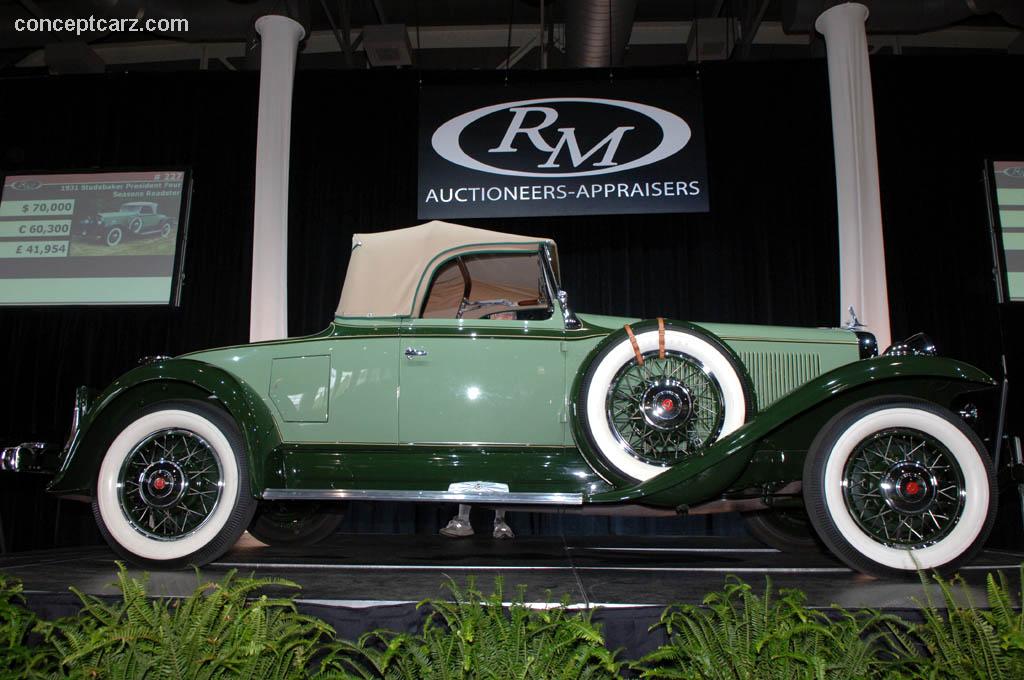
Four Seasons Roadster
Chassis #: 7033515
View info and history
Auction entries : 1Studebaker was one of the first companies to cast four and six-cylinder engines in single-piece en bloc castings. By 1926 Studebakers all were 6-cylinder powered and priced comparably with Buick's sixes of the period. By the late twenties, the company had become a successful manufacturer of mid-market cars that offered style, comfort, and luxury at an affordable price. During this time, the company made a bid for the high-end car market with the introduction of the new President powered by a high output eight-cylinder engine. According to Studebaker, the new President 'finds a parallel in sustained speed only in the light of comets, meteors, and other heavenly bodies'. By 1928, the engine's size measured 337 cubic inches and it produced 109 horsepower. The company had a solid reputation and a quality product, but it was the engine that earned the company its pedigree in the performance arena. In 1928, three Presidents circled the Atlantic City board track for 25,000 miles, averaging 68mph. Later, in 1931, the engine was upgraded to nine main bearing construction, and a modified President won the Pike's Peak hillclimb. Even at the Indianapolis 500, Studebakers consistently finished in the top ten.The company was still a force in the market in 1931, despite the Great Depression and what many consider to be a series of management misadventures. The company had become burdened with a diverse product line, and struggled with the acquisition of Pierce-Arrow, yet rallied around the new President model and continued to grow its performance image.
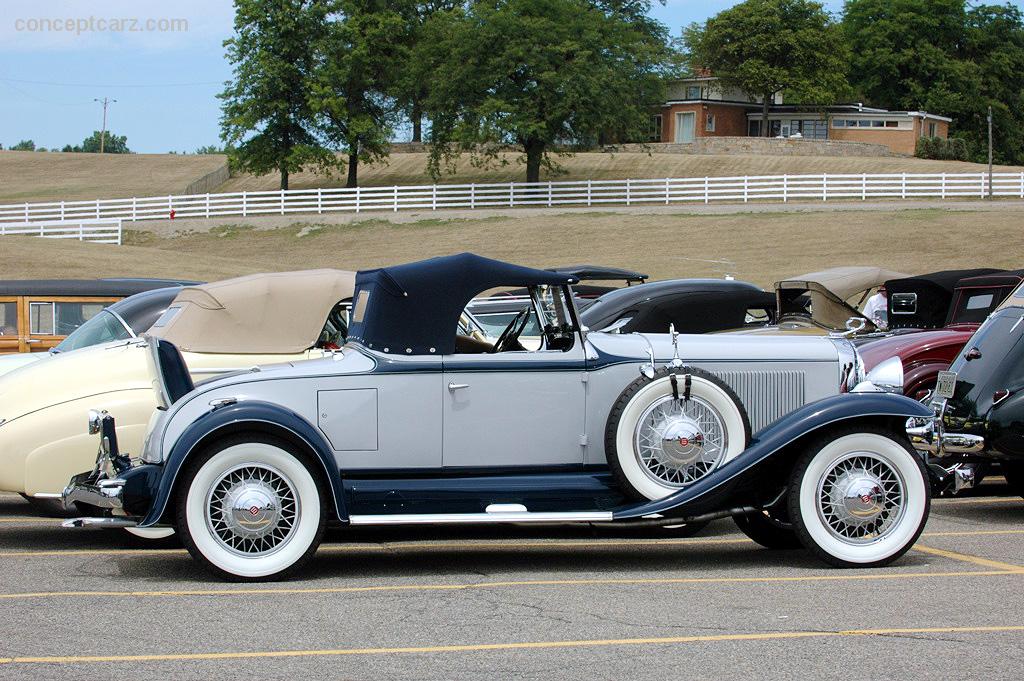
Four Seasons Roadster
Chassis #: 7037191
View info and history
Auction entries : 1With the help of the nine main bearing engine, Studebaker held 114 records, 35 of which would still stand 35 years later. No other car of its era was as successful in motorsports competition. The competition's success helped bolster sales in the showroom, and every little bit helped during the lean year of the Depression.The 1931 President was built on either a 'short' 130-inch wheelbase (Series 80) or a longer 136-inch platform (Series 90). Body styles on the Series 80 included a sedan and coupe priced at $1,850, a two-door state Roadster at $1,900, and a four-door State Sedan and two-door State Coupe priced at $1,950. Body styles on the larger Series 90 included a seven-passenger tourer priced at $1,850, a seven-passenger state tourer at $2,050, a seven-passenger sedan at $2,150, and a State Victoria, State Brougham, State sedan, and State Limousine at $2,250. The Model 80 four-seasons convertible roadster was a new body style for 1931. Both the Series 80 and Series 90 were equipped with an L-head, inline eight-cylinder engine with a 337 cubic-inch displacement, a Stromberg two-barrel carburetor, nine main bearings, solid valve lifters, 5.10:1 compression ratio, and 122 horsepower at 3,200 RPM. The engine was backed by a three-speed manual transmission with a multiple dry disc clutch and floor-mounted gearshift controls. Bendix external expanding mechanical brakes were on all four wheels, as were Kelsey-Hayes wood spoke wheels. Regal and State Studebaker models wore wire-spoke wheels as standard equipment.
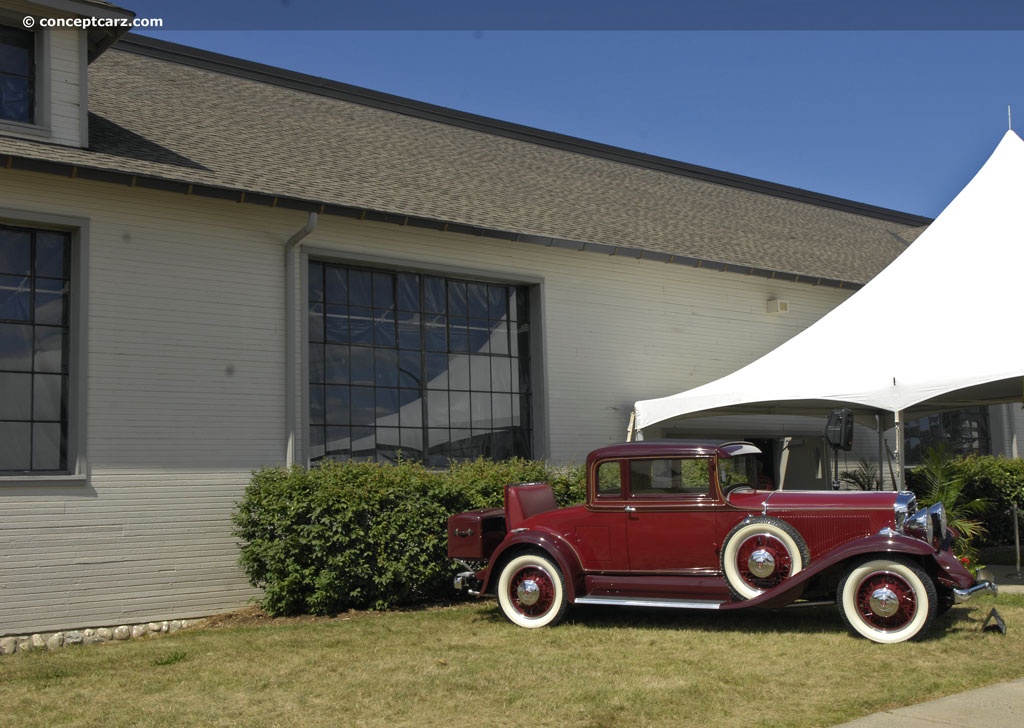
Coupe
Chassis #: 7035427
View info and history
Auction entries : 1Along with the nine main bearing engines, additional mechanical innovations for 1931 included improved carburetion and manifolding, freewheeling, improved steering gear, and improved brakes with cable control (a mid-year introduction). The President wore a larger radiator cap, a vee-shaped radiator, 'veed' single bar bumper, oval-shaped headlights, and parking lamps on the front fenders. Standard equipment on the President models included Houdaille shock absorbers and spring covers, ball bearing spring shackles, non-shatterable glass, windshield wiper, cigar lighter, ignition lock, speedometer, gas gauge, thermometer, freewheeling, and tail and stoplight. Between June of 1930 to September of 1931, Studebaker built approximately 6,340 examplse of the Presdient Series 80 and approximately 2,762 examples of the President Series 90.
by Daniel Vaughan | Jun 2021
Four Seasons Roadster
Chassis #: 7033515
View info and history
Auction entries : 1
Four Seasons Roadster
Chassis #: 7037191
View info and history
Auction entries : 1
Coupe
Chassis #: 7035427
View info and history
Auction entries : 1
by Daniel Vaughan | Jun 2021
Related Reading : Studebaker President History
The Studebaker Company was formed in 1852 as a wagon manufacturer and eventually changed to automotive production, making them one of the oldest names in the automobile industry. They were in the automotive business from 1902 through 1966, a total of 64 years. They produced electric-powered cars for the first two years and introduced gasoline power in 1904. During the 1920s, they produced vehicles....
Continue Reading >>
Continue Reading >>
Similarly Priced Vehicles


1931 Studebaker President Series 80 Vehicle Profiles


Recent Vehicle Additions


Performance and Specification Comparison
Price Comparison
$823 - $9,012
$1,585 - $1,685
$1,850 - $2,550
President Specification Comparison by Year
Year
Production
Wheelbase
Engine
Prices
13,186
127.00 in., 131.00 in.
6 cyl., 354.00 CID., 75.00hp
8 cyl., 312.50 CID., 100.00hp
8 cyl., 337.00 CID., 109.00hp
8 cyl., 312.50 CID., 100.00hp
8 cyl., 337.00 CID., 109.00hp
$1,800 - $2,475
Related Automotive News

Victory For Tanner Foust In Finland American Rockstar Energy Drink Driver Takes Second Win Of 2013
KOUVOLA, Finland (June 10, 2013) -- Tanner Foust earned another European Rallyross Championship win this weekend in Finland, to make it two victories in two championship starts this year.
It was a come-from-behind performance for Foust, who started...
French Indycar Racing Star Simon Pagenaud Will Race At Pikes Peak International Hill Climb
Colorado Springs, June 5----------Honda-powered IndyCar racer Simon Pagenaud of France, winner of Sundays IZOD IndyCar Series race at the Detroit Grand Prix, and eighth at the Indianapolis 500 two weeks ago, will make his Pikes Peak International...

Tanner Foust Favored For X Games Medal Rookies Victorious After First-Corner Crash Claims Veterans
FOZ DO IGUAÇU, Brazil (April 23, 2013) - Rockstar Energy Drink driver Tanner Foust had a target on his back this weekend in Brazil, where the opening round of the Global Rallycross Championship took place on a challenging X Games course at Foz...

AL UNSER JR. NAMED GRAND MARSHAL FOR THE PORTLAND HISTORIC AUTOMOBILE RACES
The Historic Motor Sports Association (HMSA) is pleased to announced that two-time Indy 500 winner Al Unser Jr. will be the Grand Marshal at the 37th running of the Portland Historic Automobile Races June 27-30, 2013.
The 1990 and 1994 CART champion...

SEBASTIEN LOEB OF FRANCE ENTERS PIKES PEAK INTERNATIONAL HILL CLIMB
One of the worlds most decorated auto racing stars is coming to Pikes Peak this summer.
Nine-time WRC World Rally Championship winner Sebastien Loeb of France has entered the 2013 Pikes Peak International Hill Climb, adding more international...