


Chassis #: 0019
To continue the notion of improving airflow, the exhausts had an up-and-over design. The engine, fully enclosed, was the Cosworth DFV unit matted to a new Lotus transmission. The new gearbox was an improved sequential unit that was very compact and strong. The driver was no longer required to operate a clutch to change gears; rather, just let up on the throttle when making upward changes. The new gearbox was used for only a short time before the team reverted back to Hewland units.
By Daniel Vaughan | Aug 2010
Similar Vehicles

Similar Automakers
Related Drivers
 Mario Gabriele Andretti
 Jean-Pierre Jacques Jarier
 Bengt Ronnie Peterson
 Héctor Alonso Rebaque
 Carlos Alberto Reutemann
Related Teams
 John Player Team Lotus
  Martini Racing Team Rebaque


1978 Lotus 79 John Player Special Mark IV Vehicle Profiles
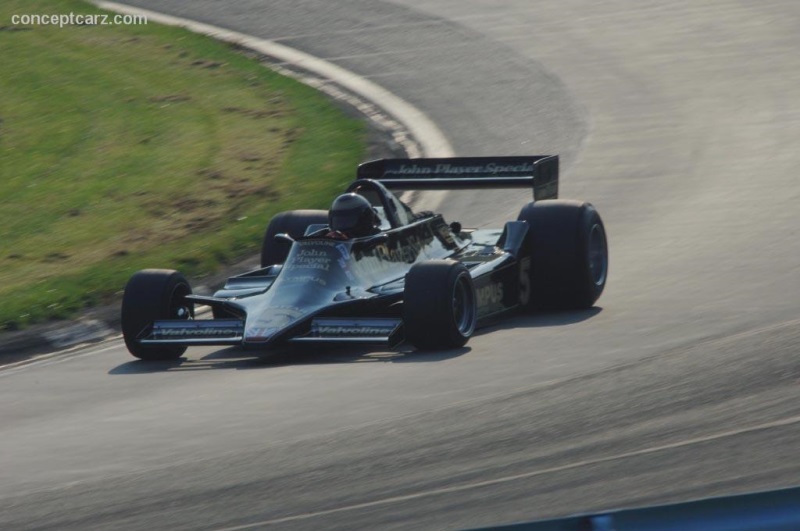
Chassis #: 0019
Recent Vehicle Additions


Related Automotive News

Bonhams Unveils Mario Andretti's Formula 1 World Championship Winning Lotus
TYPE 79 TO BE OFFERED AT NEW ABU DHABI GRAND PRIX SALE
One of the most important and evocative World-Championship-winning Grand Prix racing cars of all time, the 1978 John Player Special Lotus-Cosworth Type 79 driven by US racing superstar Mario...

WILLIAMS MARTINI RACING TO FIELD HOST OF ICONIC FORMULA ONE CARS AT AUTOSPORT INTERNATIONAL
Autosport International is proud to announce the legendary Williams Formula One cars set to appear at the 2017 show
Display will include the FW07 which gave Williams its first victory, Nigel Mansells 1992 Drivers Championship-winning FW14B, Damon...

Mille Miglia to Formula 1 - The Cars are the Starsat Rolex Monterey Motorsports Reunion
MONTEREY, Calif., Aug. 1, 2016 —When the green flag waves Aug. 18 to kick-off the seventh edition of the Rolex Monterey Motorsports Reunion at Mazda Raceway Laguna Seca, spectators will enjoy a paddock filled with 550 authentic race cars steeped...
RK MOTORS COLLECTOR CAR AUCTIONS REGISTERS $9.5 MILLION IN SALES, HAMMER COMES DOWN ON MORE THAN 100 CARS
Charlotte, N.C. (November 4, 2013) — Spanning two days, two continents and real-time bidding from a global audience, this weekends RK Motors Collector Car Auction saw the hammer come down on 104 investment-grade racers, rare muscle cars and European...
RK MOTORS INTRODUCES INDUSTRY'S FIRST-EVER INTERNATIONAL AUCTION HUB AND SIMULCAST AUCTION IN UNITED ARAB EMIRATES
Charlotte, N.C. – October 1, 2013— RK Motors Collector Car Auctions (RKMCCA) today announced it will host a real-time, simulcast-linked four-hour auction event in the U.S. and United Arab Emirates (UAE) on November 2, as part of its October 31...

RK Motors Collector Car Auctions To Offer Historic Hunt McLaren M26 Formula 1 Racecar
Charlotte, N.C. – September 9, 2013-- RK Motors Collector Car Auctions (RKMCCA) will offer collector car enthusiasts the first-ever opportunity to bid on James Hunts iconic1977 McLaren M26 (Lot #3032). The legendary racecar will be in the spotlight...


