History
The Alfa Romeo Tipo 33 name was used from 1967 through 1977 for Alfa Romeo sports racing prototypes and even a few road-going cars. Alfa Romeo's history in sports car racing goes back to pre-World War vintage. Their legacy continued in 1950 and 1951 as they won the first two Formula 1 World Championships. After this accomplishment, they retired from racing to focus on the production of road-going vehicles. Their absence from racing would be only for a short time, as their Zagato-bodied TZ1 was introduced in 1963. Its light alloy body, tubular frame, disc brakes, and independent suspension gave the vehicle superior handling and performance. The work had been managed by Carlo Chiti of Autodelta, a new competition department formed by Alfa Romeo. The Giulia 1600 GTA soon followed and was a dominant force at many of their racing expeditions.
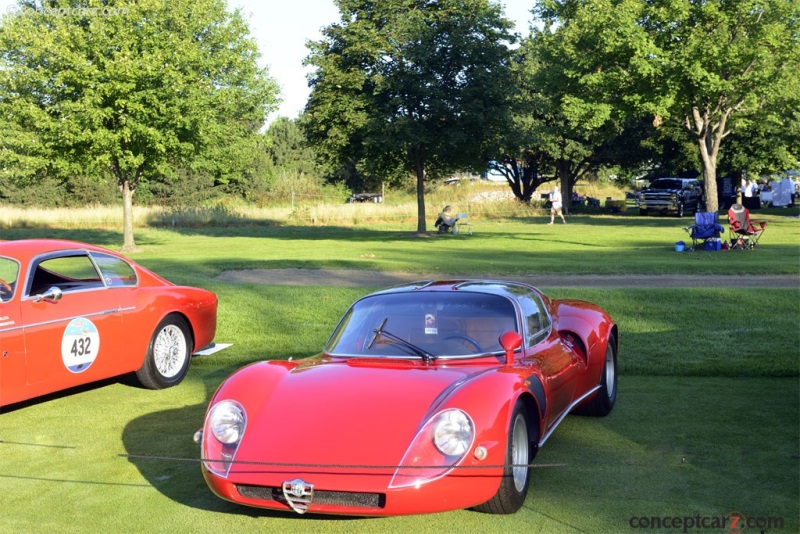
During the early 1960s, Alfa Romeo began designing a new racer which was given the codename '105.33'. The designs were later sent to Autodelta for further development. The '105' was later dropped and the vehicle became known as the '33' when it was introduced for the 1967 season. As the iterations of the Tipo 33 evolved, the names of the original cars became known as the '33/2', with the '2' representing their two-liter engines. Mounted mid-ship was a quad-cam V8 engine that was highly tuned to produce an impressive 270 horsepower. For its inaugural race at the Belgium hillclimb, the Tipo 33/2 proved its potential by emerging victorious. The rest of the season was plagued by mechanical issues which made the racer unreliable.
Work and testing to evolve the Tipo 33 continued for the 1968 season. The bodywork and engine were slightly improved in an effort to resolve reliability issues and to improve the vehicle's performance. Udo Schütz and Nino Vaccarella were able to navigate the 2-liter Tipo 33 at the 24 Hours of Daytona. A few other impressive victories and podium finishes followed throughout the season, but the Porsche rivals with their bigger engines often outpaced the Alfa Romeos. Alfa Romeo's team finished third in the World Championship for 1968.
The Tipo 33/2 was able to secure many class victories but it was not powerful enough to contend for overall victories. Work began on a three-liter unit that would be able to contend with the competition. The V8 3-liter unit was given four valves per cylinder and adapted to an aluminum monocoque type chassis which had shrunk in size by 10 cm. At the 12 Hours of Sebring in 1969, Alfa Romeo debuted the 33/3. The racer had 400 horsepower and was in the same class as the Ferrari 312P and the Porsche 908. The Alfa Romeo team would have a dismal season and often started the 33/2 in place of the 33/3.
For 1970 there were two body styles created, a long and short version. The long tail spider version was known as the Le Mans Spider. Worked continued to improve the vehicle's reliability issues. The car was unable to contend with the dominant Porsche 917 and Ferrari 512.
In 1970 an Alfa Romeo Tipo 33/3 was in Steve McQueen's movie 'Le Mans'.
In 1971 the Tipo 33/3 was given a five-speed gearbox. Many of the issues had been resolved and the 33/3 had a rather successful season, finishing second in the Constructor's World Championship. Rolf Stommelen and Nanni Galli had driven their cars to class wins at the 1000km Buenos Aires. At Sebring, the class win victory was repeated. At the 1000km Brands Hatch, De Adamich and Pescarolo were able to outpace the Porsche 917's and secure an overall victory. Vaccarella and Hezemans won outright victories at the Targa Florio, the vehicle's most impressive accomplishment of the season.
Near the close of the 1971 season, Autodelta introduced a new prototype racer dubbed the 33 TT3. The 'TT' meant Tellaio Tubulare - meaning tubular chassis for the vehicle's spaceframe type chassis. Much had been learned from the prior racers and adapted to this new vehicle. The weight distribution was greatly improved by moving the driving position forward and relocating the gearbox ontop of the engine.
In 1973 a Carlo Chiti-designed 12-cylinder box engine was placed in the vehicle. Alfa Romeo's fitted with this engine were known as the 33 TT 12. With the increase in power, the Alfa Romeo team won many of the races in 1974 and by 1975 was dominating the competition. The Alfa Romeo team scored seven victories in eight championship races. They repeated their accomplishments in 1976 with the Tipo 33 SC 12.
The Tipo 33 SC 12 had a 2995cc 12-cylinder boxer engine that produced 520 horsepower. Alfa Romeo secured the Sports Car Championship in 1977. The final race of the season had been raced with a turbocharged version of the 12-cylinder engine which increased horsepower to 640.
Part of the reasons for Alfa Romeo's success with the Tipo 33 models was its continued development, excellent drivers, and dwindling competition. Ferrari had left sports car racing in 1974 to compete in Formula One. FIA had added new regulations throughout the early 1970's which made formidable contenders such as the Porsche 917 and Ferrari 512 ineligible to compete.
By Daniel Vaughan | Aug 2007
During the early 1960s, Alfa Romeo began designing a new racer which was given the codename '105.33'. The designs were later sent to Autodelta for further development. The '105' was later dropped and the vehicle became known as the '33' when it was introduced for the 1967 season. As the iterations of the Tipo 33 evolved, the names of the original cars became known as the '33/2', with the '2' representing their two-liter engines. Mounted mid-ship was a quad-cam V8 engine that was highly tuned to produce an impressive 270 horsepower. For its inaugural race at the Belgium hillclimb, the Tipo 33/2 proved its potential by emerging victorious. The rest of the season was plagued by mechanical issues which made the racer unreliable.
Work and testing to evolve the Tipo 33 continued for the 1968 season. The bodywork and engine were slightly improved in an effort to resolve reliability issues and to improve the vehicle's performance. Udo Schütz and Nino Vaccarella were able to navigate the 2-liter Tipo 33 at the 24 Hours of Daytona. A few other impressive victories and podium finishes followed throughout the season, but the Porsche rivals with their bigger engines often outpaced the Alfa Romeos. Alfa Romeo's team finished third in the World Championship for 1968.
The Tipo 33/2 was able to secure many class victories but it was not powerful enough to contend for overall victories. Work began on a three-liter unit that would be able to contend with the competition. The V8 3-liter unit was given four valves per cylinder and adapted to an aluminum monocoque type chassis which had shrunk in size by 10 cm. At the 12 Hours of Sebring in 1969, Alfa Romeo debuted the 33/3. The racer had 400 horsepower and was in the same class as the Ferrari 312P and the Porsche 908. The Alfa Romeo team would have a dismal season and often started the 33/2 in place of the 33/3.
For 1970 there were two body styles created, a long and short version. The long tail spider version was known as the Le Mans Spider. Worked continued to improve the vehicle's reliability issues. The car was unable to contend with the dominant Porsche 917 and Ferrari 512.
In 1970 an Alfa Romeo Tipo 33/3 was in Steve McQueen's movie 'Le Mans'.
In 1971 the Tipo 33/3 was given a five-speed gearbox. Many of the issues had been resolved and the 33/3 had a rather successful season, finishing second in the Constructor's World Championship. Rolf Stommelen and Nanni Galli had driven their cars to class wins at the 1000km Buenos Aires. At Sebring, the class win victory was repeated. At the 1000km Brands Hatch, De Adamich and Pescarolo were able to outpace the Porsche 917's and secure an overall victory. Vaccarella and Hezemans won outright victories at the Targa Florio, the vehicle's most impressive accomplishment of the season.
Near the close of the 1971 season, Autodelta introduced a new prototype racer dubbed the 33 TT3. The 'TT' meant Tellaio Tubulare - meaning tubular chassis for the vehicle's spaceframe type chassis. Much had been learned from the prior racers and adapted to this new vehicle. The weight distribution was greatly improved by moving the driving position forward and relocating the gearbox ontop of the engine.
In 1973 a Carlo Chiti-designed 12-cylinder box engine was placed in the vehicle. Alfa Romeo's fitted with this engine were known as the 33 TT 12. With the increase in power, the Alfa Romeo team won many of the races in 1974 and by 1975 was dominating the competition. The Alfa Romeo team scored seven victories in eight championship races. They repeated their accomplishments in 1976 with the Tipo 33 SC 12.
The Tipo 33 SC 12 had a 2995cc 12-cylinder boxer engine that produced 520 horsepower. Alfa Romeo secured the Sports Car Championship in 1977. The final race of the season had been raced with a turbocharged version of the 12-cylinder engine which increased horsepower to 640.
Part of the reasons for Alfa Romeo's success with the Tipo 33 models was its continued development, excellent drivers, and dwindling competition. Ferrari had left sports car racing in 1974 to compete in Formula One. FIA had added new regulations throughout the early 1970's which made formidable contenders such as the Porsche 917 and Ferrari 512 ineligible to compete.
By Daniel Vaughan | Aug 2007
Similar Vehicles


Alfa Romeo Monthly Sales Volume
March 2023
2,390


1968 Alfa Romeo Tipo 33 Stradale Vehicle Profiles

Recent Vehicle Additions


Performance and Specification Comparison
33 Stradale Specification Comparison by Year
Year
Production
Wheelbase
Engine
Prices
Related Automotive News

CHRYSLER GROUP IN 2015, UNDER THE HOOD: MORE POWER, GREATER EFFICIENCY AND EXCEPTIONAL VALUE
Introducing the HEMI® Hellcat – Chrysler Groups most powerful V-8 ever 18th new engine added to Company lineup in less than five years
Celebrated TorqueFlite family grows by one with most robust eight-speed automatic in Chrysler Group history 15...

Audi Confirmed For Salon Privé 2013
Salon Privé 2013 - 4th to 6th September
Syon Park, London, 21 August 2013 – Audi is set to display the R8 V8 Spyder, RS 6 Avant and RS 4 Avant at Salon Privé 2013.
A hand-built, high-revving V8 engine mounted just behind the passenger...

1964 Nurburgring 1000 Kilometers: Survive for One Last Victory
During the late 1950s, Richie Ginther would begin a relationship with John von Neumann and this partnership would result in one of the most dominant periods of American sportscar racing in which Ginther and Porsche would be virtually unbeatable. Nearly...

The Champion in Touring Car Racing : The BMW M3
In August 1985, a rumour surfaced in motor magazine Auto-Deutschland which emanated from a new sports car. An A Group Car from BMW that was a thoroughbred racing car according to the rules but was also to be produced in a version licensed to drive on...

Auctions America By RM's 2012 Auburn Spring Auction
Variety is the buzzword for this years Auctions America by RM June 1-3 Auburn Spring auction, which will offer a huge range of collector vehicles and an enormous private collection of automotive memorabilia. More than 600 American muscle cars, Classics,...