History
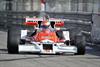
The McLaren M23 was introduced in 1973 and borrowed design inspired from the Lotus 72 and from their own M16 Indy car. McLaren had separated itself from most other racing car manufacturers by dabbling in multiple series. The traditional thought was to specialize in one arena rather than spread one's self thin by trying to do it all. McLaren proved they were up to the task by running successfully in four major championships - Formula 1, Formula 5000, CanAm, and Indy. Part of their success was using knowledge gained in one series to benefit the others. By the early 1970's, McLaren had won the Indy 500 and the F5000, CanAm, and F1 Championship.
McLaren entered the F1 Series in 1966 and managed a few wins throughout the first few years. It was not until McLaren married technology from their F1 program to their Indy program that their prospects in the sport changed. Gordon Cuppock took the monocoque of the M16B, the car that won the Indy 500 in 1972, and adapted it to the M19 Formula One car to create the M23.
McLaren began using the car in the third race of the 1973 season. Denny Hulme and Peter Revson drove the car to a third-place finish in the constructor's championship. Revson, who had scored two victories, one at the British Grand Prix and the second at the Canadian Grand Prix, finished fifth in the championship, while Hulme finished in sixth position with one race victory. Revson went to race for Shadow in 1974. Tragedy struck at the South African Grand Prix in Johannesburg when his suspension failed in his Shadow DN3, and he was killed. This was very unfortunate as his brother died in a crash in Denmark in 1967. Revson was replaced by Tom Pryce in F1 competition, who lost his life three years later at the same Grand Prix.
In 1974 the Yardley livery on the M23 was replaced with new sponsorship, Marlboro-Texaco. This would begin a relationship between Marlboro and McLaren that would last for a long time. Emerson Fittipaldi was added to the team to take the place of Revson. In the first two races of the season, the Hulme and Fittipaldi duo scored victories for Team McLaren. Fittipaldi finished the season in second place in the world championship. The work by both drivers earned the McLaren team its first constructor's championship title. To add to their successful season, an M16C had been driven to the team's second Indy 500 victory.
At the end of the 1974 season, Hulme retired from competition and was replaced by Jochen Mass. The M23 continued to be used in competition and was still competitive enough to earn Fittipaldi a second-place finish behind Austrian Niki Lauda in his Ferrari 312T. McLaren finished in third position in the constructors' championship.
The 1975 season was one of the most entertaining seasons of all time, though controversial. The entire season came down to the last race and the last few laps. The season ended much differently than it began. During the first eight races, Niki Lauda racked up enough points to lead the next closest competitor by nearly double. He had won four races and earned three podium finishes. At Nurburgring, Lauda was involved in an accident that left him burned, bruised, and in no condition to finish the season. He returned to the sport only three races after his accident, still bearing the burns, bruises, and injuries of his accident. He was in no condition to drive, yet he did, though he was not as fast as he was before the race. Hunt took advantage of the situation and won four the next six races. The final race was at the Japanese Grand Prix. Hunt was just three points behind Lauda. The day before the race, it rained so much that the teams and drivers voted not to race. The event organizers felt compelled to give the crowd what they had come to see, so the race was not canceled. Shortly before the race, the rain subsided slightly which made conditions a little more suitable for the drivers. With the accident still fresh in Lauda's mind, he decided to retire from the race. Hunt still needed a fourth-place finish to pass Lauda in points and secure the championship. With only a few laps to go, Hunt was in fifth place. Due to the conditions on the track, many racers, including Hunt, had spun and had to battle to regain their positions. With only three laps to go, Hunt was able to move into third place and secure his championship victory.
The M23 was used again in 1976 but raced for only part of the season, as it was replaced by the M26. By this time, McLaren was focusing all their attention on the sport which was not a good formula for the team. Their luck changed for the next few years in Formula 1 competition and they experienced their worst performance in Formula 1 competition.
The M23 had won 16 victories, one constructors' championship, and two drivers championships. In total, 13 examples were produced.
By Daniel Vaughan | Jan 2007
McLaren entered the F1 Series in 1966 and managed a few wins throughout the first few years. It was not until McLaren married technology from their F1 program to their Indy program that their prospects in the sport changed. Gordon Cuppock took the monocoque of the M16B, the car that won the Indy 500 in 1972, and adapted it to the M19 Formula One car to create the M23.
McLaren began using the car in the third race of the 1973 season. Denny Hulme and Peter Revson drove the car to a third-place finish in the constructor's championship. Revson, who had scored two victories, one at the British Grand Prix and the second at the Canadian Grand Prix, finished fifth in the championship, while Hulme finished in sixth position with one race victory. Revson went to race for Shadow in 1974. Tragedy struck at the South African Grand Prix in Johannesburg when his suspension failed in his Shadow DN3, and he was killed. This was very unfortunate as his brother died in a crash in Denmark in 1967. Revson was replaced by Tom Pryce in F1 competition, who lost his life three years later at the same Grand Prix.
In 1974 the Yardley livery on the M23 was replaced with new sponsorship, Marlboro-Texaco. This would begin a relationship between Marlboro and McLaren that would last for a long time. Emerson Fittipaldi was added to the team to take the place of Revson. In the first two races of the season, the Hulme and Fittipaldi duo scored victories for Team McLaren. Fittipaldi finished the season in second place in the world championship. The work by both drivers earned the McLaren team its first constructor's championship title. To add to their successful season, an M16C had been driven to the team's second Indy 500 victory.
At the end of the 1974 season, Hulme retired from competition and was replaced by Jochen Mass. The M23 continued to be used in competition and was still competitive enough to earn Fittipaldi a second-place finish behind Austrian Niki Lauda in his Ferrari 312T. McLaren finished in third position in the constructors' championship.
The 1975 season was one of the most entertaining seasons of all time, though controversial. The entire season came down to the last race and the last few laps. The season ended much differently than it began. During the first eight races, Niki Lauda racked up enough points to lead the next closest competitor by nearly double. He had won four races and earned three podium finishes. At Nurburgring, Lauda was involved in an accident that left him burned, bruised, and in no condition to finish the season. He returned to the sport only three races after his accident, still bearing the burns, bruises, and injuries of his accident. He was in no condition to drive, yet he did, though he was not as fast as he was before the race. Hunt took advantage of the situation and won four the next six races. The final race was at the Japanese Grand Prix. Hunt was just three points behind Lauda. The day before the race, it rained so much that the teams and drivers voted not to race. The event organizers felt compelled to give the crowd what they had come to see, so the race was not canceled. Shortly before the race, the rain subsided slightly which made conditions a little more suitable for the drivers. With the accident still fresh in Lauda's mind, he decided to retire from the race. Hunt still needed a fourth-place finish to pass Lauda in points and secure the championship. With only a few laps to go, Hunt was in fifth place. Due to the conditions on the track, many racers, including Hunt, had spun and had to battle to regain their positions. With only three laps to go, Hunt was able to move into third place and secure his championship victory.
The M23 was used again in 1976 but raced for only part of the season, as it was replaced by the M26. By this time, McLaren was focusing all their attention on the sport which was not a good formula for the team. Their luck changed for the next few years in Formula 1 competition and they experienced their worst performance in Formula 1 competition.
The M23 had won 16 victories, one constructors' championship, and two drivers championships. In total, 13 examples were produced.
By Daniel Vaughan | Jan 2007
Similar Vehicles
Similar Automakers
Related Drivers
 Emilio de Villota Ruíz
 Bruno Giacomelli
 James Simon Wallis Hunt
 Robert Brett Lunger
 Jochen Richard Mass
 Nelson Souto Maior Piquet Tony Trimmer
 Joseph Gilles Henri Villeneuve
Related Teams
BS Fabrications Centro Asegurador F1 Chesterfield Racing Iberia Airlines Liggett Group/BS Fabrications Marlboro McLaren Melchester Racing 


1977 McLaren M23 Vehicle Profiles


Recent Vehicle Additions


Related Automotive News

Mika Häkkinen To Drive Iconic McLaren M23 At Rolex Monterey Motorsports Reunion
Two-time Formula 1 champ fills in for Jenson Button on Aug. 18-19
MONTEREY, Calif., August 9, 2017 — McLaren ambassador Mika Hakkinen will delight fans when he gets behind the wheel of Emerson Fittipaldis 1974 world championship-winning...

THE 2014 AMELIA ISLAND CONCOURS D'ELEGANCE HONORS FIFTY YEARS OF McLAREN
McLarens 50th anniversary will be celebrated at the 19th annual Amelia Island Concours dElegance on March 9, 2014, with a display of rare and significant McLaren racers from five decades of competition.
McLarens were not only victorious in the worlds...

Goodwood Festival of Speed 2013: auction of Mercedes-Benz W 196 R one of highlights at world's 'largest motorised garden party'
Mercedes-Benz Classic presents great moments in motor-racing history at Goodwood
Motorsport festival celebrating its 20th anniversary
Auction of only privately owned post-war Silver Arrow by Bonhams sure to cause a stir
Stuttgart – This...
Credit Suisse Prepares For Second Instalment of Historic Racing Forum At Goodwood Revival 2012
Following success at GP de Monaco Historique, the Credit Suisse Historic Racing Forum will return at worlds leading historic racing fixture
Provocative Is the spirit of historic racing under threat debate to lead 2012 Credit Suisse activities
...

Credit Suisse Celebrates Successful 2012 GP De Monaco Historique
The historic racing community bid farewell to a thrilling weekend of action on the streets of Monaco as the 8th Grand Prix de Monaco Historique came to a close on Sunday evening.
In a weekend that saw some captivating motor racing on the worlds most...

Credit Suisse Historic Racing Forum at 8th Grand Prix de Monaco Historique
The Credit Suisse Drivers Club in Monaco played host this morning to an engaging 1st Credit Suisse Historic Racing Forum in front of a capacity audience.
Media, VIPs and many of the historic racers themselves listened in as respected motoring journalist...


