1939 Alfa Romeo 6C 2300 B
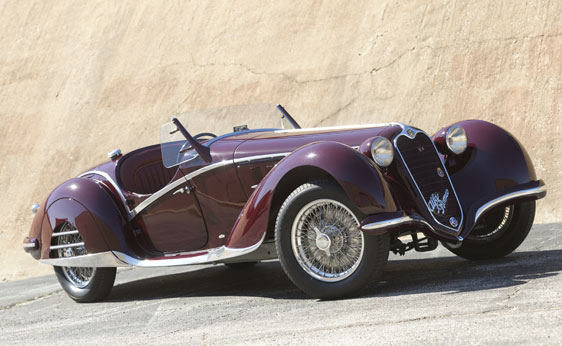
1939 Alfa Romeo 6C 2300 B Navigation
History
The 2.3-liter version of Vittorio Jano's engine was a continuation of excellence and perfection. The 1500 was the first increment, and it truly created recognition for the Italian based manufacturer. The 1750 and 1900 soon followed, then came the 2300 which offered just over 70 horsepower initially. Its construction was very similar to its predecessors, utilizing two overhead camshafts actuating two valves for each cylinder. It was formed using a cast-iron block and light-alloy head and mated to a four-speed gearbox with drum brakes on all four corners.
The first car to house the 2300 engine was the 63 2300 which made its inaugural debut at the 1934 Milan Motorshow. The body was courtesy of Castagna in four-door saloon configuration. A short-wheelbase Gran Turismo version soon followed, as did a higher compression version of the engine offering nearly 100 horsepower. These sporty versions were called the Pescara model and only sixty examples would ever be produced. The long wheelbase versions were called the Turismo's, the shorter Gran Turismos were known as the Pescara's. Within a few years, they would simply be known as the SWB and LWB for 'short' and 'long' wheelbase respectively.
Time brings about improvement, and very little time transpired before a 'B' version was introduced. In 1935 the 6C 2300B was introduced which brought new changes to the suspension and chassis, and mild improvements to the already potent powerplant. The suspension was independent in both the front and rear with swing axles in the rear and wishbones in the front.
In 1937 a Pescara emerged from the Mille Miglia with a class victory; in its honor the Pescara's name was changed to MM.
Production of the 2300 continued until 1939 when it was replaced by the 6C 2500 which would remain in production, except during war time, until 1952.
By Daniel Vaughan | Oct 2007
The first car to house the 2300 engine was the 63 2300 which made its inaugural debut at the 1934 Milan Motorshow. The body was courtesy of Castagna in four-door saloon configuration. A short-wheelbase Gran Turismo version soon followed, as did a higher compression version of the engine offering nearly 100 horsepower. These sporty versions were called the Pescara model and only sixty examples would ever be produced. The long wheelbase versions were called the Turismo's, the shorter Gran Turismos were known as the Pescara's. Within a few years, they would simply be known as the SWB and LWB for 'short' and 'long' wheelbase respectively.
Time brings about improvement, and very little time transpired before a 'B' version was introduced. In 1935 the 6C 2300B was introduced which brought new changes to the suspension and chassis, and mild improvements to the already potent powerplant. The suspension was independent in both the front and rear with swing axles in the rear and wishbones in the front.
In 1937 a Pescara emerged from the Mille Miglia with a class victory; in its honor the Pescara's name was changed to MM.
Production of the 2300 continued until 1939 when it was replaced by the 6C 2500 which would remain in production, except during war time, until 1952.
By Daniel Vaughan | Oct 2007
The Alfa Romeo 6C 2500 was introduced near the end of the 1930's. The 6C name was derived from the engine size, an inline-six while the 2500 represented the engine's cubic-centimeter displacement size.
The engine was a version of Vittorio Jano designed a six-cylinder engine. The 6C was available in a plethora of body styles and wheelbases and was produced during two different times in history. Most of the coachwork was handled by Touring of Italy or by Pinin Farina. The body styles ranged from coupes and convertible to a four-seater salon. In 1939 Alfa Romeo introduced the SS version, a short-wheelbase model, dubbed 'SS' for Super Sport, that had a high-compression 6C engine rated at 105 horsepower. It was the top-of-the-line 6C model that married style and performance together to create the perfect road-going vehicle.
World War II had interrupted production for many automobile manufacturers. During this time many switched their efforts to support the war, such as building engines for marine and aircraft or by producing vehicles that were suitable for wartime. When Alfa Romeo resumed production, their vehicles were similar to those they had offered in 1939. The main difference was that Alfa Romeo now bodied the cars themselves rather than providing the rolling chassis for custom coachbuilders to body. The designs had become standard but they were still based on sketches and designs produced by coachbuilders such as Pinin Farina and Touring. Pinin Farina built exclusive bodies such as the Cabriolet. These vehicles were elegant and stylish and had a price tag that matched. Touring built the Coupes which became known as the Villa d'Este in 1949 after winning the famous Concours d'Elegance Villa d'Este. When outfitted with the Superleggera, meaning lightweight, bodies were capable of speeds in excess of 100 mph.
The engines were similar to the Jano designed six-cylinder power plant, capable of producing 110 horsepower. Independent suspension was installed to soften the ride while improving performance and handling characteristics. A four-speed manual transmission was similar to the one used prior to the onset of the war.
The history of the Alfa Romeo 6C 2500 automobiles are extensive. The various designs and body-styles matched with their mechanical capabilities make this one of the finest Alfa Romeos ever produced.
By Daniel Vaughan | Oct 2006
The engine was a version of Vittorio Jano designed a six-cylinder engine. The 6C was available in a plethora of body styles and wheelbases and was produced during two different times in history. Most of the coachwork was handled by Touring of Italy or by Pinin Farina. The body styles ranged from coupes and convertible to a four-seater salon. In 1939 Alfa Romeo introduced the SS version, a short-wheelbase model, dubbed 'SS' for Super Sport, that had a high-compression 6C engine rated at 105 horsepower. It was the top-of-the-line 6C model that married style and performance together to create the perfect road-going vehicle.
World War II had interrupted production for many automobile manufacturers. During this time many switched their efforts to support the war, such as building engines for marine and aircraft or by producing vehicles that were suitable for wartime. When Alfa Romeo resumed production, their vehicles were similar to those they had offered in 1939. The main difference was that Alfa Romeo now bodied the cars themselves rather than providing the rolling chassis for custom coachbuilders to body. The designs had become standard but they were still based on sketches and designs produced by coachbuilders such as Pinin Farina and Touring. Pinin Farina built exclusive bodies such as the Cabriolet. These vehicles were elegant and stylish and had a price tag that matched. Touring built the Coupes which became known as the Villa d'Este in 1949 after winning the famous Concours d'Elegance Villa d'Este. When outfitted with the Superleggera, meaning lightweight, bodies were capable of speeds in excess of 100 mph.
The engines were similar to the Jano designed six-cylinder power plant, capable of producing 110 horsepower. Independent suspension was installed to soften the ride while improving performance and handling characteristics. A four-speed manual transmission was similar to the one used prior to the onset of the war.
The history of the Alfa Romeo 6C 2500 automobiles are extensive. The various designs and body-styles matched with their mechanical capabilities make this one of the finest Alfa Romeos ever produced.
By Daniel Vaughan | Oct 2006
In the early 1930s, Alfa Romeo was in financial trouble. It was rescued by the Italian government who took control of the company in 1933 through the Istituto Riconstruzione Industriale (IRI). The day-to-day operation of the racing program was given to Enzo Ferrari. With the racing program well managed and the concerns of the marketplace put to rest, the Alfa Romeo engineers were free to create some of the most elegant and technology advanced vehicles of their day.
The Alfa Romeo 6C 2300 was introduced in 1934. They featured a dual overhead cam six-cylinder engine that produced nearly 70 horsepower. This figure rose rather quickly as racing versions soon emerged, bringing horsepower closer to 100 bhp. With the help of Enzo Ferrari, the 6C 2300 did well in competition; its first victory made at the Targa Abruzzo distance races in Pescara in 1934 where they swept the field. In honor of this accomplishment, a small series of these were produced as the 6C 2300 Pescara.
For 1935, the 6C 2300 was given hydraulic brakes, a fully independent suspension, and a lighter, more modern chassis. These changes resulted in a name change, now dubbed the 6C 2300B. Future changes to the series included a new gearbox with Synchromesh on the third and top gear and improved frame mountings.
The top-of-the-line 6C 2300B was Mille Miglia version, built on the short chassis with a 105 horsepower engine. Perhaps the most memorable were those clothed by Carrozzeria Touring, one of which took first place in the Turismo class of the 1937 Millle Miglia and 4th overall. There were only 107 examples of the 6C 2300B MM produced between 1938 and 1939.
By Daniel Vaughan | Mar 2009
The Alfa Romeo 6C 2300 was introduced in 1934. They featured a dual overhead cam six-cylinder engine that produced nearly 70 horsepower. This figure rose rather quickly as racing versions soon emerged, bringing horsepower closer to 100 bhp. With the help of Enzo Ferrari, the 6C 2300 did well in competition; its first victory made at the Targa Abruzzo distance races in Pescara in 1934 where they swept the field. In honor of this accomplishment, a small series of these were produced as the 6C 2300 Pescara.
For 1935, the 6C 2300 was given hydraulic brakes, a fully independent suspension, and a lighter, more modern chassis. These changes resulted in a name change, now dubbed the 6C 2300B. Future changes to the series included a new gearbox with Synchromesh on the third and top gear and improved frame mountings.
The top-of-the-line 6C 2300B was Mille Miglia version, built on the short chassis with a 105 horsepower engine. Perhaps the most memorable were those clothed by Carrozzeria Touring, one of which took first place in the Turismo class of the 1937 Millle Miglia and 4th overall. There were only 107 examples of the 6C 2300B MM produced between 1938 and 1939.
By Daniel Vaughan | Mar 2009
- 1939 Alfa Romeo 6C 2300 B Menu
- Article
- Image gallery
- Valuation
- Specifications
- Profiles


1939 Alfa Romeo 6C 2300 B Vehicle Profiles


Recent Vehicle Additions


Related Automotive News

Phenomenal Ferraris and Italian Thoroughbreds Offered at Gooding & Company's Pebble Beach Auctions
The auction house announced a stable of Italian star cars, including a 1950 Ferrari 166 MM Berlinetta Le Mans, a 1961 Ferrari 400 Superamerica Series I Coupe Aerodinamico, and a 1954 Ferrari 500 Mondial Series I Spider.
A stunning group of star...

'Storie Alfa Romeo' Episode 1: Driving The 24 HP, From The Origins To The First International Victories (1906-1925)
The Frenchman from Naples
Officially the story of Alfa Romeo begins on the 24th of June 1910, with the foundation of Anonima Lombarda Fabbrica Automobili (ALFA). But it actually starts a few years earlier, with a colourful character a Frenchman...
RM SOTHEBY'S TO OFFER THE EX-FANGIO, EX-WORKS FERRARI 290 MM IN NEW YORK CITY...
RM SOTHEBYS TO OFFER THE EX-FANGIO, EX-WORKS FERRARI 290 MM IN NEW YORK CITY ONE OF THE WORLDS MOST HISTORIC AND VALUABLE SPORTS RACING CARS
RM Sothebys secures ex-works 1956 Ferrari 290 MM by Scaglietti, chassis 0626, for its Driven...
Luigi Musso: Talented, Tempting and Troubled
Following Alberto Ascaris back-to-back titles in 1952 and 1953 there have been no Italian Formula One World Champions. While there has been a great amount of hope throughout the years, Italians have been left without a World Champion. Perhaps, it could...

Techno Classica 2014: more than 30 racing cars to celebrate 120 years of Mercedes-Benz motor racing history
Cars that were the heroes of magical moments put their stamp on this high-powered, most comprehensive show presentation
With more than 30 vehicles, Mercedes-Benz Classic presents motor racing history in all its unique breadth and depth
120 years o...