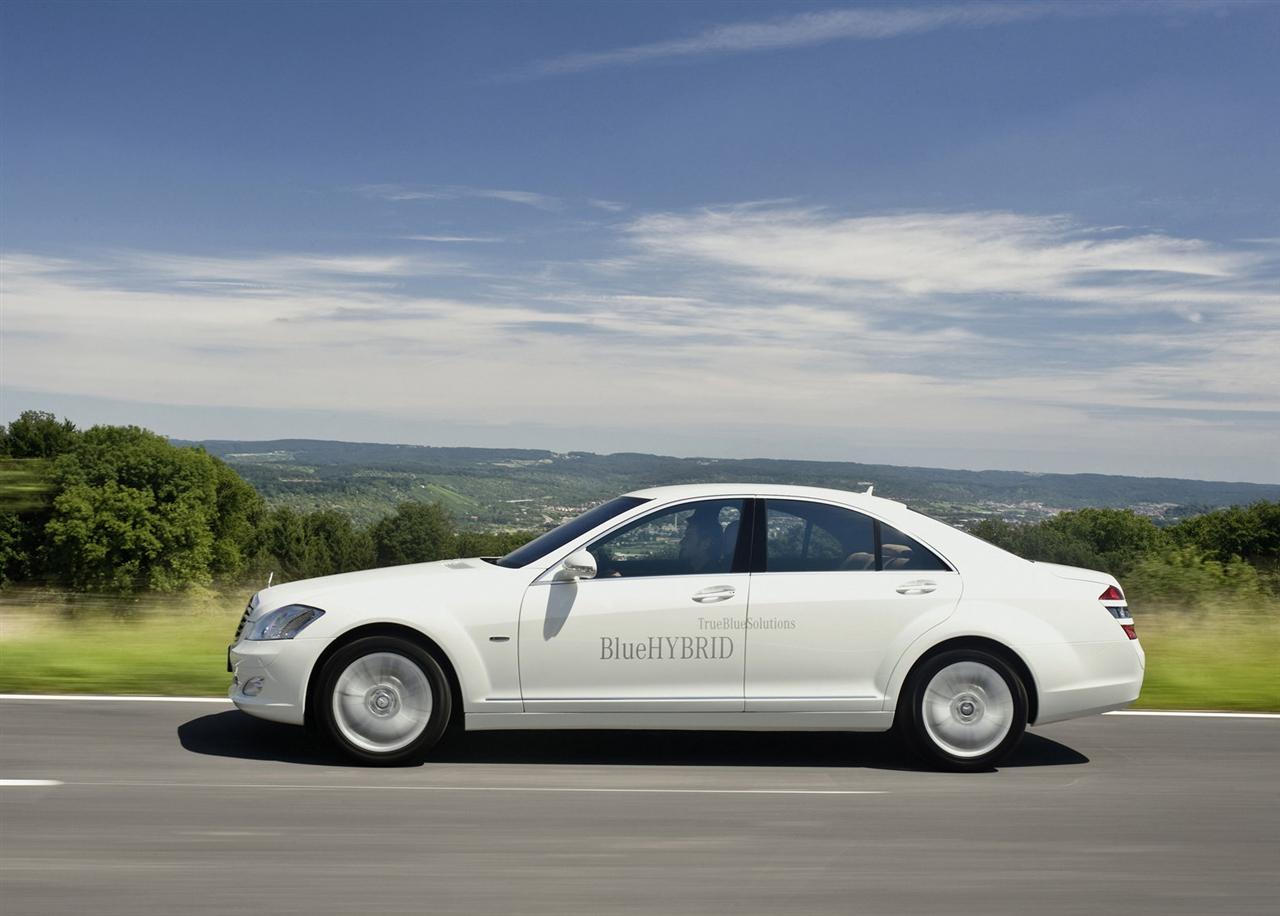
2010 Mercedes-Benz S400 BlueHYBRID
2010 Mercedes-Benz S400 BlueHYBRID Navigation
2010 Mercedes-Benz S400 BlueHYBRID Model Years
Mercedes-Benz S400 BlueHYBRID

Mercedes-Benz is launching its first passenger car model equipped with a hybrid drive system in summer 2009 - the Mercedes-Benz S400 BlueHYBRID. The combination of a modified V6 petrol engine and a compact hybrid module makes the Mercedes-Benz S400 BlueHYBRID the world's most economical luxury saloon with a spark-ignition engine. The NEDC combined fuel consumption is a mere 7.9 litres per 100 kilometres. This makes for the world's lowest CO2 emissions in this vehicle and performance class - just 190 grams per kilometre. These exemplary figures go hand in hand with assured performance. The 3.5-litre petrol engine develops an output of 205 kW/279 hp, the electric motor generates 15 kW/20 hp and a starting torque of 160 Nm. The result is a combined output of 220 kW/299 hp and a combined maximum torque of 385 newton metres. Moreover, the new Mercedes-Benz S400 BlueHYBRID is the first series-production model to be equipped with a particularly efficient lithium-ion battery specially developed for automotive use. This is another major contribution by Mercedes-Benz to the electrification of the car.The new Mercedes-Benz S400 BlueHYBRID is based on the S350, and features an extensively modified drive train. This encompasses a further development of the 3.5-litre V6 petrol engine, an additional magneto-electric motor, the 7G-TRONIC seven-speed automatic transmission specially configured for the hybrid module, the necessary operating and control electronics, the transformer and a high-voltage lithium-ion battery.The compact hybrid module is a disc-shaped electric motor that also acts as a starter and generator. The system offers a double benefit, as it both helps to save fuel and increases driving enjoyment. This is partly due to the booster effect of the electric motor, as it powerfully backs up the petrol engine with a maximum additional torque of 160 newton metres during the high-consumption acceleration phase. The driver benefits from the combined action of these two units in the form of even more impressive torque characteristics and smooth, effortlessly superior acceleration.The hybrid module also has a comfortable start/stop function, which switches the engine off when the vehicle is at a standstill - for example at traffic lights. When it's time to move off again, the electric motor almost imperceptibly restarts the main power unit. This likewise makes a contribution to fuel economy and environmental protection: because the engine restarts first time, and practically instantly, emissions are also minimised during the starting phase.When the vehicle is braked the electric motor acts as a generator, and is able to recover braking energy by a process known as recuperation. Working in finely tuned partnership, the electric motor supplements the braking effect of the petrol engine and the wheel brakes to deliver a smoothly progressive braking action. The recuperated energy is stored in a compact yet highly efficient lithium-ion battery in the engine compartment, and made available when required. This complex system is managed by a high-performance control unit, which is likewise located in the engine compartment.A milestone on the road to electrification
 The centrepiece of the modular, very compact and highly efficient hybrid drive system is the new high-voltage lithium-ion battery, which was specially developed for automotive use and is the first such unit worldwide to be introduced in a series-production vehicle. In this way Mercedes-Benz is making a trailblazing contribution to the electrification of the car, with the Mercedes-Benz S-Class once again playing the role of the technological trendsetter.Major advantages over conventional nickel/metal hydride batteries include a higher energy density and better electrical efficiency, together with more compact dimensions and a lower weight. Thanks to space-saving installation in the engine compartment, where it replaces the conventional starter battery, the generous interior space and boot capacity of the S400 remain unchanged. The lithium-ion battery not only stores energy for the electric motor, but is also connected to the 12-Volt onboard network via the transformer to supply power to other standard consumers such as the headlamps and comfort features. The completely newly designed battery system consists of the cell block with its lithium-ion cells and the cell monitoring system, the battery management function, the high-strength housing, the cooling gel, the cooling plate, the coolant feed and the high-voltage connector.Optimised thermal efficiency lowers the engine's fuel consumption
The 3.5-litre V6 petrol engine with variable valve control has been throughly re-engineered and improved. In the process the development engineers made use of the advantages offered by the Atkinson principle,where the expansion phase is longer than the compression phase. The intake valve is kept open slightly longer between the intake and compression phases, which improves the engine's thermal efficiency while reducing the specific fuel consumption and untreated emissions. A new cylinder head, different pistons and a modified camshaft with different camshaft control increase the output by 5 kW/7 hp to 205 kW/279 hp - while reducing fuel consumption at the same time.

The compact, disc-shaped electric motor, which is space-savingly installed in the torque converter housing between the engine and the 7G-TRONIC seven-speed automatic transmission, improves efficiency even further. This is a 3-phase AC external rotor magneto motor, which develops a peak output of 15 kW/20 hp and a starting torque of 160 newton metres with an operating voltage of 120 Volts.This compact motor also acts as a starter and generator, adopting the functions of both these conventional ancillary units.Sophisticated interaction with the internal combustion engine makes numerous additional functions possible that positively influence the emissions and agility of the Mercedes-Benz S400 BlueHYBRID in equal measure. Moreover, this disc-shaped motor effectively dampens torsional vibrations in the drive train, thereby further reducing noise and vibrations in the interior. The result is even more ride comfort for both driver and passengers.'Boost' effect for even more driving pleasure

The overall system offers extensive benefits: firstly by helping to save fuel, and secondly by increasing driving pleasure with the help of the 'boost' effect, where the electric motor gives powerful assistance to the petrol engine with its maximum torque of 160 newton metres right from the beginning of the fuel-intensive acceleration phase. This means that the hybrid drive system of the Mercedes-Benz S400 BlueHYBRID moves off powerfully even from very low engine speeds, as the torque curve impressively confirms. The additional torque of the hybrid module also has a consistently positive effect during subsequent acceleration phases. In all driving situations, the driver therefore benefits from the interaction between the two units in the form of powerful responsiveness and muscular torque - but without an increased fuel consumption.The Mercedes-Benz S400 BlueHYBRID accelerates from zero to 100 km/h in 7.2 seconds, and reaches an electronically governed top speed of 250 km/h. The Mercedes-Benz S400 BlueHYBRID betters the already very favourable NEDC fuel consumption of the conventionally powered S350 by up to 2.2 litres per 100 kilometres. CO2 emissions are reduced by 21 percent.The start/stop function already saves fuel when rolling to a stop
In addition the hybrid module features an extremely comfortable and efficient start/stop function, which already switches the engine off when the vehicle is rolling to a stop at less than 15 km/h, for example before stopping at traffic lights. When it's time to move off again, the electric motor immediately and imperceptibly restarts the main engine as soon as the driver releases the brake pedal or operates the accelerator. This likewise contributes to fuel economy and environmental conservation: as the engine restarts practically instantly, emissions are also minimised during the starting phase. The vibrations and jolts that are unavoidable when starting with a conventional starter are also reduced to a minimum.
When the vehicle is braked, the electric motor acts as a generator and uses a process known as recuperation to convert the kinetic energy into electrical energy. This energy is stored in the compact yet highly efficient lithium-ion battery, and made available when required.In the process the electric motor assists the engine braking effect of the internal combustion engine in two smooth, seamless stages: In stage one, on the overrun with no braking action, the electric motor acts as a generator and begins to recuperate energy. Stage two commences as soon as the driver lightly operates the brake pedal: the generator output is then increased proportionally, and perceived as heavier deceleration by the driver. Only when more brake pedal pressure is applied are the wheel brakes activated in addition to recuperation. In this way more electrical energy can be generated, while saving wear and tear on the hydraulic braking system at the same time. To make the best possible use of this double benefit, Mercedes engineers also developed a new braking system with a new brake pedal module for the Mercedes-Benz S400 BlueHYBRID.Cleverly located control electronics
Dedicated control electronics are required to operate the 3-phase AC electric motor in the 120-Volt high-voltage DC network. The current converter is accommodated in the space formerly occupied by the starter. As the control electronics heat up as a result of electric currents measuring up to 150 amps, the system is equipped with its own, additional low-temperature cooling circuit.Mercedes-Benz engineers have accommodated the transformer in the right front wheel arch, where it facilitates the exchange of energy between the 120-Volt high-voltage network and the 12-Volt onboard network - and also allows the option of emergency starting with jump leads if the standard battery should lose its charge. To ensure a consistently high level of electrical efficiency, the transformer is likewise cooled by a low-temperature circuit. The 12-Volt lead/acid battery is installed in the boot, and not only supplies the standard consumers but also the monitoring system for the high-voltage components with energy. Thanks to its interaction with the lithium-ion battery, it is considerably smaller in size and lighter than usual.Tried-and-tested automatic transmission with a new configuration
Mercedes-Benz developers also adapted the well-proven 7G-TRONIC automatic transmission to suit the hybrid drive, with newly programmed software for the transmission management system. A newly developed auxiliary oil pump ensures reliable lubrication of the transmission even during phases when the internal combustion engine is switched off.This complex system is managed by the modified high-performance engine control unit. This incorporates extensive functions, and distinguishes between operating conditions such as city traffic, rural journeys, motorway driving or slow manoeuvring.Hybrid status is shown in the instrument cluster
The driver is also able to monitor the status of the hybrid drive system visually. The instrument cluster has a separate, centrally positioned, display showing the energy flow during boost and recuperation phases, as well as the battery charge status.Seven-stage safety concept in addition to the Mercedes-Benz standard
As is usual at Mercedes-Benz, the development engineers gave safety aspects their very special attention. Know-how incorporated into the series-production car included long years of Daimler research experience with fuel-cell technology. The challenge lay in not only complying with all the worldwide and in-house legal crash test requirements, but also in ensuring the greatest possible safety for the electrical components. This safety system already applies in production, includes workshop personnel during servicing and maintenance, and also takes the emergency services into account when passengers need to be recovered following an accident.Accordingly the hybrid technology of the Mercedes-Benz S400 BlueHYBRID is equipped with an extensive 7-stage safety concept.• In the first stage all the wiring is colour-coded to eliminate confusion, and marked with safety instructions. This prevents assembly errors in production, and makes the regular quality checks easier to carry out.The second stage comprises comprehensive contact protection for the entire system by means of generous insulation and newly developed, dedicated connectors.
• As part of the third stage, the world's first lithium-ion battery to be used in a series-production model has been given a whole package of carefully coordinated safety measures. This innovative battery is accommodated in a high-strength steel housing, and also secured in place. Bedding the battery cells in a special gel effectively dampens any jolts and knocks. There is also a blow-off vent with a rupture disc and a separate cooling circuit. An internal electronic controller continuously monitors the safety requirements and immediately signals any malfunctions.• The fourth stage of the safety concept includes separation of the battery terminals, individual safety-wiring for all high-voltage components and continuous monitoring by multiple interlock switches. This means that all high-voltage components are connected by an electric loop. In the event of a malfunction the high-voltage system is automatically switched off.• Active discharging of the high-voltage system as soon as the ignition is switched to 'Off', or in the event of a malfunction, is part of the fifth stage.• During an accident, the high-voltage system is completely switched off within fractions of a second (stage six).• As the seventh and last stage, the system is continuously monitored for short circuits.Thanks to its compact dimensions and modular design, the additional weight of the overall system is only 75 kilograms - including the comprehensive safety systems. The superior driving experience for which a Mercedes is known is therefore ensured by this trailblazing and very versatile technology, which can be used for practically all Mercedes-Benz model series. Moreover, the payload remains unchanged at 595 kilograms.The intelligent high-performance engine management system responds very sensitively to different driving conditions, and optimally configures the drive system for the relevant application, ensuring that both fuel consumption and emissions are kept to the lowest possible level.At standstill the petrol engine is usually switched off, and therefore consumes no fuel. (concept carz) The electric drive of the refrigerant compressor and steering servo pump allows uninterrupted operation of the air conditioning and power steering. Comfort is in no way compromised, and is at the same high level as in all S-Class models.Moving off and acceleratingaway gently remains a smooth and comfortable procedure. A driver who kicks down the accelerator for a brisk start benefits from the boost function of the electric motor, which produces considerably more dynamic acceleration.At constant speedsthe intelligent electronics recognise situations such as relaxed motorway stretches, and automatically adjust the load point of the internal combustion engine to achieve a lower specific fuel consumption, thereby helping to save fuel and reduce emissions.When rolling to a stopthe recuperation function is activated as soon as the drive is interrupted in any way (foot off the accelerator, engine braking). Once the vehicle speed falls below 15 km/h, the petrol engine is automatically switched off.If the driver brakes using the brake pedal, the electric motor initially begins to convert the vehicle's kinetic energy into electrical energy. In this case the electric motor acts as a generator, storing the kinetic energy as electrical energy in the lithium-ion battery. This process feels like a stronger engine braking effect to the driver. The conventional disc brakes at the wheels are not yet employed, saving wear and tear. The disc brakes are only activated if the driver applies heavy pressure to the brake pedal, braking the car together with the engine brake and recuperation.Once the driver selects 'R' (reverse) in the 7G-TRONIC automatic transmission when manoeuvring, this automatically activates the Manoeuvring mode and prevents the start/stop function from switching off the engine at short, frequent intervals.The advantages of the hybrid drive system really come into their own in city traffic, with frequent stops at red traffic lights. Already switching off the petrol engine as the car frequently coasts to a stop significantly lowers the fuel consumption and emissions, while the long recuperation phases increase the battery charge. The electric motor ensures particularly comfortable and rapid restarting when the start/stop function is active.On rural roadsthere are frequent changes between boost, constant speed and recuperation phases. Depending on the nature of the route, large quantities of recuperation energy are available to reduce fuel consumption and emissions. The more braking and acceleration phases there are, the better: uphill and downhill gradients, as well as winding, dynamic stretches, make for the largest savings.The hybrid effect is inherently less important on motorways, however thanks to specific modifications to the V6 petrol engine and the 7G-TRONIC automatic transmission, the driver is also able to achieve significant fuel savings and correspondingly lower emissions on fast road stretches like these.The Mercedes-Benz S400 BlueHYBRID is produced at the Sindelfingenplant, together with the other S-Class models. The petrol engine, 7G-TRONIC automatic transmission and electric motor are first put together to form a hybrid module, then delivered to the production line as a unit. The market launch in western Europe is planned for June 2009; China is expected to follow in August 2009 and the ÚSA in September 2009.Modular technologies for the environmentally friendly future of the premium car
The new S400 BlueHYBRID exemplifies the strategy of Mercedes-Benz, whose declared aim is to offer the brand's customers economical and environmentally compatible premium cars - without compromising in terms of typical brand attributes such as safety, comfort and a superior driving experience.Major areas of development focus include modular drive technologies, which are used on a stand-alone basis or in combination depending on the vehicle class, operating profile and customer requirements - Mercedes-Benz has already described how this applies to the product portfolio in its 'Road to the Future'. In this context Mercedes-Benz also provides an outlook on the future of the internal combustion engine, with the innovative DIESOTTO engine in the Mercedes-Benz F700 research car.Source - Mercedes-Benz
The Mercedes Benz S Class: automobile comfort of the highest standard
The Mercedes Benz S Class: automobile comfort of the highest standard
S Class the epitome of automobile comfort Every generation of vehicles provides ground-breaking solutions to the expectations of customers with regard to comfortThe history of the Mercedes Benz S Class shows that automobile comfort is far more than just a luxurious ambiance, size and performance. In fact it is far more the intelligent support of the driver and passengers through in....
Continue Reading >>
Continue Reading >>
- 2010 Mercedes-Benz S400 BlueHYBRID Menu
- Article
- Image gallery
- Specifications
Mercedes-Benz
Similar Automakers


Recent Vehicle Additions


Performance and Specification Comparison
Related Automotive News

Sparking A Revolution – New Audi Plug-In Hybrid Models Built On Three Decades Of Expertise
Technology Insight
As Audi prepares to launch a range of new plug-in hybrid electric models in the UK, we take a look back at the companys first hybrid model, the 100 Avant quattro Duo of 1989
Audi Duo paved the way for hybrid technology t...

New Audi Q5 TFSi E Leads The Brand's Plug-In Hybrid Charge
Highly successful SUV now fitted with TFSI engine and powerful electric motor
Q5 55 TFSI e quattro develops 367PS system output and 500Nm of torque, from just 1,250rpm
Electric range of over 26 miles, with electric driving at up to 84mph
Ideal fo...

Honda Hybrid Performance Brings New Levels Of Refinement And Efficiency To All New CR-V
First time that a Honda SUV in Europe is available with hybrid technology
Honda Hybrid Performance system uses intelligent Multi-Mode Drive (i-MMD) technology to transition seamlessly between power sources
System combines two powerful electric mot...

Mitsubishi Outlander PHEV Offers The Best Of Both Worlds With EV Efficiency And Gas SUV Capabilities
Mitsubishi Motors 100 years of engineering prowess is put to work to create a vehicle that is both capable and environmentally friendly
Best-selling PHEV in Europe is now ready to take on the U.S. market starting MSRP of under %2435,000
HUNTING...

PORSCHE 918 SPYDER WOWS GOODWOOD
Innovative 887 hp plug-in hybrid super sports car makes public dynamic debut at Festival of Speed
Pedigree motorsport technology delivers maximum performance with minimum fuel consumption
Mid-mounted 4.6-litre V8 engine and two electric motors wit...