History
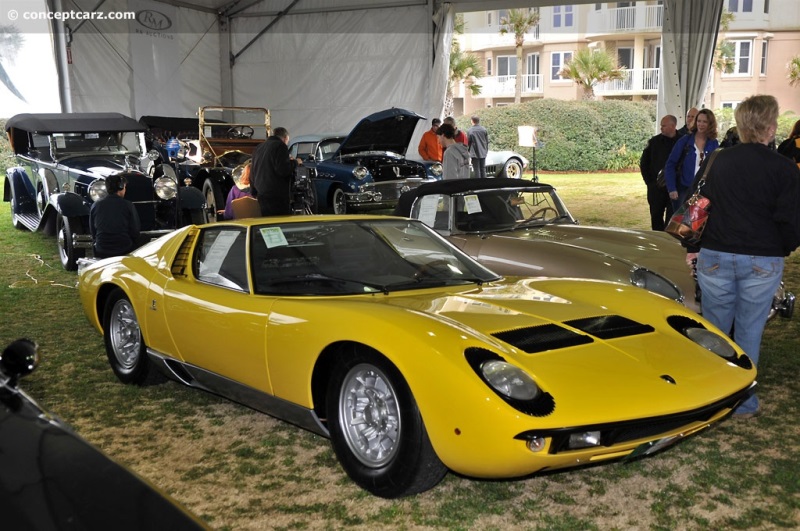
The Miura was first shown to the public at the November 1965 Turin Auto Show. At the time, it did not have a body. It was just a rolling-chassis. The design was mid-engined, very revolutionary at the time. Bertone was chosen to body the vehicle. Nuccio Bertone gave the project to Marcello Gandini. In early 1966 the Bertone body and the chassis designed by Giampaolo Dallara were assembled into one unit. In completed form, it was shown to the public at the 1966 Geneva Auto Show and dubbed the Miura. The name coming from a breed of Spanish fighting bulls.
The vehicle was instantly popular with demand overshadowing the supply. Ferruccio Lamborghini had originally planned the Miura to be a low production, flagship vehicle with production set to around 30 models. The demand for the vehicle eventually changed the plan for the vehicle and throughout its lifespan, three series of the Miura were produced, the P400, S, and the SV. Each series brought with it mechanical and aesthetical changes through either fixed problems from the prior series or brought about new developmental improvements.
The P400 was the first series, the 'P' stood for Posteriore, the location of the engine. The 400 represented the engine size of 4.0 liters. The four-liter engine was capable of producing 350 horsepower to the rear wheels. The spot-welded chassis was made from steel and the steering was a rack-and-pinion unit built and designed by Lamborghini. The front and rear hoods were both 'clamshell' design. There were two small compartments in the rear allowing a small amount of luggage or storage space.
Since the vehicle had been initially intended to be a temporary vehicle, it was poorly assembled and lacked quality. Another major problem was the lack of materials available. The builders of the vehicle rarely had the parts and resources they needed to keep up with demand. As time progressed, so did the quality.
Production began in March of 1967 and offered at a price of nearly $20,000 US dollars with 108 units being constructed. The Miura S series appeared in December of 1968. It was debuted to the public at the 1968 Turin Auto Show. The 'S' stood for 'Spinto' meaning 'Pushed' or 'Tuned'. Horsepower had been increased to 370, thanks in part to the use of a new combustion chamber and larger intakes. The later 'S' series models were given ventilated disc brakes and a modified rear suspension. Air conditioning was available for an extra cost.
In March of 1971, the final version of the Miura, the SV, was displayed at the Geneva Auto Show. The SV was the pinnacle of performance in regards to the Miura series. The rear suspension received modifications including a wider track. Wider tires were placed increasing the performance and handling. The headlights, turn signals, bumper, and tail lights received changes. A carburetor change and larger intakes brought the horsepower rating to 385. During its production lifespan, only 142 examples of the Miura SV were created. The acronym 'SV' represented 'Sprint Veloce'.
750 examples of the Miuras were built, the last being constructed on October 12, 1973. Production would have continued but Lamborghini was preparing to introduce its successor, the Countach. Since Lamborghini was a small shop, it could only handle the production of one model.
By Daniel Vaughan | Jun 2006
The vehicle was instantly popular with demand overshadowing the supply. Ferruccio Lamborghini had originally planned the Miura to be a low production, flagship vehicle with production set to around 30 models. The demand for the vehicle eventually changed the plan for the vehicle and throughout its lifespan, three series of the Miura were produced, the P400, S, and the SV. Each series brought with it mechanical and aesthetical changes through either fixed problems from the prior series or brought about new developmental improvements.
The P400 was the first series, the 'P' stood for Posteriore, the location of the engine. The 400 represented the engine size of 4.0 liters. The four-liter engine was capable of producing 350 horsepower to the rear wheels. The spot-welded chassis was made from steel and the steering was a rack-and-pinion unit built and designed by Lamborghini. The front and rear hoods were both 'clamshell' design. There were two small compartments in the rear allowing a small amount of luggage or storage space.
Since the vehicle had been initially intended to be a temporary vehicle, it was poorly assembled and lacked quality. Another major problem was the lack of materials available. The builders of the vehicle rarely had the parts and resources they needed to keep up with demand. As time progressed, so did the quality.
Production began in March of 1967 and offered at a price of nearly $20,000 US dollars with 108 units being constructed. The Miura S series appeared in December of 1968. It was debuted to the public at the 1968 Turin Auto Show. The 'S' stood for 'Spinto' meaning 'Pushed' or 'Tuned'. Horsepower had been increased to 370, thanks in part to the use of a new combustion chamber and larger intakes. The later 'S' series models were given ventilated disc brakes and a modified rear suspension. Air conditioning was available for an extra cost.
In March of 1971, the final version of the Miura, the SV, was displayed at the Geneva Auto Show. The SV was the pinnacle of performance in regards to the Miura series. The rear suspension received modifications including a wider track. Wider tires were placed increasing the performance and handling. The headlights, turn signals, bumper, and tail lights received changes. A carburetor change and larger intakes brought the horsepower rating to 385. During its production lifespan, only 142 examples of the Miura SV were created. The acronym 'SV' represented 'Sprint Veloce'.
750 examples of the Miuras were built, the last being constructed on October 12, 1973. Production would have continued but Lamborghini was preparing to introduce its successor, the Countach. Since Lamborghini was a small shop, it could only handle the production of one model.
By Daniel Vaughan | Jun 2006
Similar Vehicles
Similar Automakers


1967 Lamborghini Miura P400 Vehicle Profiles


Chassis #: 3057
Engine #: 1190


Recent Vehicle Additions


Performance and Specification Comparison
Miura P400 Specification Comparison by Year
Year
Production
Wheelbase
Engine
Prices
Related Automotive News

Lamborghini Celebrates The 50Th Anniversary Of The Jarama GT
This year marks the 50th Anniversary of the Lamborghini Jarama GT, presented for the first time at the Geneva Motor Show in March 1970.
The Jarama, whose name derives from an area north of Madrid famous for breeding fighting bulls, was the latest evolution...

The Best Of Lamborghini At London Concours 2020
The London Concours has announced its Great Marques Lamborghini display, celebrating the very best from SantAgata
Line-up includes icons early pioneers like the 400GT and iconic Miura, through to the Diablo SV, Murcielago and Aventador SVJ
Les...

Monterey Car Week. Promises Delivered.
BMW Unveils Production BMW M8 Coupe, M8 Convertible and M850i Gran Coupe.
North American Premieres of the BMW Vision M NEXT and Long Lost BMW Garmisch Recreation.
Pebble Beach, CA – August 15, 2019… On the occasion of the Monterey Car Week...

Lamborghini Miura Celebrated In A Dedicated Class At The 59Th Pebble Beach Concours d'Elegance
SantAgata Bolognese, 12 August 2019 – The Pebble Beach Concours dElegance, established in 1950, is the one of the most renowned classic car shows in the world, and every year the selection of cars for display is very severe, because only the...

THE LAMBORGHINI MIURA CELEBRATES ITS 50TH ANNIVERSARY ON THE ROADS OF 'THE ITALIAN JOB'
SantAgata Bolognese, 20 May 2016 - As part of celebrations commemorating the 50th anniversary of the Miura, Automobili Lamborghini has sent two Miuras from its Museum down the route used in the film, The Italian Job, directed by Peter Collinson....