1964 Studebaker Avanti
1964 Studebaker Avanti Navigation
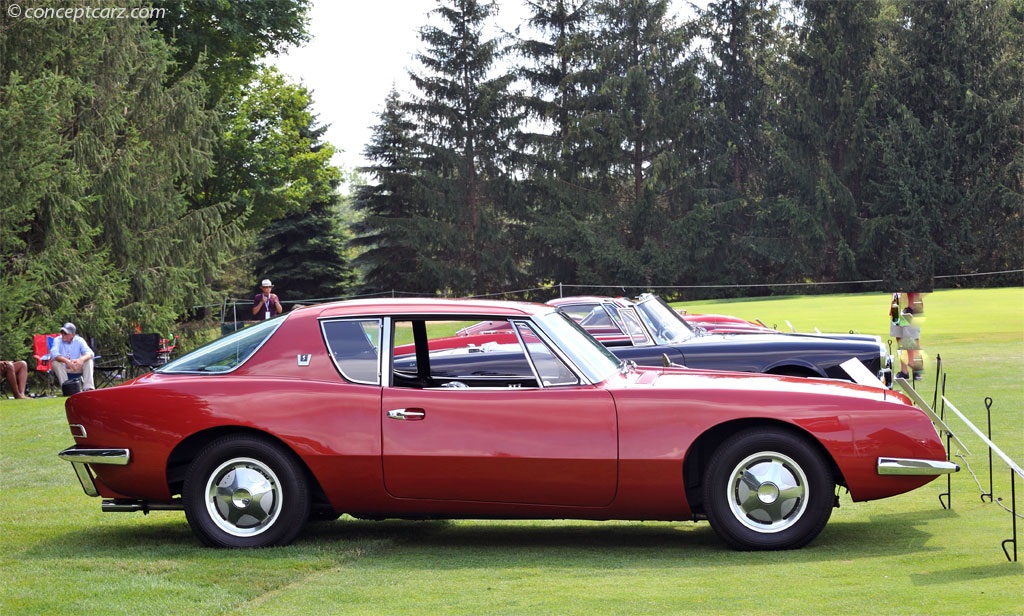
The Avanti was Studebaker's final attempt at rebuilding its corporate fortunes. As the 1950s were coming to a close, the Studebaker-Packard Corporation was reeling from decreasing automobile sales. Sherwood Egbert assumed the company's presidency in 1961 and immediately began work on two fronts, with Brooks Stevens commissioned to update the existing models, and Raymond Loewy Associates tasked with designing a sporty new Studebaker with style and performance. The new car was dubbed the Avanti, meaning 'Foward' in Italian. 
Sport Coupe
View info and historyRaymond Loewy's team included Tom Kellogg, Bob Andrews, and John Ebstein, and the entire design was created in a mere 40 days. The clay scale model was created in eight days, with one half being a four-seat GT coupe and the other side being a two-place sports car. The Avanti used a modified Studebaker Lark 109-inch convertible chassis, clothed in fiberglass bodywork, and powered by a modified 289 Hawk engine with an optional Paxton supercharger. The line of high-performance engine options, developed by famed racer and record holder Andy Granatelli, ranged from the 'R1' 289 CID V8 with 240 horsepower, the Paxton-supercharged 'R2' with 290 horsepower, the supercharged 'R3' with 335 horsepower, the twin-carbureted 'R4', and the twin-supercharged 'R5.' Granatelli proved the Avanti's capabilities, setting dozens of speed records at Bonneville in late 1962, including a 158.14-mph flying mile blast with a stock but carefully tuned R2 Avanti. In total, the Avanti would set 29 world speed records at the Bonneville Salt Flats. At the time of its introduction, the Avanti was the fastest production car in the world.The Bendix disc brakes were the first caliper discs in domestic production.
Sport Coupe
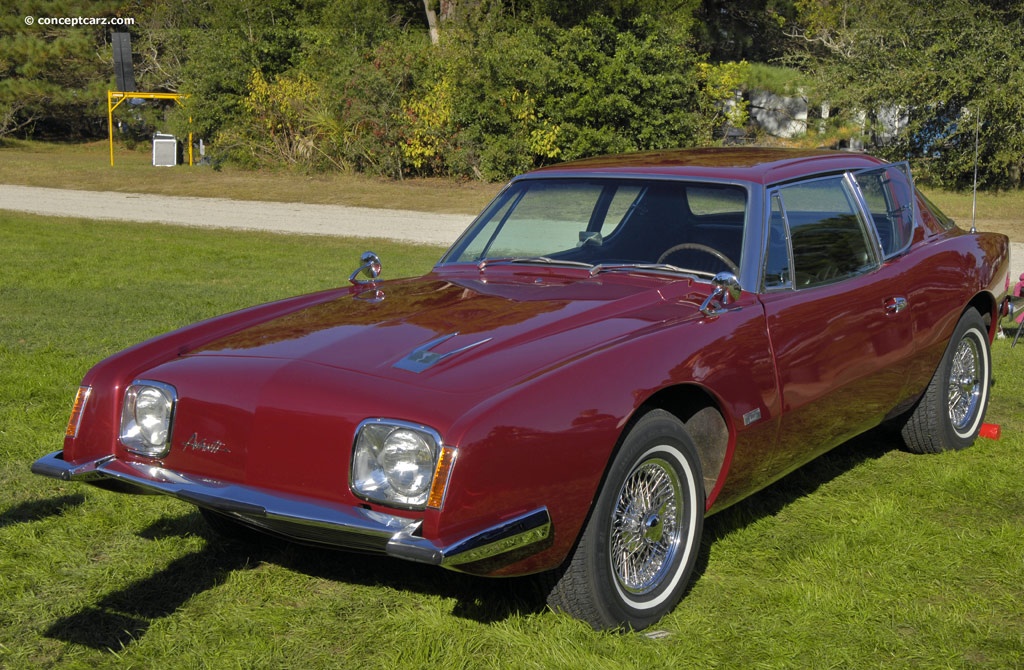
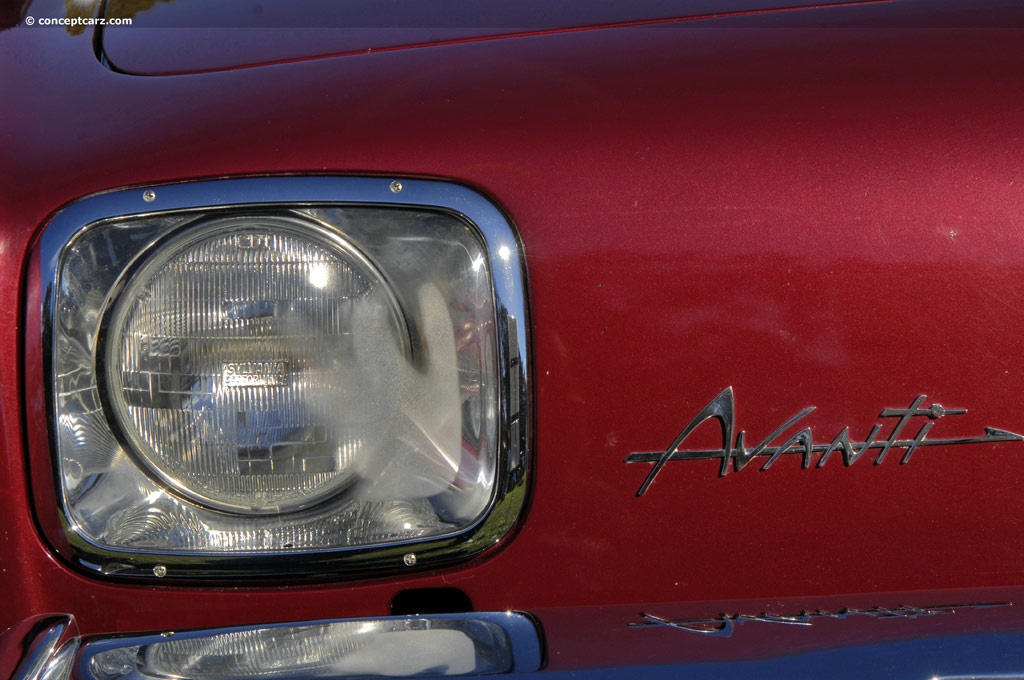
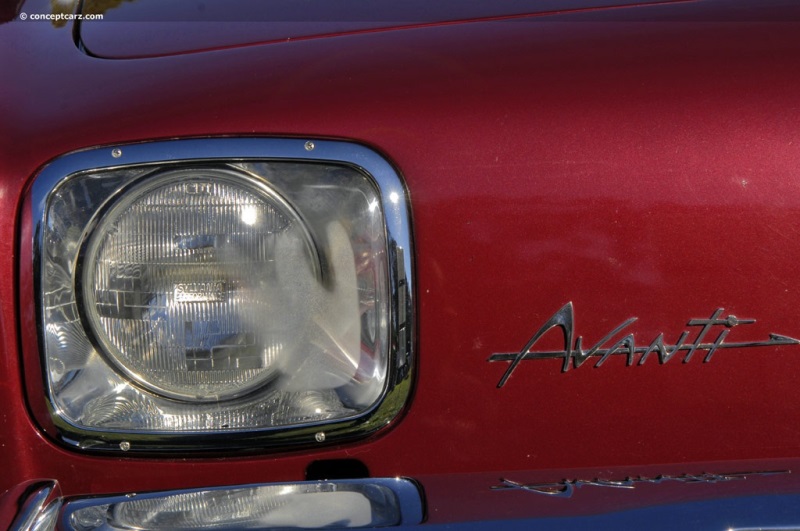
View info and historyStudebaker marketed the Avanti as 'America's only four-passenger high-performance personal car.' The front-engine, rear-wheel-drive, two-door coupe had a luxurious yet purposeful designed interior similar to that of an aircraft cockpit. The exterior styling was unique, particularly the nose, which was rendered completely without a conventional grille and taking its cooling air in through a wide, nearly hidden, gap under the bumper. The front fenders were distinctive blades extending well forward of the nose. The graceful curves and pronounced Coke bottle sweep of the overall design were complemented by the parabolic curves and shape of the wheel wells. In the back were dual exhausts with low-restriction mufflers. Introduced in 1962, Egbert estimated that approximately 20,000 examples would be sold in its inaugural year. However, sales fell far short of those estimates with approximately 1,200 units sold. The Avanti's lifespan was cut short by the closure of Studebaker's factory on December 20th, 1963. It is believed that 3,834 examples were sold in 1963 and 809 the following year.
by Daniel Vaughan | May 2021
Sport Coupe
View info and history
Sport Coupe
View info and history
by Daniel Vaughan | May 2021
Related Reading : Studebaker Avanti History
Studebaker came into existence in the very early 1800s when they specialized in making wagons for the Union Army during the Civil War. The company later switched over to producing automobiles and by the 1920s had built a reputation for making a fairly good car at a reasonable price. As the 1920s came to a close, the Great Depression, coupled with stiff competition, made business difficult for the....
Continue Reading >>
Continue Reading >>
Related Reading : Studebaker Avanti History
The Studebaker marquis had been in the business for over 100 years before the Avanti was debuted. In the mid-1950s the company lacked the economy of scale of the bigger U.S. automakers like General Motors and couldnt compete with their prices. They managed to tread water by producing compact economy Lark models that sold remarkably well for the times until 1961 when their volume fell by more than....
Continue Reading >>
Continue Reading >>
- 1964 Studebaker Avanti Menu
- Article
- Image gallery
- Valuation
- Specifications
- Profiles
- Production figures
Studebaker
Similarly Sized Vehicles
from 1964


1964 Studebaker Avanti Vehicle Profiles


Recent Vehicle Additions


Performance and Specification Comparison
Price Comparison
$1,935 - $2,525
$2,055 - $2,550
$2,071 - $2,960
$2,310 - $2,840
Avanti Specification Comparison by Year
Year
Production
Wheelbase
Engine
Prices
3,834
109.00 in.
8 cyl., 289.00 CID., 180.00hp
8 cyl., 289.00 CID., 240.00hp
8 cyl., 289.00 CID., 290.00hp
8 cyl., 289.00 CID., 240.00hp
8 cyl., 289.00 CID., 290.00hp
$4,440 - $4,440
Related Automotive News

Four wheel drive, done differently
Two unlikely machines, matched up in the dirt
Houston. Monster Jam® driver Linsey Read – who has been at the wheel of monster trucks for a decade as part of the Monster Jam series – invited experienced,...

Jay Kay's Cosmic Girls Lead Star Cars At Bonhams Bond Street Sale
Trio of Rare Supercars Offered from Jamiroquai Singers Collection
Jay Kay with his (L-R) 2016 Ferrari F12tdf Berlinetta,
1973 Porsche 911 Carrera RS 2.7-litre Lightweight and 2004 Porsche Carrera GT
A trio of rare and coveted motor cars...

'Hellephant' In The Room: Mopar Stampedes Into SEMA With 1,000-Horsepower 426 Crate Hemi® Engine
Hellephant 426 Supercharged Mopar Crate HEMI® Engine and Kit revealed during Mopar press briefing at 2018 SEMA Show in Las Vegas
Hellephant Mopar Crate Engine delivers mammoth numbers 1,000 horsepower and 950 lb.-ft. of torque
New 1,000-horse...

JOE MCMURREY COLLECTION TO HEADLINE DANA MECUM'S 29TH ORIGINAL SPRING CLASSIC
Rare Shelby 427 Cobra Roadster, GT350s and more head to Indianapolis, May 17-21
Walworth, Wis. – April 7, 2016 – An impressive array of 17 prized and desirable vehicles from the collection of noted Shelby aficionado Joe McMurrey of Longview,...

BENTLEY AT THE PALACE OF HOLYROODHOUSE CONCOURS OF ELEGANCE
Historical Bentleys star at prestigious Edinburgh event
1952 R-Type Continental, Blue Train and 8 Litre among line up
Bentley Sunday highlights best of British brands historic range
(Crewe, 31 August) Scotlands historical seat of pow...