1959 Huffaker BMC MK1
1959 Huffaker BMC MK1 Navigation
History
Joe Huffaker got his start in the automotive business creating racing specials and Formula Juniors, before moving into the competitive and exciting market of large displacement sports racing cars. The Formula Junior market had been a successful venture for Huffaker, but by the early 1960s, it had become too competitive, with new makes and models appearing very frequently. Huffaker left the diluted scene, which was becoming plagued by high costs, for something with slightly more cubic capacity.
Huffaker Engineering sold their Formula Junior race cars for around $4,500 which included an engine. The cost was lower if the buyer just wanted it without the engine, including just running gear, fiberglass body, ladder chassis, and suspension.
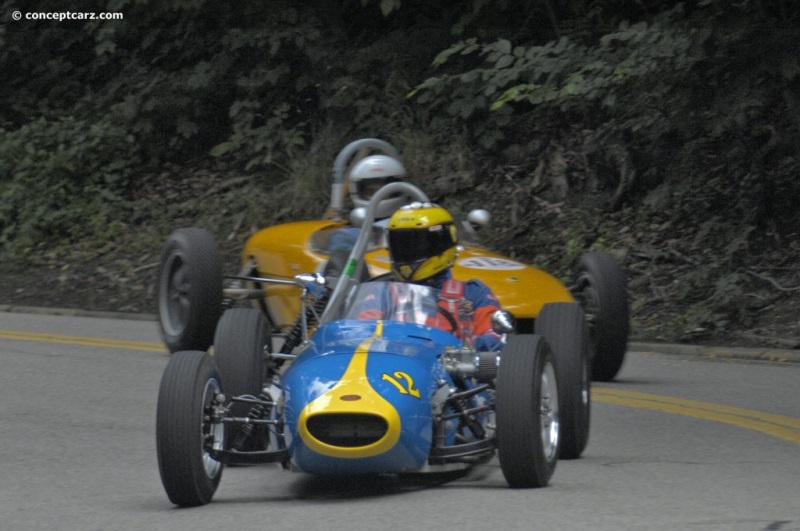
By the late 1950s, the front-engined design was being displaced for the more popular mid-engine setup. Those marque's that chose to keep the front-engined design soon found their cars running near the back of the pack. Huffaker's BMC FJ racers had the front-engine design and were dubbed the MKI. It had an engine that was mounted at a 35-degree angle and mated to a four-speed BMC gearbox. Drum brakes could be found at all four corners. The completed car weighed a mere 750lbs which made it too light to pass regulations. To comply with the rules, extra weight was added.
Power was from a modified Austin A-40 A-series engine that was given larger valves, modified cam and pistons, and a side-draft Weber carburetor. Horsepower was impressive at nearly 90 BHP from the small 980cc unit. With this finely tuned unit and experienced factory drivers, the BMC MKI earned nine first-place finishes and two seconds. Though this was extremely impressive, the fact that they had only three DNFs was a true testament to the car's stamina and durability.
By 1960, the mid-engine design made front-engined cars nearly obsolete. Huffaker responded to this new trend by creating the MKII. The MK2 had a wheelbase that measured 85 inches, a Volkswagen transaxle, and a coil-over suspension in both the front and rear. Drum brakes were at all four corners.
In competition, the MK2 was certainly fast and had track times better than the MKI. They could keep pace with the Lotus 18 but were soon overshadowed when Lotus unveiled their new car - the Lotus 20 in 1961. The Cooper MK2 cars were also quicker.
As a result, only 14 examples of the BMC MK2 were created plus a few kits. An MKII cost nearly $4,000 while the kit was priced at about $2,000.
The BMC MKII was powered by a new Formula Junior engine that displaced 1100cc and produced nearly 100 horsepower.
By Daniel Vaughan | Feb 2009
Huffaker Engineering sold their Formula Junior race cars for around $4,500 which included an engine. The cost was lower if the buyer just wanted it without the engine, including just running gear, fiberglass body, ladder chassis, and suspension.
By the late 1950s, the front-engined design was being displaced for the more popular mid-engine setup. Those marque's that chose to keep the front-engined design soon found their cars running near the back of the pack. Huffaker's BMC FJ racers had the front-engine design and were dubbed the MKI. It had an engine that was mounted at a 35-degree angle and mated to a four-speed BMC gearbox. Drum brakes could be found at all four corners. The completed car weighed a mere 750lbs which made it too light to pass regulations. To comply with the rules, extra weight was added.
Power was from a modified Austin A-40 A-series engine that was given larger valves, modified cam and pistons, and a side-draft Weber carburetor. Horsepower was impressive at nearly 90 BHP from the small 980cc unit. With this finely tuned unit and experienced factory drivers, the BMC MKI earned nine first-place finishes and two seconds. Though this was extremely impressive, the fact that they had only three DNFs was a true testament to the car's stamina and durability.
By 1960, the mid-engine design made front-engined cars nearly obsolete. Huffaker responded to this new trend by creating the MKII. The MK2 had a wheelbase that measured 85 inches, a Volkswagen transaxle, and a coil-over suspension in both the front and rear. Drum brakes were at all four corners.
In competition, the MK2 was certainly fast and had track times better than the MKI. They could keep pace with the Lotus 18 but were soon overshadowed when Lotus unveiled their new car - the Lotus 20 in 1961. The Cooper MK2 cars were also quicker.
As a result, only 14 examples of the BMC MK2 were created plus a few kits. An MKII cost nearly $4,000 while the kit was priced at about $2,000.
The BMC MKII was powered by a new Formula Junior engine that displaced 1100cc and produced nearly 100 horsepower.
By Daniel Vaughan | Feb 2009
- 1959 Huffaker BMC MK1 Menu
- Article
- Image gallery
- Specifications
- Profiles
- Production figures


1959 Huffaker BMC MK1 Vehicle Profiles
Recent Vehicle Additions


Related Automotive News

Official 2021 Rolex Monterey Motorsports Reunion poster pays tribute to Ford Trans-Am power
An event as special as the Rolex Monterey Motorsports Reunion deserves a poster fitting of its prestige. Luckily, California native Kelly Telfer is familiar with both WeatherTech Raceway Laguna Seca and Trans-Am era racers.
Telfer, a third-generation...

Rolex Monterey Motorsports Reunion and Ford Motor Company Celebrate Ford in Trans-Am
Featuring 55th Anniversary of the Pony Car Wars
The distinct unmuffled rumble of brute American muscle cars will be celebrated at the Rolex Monterey Motorsports Reunion August 12-15 as Ford Motor Company presents Ford in Trans-Am - a 55th Anniversary.
...

Mecum Reveals The Ken Miles Shelby GT350 R-Model For Indy This May
John Atzbach Collection Includes Shelbys, Lamborghinis and Thousands of Collectibles to be Offered at Dana Mecums 33rd Original Spring Classic
WALWORTH, Wis. – March 11, 2020 – The awe-inspiring collection of John Atzbach—highlighted...

Dream Car Saturday Ready to Launch at Russo and Steele's 15th Anniversary Scottsdale Auction Event!
Scottsdale, Arizona (January 17, 2015) – Following 2 great days of record attendance, stratospheric sell through and a world class seminar moderated by SEMA Hall of Fame member Wade Kawasaki and featuring an all-star panel of guest experts which...

Russo and Steele Collector Automobile Auctions Kicks Off 15th Anniversary with Eight Initial Offerings to Watch
Scottsdale, Arizona (December 1st, 2014) – For Enthusiasts – By Enthusiasts. ™ This is far more than a tagline at Russo and Steele Collector Automobile Auctions. Its a lifestyle, and we are gearing up to deliver that singular passion to the High...