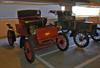
Oldsmobile introduced their Model 6C in April of 1904 and would remain in production until the end of the year. Its design was similar to the model it was replacing - the model R - but they were different in many details. The Model 6C was a little longer, had heavier running gear, and there were drum and hub brakes on the rear wheels. Even though it received new brakes, it did keep its brake in the rear axle differential housing. The car became stiffer and stronger, and the body was built entirely of wood. The paint was black with bright red trim. The standard body trim was a curved dash runabout with seating for two. The engine was a single-cylinder engine capable of producing seven horsepower. 
Standard RunaboutIn total, there were approximately 2500 examples of the Model 6C produced.
by Daniel Vaughan | Jun 2009

Standard Runabout
by Daniel Vaughan | Jun 2009
One of the first high-volume mass-produced automobiles, the Oldsmobile 6C, or the Curved Dash, was debuted by the Oldsmobile Company in 1901 and continued to be produced until 1907. During the initial year, a total of 425 units were produced, and approximately 2,500 in the year 1902 and more than 19,000 produced during the entire production run.
Standard RunaboutThe 6C was a runabout model that could fit two passengers and ran for around $650 in the US at the first production period. The 6C was priced fairly and competitively in comparison with the Ford. The Ford sold for around $850. Internally, the flat-mounted water-cooled single-cylinder engine was placed at the center of the vehicle and was capable of producing 4 hp meanwhile relying on a brass gravity-feed carburetor. A semi-automatic design, the transmission had two forward speeds and one reverse. An epicyclic, or planetary type was the low speed forward and reverse system. Utilizing Concord springs the 6C weighed around 850 lbs. The success of the Oldsmobile 6C or the Curved Dash came about quite incidentally. A fire actually completely destroyed a huge amount of models before in March of 1901 they had been approved for production, and the only model left intact was the Curved Dash. The losses at the Oldsmobile plant were valued at $72,000 (back then, a staggering amount) and included all of Ransom's prototypes except for a 'one-lung' single-seat runabout with an elegantly curved front in carriage parlance. The Oldsmobile Curved-Dash is famous for not only being the first best-selling American car of the 20th Century, while also being the vehicle responsible for saving its Company. 'Rescued' from the disastrous fire, Oldsmobile may not have continued on past 1902. The story behind the fire was that a worker risked his life to push this little vehicle out of the burning building. Additional research indicates that the Oldsmobile firm had already settled on this as the initial product and would have been able to construct it from detailed sketches that managed to survive the blaze.
Standard RunaboutThe Curved-Dash was absolutely everything 'horseless carriages' needed to be to remain and become a permanent part of history, versatile and reliable. The name 'Curved-Dash came from the very distinctive shape of the vehicle. In production by late 1901, the Curved-Dash became the first production Oldsmobile in Lansing. Very similar to other early century vehicles, the Oldsmobile Curved-dash runabout was simple, and 'cart-like-truly'; a carriage without the horse. The drive-train of the 6C followed that of Ransom's first gasoline vehicle except for a single-cylinder engine, and the side valves and water-cooling engine was found underneath a two-passenger buggy seat. Under the floorboard was a horizontal radiator and a food lever was provided for controlling speed. Dual batteries controlled the ignition system and it had a suggested lifetime of 3-4 months. 55-inch-wide tubular-steel axed supported the body with the 'at the time' customary wood and fabric construction. The steel was mounted 60 inches apart and was connected on each side by a long truss-shaped leaf spring flattened in the middle for attachment to a rectangular frame of channel-section steel. A tiller controlled the steering.
Standard RunaboutBraking on the Oldsmobile 6C was controlled by a foot pedal that caused a clutch band to grab a flange on the drive sprocket. Also in the mechanics of the vehicle, was an emergency brake, which was a drum on the transmission jackshaft acting directly on the rear axle. The wheels were 28-inch-diameter wire or wood-spoke units that mounted three-inch-wide tires. Curb weight came to a feathery 700 lbs with the four-gallon fuel and water reservoirs full.Most any blacksmith could repair the Curved-Dash quite simply and the car was able to withstand the rugged, rutted roads of early rural America. And with its affordable price-tag of $650, the Curved Dash easily found acceptance with consumers. For the 1902 model year, the Oldsmobile Curved-Dash sold enough units to claim the title as the 'best-selling vehicle in the nation's infant auto industry'. Additional features and accessories that were added to make the success of the Oldsmobile 6C were extras such as a rear-facing 'Dos-a-Dos' auxiliary seat for an additional $25, a folding top with a roll-up rear curtain in rubber for an additional $25, or leather for an additional $50 and a 'storm apron' which was not much more than a large, heavy blanket.By Jessica Donaldson
Standard Runabout

Standard Runabout

Standard Runabout
Similar Vehicles
Similarly Priced Vehicles


1904 Oldsmobile Model 6C Vehicle Profiles


Recent Vehicle Additions


Performance and Specification Comparison
Price Comparison
Related Automotive News

A (Silver) Ghost Story For Christmas
Whether youre a long-time classic car owner looking to add to your collection, are about to take your first steps into the joy of classic car ownership or are planning to delight someone by presenting them with their own piece of four-wheeled history...

Top Three Finalists In SEMA's 'Battle Of The Builders' Roll On Coker Tires
Las Vegas (November, 2017) – All three finalists in the fourth annual SEMA Battle of the Builders competition were equipped with period-correct tires made or distributed by Coker Tire, as the highly anticipated event reached its culmination...

COKER DOMINATES THE FIELD AT PEBBLE BEACH CONCOURS
Coker Tire-equipped classics took home Best of Show and 15 Best in Class wins out of 26 classes, with 77 out of the 110 cars in pre-war classes riding on Coker Tires, at the prestigious Pebble Beach Concours dElegance.
Chattanooga, Tenn....
2015 Fall Carlisle Auction Preview
Carlisle Auctions Returns for its Annual Fall Carlisle Offering 2015 Two-Day Event Features Classics of all Eras
CARLISLE, PA – Success! What Carlisle Auctions has done since its inception in the fall of 2012 can be summed up with that...

Rolex Monterey Motorsports Reunion : A Brilliant Finish
There are times to spectate and there are times to roll up ones sleeves and participate. At the Rolex Monterey Motorsports Reunion this year, both options brought abundant joy, as more than 550 authentic and historic race cars from nearly every decade...