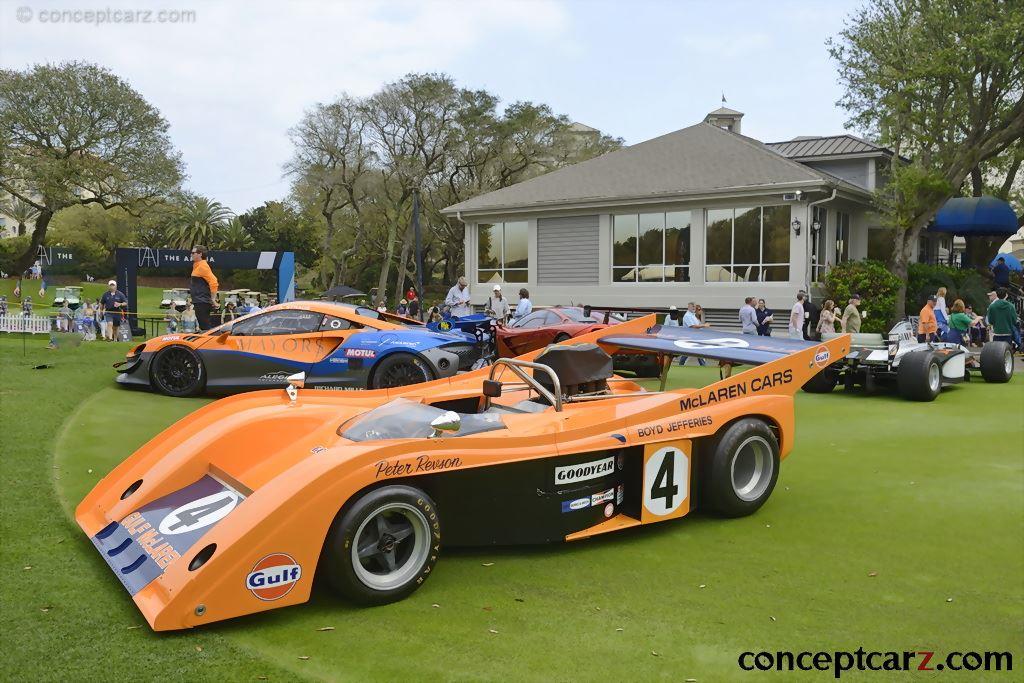
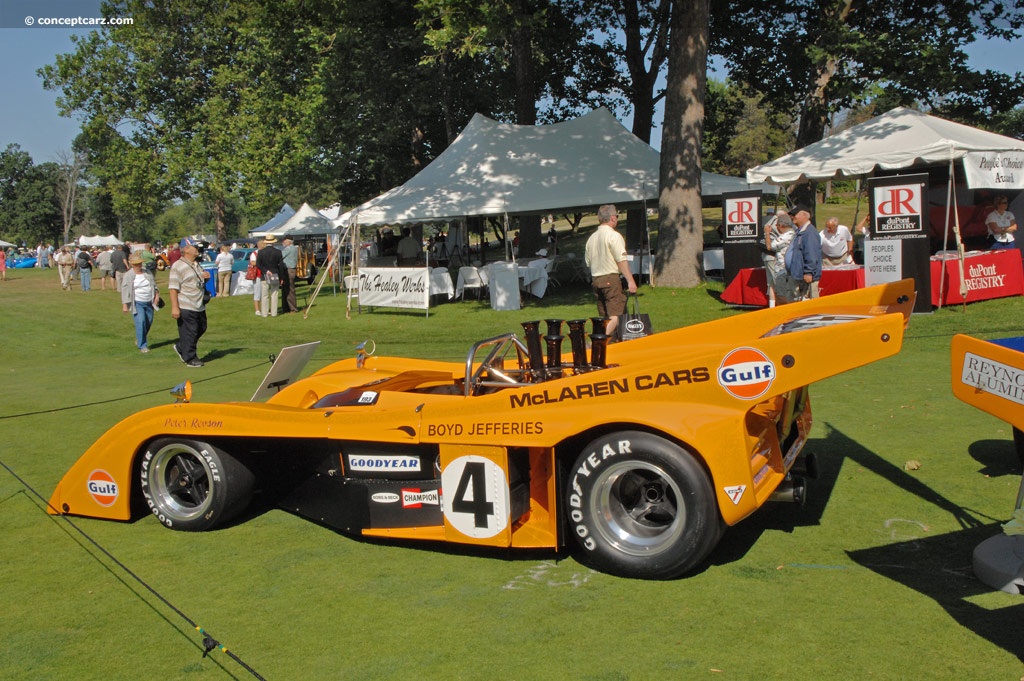
A sports prototype, the McLaren M20 was developed by McLaren for the 1972 season of the Canadian-American Challenge Cup. The M20 Can-Am was constructed around the 'coke bottle' platform with a very low polar movement chassis while the vehicle's mass was concentrated within the wheelbase. The body was constructed of McLaren fiberglass while the engine was an 8.1-liter Chevrolet V8 fuel injected semi-stressed, steadied on the rear of the tub. The 100-inch wheelbase extended 2 inches from the M8F specifications.
Chassis #: M20-1
View info and history
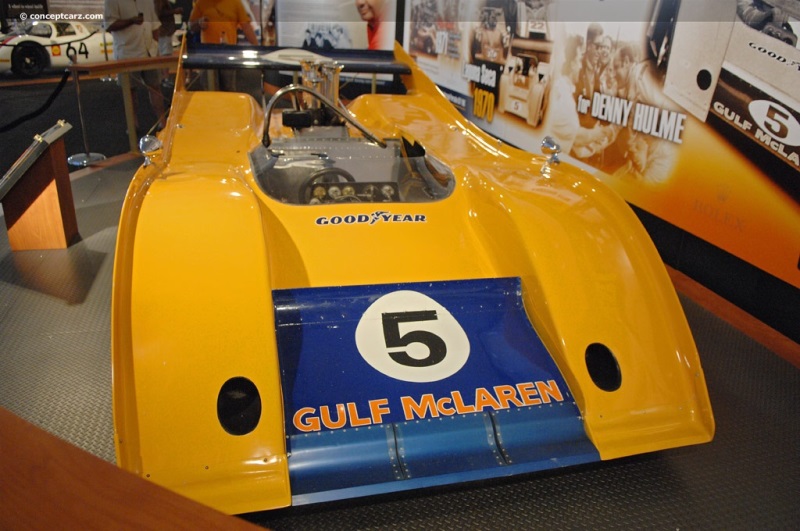
Auction entries : 1The McLaren M20 served as a replacement for the team's 1971 M8Fs though it later became the last Can-Am design created by McLaren before the team left the series after failing to secure the 1972 championship title. One of the team's primary goals when designing the replacement for the M8Fs was to improve the cooling structure of the vehicles in order to give their racers more comfort during the races. Much like earlier McLaren sports vehicles, the M8F featured a larger radiator that was mounted in the front of the car where the air was drawn from openings in the nose and exited upwards over the open cockpit. The designers, Tyler Alexander and Gordon Coppuck came up with a solution to this heat problem which utilized two radiators, one each mounted on either side of the cockpit and drew air from the side of the bodywork. Decreasing fatigue on the drivers, hot air that exited the radiator no longer passed over the cockpit. McLaren's designers were not free to redesign the nose for better aerodynamic efficiency with the radiator that was no longer found in the nose of the vehicle. Increasing the downforce on the front end of the vehicle resulted in the addition of an adjustable airfoil between the front wheel fenders which led to increased grip while cornering. The fuel tanks were also redesigned inside the car to make room for the new radiator design. Designed to flow from the outward tanks into the central tank to that fuel burned off during the race and didn't affect the weight distribution of the vehicle, the new tanks for the M20 were compacted around the cockpit.
Chassis #: M20-1
View info and history
Auction entries : 1The McLaren designers once again used a Chevrolet V8 engine which increased in displacement to 509 cubic inches and produced approximately 750 hp. The engine was mated to a Hewland Mk II gearbox that was mounted behind the engine rather than between the engine and cockpit as competitors Alfa Romeo and Porsche used. Similar to the M8F, the bodywork was fiberglass and was joined to the aluminum chassis which maintained the 'Coke bottle' design but with the addition of ducting on the side to feed the radiators. The brakes of the M20 were developed in conjunction with Lockheed. Grooves were machined into the discs to prevent out-gassing and improved on the recently cross-drilled brakes from the earlier season. Goodyear continued on as the team's official tire supplier. Until the Can-Am championship was canceled at the end of the 1974 season, M20s continued to be entered by private teams. During the 1972 season, McLaren driver Denny Hulme won two races while Scooter Patrick won a single event in 1974 with a privately entered M20. At Mosport Park, the two new McLaren M20s debuted during the inaugural round of the 1972 season. Denny Hulme did achieve victory with the #5 entry following minor tire difficulties but it did beat Porsche's all-new turbocharged 917/10. More problems appeared at Road Atlanta and aerodynamics led to Hulme's vehicle becoming airborne and flipping while following too closely behind one of the Porsches. Hulme's vehicle was completely destroyed and was replaced by the third M20. Denny was quickly able to recover from the wreck and earned his second victory of the season at Watkins Glen International, followed immediately by Revson in the other McLaren M20. Helped out by rain on the race day, Porsche earned their second victory in the following round.McLaren held little hope of the 1972 championship as a variety of mechanical problems, due to the Chevy engine, left them unable to finish several events. Hulme earned two second-place finishes as Edmonton and Riverside, but unfortunately, it wasn't a match for Penske-Porsche driver George Follmer. Able to maintain second place over the troubled season, Hulme only earned half the points total that Follmer received, while Revson was classified sixth in the standings.
Chassis #: M20-1
View info and history
Auction entries : 1For the first time since 1966, the Can-Am Championship was not secured and the team owner Teddy Mayer chose instead to concentrate the company on Formula One and USAC IndyCars, leaving the Can-Am Series behind.A total of three M20s were produced in 1972 by McLaren. Unfortunately, unlike earlier McLarens, no customer variants were ever developed for private teams prior to McLaren leaving the Can-Am series. All three M20s including Hulme's rebuilt vehicle were sold to separate teams after McLaren had no more use for the M20s. One of these cars was purchased for driver David Hobbs by Roy Woods Racing to continue campaigning in Can-Am, meanwhile, Fred Corbett purchased a vehicle originally for Mario Andretti who eventually was replaced by John Cannon. To better compete with Porsche's 917/30, Corbett's M20 was modified to add a turbocharger. The third McLaren M20 was sold to the German Felder Racing Team for driver Helmut Kelleners who utilized it in the European Interserie championship.By Jessica Donaldson
Chassis #: M20-1
View info and history
Auction entries : 1

Chassis #: M20-1
View info and history
Auction entries : 1
Chassis #: M20-1
View info and history
Auction entries : 1


1972 McLaren M20 Vehicle Profiles
Designer: Gordon Cuppock
Chassis #: M20-2

Designer: Gordon Cuppock
Chassis #: M20-1
Recent Vehicle Additions


Related Automotive News

Can-Am History Roars Back to Life at Spring Classic May 19-21
The Can-Am Series made its last appearance at Mazda Raceway Laguna Seca at the 1973 Monterey Grand Prix. Vic Elford (10) in the UOP Shadow was chased through the Corkscrew by winner Mark Donohue (6) in the dominant Sunoco Porsche 91730.
MONTEREY,...

JOHN SURTEES CBE ANNOUNCES AUCTION LOTS FOR THE 2016 HENRY SURTEES FOUNDATION TEAM KARTING CHALLENGE
Tuesday 5 July 2016 – Mercedes-Benz World Circuit, Brooklands
Team entries are shaping up well for the hotly contested Henry Surtees Foundation Team Karting Challenge, which will take place on Tuesday 5 July 2016. The event organised by John S...
RRDC Evening with George Follmer a Highlight of Long Beach Grand Prix
LONG BEACH, Calif. (April 15, 2016) - On April 14, in front of a capacity crowd of auto racing dignitaries, corporate executives and champion race-car drivers, Can-Am, USRRC and Trans-Am champion George Follmer was honored by the Road Racing Drivers...

Golden Years of Can-Am Racing Showcased at 2016 Rolex Monterey Motorsports Reunion
MONTEREY, Calif. March 9, 2016 — Known for its excess is barely adequate reputation, the Can-Am Series was known for its free-wheeling rule interpretations that brought experiments such as big wings, two engines, ground effects, perfecting turbocharging...
RRDC VOTES IN 37 NEW MEMBERS FOR 2013
HILLIARD, Ohio (Nov. 7, 2013) - Thirty-seven race-car drivers and motorsports professionals have been voted into the Road Racing Drivers Club in 2013. The group includes 13 Regular Members from the open-wheel and sports-car racing ranks, 20 Associate...


