1956 Eldorado Brougham Concept | 1956 Eldorado Seville Prototype | 1958 Series 70 Eldorado Brougham ![]() | 1958 Eldorado Biarritz Concept ![]() |
1957 Cadillac Series 70 Eldorado Brougham news, pictures, and information | ||
| Tweet | ||
![]() | ![]() |
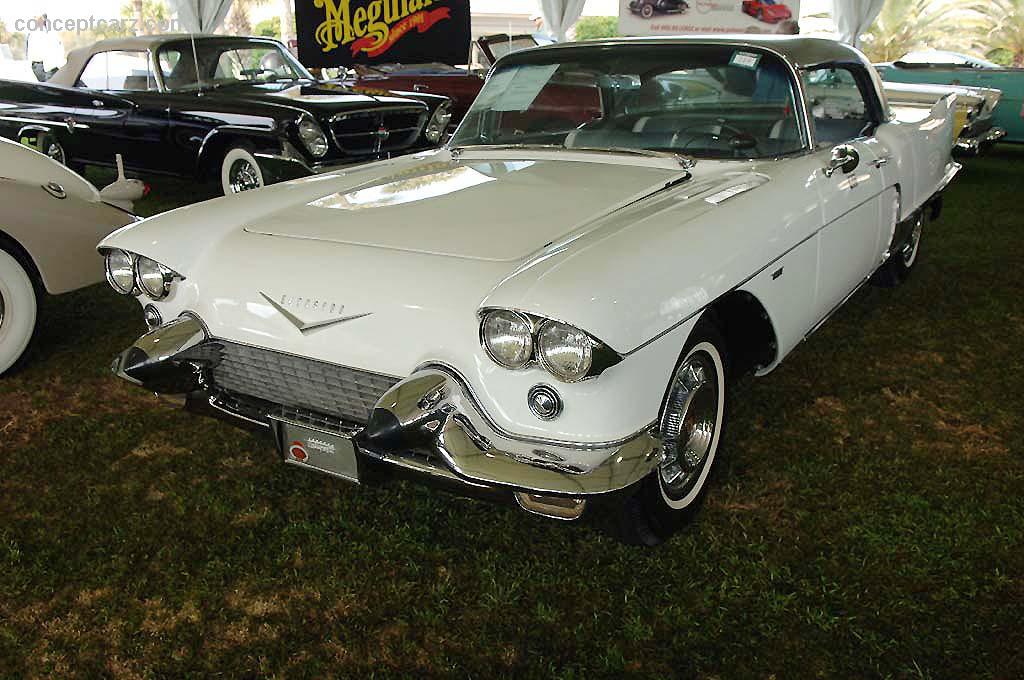
This car was number 107 of 400 built in 1957. It sold for $13,074.
It had a 325 horsepower engine with 2 four-barrel carbs. It came with a stainless steel roof, chrome plated aluminum bumpers and was the first production car with quad headlamps.
![]() | ![]() | ![]() | Hardtop Sedan Chassis Num: 5770121759 |
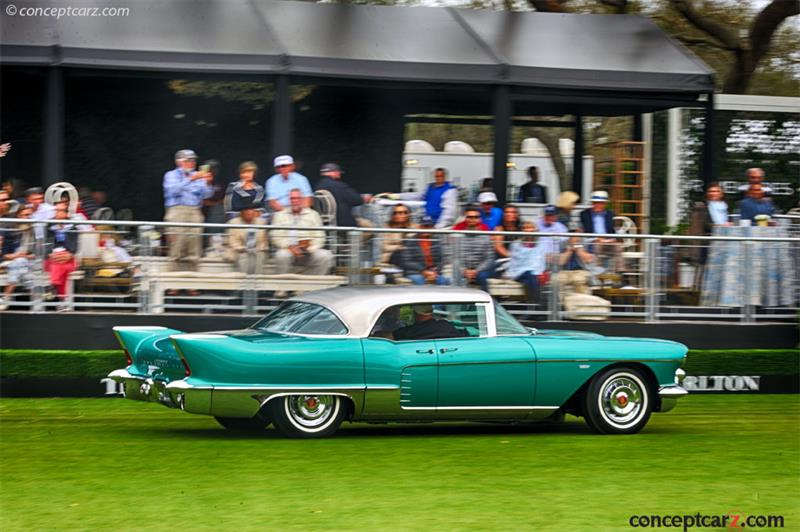
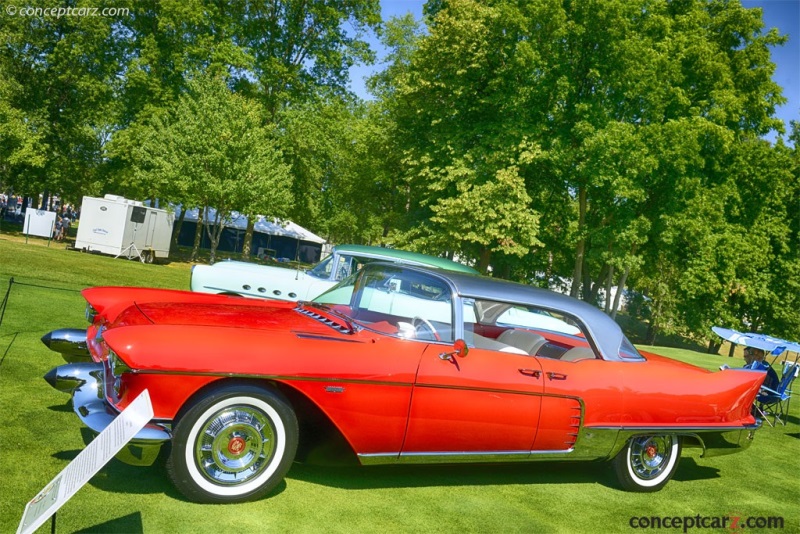
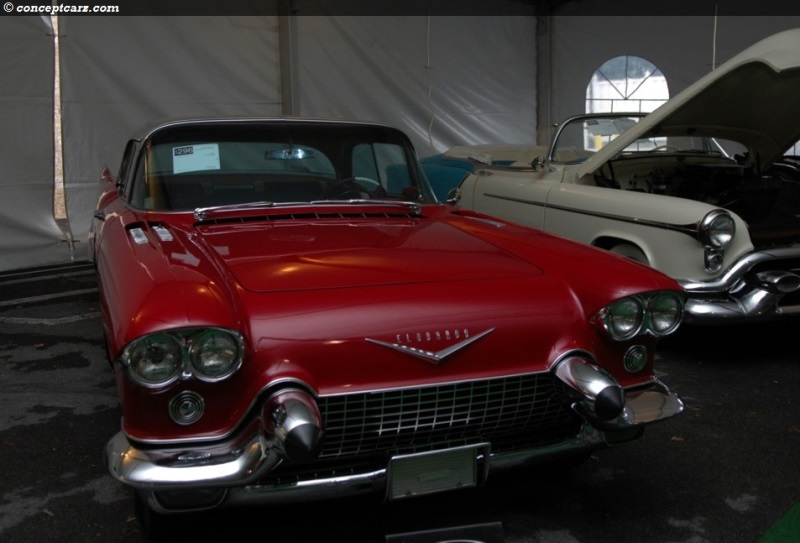
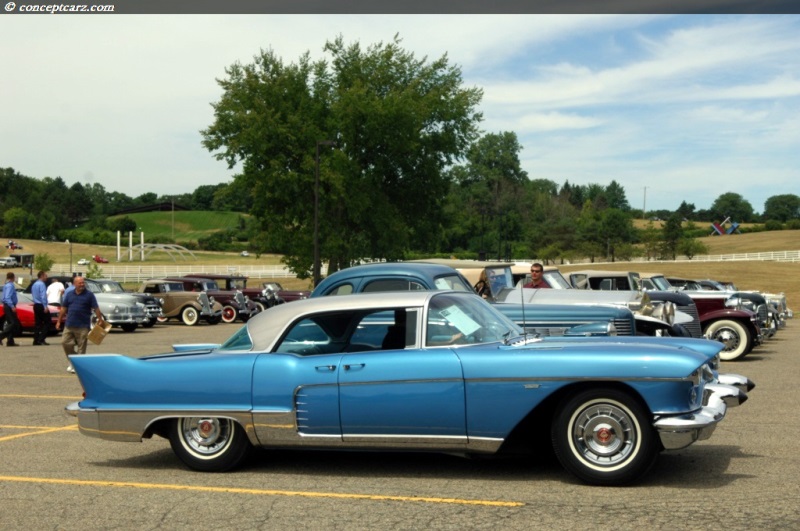
There were a total of 905 Eldorado Broughams constructed between 1957 through 1960. The design was inspired by the Eldorado Brougham of 1955 and constructed as an ultra-luxury automobile. When new, the vehicle would set the buyer back $13,000 which was a rather sizable price tag at the time.
There were four doors and a pillar-less stainless steel hard top. The list of standard equipment included air conditioning, E-Z Eye tinted windshield, automatic headlight dimmer, and multiple power accessories. One of the big features that improved the vehicles ride was the air ride suspension. This kept the car level regardless of the road conditions or the load being carried in the vehicle. The system was not without its growing pains; it was expensive to produce and maintain. It was discontinued after the 1960 model year.
This example is finished in white with black, white and gray interior. The odometer reads just 30,000 miles since new. It was awarded its Junior and Senior Award status by the AACA. The air ride suspension has been removed and replaced with a conventional and period correct suspension system.
At auction, bidding reached $125,000 but failed to satisfy the reserve. The car was left unsold.
By Daniel Vaughan | Apr 2007
![]() | ![]() | ![]() | Hardtop Sedan Chassis Num: 5770058691 |
| Sold for $115,500 at 2007 RM Auctions. | |||
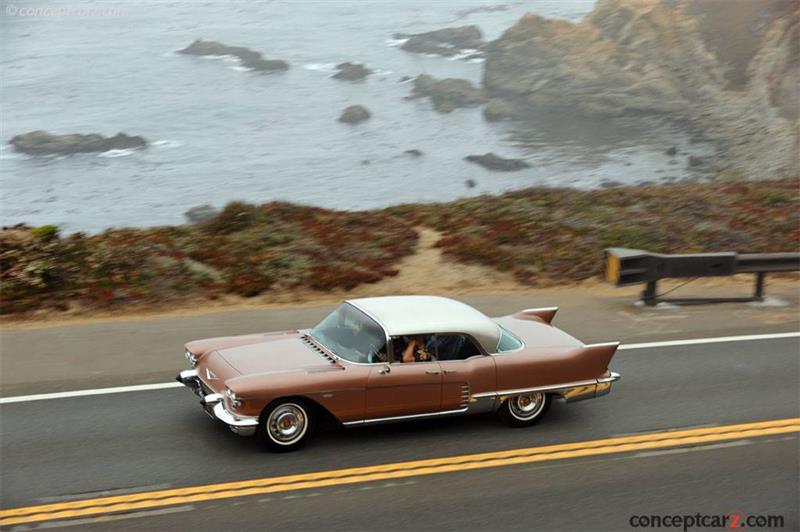
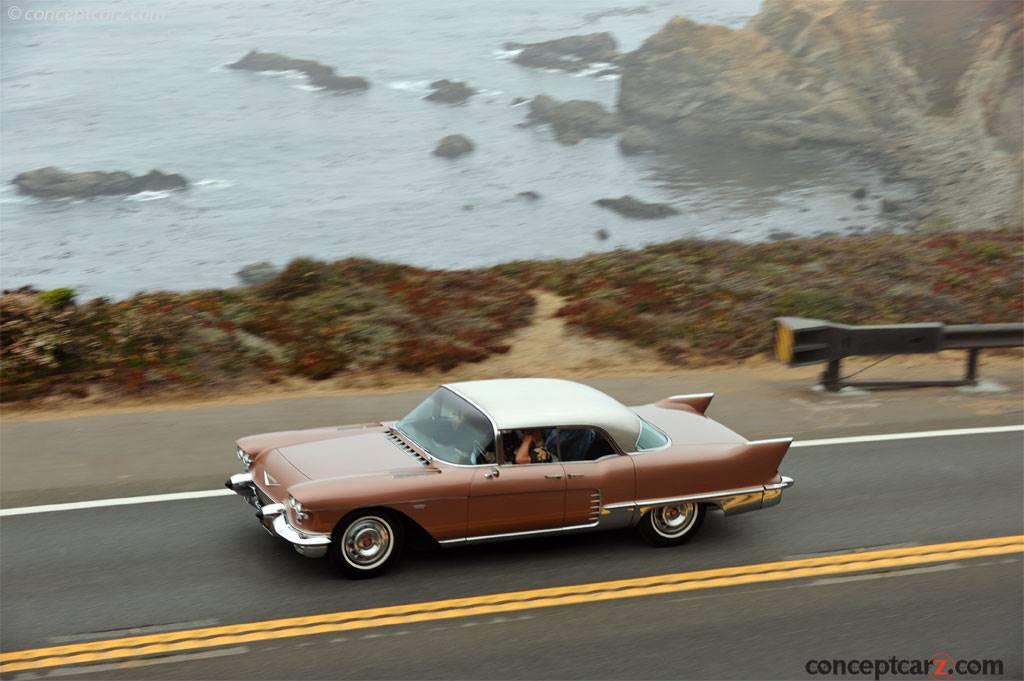
The Eldorado Broughams were the pinnacle of American design and luxury and commanded a price tag of over $13,000. The designs featured a four-door pillar less setup with a brushed stainless steel roof. The interior featured a bar and vanity set and outfitted with the finest materials available. Standard equipment included air-conditioning, an E-Z Eye tinted windshield, automatic headlight dimmer, and numerous power-operated accessories. The Eldorado Brougham also introduced air ride suspension to the Cadillac marque.
This example has an odometer that read 76,000 miles and has recently undergone a mechanical and cosmetic restoration. The car was stripped and repainted and the interior was correctly reupholstered in blue cloth with blue leather. It is equipped with power steering, power brakes, power windows, power locks and air conditioning, among other items.
This car was expected to sell for $120,000 - $140,000. Those figures were nearly achieved as the bidding reached $115,500 and the car was sold.
By Daniel Vaughan | Aug 2007
![]() | Hardtop Sedan Chassis Num: 5770096914 | |
| Sold for $110,000 at 2007 RM Auctions. Sold for $115,500 at 2010 Gooding & Company. | ||
This particular example has an older restoration that has been refreshed and fully serviced. The chrome shows well and the brushed stainless steel roof is in excellent condition. It was offered for sale at the Vintage Motor Cars sale at Hershey, PA presented by RM Auctions. It was estimated to sell for $100,000 - $150,000. The lot was sold for $110,000 including buyer's premium.
It has an overhead valve eight-cylinder engine and a four-speed Hydramatic transmission. There are servo-assisted four-wheel hydraulic drum rakes. The paintwork is maroon and white with a leather interior. There are wool carpets and a leather dashboard.
By Daniel Vaughan | Dec 2007
![]() | ![]() | ![]() | Hardtop Sedan |
The Eldorado Brougham was a very stately and luxurious car that featured a stainless steel roof, air suspension, and the first memory power seats and every other convenience and comfort feature GM used at the time. Power was from a V8 engine that offered 310 horsepower.
This example is believed to have been originally bought by a member of the Rockefeller family. The original owner had the roof converted into a town car. The current owner purchased the car in 1968 and had the paint and upholstery restored in 1998. The 2009 Meadow Brook Concours d'Elegance was the first time the car was shown at a Concours.
![]() | Hardtop Sedan Chassis Num: 5770092463 | |
| Sold for $77,500 at 2011 RM Auctions. | ||
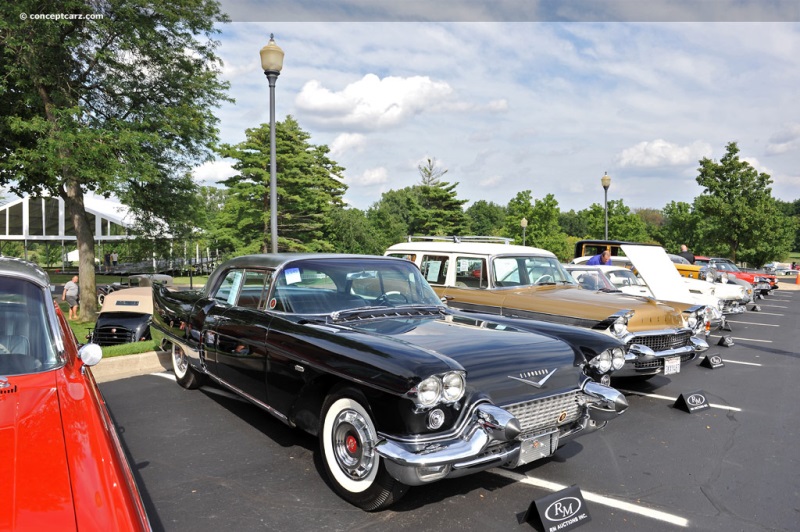
This Eldorado Brougham is an elegant Ebony over black leather combination example riding on period-correct whitewall tires. It benefits from a recent restoration and has been well maintained throughout its life.
In 2011, the car was offered for sale at the St. John auction presented by RM Auctions. It was estimated to sell for $90,000 - $120,000. As bidding came to a close, the car had been sold for the sum of $77,500, including buyer's premium.
By Daniel Vaughan | Oct 2011
The Eldorado was a word with many meanings. It was chosen as the name to adore an upscale car that was built by Cadillac to celebrate its Golden Anniversary in 1952. Mary-Ann Zukosky, a secretary in the merchandising department, participated in a in-house competition and suggested the name. Eldorado was derived from the Spanish words 'el dorado' meaning 'golden one'. The name had first been used by the chief of a South American Indian tribe. The story was that his followers and tribe would sprinkle his body with gold dust on ceremonial occasions. He would later cleanse himself by diving into a lake.
Another story states the name represents a legendary but undiscovered city in South America filled with riches. Many European adventurers have long sought for this city including England's Sir Walter Raleigh.
'Palm Spring Life' magazine claimed the name Eldorado was derived from a Californian resort that was frequently visited by General Motors executives. The name of the resort located in Coachella Valley was the Eldorado Country Club.
In respects to the automobile built by General Motors, the Eldorado name was first used in 1953 and given to a limited-edition, low production, convertible and would continue to be used for many years. The original Eldorado was indeed a limited-production vehicle with only 532 examples created. The year prior, GM had shown the 'El Dorado' concept car in celebration of its 50 year anniversary. The Eldorado was the production version of this concept. It was based on the Series 62 and carried no special badging except a golden nameplate 'Eldorado' could be found in the center of the dash.
The convertible tops were available in black or white while the rest of the body could be ordered in one of four colors that included Azure Blue, Artisan Ochre, Alpine White, and Aztec Red. It carried a factory sticker price of $7,750 which was nearly twice as expensive as the vehicle it had been based, the Series 62.
The styling was influenced by the legendary Harley Earl who championed the wraparound windshield design along with other unique and stylish features.
The following year the Eldorado lost much of its unique qualities as it began sharing its body with other standard Cadillac's. This standardization allowed for lower, more cost effective pricing.
For 1955 the Eldorado continued to grow in bold features and radical designs. Tailfins could now be found in the rear giving the impression the car was in motion or pointing forward, even at a stand still. The following year Cadillac introduced the Eldorado Seville, a two-door hardtop coupe version.
One of the most memorable and sought-after designs of the Eldorado appeared in 1957, the Eldorado Brougham. At a price of over $13,000, the Brougham brought ulta-luxury and four doors. Event at this high price, it is estimated that GM lost over $10,000 on each of these hand assembled masterpieces. It cost more than most luxury marque models such as Rolls-Royce. The hardtop roof was stainless steel and it included almost every convenience option offered by General Motors, including dual headlights and air suspension. During its two year production run, only 704 examples were produced.
1957 also saw a new rear-end design on the Eldorado, often referred to as the 'chipmunk cheeks.' Little changed in 1958 and in 1959 Cadillac scaled back on the design. Though it was a couple years older its price remained relatively the same, selling at around $13,075. The assembly was handled by the famous Italian coachbuilder, Pinin Farina. These virtually hand-built machines had large fins, 'rocket-ship' taillights, and a very modern design for its era.
1960 was the last year Cadillac built the Seville version. GM made the Eldorado a trim option on the standard Cadillac convertible which would continue until 1966.
In 1967 the Eldorado was redesigned and now shared an E-Body platform with the Build Riviera and the Oldsmobile Toronado. The styling had been courtesy of GM's styling chief Bill Mitchell. One of the more distinctive features were the hidden lights. It continued to define luxury, prestige, and style. Under the hood lurked a potent 429 cubic-inch V8 which drove the front wheels. Zero-to-sixty took less than 9 seconds. This excellent performance did not translate to all of its mechanical components and its drum brakes were rather inadequate for its size and speed. Disc brakes could be purchased for an additional price.
Strict government regulations, emissions, and safety concerns meant the Eldorado changed slightly in aesthetics and mechanical components for 1968. For 1969 the hidden headlights were no longer part of the Eldorado design. A halo vinyl roof was offered as optional equipment.
A massive 500 cubic-inch V8 engine capable of producing 400 horsepower was offered exclusively on the Eldorado from 1970 through 1975. Thereafter, it was standard on all full size Cadillac's.
GM redesigned their full-size cars in 1971, with the new design lasting until 1975. The Eldorado was again offered as a convertible with fender skirts. The opera window design was all new and would prove to be very popular, indicated by its imitation by almost every domestic manufacturer. The opera window was a fixed rear side window surrounded by a vinyl roof.
Near the close of the 1970's many marques were decreasing the size of their cars. The Eldorado and Toronado continued to remain large and luxurious. In 1979 the Eldorado decreased in size and now sat atop a chassis which it shared with the Buick Riviera and the Toronado. Due to increasing oil prices and stricter government regulations, the engines began to decrease in size as well.
The notchback roofline was perhaps the most distinctive feature on the Eldorado. Its rear window was nearly vertical. An Independent rear suspension could now be found on the Eldorado, offering more rear passenger seating and a larger trunk while retaining a smaller body. The Eldorado Biarritz model was offered with a stainless-steel roof, just like the one that had been used on the first Brougham.
To further comply with evolving government regulations and rising fuel concerns, GM introduced a variable displacement engine in 1981. The idea was to turn off inactive cylinders while not in use. When power was needed, those sleeping cylinders would come alive and provide the power that was need. The idea was genius, but the execution was disastrous. On many occasions, it did not work well or at all which did much to scare the reputation of the Eldorado resulting in poor sales. Within the next few years, the sales rebound and the Eldorado was able to regain its market share.
By 1986, the size of the Eldorado had decreased substantially, now being similar in size to a compact car. The design was mediocre and for the first time in its history it was available with sedan frames around its windows. Many believed that this drastic change was due to fears of skyrocketing fuel prices that would send consumers running to smaller, lighter, and fuel efficient vehicles. Rather, fuel prices remained reasonable and the Eldorado sales plummeted. There were future revisions and aesthetic changes but sales continued to slow for the following years.
In 1992 the Cadillac Eldorado was reborn. Though it did not grow much in size it gained much ground in the styling department. Its design drew from its past and incorporated the frameless window glass that was distinctive to the Eldorado. The Northstar V8 was placed under the hood and provided excellent power and response. The styling and power resulted in increased sales and popularity. Though the four-door Cadillac Seville consistently outsold the two-door Eldorado, it had regained much of its prestige that it had lost.
For the following years, there were minor enhancements to the design and the interior.
In 2003, Cadillac celebrated the 50th model year of this nameplate. An ETC version was offered that produced an astonishing 300 horsepower. A limited number of red and white colored cars, the same as the 1953 convertible, were produced as a tribute to the legacy of the Eldorado.
On April 22, 2002, production of the Eldorado ceased.
By Daniel Vaughan | May 2006
For more information and related vehicles, click hereAnother story states the name represents a legendary but undiscovered city in South America filled with riches. Many European adventurers have long sought for this city including England's Sir Walter Raleigh.
'Palm Spring Life' magazine claimed the name Eldorado was derived from a Californian resort that was frequently visited by General Motors executives. The name of the resort located in Coachella Valley was the Eldorado Country Club.
In respects to the automobile built by General Motors, the Eldorado name was first used in 1953 and given to a limited-edition, low production, convertible and would continue to be used for many years. The original Eldorado was indeed a limited-production vehicle with only 532 examples created. The year prior, GM had shown the 'El Dorado' concept car in celebration of its 50 year anniversary. The Eldorado was the production version of this concept. It was based on the Series 62 and carried no special badging except a golden nameplate 'Eldorado' could be found in the center of the dash.
The convertible tops were available in black or white while the rest of the body could be ordered in one of four colors that included Azure Blue, Artisan Ochre, Alpine White, and Aztec Red. It carried a factory sticker price of $7,750 which was nearly twice as expensive as the vehicle it had been based, the Series 62.
The styling was influenced by the legendary Harley Earl who championed the wraparound windshield design along with other unique and stylish features.
The following year the Eldorado lost much of its unique qualities as it began sharing its body with other standard Cadillac's. This standardization allowed for lower, more cost effective pricing.
For 1955 the Eldorado continued to grow in bold features and radical designs. Tailfins could now be found in the rear giving the impression the car was in motion or pointing forward, even at a stand still. The following year Cadillac introduced the Eldorado Seville, a two-door hardtop coupe version.
One of the most memorable and sought-after designs of the Eldorado appeared in 1957, the Eldorado Brougham. At a price of over $13,000, the Brougham brought ulta-luxury and four doors. Event at this high price, it is estimated that GM lost over $10,000 on each of these hand assembled masterpieces. It cost more than most luxury marque models such as Rolls-Royce. The hardtop roof was stainless steel and it included almost every convenience option offered by General Motors, including dual headlights and air suspension. During its two year production run, only 704 examples were produced.
1957 also saw a new rear-end design on the Eldorado, often referred to as the 'chipmunk cheeks.' Little changed in 1958 and in 1959 Cadillac scaled back on the design. Though it was a couple years older its price remained relatively the same, selling at around $13,075. The assembly was handled by the famous Italian coachbuilder, Pinin Farina. These virtually hand-built machines had large fins, 'rocket-ship' taillights, and a very modern design for its era.
1960 was the last year Cadillac built the Seville version. GM made the Eldorado a trim option on the standard Cadillac convertible which would continue until 1966.
In 1967 the Eldorado was redesigned and now shared an E-Body platform with the Build Riviera and the Oldsmobile Toronado. The styling had been courtesy of GM's styling chief Bill Mitchell. One of the more distinctive features were the hidden lights. It continued to define luxury, prestige, and style. Under the hood lurked a potent 429 cubic-inch V8 which drove the front wheels. Zero-to-sixty took less than 9 seconds. This excellent performance did not translate to all of its mechanical components and its drum brakes were rather inadequate for its size and speed. Disc brakes could be purchased for an additional price.
Strict government regulations, emissions, and safety concerns meant the Eldorado changed slightly in aesthetics and mechanical components for 1968. For 1969 the hidden headlights were no longer part of the Eldorado design. A halo vinyl roof was offered as optional equipment.
A massive 500 cubic-inch V8 engine capable of producing 400 horsepower was offered exclusively on the Eldorado from 1970 through 1975. Thereafter, it was standard on all full size Cadillac's.
GM redesigned their full-size cars in 1971, with the new design lasting until 1975. The Eldorado was again offered as a convertible with fender skirts. The opera window design was all new and would prove to be very popular, indicated by its imitation by almost every domestic manufacturer. The opera window was a fixed rear side window surrounded by a vinyl roof.
Near the close of the 1970's many marques were decreasing the size of their cars. The Eldorado and Toronado continued to remain large and luxurious. In 1979 the Eldorado decreased in size and now sat atop a chassis which it shared with the Buick Riviera and the Toronado. Due to increasing oil prices and stricter government regulations, the engines began to decrease in size as well.
The notchback roofline was perhaps the most distinctive feature on the Eldorado. Its rear window was nearly vertical. An Independent rear suspension could now be found on the Eldorado, offering more rear passenger seating and a larger trunk while retaining a smaller body. The Eldorado Biarritz model was offered with a stainless-steel roof, just like the one that had been used on the first Brougham.
To further comply with evolving government regulations and rising fuel concerns, GM introduced a variable displacement engine in 1981. The idea was to turn off inactive cylinders while not in use. When power was needed, those sleeping cylinders would come alive and provide the power that was need. The idea was genius, but the execution was disastrous. On many occasions, it did not work well or at all which did much to scare the reputation of the Eldorado resulting in poor sales. Within the next few years, the sales rebound and the Eldorado was able to regain its market share.
By 1986, the size of the Eldorado had decreased substantially, now being similar in size to a compact car. The design was mediocre and for the first time in its history it was available with sedan frames around its windows. Many believed that this drastic change was due to fears of skyrocketing fuel prices that would send consumers running to smaller, lighter, and fuel efficient vehicles. Rather, fuel prices remained reasonable and the Eldorado sales plummeted. There were future revisions and aesthetic changes but sales continued to slow for the following years.
In 1992 the Cadillac Eldorado was reborn. Though it did not grow much in size it gained much ground in the styling department. Its design drew from its past and incorporated the frameless window glass that was distinctive to the Eldorado. The Northstar V8 was placed under the hood and provided excellent power and response. The styling and power resulted in increased sales and popularity. Though the four-door Cadillac Seville consistently outsold the two-door Eldorado, it had regained much of its prestige that it had lost.
For the following years, there were minor enhancements to the design and the interior.
In 2003, Cadillac celebrated the 50th model year of this nameplate. An ETC version was offered that produced an astonishing 300 horsepower. A limited number of red and white colored cars, the same as the 1953 convertible, were produced as a tribute to the legacy of the Eldorado.
On April 22, 2002, production of the Eldorado ceased.
By Daniel Vaughan | May 2006
| Magnificent Series of Coachbuilt Classics To Grace RM's Amelia Island Concours D'Elegance Sale | |
![]() | • RM Auctions returns as the official auction house of the Amelia Island Concours d'Elegance, March 9, 2013 • Single-day sale features breathtaking roster of more than 80 investment-quality collector cars • Notable highlights include an outstanding series of coachbuilt classics headlined by a multi-million-dollar 1935 Duesenberg Model SJ Walker-LaGrande Convertible Coupe and a trio of Cords from the personal collection of Jim Fasnacht • Frequently updated list of entries available online at r...[Read more...] |
| Corvette Shines in the Big Apple | |
![]() | All-new Corvette Stingray comes to New York City 60 years to the day after Motorama debut 2013-01-16 Sixty years ago tomorrow, spectators lined New York City's posh Park Avenue, waiting to get a glimpse of the ground-breaking Chevrolet Corvette on display at the General Motors' Motorama show. On Thursday, the Corvette will be back in The Big Apple, marking the historic milestone with the all-new 2014 Chevrolet Corvette Stingray. The all-new Corvette Stingray debuted earlier...[Read more...] |
| CADILLAC CONCEPT CARS STAR at AMELIA CONCOURS d'ELEGANCE | |
![]() | There are limited production cars, there are rare cars and there are concept cars that never find their way to the showroom. A fleet of Cadillac's rare and mythic Motorama and Detroit Auto Show Concept Cars will take to the field at the 18th Annual Amelia Island Concours d'Elegance on Sunday March 10, 2013. Created under the supervision of GM's legendary styling chief, Harley Earl, the Cadillac Concept cars of the 'Fifties were created as the stars of GM's Motorama shows. All are blood anc...[Read more...] |
| GM Design: 85 Years of Making Art That Moves You | |
![]() | As GM Design celebrates its 85th birthday this month, the 1,900 men and women in GM's 10 global design centers are focused on the future, united in their vision to entice consumers to fall in love and see vehicles as they do: art that moves you. 'Our global team is united around its passion for designing vehicles that make an emotional connection with customers,' said Ed Welburn, GM vice president, Global Design. 'What was true 85 years ago is still true today: A designer's role is to create...[Read more...] |
| Auctions America By RM's 2012 Auburn Spring Auction | |
![]() | 'Variety' is the buzzword for this year's Auctions America by RM June 1-3 Auburn Spring auction, which will offer a huge range of collector vehicles and an enormous private collection of automotive memorabilia. More than 600 American muscle cars, Classics, foreign sports cars and hot rods will cross the block at the historic Auburn Auction Park, the company's national headquarters in Auburn, Indiana. 'Last year was our first spring event at the park,' said Auctions America by RM's President ...[Read more...] |
1957
Cadillac
models |
| Cadillac Series 62 |
| Cadillac Series 75 Fleetwood |
| Similar Vehicles | |
![]() | 1958 Cadillac Series 70 Eldorado Brougham |
![]() | 1957 Lincoln Continental Mark II |
| Similar Automakers | |
| Chevrolet | Chrysler |
| Dodge | Ford |
| GMC | Hummer |
| Jeep | Lincoln |
| Mercury | Pontiac |
| Saturn | |
| Similarly Sized Vehicles from 1957 |
| Cadillac Series 62 |
| DeSoto Firesweep |
| Oldsmobile Starfire Ninety-Eight |
| Cadillac: 1951-1960 |
| Similar Automakers |
| Cadillac History |
| Other models by Cadillac |
| Manufacturer Website |
| ||||||||||||||||||||||||||||||||||||||||||||
1956 Eldorado Brougham Concept | 1956 Eldorado Seville Prototype | 1958 Series 70 Eldorado Brougham ![]() | 1958 Eldorado Biarritz Concept ![]() |


1956 Eldorado Brougham Concept


1957