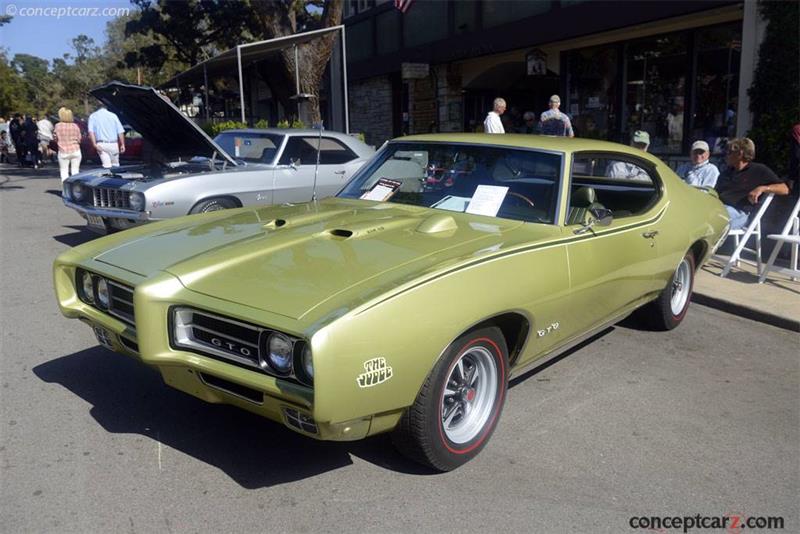
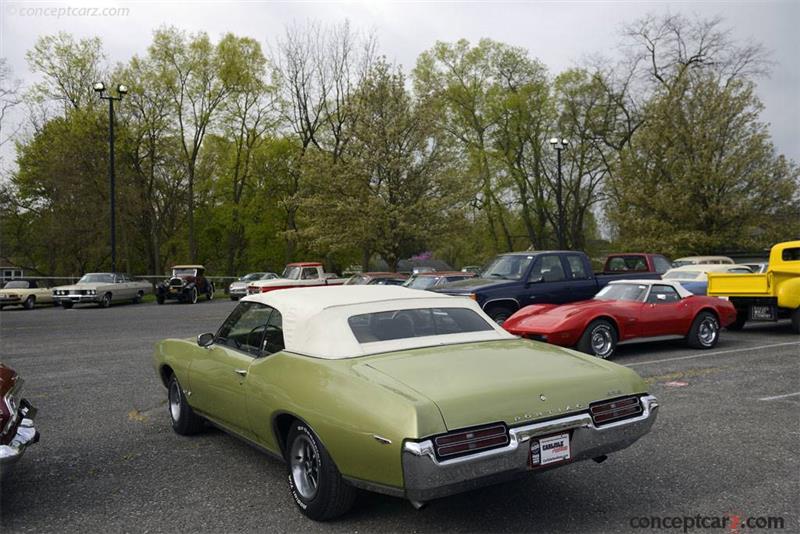
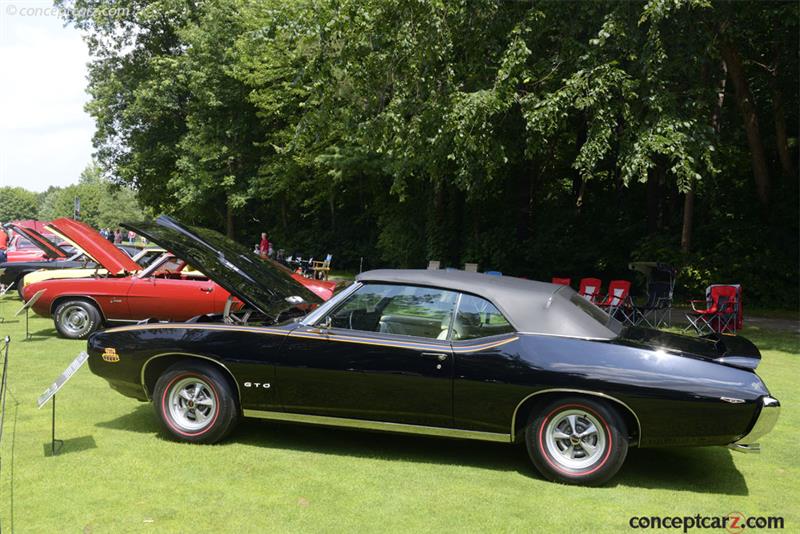
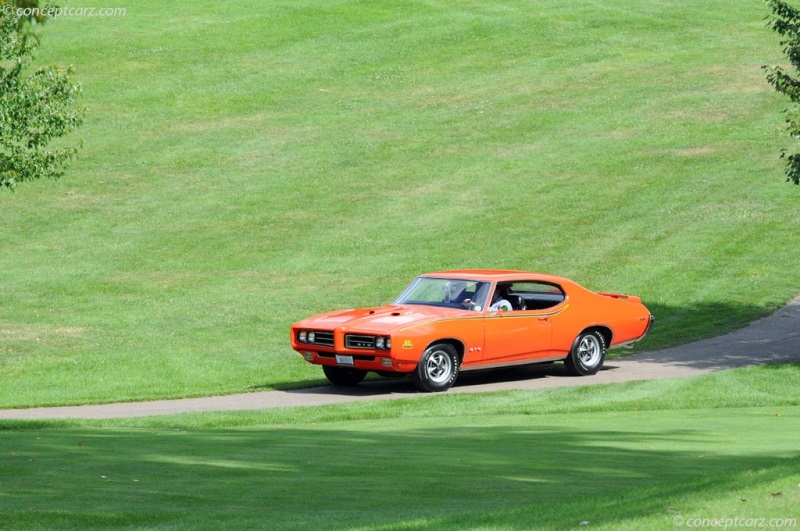
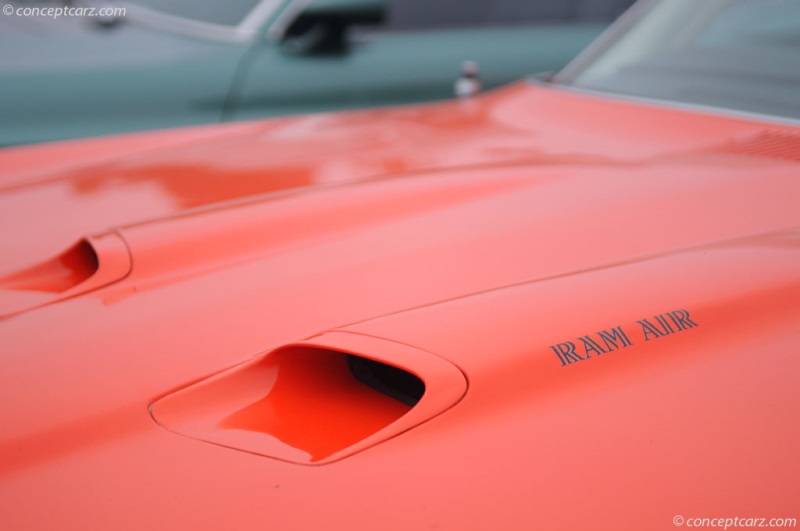
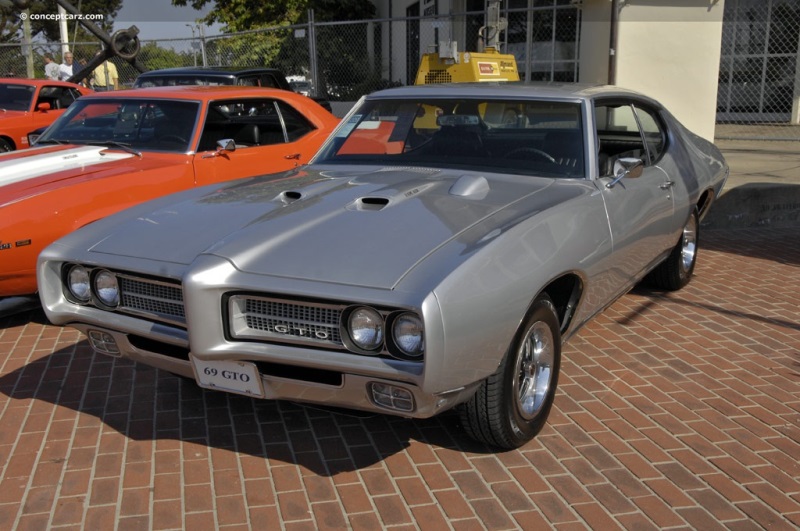
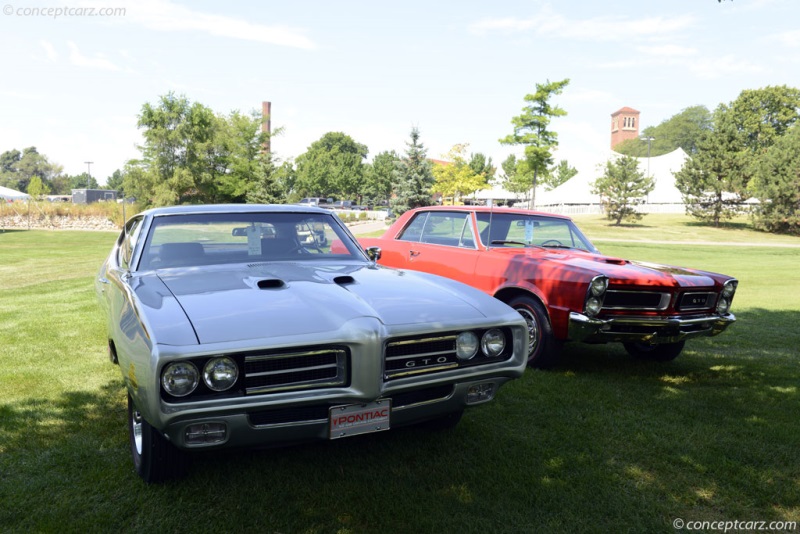
Bill Collins teamed up with John DeLorean to create the first real 'muscle-car' by stuffing a big engine into a mid-size car and creating the legendary GTO. At the time, rules at General Motors forbid offering a standard model with such a powerful combination, but Collins and DeLorean had found a loophole big enough to drive a big-block V8 though. After two years of strong sales and a glowing reputation of building performance vehicles, the GTO was declared a model unto itself. The second-generation Pontiac GTO was introduced in 1968, along with the A-body Tempest on which it was based. The wheelbase dropped from 115 to 112 inches, and overall length shrank nearly six inches to 201.2. The new hardtop wore a roofline more in keeping with the late-1960s trend toward fastbacks. There were four horizontally placed headlights in the front, although an extra-cost option would conceal them behind doors. The taillights were now part of the bumper assembly. The windshield wipers, for the first time, were concealed behind the rear of the hood when not in use.The 400 cubic-inch V8 engine offering 265 horsepower in the economical two-barrel version. The Ram Air II induction had 360 hp. A base-engine GTO with automatic transmission and a 3.23:1 rear axle covered the quarter-mile in 15.93 seconds at 88.3 miles per hour. A Ram Air four-speed manual car with drag-strip-ready 4.33:1 gears reduced the trip to 14.45 seconds at 98.2 miles per hour. For 1969, the Pontiac GTO received only minor changes, including a new locking steering column and the deletion of vent windows. The 350 hp standard and 265 hp two-barrel V8 versions remained unchanged. The Ram Air III produced 366 horsepower and 445 lb-ft of torque. The Ram Air IV was rated at 370 horsepower and 445 lb-ft. All of the four-barrel GTO engines had 10.75:1 compression.The two-barrel 400 could only be mated to the three-speed Turbo Hydra-Matic transmission. The four-barrel V-8s were available with either a three-speed manual, four-speed manual, or the Turbo Hydra-Matic. The standard rear axle gears included 2.93:1 for the two-barrel engine and 3.90:1 for the Ram Air IV engine. Many ratios were available by special order and air conditioning was not available when gears from 3.36:1 to 4.33:1 were requested.'The Judge' performance option was introduced in 1969 (December 18th of 1968) and added $337.02 (Code TW1 Judge Option) to the base price. It was an unrestrained performance option with an irreverent attitude and marketing to match, with famous taglines including 'All Rise for The Judge' and the infamous line, 'The Judge can be bought.' It did not add any comfort amenities but under the hood, it was downright potent. A new air-induction system was added to the engine, Ram-Air III, which delivered 366 horsepower from the 400 CID V8, and this was backed up by a choice of a heavy-duty three-speed or a close-ratio four-speed manual transmission. The Judge was originally available only in Carousel Red, which looked orange to most observers, with special striping and badging. It rode on Rally II wheels and was devoid of the usual beauty trim rings to keep cost and weight to a minimum. Dual functional hood scoops fed fresh, cool air into the deep-breathing RA II engine, with the air intakes opened and closed as necessary with a push-pull cable actuated by a button marked 'Ram Air' underneath the dash panel. Advertised as a benefit for traveling at high speeds was a 60-inch wide rear-deck spoiler-air-foil that was supposed to increase down-drafts and help stabilize the ride. A body-color, flexible Endura front bumper surrounded a sinister blacked-out twin-element grille with optional retractable headlight covers. Higher-rate springs and recalibrated shocks brought handling and road holding up to the same standards as the engine's performancePontiac built 6,725 Judge hardtops and 108 convertibles for 1969.
by Daniel Vaughan | Aug 2019
by Daniel Vaughan | Aug 2019
Similarly Sized Vehicles
from 1969


1969 Pontiac GTO Vehicle Profiles



Recent Vehicle Additions


Performance and Specification Comparison
Price Comparison
$2,770 - $3,200
$2,831 - $3,775
$3,090 - $3,665
$3,866
GTO Specification Comparison by Year
Year
Production
Wheelbase
Engine
Prices
87,684
112.00 in.
8 cyl., 350.00 CID., 265.00hp
8 cyl., 350.00 CID., 320.00hp
8 cyl., 400.00 CID., 330.00hp
8 cyl., 400.00 CID., 335.00hp
8 cyl., 400.00 CID., 340.00hp
8 cyl., 400.00 CID., 350.00hp
8 cyl., 400.00 CID., 360.00hp
8 cyl., 400.00 CID., 366.00hp
8 cyl., 428.00 CID., 375.00hp
8 cyl., 428.00 CID., 390.00hp
8 cyl., 350.00 CID., 320.00hp
8 cyl., 400.00 CID., 330.00hp
8 cyl., 400.00 CID., 335.00hp
8 cyl., 400.00 CID., 340.00hp
8 cyl., 400.00 CID., 350.00hp
8 cyl., 400.00 CID., 360.00hp
8 cyl., 400.00 CID., 366.00hp
8 cyl., 428.00 CID., 375.00hp
8 cyl., 428.00 CID., 390.00hp
$3,000 - $3,100
72,287
112.00 in.
6 cyl., 250.00 CID., 175.00hp
8 cyl., 400.00 CID., 350.00hp
8 cyl., 399.64 CID., 370.00hp
8 cyl., 428.00 CID., 375.00hp
8 cyl., 428.00 CID., 390.00hp
8 cyl., 400.00 CID., 350.00hp
8 cyl., 399.64 CID., 370.00hp
8 cyl., 428.00 CID., 375.00hp
8 cyl., 428.00 CID., 390.00hp
$2,831 - $4,210
40,149
112.00 in.
8 cyl., 350.00 CID., 255.00hp
8 cyl., 400.00 CID., 265.00hp
8 cyl., 400.00 CID., 330.00hp
8 cyl., 399.58 CID., 350.00hp
8 cyl., 455.00 CID., 360.00hp
8 cyl., 455.00 CID., 366.00hp
8 cyl., 455.00 CID., 370.00hp
8 cyl., 400.00 CID., 265.00hp
8 cyl., 400.00 CID., 330.00hp
8 cyl., 399.58 CID., 350.00hp
8 cyl., 455.00 CID., 360.00hp
8 cyl., 455.00 CID., 366.00hp
8 cyl., 455.00 CID., 370.00hp
$830 - $3,600
10,532
112.00 in.
8 cyl., 400.00 CID., 300.00hp
8 cyl., 455.00 CID., 325.00hp
8 cyl., 455.66 CID., 335.00hp
8 cyl., 455.00 CID., 325.00hp
8 cyl., 455.66 CID., 335.00hp
$3,450 - $4,070
Related Automotive News

15 Exciting Collector Automobiles to Watch During This January's Scottsdale, Arizona Car Week Auctions
Scottsdale, Arizona (January 13th, 2016) – Astute Collectors of the worlds most sought after and most valuable automobiles know that Scottsdale, Arizona in January is where the market values for collector cars are established each year. As such, they...

Thomas Scott Collection of Classic American Automobiles to be On Offer at No Reserve at Russo and Steele's 2015 Monterey Collector Automobile Auction Event
Scottsdale, Arizona (July 18th, 2015) – Thomas Scott is an accountant and entrepreneur from Athens, Georgia who has had a love for all things automotive for as long as he can remember. He possesses a lifetime of passion for buying, selling and...

MECUM IN HOUSTON APRIL 9-11 WITH 1,000 COLLECTOR CARS AT AUCTION
Three Featured Collections Including 45 Cars from Houstons Charlie Thomas
WALWORTH, Wis. – March 12, 2015 – Following the historic sale of the 1964 Ford GT40 Prototype for %247 million in 2014, Mecum Auctions returns to Houstons NRG...

Low Mileage Collectables offered at Fort Lauderdale Auction
Auctions America kicks off its 2014 collector car calendar March 14-16 in Fort Lauderdale
Leading recent entries are fantastic low mileage examples including a 2005 Ford GT, a 2006 Ford GT Heritage Edition, a 1954 Chevrolet Corvette and a 1967 Ch...

Holden Celebrates 35 Years of Commodore
Holden is celebrating the 35th anniversary of its most iconic nameplate, Commodore.
For over three decades, the Holden Commodore has delivered significant advances in vehicle performance, safety and comfort on the way to becoming Holdens longest-standing...