2002 Chevrolet Bel Air Concept
2002 Chevrolet Bel Air Concept Navigation
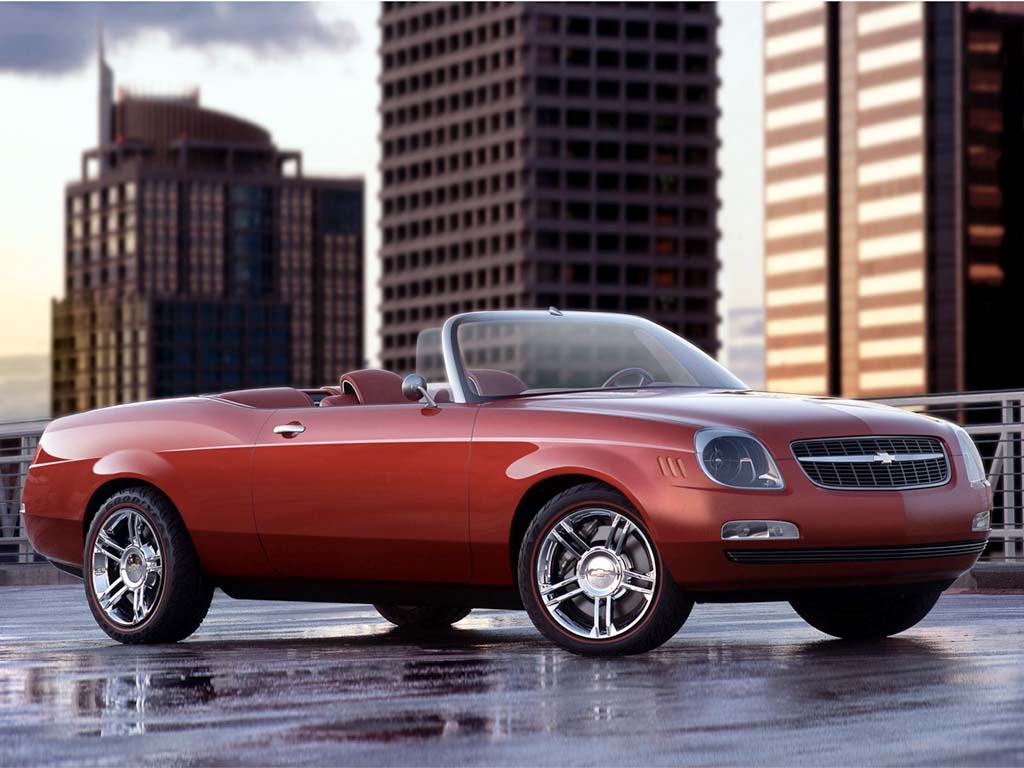
The Chevrolet Bel Air concept is a modern American convertible built on the tradition of the legendary 1955-57 Chevys of the same name. The two-door Bel Air concept celebrates an American icon in a manner reminiscent of the originals with style, performance and an exciting new engine.
'This is not just another convertible,' said Wayne Cherry, GM's vice president for design. 'The Bel Air is about embracing the essence of those mid-50s Chevys -- the ‘tri-5s' -- in a contemporary way. This car is the right size for America, just like the originals were in the 1950s.'
The 1955 Bel Air enhanced Chevrolet's image virtually overnight with its natty styling and unique powertrain.
 The new Bel Air concept vehicle retraces the graceful flowing lines of those classic originals. The modern exterior with its signature beltline kick-up gives the vehicle a sleek appearance. And with its somewhat taller profile and higher driving position, the vehicle's proportions recreate the comfort, visibility and ease of entry and exit of the cars of the 1950s.
The Chevrolet bowtie is displayed prominently on the Bel Air's egg-crate grille and five-spoke aluminum wheels with 18-inch tires enhance the car's sporty look.
The rear-wheel-drive concept also was inspired by several interior design cues from its 1950s predecessor. The simple, elegant passenger compartment features a twin-element instrument panel, steering column-mounted gearshift and bench seats. The seats are covered in soft high-technology fabrics, in colors that match the exterior. The front seats are cleverly designed to slide forward for easier backseat entry.
But the concept's kinship with the tri-5s goes beyond the interior and styling cues, Cherry §äid. The legacy also extends under the hood.
The original small-block Chevrolet V8 option featured in the 1955 used the latest advances in engine technology to set a new benchmark for performance and dependability, Cherry §äid. The engine for the Bel Air concept uses today's advanced technology to provide affordable, efficient performance, he §äid.
'This new engine is just as significant as that V8 was in the '55,' said Cherry.
The Bel Air is powered by a Vortec 3500 turbocharged inline five-cylinder concept engine based on the highly regarded inline engine family that debuted in GM's midsize sport-utility vehicles. The all-aluminum engine delivers up to 315 horsepower and 315 lb-ft of torque, and is mated to a Hydra-Matic 4L60-E electronically controlled four-speed automatic transmission. (posted on conceptcarz.com)
'This engine sets a new benchmark,' Cherry §äid. 'You can go from a super-efficient five-cylinder to a high-performance engine all in the same package.'
To provide the appropriate structure for a large convertible, the Bel Air concept uses a 21st century interpretation of body-on-frame construction, employing the same hydroforming technology used in the frame rails of the Corvette and GM's new midsize sport-utility vehicles. The hydroformed frame rails help provide impressive torsional rigidity and stiffness in a light package, for terrific ride and handling.
Cherry said the design team had fun capturing the expressiveness and flair of the 1955-57 Bel Airs by drawing on some of the cars' intriguing details, such as the traffic light viewfinder and the gas filler cap located in the taillight.
Chevrolet has long appealed to a diverse cross section of consumers who want dependable, spirited vehicles. The 1955-57 Chevrolets provided refreshing, exciting designs; powerful, reliable engines; and smart, spacious interiors at a great price. The cars became symbols of the can-do American spirit of the 1950s, and they are in high demand by car collectors of all ages.
'This concept plays to people who are rediscovering the fun and excitement of the open-air vehicle, as well as those discovering them for the first time,' Cherry §äid.
The Bel Air concept taps the interest in nostalgia that people of all ages share while creating a fun, uniquely American automobile for a whole new generation of drivers, Cherry §äid. The concept blends the excitement of the 1955-57 Bel Airs, cutting-edge powertrain technology and the charm of open-air motoring.Source - GM
'This is not just another convertible,' said Wayne Cherry, GM's vice president for design. 'The Bel Air is about embracing the essence of those mid-50s Chevys -- the ‘tri-5s' -- in a contemporary way. This car is the right size for America, just like the originals were in the 1950s.'
The 1955 Bel Air enhanced Chevrolet's image virtually overnight with its natty styling and unique powertrain.
 The new Bel Air concept vehicle retraces the graceful flowing lines of those classic originals. The modern exterior with its signature beltline kick-up gives the vehicle a sleek appearance. And with its somewhat taller profile and higher driving position, the vehicle's proportions recreate the comfort, visibility and ease of entry and exit of the cars of the 1950s.
The Chevrolet bowtie is displayed prominently on the Bel Air's egg-crate grille and five-spoke aluminum wheels with 18-inch tires enhance the car's sporty look.
The rear-wheel-drive concept also was inspired by several interior design cues from its 1950s predecessor. The simple, elegant passenger compartment features a twin-element instrument panel, steering column-mounted gearshift and bench seats. The seats are covered in soft high-technology fabrics, in colors that match the exterior. The front seats are cleverly designed to slide forward for easier backseat entry.
But the concept's kinship with the tri-5s goes beyond the interior and styling cues, Cherry §äid. The legacy also extends under the hood.
The original small-block Chevrolet V8 option featured in the 1955 used the latest advances in engine technology to set a new benchmark for performance and dependability, Cherry §äid. The engine for the Bel Air concept uses today's advanced technology to provide affordable, efficient performance, he §äid.
'This new engine is just as significant as that V8 was in the '55,' said Cherry.
The Bel Air is powered by a Vortec 3500 turbocharged inline five-cylinder concept engine based on the highly regarded inline engine family that debuted in GM's midsize sport-utility vehicles. The all-aluminum engine delivers up to 315 horsepower and 315 lb-ft of torque, and is mated to a Hydra-Matic 4L60-E electronically controlled four-speed automatic transmission. (posted on conceptcarz.com)

A button on the steering wheel activates the powertrain control module to trigger a more aggressive spark and fueling calibration for maximum horsepower.
'This engine sets a new benchmark,' Cherry §äid. 'You can go from a super-efficient five-cylinder to a high-performance engine all in the same package.'
To provide the appropriate structure for a large convertible, the Bel Air concept uses a 21st century interpretation of body-on-frame construction, employing the same hydroforming technology used in the frame rails of the Corvette and GM's new midsize sport-utility vehicles. The hydroformed frame rails help provide impressive torsional rigidity and stiffness in a light package, for terrific ride and handling.
Cherry said the design team had fun capturing the expressiveness and flair of the 1955-57 Bel Airs by drawing on some of the cars' intriguing details, such as the traffic light viewfinder and the gas filler cap located in the taillight.
Chevrolet has long appealed to a diverse cross section of consumers who want dependable, spirited vehicles. The 1955-57 Chevrolets provided refreshing, exciting designs; powerful, reliable engines; and smart, spacious interiors at a great price. The cars became symbols of the can-do American spirit of the 1950s, and they are in high demand by car collectors of all ages.
 'This concept plays to people who are rediscovering the fun and excitement of the open-air vehicle, as well as those discovering them for the first time,' Cherry §äid.
The Bel Air concept taps the interest in nostalgia that people of all ages share while creating a fun, uniquely American automobile for a whole new generation of drivers, Cherry §äid. The concept blends the excitement of the 1955-57 Bel Airs, cutting-edge powertrain technology and the charm of open-air motoring.Source - GM
Related Reading : Chevrolet Bel Air History
From 1950 through 1952, Chevrolet hardtops in the Deluxe model line were dubbed the Bel Air. It took a few more years before it would become its own distinct series. In 1953, the Bel Air became its own model and was applied to Chevrolets top-of-the-line model range. By 1955, the cars were offered with an optional V8 engine which greatly improved the cars performance. In 1953 Chevrolet....
Continue Reading >>
Continue Reading >>
- 2002 Chevrolet Bel Air Concept Menu
- Article
- Image gallery
- Specifications
- Production figures


Recent Vehicle Additions


Related Automotive News

Toyota Marks 50-Millionth Corolla Sold
From A Humble Start, the Corolla Grew to Become the Worlds Best-Selling Model, and Toyota Celebrates This Milestone Cars Place in Automotive History and Customers Lives
PLANO, Texas (August 26, 2021) – This past July, Toyota sold the 50-millionth...

Audi RS 3 Sedan Earns 2018 Car And Driver '10Best Car Of The Year' Award
Newest Audi Sport model recognized as a Car and Driver 10Best Car of the Year at the 2017 Los Angeles Auto Show
RS 3 Sedan delivers unrivaled performance in its segment, coupled with a high level of everyday functionality
Car and Driver 10Best awa...

2016 CHEVROLET CRUZE FEATURES NEW ECOTEC ENGINES
New engine family, 6T35 transmission balance power, efficiency and refinement
DETROIT – The 2016 Chevrolet Cruze is powered by General Motors new, global family of Ecotec small-displacement engines, featuring a modular architecture that...

2015 Chevrolet Performance Catalog Packed with New Parts
New Z28 parts, LT1LTG crate engines, manual-trans install kits, stage kits featured
LAS VEGAS – The all-new 2015 Chevrolet Performance catalog is the go-to resource for enthusiasts seeking to take their Chevy to higher levels of perfo...
MODEL YEAR 2015: NEW GOLF FAMILY, REDESIGNED JETTA, AND NEW TDI® CLEAN DIESEL ENGINE HEAD THE CHANGES
In a busy year, Volkswagen will also add a new Golf SportWagen, an all-new Golf R, a redesigned Touareg SUV, and the companys first U.S.-market EV, the e-Golf
All-new Golf is bigger, lighter, and more fuel-efficient than the previous model,...