History
Life changed after World War II. After five years of war, Britain emerged worn-torn and weary, but ready to enjoy life. The technology of the war years was finding its way into the post-war racing scene and into car production. This turned a number of would-be passengers into drivers. And Jaguar was in a prime position to take advantage of this shift in thinking. The Jaguar MK IX represents one of the first and finest examples of the owner-driver luxury car.
Back in 1956, Jaguar introduced its big Mark VIII at the London Motor Show. Similar to the Mark VII, the new car's interior featured more luxurious appointments and fittings. The large, rectangular grille was accented by chrome and large headlights. This was a change from its predecessor. Chrome trim applied to the car's waist allowed Jaguar to create two-toned paint schemes, which further caused the car to be reminiscent of the more luxurious chauffer-driven cars like Rolls-Royce and others.
During the period of the big cats, Jaguar was also having success in sports car racing. Routinely, the company's sports cars were favorites at such races as the 24 Hours of Le Mans and other endurance events. This allowed the technology used in their sports cars to make it into their luxurious production cars. One of the first of the company's production cars to benefit from the company's racing pedigree was its Mark IX.
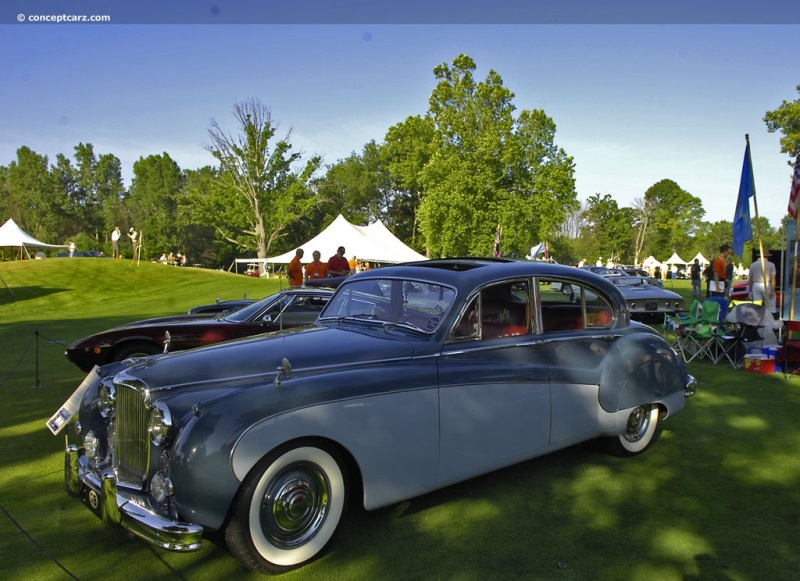
Introduced in 1959, the Mark IX replaced the Mark VIII, but, bore a striking resemblance to the car it replaced. The large, rectangular-shaped chrome grille remained for the Mark IX. It too offered chrome trim and two-toned paint schemes. Though bearing great similarity with its predecessor on the outside, the 'new' parts of the car were more noticeable inside the passenger compartment, and in areas less visible.
The interior was offered with a number of luxuriant appointments, including copious amounts of fine inlaid burl walnut, vat-dyed Connolly leather seats and doors, Wilton carpeting and a standard sunshine roof. Drawing from the company's racing success, the Mark IX was one of the first production cars to offer four-wheel disc brakes, developed by Dunlop.
Power for the 4,000 pound cat came from an enlarged 3.8-liter, 220 bhp dual overhead cam straight 6-cylinder engine. The power was delivered to the wheels by a Borg Warner three speed automatic gearbox. However, a four speed manual transmission and overdrive were offered as optional.
Ride comfort and handling was controlled through torsion bar independent front suspension and a leaf sprung live rear axle. Each of these suspension features were retained from its Mark VIII predecessor.
Besides the more important luxurious features, the large, 120 inch wheelbase also enabled the interior to be roomy and comfortable. It also allowed for a large, deep trunk. The deep trunk allowed for the car's spare tire to be fitted vertically inside of it, although taking away from the overall available trunk space.
Some of the car's more interesting features were found by exploring the number of recessed compartments around the car and by taking it for a spin, especially at night. A number of the recessed compartments would feature basic tools necessary to work on the car. The steering wheel had the ability to telescope. Interestingly, the Mark IX was fitted with black-light bulbs for the illumination of the dash. The rear seat passengers were able to enjoy twin picnic tables, a clock and a locking center cabinet.
Surprisingly, the big cat was also a solid performer. It could go zero to 60 mph in 11.3 seconds. The car had a top speed of 114 mph. The power and the disc brakes have also caused the Mark IX to become a common choice for Goodwood's 'Revival' meetings.
Nose to tail, Jaguar's Mark IX was and is a truly aesthetically pleasing car. But its true luxuriousness comes from seeing and feeling this big cat. The car's performance, ride, comfort and looks make it absolutely understandable why the Mark IX was able to compete with Rolls Royce and other luxurious automobiles. Comfortable at speed and on a slow drive in the summer sunshine, the Mark IX provided a truly wonderful way to experience and enjoy the world and life.
Sources:
'1960 Jaguar MK IX', (http://californiaclassix.com/archive/Jaguar_Mk9.html). CaliforniaClassix.com. http://californiaclassix.com/archive/Jaguar_Mk9.html. Retrieved 7 February 2011.
Wikipedia contributors, 'Jaguar Mark VIII', Wikipedia, The Free Encyclopedia, 30 December 2010, 13:38 UTC, http://en.wikipedia.org/w/index.php?title=Jaguar_Mark_VIII&oldid=404990868 accessed 7 February 2011
Wikipedia contributors, 'Jaguar Mark IX', Wikipedia, The Free Encyclopedia, 30 December 2010, 13:39 UTC, http://en.wikipedia.org/w/index.php?title=Jaguar_Mark_IX&oldid=404990913 accessed 7 February 2011By Jeremy McMullen
Back in 1956, Jaguar introduced its big Mark VIII at the London Motor Show. Similar to the Mark VII, the new car's interior featured more luxurious appointments and fittings. The large, rectangular grille was accented by chrome and large headlights. This was a change from its predecessor. Chrome trim applied to the car's waist allowed Jaguar to create two-toned paint schemes, which further caused the car to be reminiscent of the more luxurious chauffer-driven cars like Rolls-Royce and others.
During the period of the big cats, Jaguar was also having success in sports car racing. Routinely, the company's sports cars were favorites at such races as the 24 Hours of Le Mans and other endurance events. This allowed the technology used in their sports cars to make it into their luxurious production cars. One of the first of the company's production cars to benefit from the company's racing pedigree was its Mark IX.
Introduced in 1959, the Mark IX replaced the Mark VIII, but, bore a striking resemblance to the car it replaced. The large, rectangular-shaped chrome grille remained for the Mark IX. It too offered chrome trim and two-toned paint schemes. Though bearing great similarity with its predecessor on the outside, the 'new' parts of the car were more noticeable inside the passenger compartment, and in areas less visible.
The interior was offered with a number of luxuriant appointments, including copious amounts of fine inlaid burl walnut, vat-dyed Connolly leather seats and doors, Wilton carpeting and a standard sunshine roof. Drawing from the company's racing success, the Mark IX was one of the first production cars to offer four-wheel disc brakes, developed by Dunlop.
Power for the 4,000 pound cat came from an enlarged 3.8-liter, 220 bhp dual overhead cam straight 6-cylinder engine. The power was delivered to the wheels by a Borg Warner three speed automatic gearbox. However, a four speed manual transmission and overdrive were offered as optional.
Ride comfort and handling was controlled through torsion bar independent front suspension and a leaf sprung live rear axle. Each of these suspension features were retained from its Mark VIII predecessor.
Besides the more important luxurious features, the large, 120 inch wheelbase also enabled the interior to be roomy and comfortable. It also allowed for a large, deep trunk. The deep trunk allowed for the car's spare tire to be fitted vertically inside of it, although taking away from the overall available trunk space.
Some of the car's more interesting features were found by exploring the number of recessed compartments around the car and by taking it for a spin, especially at night. A number of the recessed compartments would feature basic tools necessary to work on the car. The steering wheel had the ability to telescope. Interestingly, the Mark IX was fitted with black-light bulbs for the illumination of the dash. The rear seat passengers were able to enjoy twin picnic tables, a clock and a locking center cabinet.
Surprisingly, the big cat was also a solid performer. It could go zero to 60 mph in 11.3 seconds. The car had a top speed of 114 mph. The power and the disc brakes have also caused the Mark IX to become a common choice for Goodwood's 'Revival' meetings.
Nose to tail, Jaguar's Mark IX was and is a truly aesthetically pleasing car. But its true luxuriousness comes from seeing and feeling this big cat. The car's performance, ride, comfort and looks make it absolutely understandable why the Mark IX was able to compete with Rolls Royce and other luxurious automobiles. Comfortable at speed and on a slow drive in the summer sunshine, the Mark IX provided a truly wonderful way to experience and enjoy the world and life.
Sources:
'1960 Jaguar MK IX', (http://californiaclassix.com/archive/Jaguar_Mk9.html). CaliforniaClassix.com. http://californiaclassix.com/archive/Jaguar_Mk9.html. Retrieved 7 February 2011.
Wikipedia contributors, 'Jaguar Mark VIII', Wikipedia, The Free Encyclopedia, 30 December 2010, 13:38 UTC, http://en.wikipedia.org/w/index.php?title=Jaguar_Mark_VIII&oldid=404990868 accessed 7 February 2011
Wikipedia contributors, 'Jaguar Mark IX', Wikipedia, The Free Encyclopedia, 30 December 2010, 13:39 UTC, http://en.wikipedia.org/w/index.php?title=Jaguar_Mark_IX&oldid=404990913 accessed 7 February 2011By Jeremy McMullen
The Jaguar Mark IX was produced for a short three years from 1959 through 1961 with just over 10,000 examples created. It was used as a replacement for the Mark VIII and was later replaced with the larger Mark X. The MK IX was very similar to the vehicle it replaced with the most visual changing occuring on the interior where it had been given a slightly modern facelift.
The Mark IX was powered by a 3.8 liter DOHC straight-six cylinder engine that produced adequate power to carry the vehicle along at respectable speeds. Four wheel disc brakes were standard along with the power steering.
By Daniel Vaughan | Feb 2011
The Mark IX was powered by a 3.8 liter DOHC straight-six cylinder engine that produced adequate power to carry the vehicle along at respectable speeds. Four wheel disc brakes were standard along with the power steering.
By Daniel Vaughan | Feb 2011
Similar Automakers
Similarly Sized Vehicles
from 1960


1960 Jaguar MKIX Vehicle Profiles

Recent Vehicle Additions


Performance and Specification Comparison
Price Comparison
$4,500 - $5,200
$4,560 - $4,760
Mark IX Specification Comparison by Year
Year
Production
Wheelbase
Engine
Prices
Related Automotive News

Gooding & Company Proudly Announces a Geared Online Auction – The European Sporting & Historic Collection From 28 January to 5 February 2021
Hailing from a private UK-based collection, these nine cars represent the very best of motorings most prosperous era, with highlights from Ferrari, Mercedes-Benz, Aston Martin, Bentley, and Rolls-Royce.
Gooding %26 Company, the internationally...

Donald Campbell's DB4 GT Speeds into Bonhams Goodwood Revival Sale
A rare 1961 Aston Martin DB4 GT, one of only 45 right-hand drive examples produced and first privately owned by Donald Campbell CBE, the world land and water speed record breaker, is to be offered at the Bonhams Goodwood Revival Sale on Saturday 14 September,...

THREE TIMES FOUR: RM SOTHEBY'S BRINGS ASTON MARTIN TRINITY TO LONDON SALE WITH DB4GT, DB4 CONVERTIBLE AND DB4 SERIES II COUPÉ
RM Sothebys assembles holy trifecta of DB4s for its 10th anniversary London sale, 7 September at Battersea Evolution
Trio led by original one-of-75 DB4GT, immaculate concours-standard Series V Convertible, and desirable left-hand-drive Series...

Gooding & Company Adds Two Legendary Ferraris to Scottsdale Offerings Including a 1959 250 GT LWB California Spider
The two-day event will also drop the hammer on a 1962 Ferrari 400 Superamerica SWB Coupe Aerodinamico along with over a dozen other models from the Italian marque
SANTA MONICA, Calif. (December 12, 2014) – Gooding %26 Company, the record-setting...

Barrett-Jackson Flavors Its January Scottsdale Auction With NASCAR Treats
RACING HERITAGE, HIGH PERFORMANCE ARE RECIPES FOR CAR-COLLECTING FEAST
SPEED™ SET FOR 39 HOURS of LIVE COVERAGE STARTING JAN. 15
The great Henry Ford once said, Auto racing began five minutes after the second car was built.
...