1963 Ferrari 250 P
1963 Ferrari 250 P Navigation
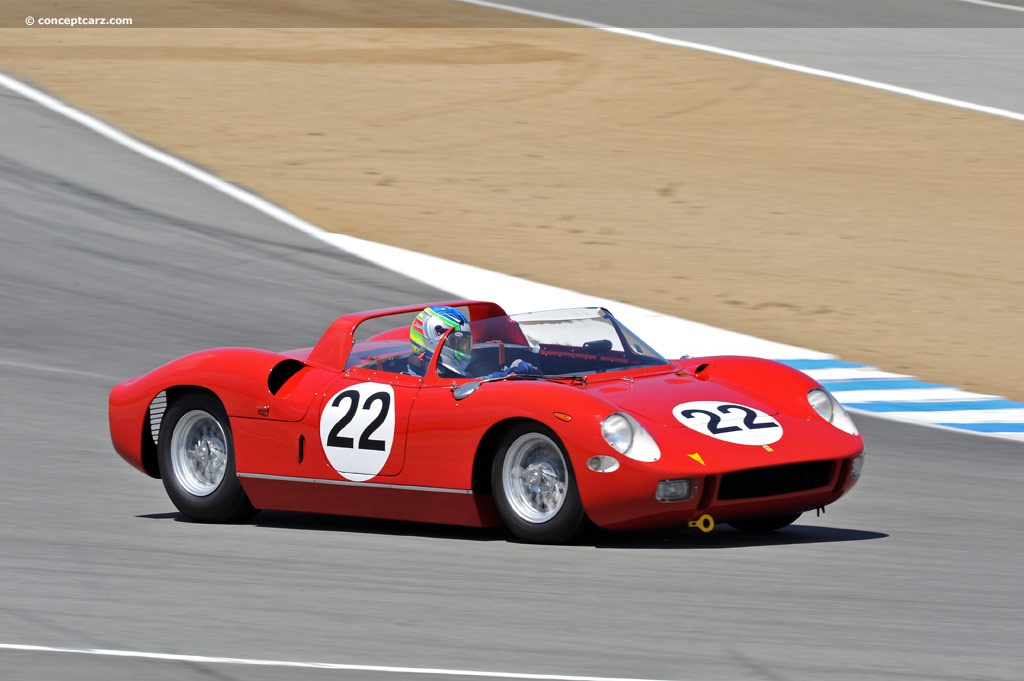
At the 1963 Le Mans 24 Hour race, Ferrari captured more than a victory, it secured another milestone when their 250 P became the first mid-engine car to capture the checkered flag at Le Mans. The mid-engine revolution had begun well before the 250P took its victory; mid-engined cars were winning in all arenas and it was only a matter of time before this configuration would rule the legendary Le Mans circuit. The mid-engine layout offered better handling and aerodynamics. 
Sports Roadster
Chassis #: 0812
View info and historyFor Ferrari, their origins with the mid-engine layout traces back to the 246 SP Prototype introduced in 1961. The 250P utilized the tubular frame from the 246 though it was enlarged to accommodate the single cam, 3-liter V12 Testa Rossa engine. The interior had seating for two; directly behind the cockpit were the engine and the five-speed gearbox. In it racing debut at Sebring, the Ferrari 250 P finished in first and second place. It went on to capture first overall at Nurburgring. In the capable hands of Ludovico Scarfiotti and Lorenzo Bandini, the 250 P earned first overall at Le Mans. A second Ferrari 250 P car finished in third place.
Sports Roadster
Chassis #: 0812
View info and historyThe following season, in 1964, Ferrari introduced their updated 275 P and 330 P, an evolution of the 250 P. They had the same basic design as the 250 P and were made available to privateers. The 250 P cars had been all Factory Works entries. The 250 Le Mans mid-engine racer was a privateer model, introduced in November of 1963 and raced with great success around the world. In total, there were around 32 examples of the 250 LM created. Most were powered by a 3.3-liter engine that produced 320 horsepower.The 275P was powered by a V-12 engine that displaced 3275cc and produced 320 horsepower, 20 more horsepower than the 250 P. The 330 P's engine displaced 3967cc and was capable of 370 horsepower.The 275 P continued the tradition of the 250 P by capturing 1st and 2nd at Sebring. In third place was the 330 P. At Nurburgring, a 275 P finished first. At Le Mans, Ferrari would earn their eighth overall victory in the 24 hour race. Drivers Jean Guichet and Nino Vaccarella crossed the finish line first in a 275 P. A pair of 330 Ps captured second and third place.
Sports Roadster
Chassis #: 0812
View info and historyFor 1965, competition had reached a new level. The legendary Ford GT40 cars were challenging Ferrari for the coveted Le Mans victory. Ferrari's answer was more horsepower and more aerodynamic bodies. Thus, the P2 series was born.Though the 275 P2 and 330 P2 had similarities to the 250 P, they did have their differences. The cars had been designed with the aid of a wind tunnel. They sat lower to the ground, were wider, lighter, had a new tail and spoiler, and had several other noticeable changes such as a more upright windscreen. Construction was handled by Carrozeria Fantuzzi. The front wheels measured eight inches while the rears were larger by an inch. Instead of the traditional wire wheels, cast-magnesium units rode at all four corners. Ferrari fitted these new cars with a suspension system similar to the ones being used in their Formula One program.Mounted mid-ship were the double overhead camshaft V-12 engines with twin plugs per cylinder. The 275 P2 produced 350 horsepower, while the 330 P2 was capable of over 400 horsepower.
Sports Roadster
Chassis #: 0812
View info and historyThe P2's would not win at Le Mans. A 275 P2 did take the overall victory at Monza and the Targa Florio while the 330 P2 won at the Nurburgring. Things went well for the 365 P2 at Reims, rewarding the car with an overall victory. A Ferrari did win at Le Mans in 1965; it was a 250 LM North American Racing Team (NART) entry driven by Jochen Rindt and Masten Gregory.
by Daniel Vaughan | Mar 2009

Sports Roadster
Chassis #: 0812
View info and history

Sports Roadster
Chassis #: 0812
View info and history

Sports Roadster
Chassis #: 0812
View info and history

Sports Roadster
Chassis #: 0812
View info and history
by Daniel Vaughan | Mar 2009
- 1963 Ferrari 250 P Menu
- Article
- Image gallery
- Specifications
Ferrari
Similar Automakers
Similarly Sized Vehicles
from 1963


1963 Ferrari 250 P Vehicle Profiles

Recent Vehicle Additions


Performance and Specification Comparison
Related Automotive News

1929 Duesenberg J/SJ Convertible And 1963 Ferrari 250/275P Win Best Of Show At The 23rd Annual Amelia Island Concours D'Elegance
JACKSONVILLE, FL (March 10, 2018) – The 1929 Duesenberg JSJ Convertible and 1963 Ferrari 250275P won the Best In Show honors on Saturday, March 10, at the 23rd annual Amelia Island Concours dElegance. The news comes following another crowd...

VIC ELFORD RECEIVES RRDC'S 2015 PHIL HILL AWARD
DAYTONA BEACH, Fla. (Jan. 22, 2015) - Vic Elford, considered one of the fastest race-car drivers of the Sixties and Seventies, was honored by the Road Racing Drivers Club with the 2015 Phil Hill Award. RRDC president Bobby Rahal made the presentation...
Luigi Musso: Talented, Tempting and Troubled
Following Alberto Ascaris back-to-back titles in 1952 and 1953 there have been no Italian Formula One World Champions. While there has been a great amount of hope throughout the years, Italians have been left without a World Champion. Perhaps, it could...

1969 24 Hours of Le Mans: A Traditional Statement Provides a Memorable Race
What if a statement ended up costing one of the biggest victories of ones career Would it be worth it Jacky Ickx would come close to finding out as he approached the checkered flag on the afternoon of the 15th of June in 1969.
Ford had determined...

1965 24 Hours of Le Mans: A Cool Head in the Face of a New Threat
Heading into the 1965 24 Hours of Le Mans it had become clear Ford was intent on taking the fight to Ferrari. Ford would spare no expense to take the fight to the company it had intended to buy. Ironically, the North American Racing Team would enter...