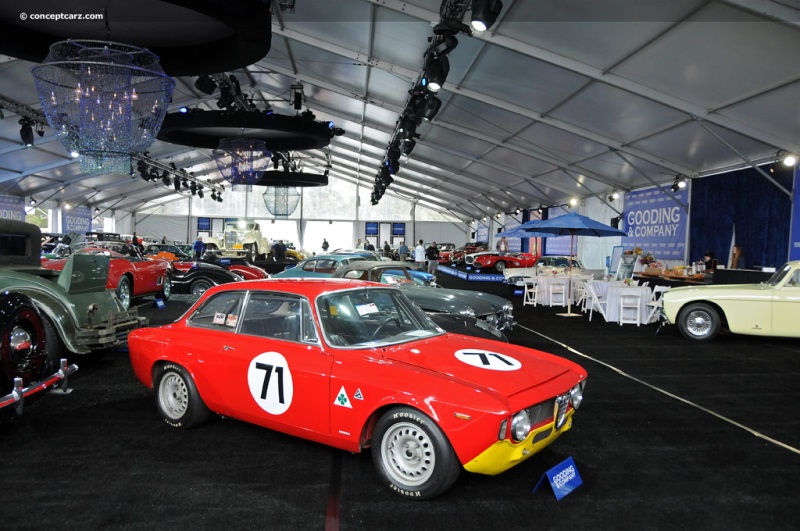
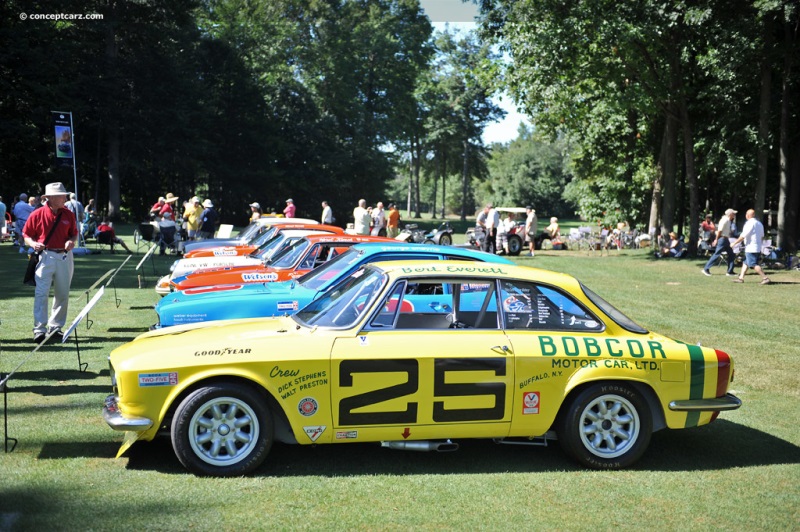
1965 Alfa Romeo Giulia Sprint GTA pictures and wallpaper 1965 Alfa Romeo Giulia Sprint GTA pictures and wallpaper 1965 Alfa Romeo Giulia Sprint GTA pictures and wallpaper 1965 Alfa Romeo Giulia Sprint GTA pictures and wallpaper
More Photographs    

View more photos
Chassis Num: 613642
 
This Alfa Romeo Giulia Sprint GTA (AR #613642) is one of the first GTAs prepared by AUTODELTA. The e Centro Automobilisimo Storico Archivo Alfa Romeo confirmed that Carlo Lepro, from Uruguay, purchased this car August 1, 1965. The car arrived in Montevideo on September 29, 1965, representing the first documented GTA on American soil. They had three weeks to make preparations for the IX Gran Premio de Turismo Internacional, Argentina. Lepro anticipated that the 1965 C class would be very competitive in view of the many Argentinean competitors driving the newest FIAT 1600 C. The FIAT 1500 had won the 1964 GP and FIAT Argentina was there in full support to win the GP again. Carlos won his 'C' class, finished 3rd overall and 1st in three out of six stages, and 3rd in two of the stages. This was a grueling 4,236.9 km of racing in 10 days. This constitutes the first win for an Alfa Romeo GTA in race sponsored by the Federation International Automobile (FIA). After 4 years of historic research and restoration, you see the car as raced in 1965.

In 1965, Alfa Romeo introduced the Giulia GTA model by Bertone. 500 cars were produced for homologation purpose to race in the European Touring Championship. Autodelta, directed by Carlo Chiti, prepared these 'Racing GTA's' (estimated only 35 between 1965-1969), in order to contest the supremacy of the dominant Ford Cortina Lotus from Colin Chapman (England).

AR#613642 is one of the first GTA's prepared by Autodelta. Carlos Lepro, from Uruguay, purchased the car on August 1, 1965. The car arrived to Montevideo on September 29, 1965, representing the first documented GTA on American soil. Carlos Lepro anticipated that the 1965 'C' Class of the IX Gran Premio de Turismo Internacional Argentina would be very competitive in view of many Argentinean drivers racing with the newest Fiat 1500 C. Fiat Argentina was in full support after winning the 1964 'C' Class Gran Premio to second place Alfa Romeo Giulia Super Ti. Carlos won his 'C' Class, finished third overall. He won 3 stages and third in 2 stages of the grueling 4,236.9 kilometers of racing in 10 days. This constitutes the first win for Alfa Romeo GTA in a race sponsored by the Federation International Automobile (FIA).

The owner of this automobile was 19 years old when he watched Carlos Lepro racing his Giulia in the owner's native Argentina in 1965. He found AR#613642 thirty-five years later in North Carolina. Stephen Barney had brought the Giulia from Uruguay to the United States in 1989.

After five years of historical research, based upon original black and white photos donated by Mrs. Lepro, restoration was performed by Roman and Robert Tucker (Michigan), and Jack Beck (Nebraska). The Giulia of Lepro is presented exactly as raced in 1965.
In 1965, Alfa Romeo introduced the Giula GTA model designed by Bertone. 500 cars were produced for homologation purpose to race in the European Touring Championship. Autodelta, directed by Carlo Chiti, prepared these racing GTA's.

AR#613642 is one of the first GTA's prepared by Autodelta. Carlos Lepro from Uruguay purchased the car in August 1965. Carlos anticipated that the 1965 'C' Class of the IX Gran Premio de Turismo International Argentina, would be very competitive in view of many Argentinean drivers racing with the newest Fiat 1500 C. Carlo won his class, finished third overall.

This win constitutes the first win for an Alfa Romeo GTA in a race sponsored by the Federation International Automobile (FIA).

the current owner was 19 years old when he watched Carlos Lepro racing his Giulia in his native Argentina in 1965. He found AR#613642 35 years later in North Carolina.
View more photos
 
This 1965 Alfa Romeo 1600 GTA was raced by Lee Midgley in the 1970 & 1971 Trans Am Opener at Laguna Seca & also the Trans Am at Mont Treblant later that season. He finished 2nd in points in 1970 & also raced a full season in the 1971 Trans Am but did not achieve a win that year. This car is being presented in 'unrestored' condition.
• 1970 two Trans Am wins

• 1970 Finished second in points

• 1971 - Best finish was a second at Olathe


Southern California racer Lee Midgley bought this Alfa Romeo GTA from a used car lot in March of 1970. In just three weeks, with the help of his son and others, Lee managed to have the car race prepped and ready for its first race, the 1970 Trans-Am season opener at Laguna Seca. Lee won that race as well as the Trans-Am at Mt. Tremblant. These two wins, along with several top 5 finishes, earned Lee second place in driver points and contributed to Alfa Romeo's win of the 1970 championship title. Lee also raced this car in the 1971 Trans-Am/2.5 challenge series where he scored several top 5 finishes but did not have any victories. His best finish was second at the Olathe, Kansas Trans-Am. The car is currently shown in its 1971 livery.
View more photos
 
This car is the 1966 Trans-Am Champion. Sponsored by Knauz Continental, the Alfa Romeo Autodelta GTA with Horst Kwech and Gaston Andrey driving had three firsts, two seconds and a fourth place in seven races, accumulating more points than any other drivers or teams. It was the 1966 ARRC (American Road Race of Champions) B-Sedan Champion for the most outstanding ARRC class win with 22 classes present. In 1967, this car was the B-Sedan Central Division champion with John Martino driving. In the 1968 Trans-Am series, this car scored two second place finishes with Tom Blank and Del Taylor driving. The car was raced in SCCA club events by Bill Taylor through 1979, including a 1977 Trans-Am race in C-Sedan trim. It is presented here in its 1966 Trans-Am livery and running gear for the first time in 41 years after a year-long restoration of the original chassis by Roman Auto Prep.
The Alfa Romeo GTA was a vehicle designed for both road and track, and produced from 1965 through 1971. The GTA was given aluminum body panels in-place of steel, which reduced the weight of the vehicle greatly. Continuing with this weight-loss plan, Alfa Romeo outfitted the cars with alloy wheels and clear plastic windows. Inside, many of the components were formed from lightweight material and non-essential items were removed. Many mechanical components, including the rear upper control arms, were comprised of lightweight materials such as aluminum. The engine was given larger carburetors, magnesium camshaft covers, sump and timing covers, and other improvements. The Stradale version produced over 110 horsepower while the racing version produced an impressive 168 horsepower.

The GTA 1300 Junior version was produced from 1968 through 1972. It featured a 1300 cc based on the 1600 engine, and produced just under 100 horsepower. That figure was quickly raised to nearly 110. The vehicle incorporated many lightweight components. In total, there were 450 examples produced.

A GTAm series was produced from 1970 through 1971. These versions did not have any aluminum parts. Power came from a 2-liter four-cylinder engine.
The 1962 the first generation of the Giulia, also known as the 105 series, was introduced at the Monaz Autodrome. The vehicles shared the same bodies as the vehicles they were replacing, the Giulietta. Power came from 1570 cc 4-cylinder engines using hemispheric combustion chambers and producing over 90 horsepower. The five speed manual gearbox was operated by a column mounted shift. The suspension was modified in the rear to improve handling but remained the same in the front.

Just like the Giulietta series, the Giulia came in multiple body-styles including the four-door berlina, spider, TZ, sprint, and Sprint Speciale.

With racing in mind, Alfa Romeo designed and built the TZ series. The TZ, meaning Tubolare Zagato, was outfitted with a light alloy body, tubular frame, disc brakes and independent suspension. The performance of the vehicle was amplified by its light body and responsive and effective handling. The large disc brakes provided excellent stopping power.

In 1963 the Giulia TI Super was introduced as a low production specialty model. With only 500 examples produced, its exclusivity is secure. Outfitted with a 112 horsepower engine, large disc brakes, and floor mounted shift, this vehicle was a performance machine.

In 1963 all models received disc brakes standard on all four wheels. Power was increased in 1965 with the introduction of the 98 horsepower Giulia Super. Externally and internally, the design was slightly modified throughout the years.

The Giulia is credited with expanding international sales of the Alfa Romeo product. Like its predecessor the Giulietta, the vehicle was available in multiple body styles and configurations. Part of its success was the economical aspects, versatility, and styling.
Trans-Am Series

The 'Trans-American Sedan' pro series debuted on March 25th of 1966 as a four-hour prequel to the Sebring 12-hour enduro. It was a series intended for the pony cars such as the Mustang, Plymouth Barracuda, and a slew of small-bore Eurosedan cars that were athletically inclined and could handle the rigors of left and right 'road' racing courses. The following year, in 1967, the competition between the ponycars escalated even further, with GM debuting their Camaro, and Pontiac their Firebird. A Mustang based Mercury Cougar and a new Plymouth Barracuda provided plenty of competition to a very full field. Most major automakers provided factory support and attracted some of the biggest names in racing; the number of races in the series rose from seven to twelve. By the 1969 season, the TransAm Series attracted over 224,000 spectators to 13 events. Factory support continued to increase and so did the competition. The sport prospered until the beginning of the 1970s, as new safety concerns, government regulations, an impending oil embargo, and expensive emissions were detrimental to the industry. The cost to build a competitive racer increased significantly. Most automakers backed out of competition, which meant a serious lack of resources and big name drivers. The glory years of the series were over, but much was still to come.

Trans-Am Rules 1966-1972
The TRANS-AM Championship is now over 30 years old on the sixth major rules format. The latest format began in 1980 and continues without major revisions today. Rules for 1966-1972 are as follows:
The series was born in 1966 with a two-class structure. Over and Under Two Liters. The 0-2 (305 cubic-inch) class was for American built 'pony cars' - while European sports sedans were in the U-2 class. O-2 cars had maximum wheelbase of 116 inches, a minimum weight of 2,800 pounds and a maximum wheel width of eight inches. Both classes were based on FIA Group 1 and 2.

1970 through 1972
The series had its first 'single class' format during these years. The small European sedans were split into their own series in 1980 leaving the American-built pony cars in a single class. The five-liter maximum (305 cubic-inch) displacement was retained while a 3,200 minimum weight was in effect.

Photos grouped by event

Amelia Island Concours d'Elegance

Pittsburgh Vintage Grand Prix

Alfa Romeo Owners Club National Convention

Hilton Head Concours d'Elegance & Motoring Festival

2005 Amelia Island Concours d'Elegance
     

1965 Alfa Romeo Giulia Sprint GTA
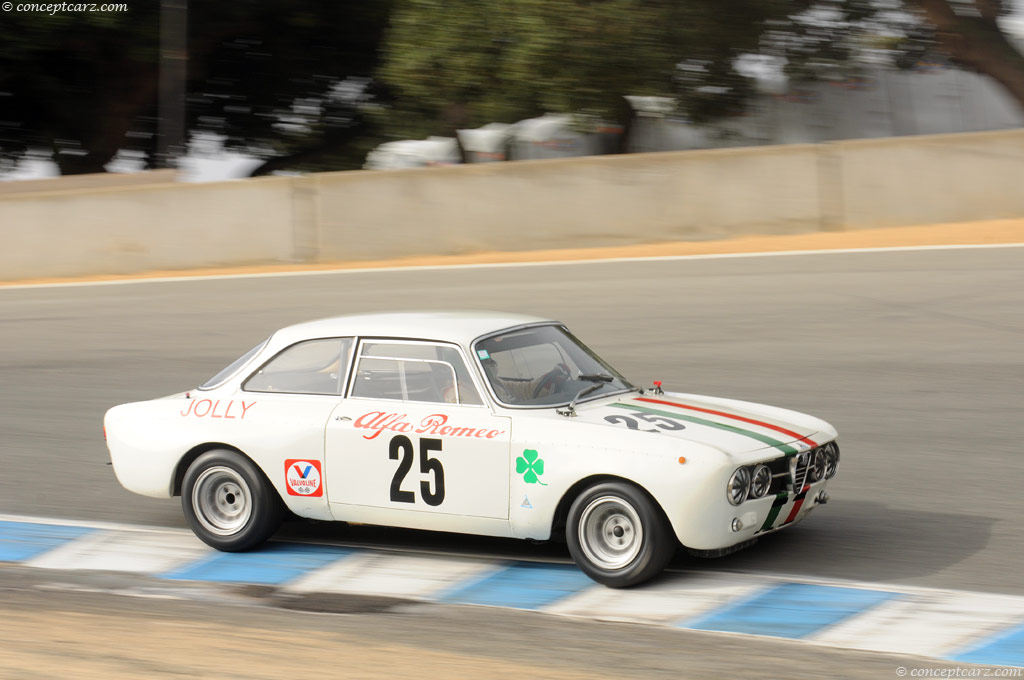
Year1965
MakeAlfa Romeo
ModelGiulia Sprint GTA
Engine LocationFront
Drive TypeRear Wheel
Production Years for Series1965 - 1969
Weight1630 lbs | 739.4 kg

Chassis / Engine Numbers Shown
Chassis Number613642

Performance
Top Speed185 km/h | 115 mph Similar top speeds

Engine  
Engine ConfigurationS
Cylinders4
Aspiration/InductionNormal
Displacement1570.00 cc | 95.8 cu in. | 1.6 L.
Valves8 valves.
2 valves per cylinder.
ValvetrainDOHC
Horsepower115.00 BHP (84.6 KW) @ 6000.00 RPM
Torque105.00 Ft-Lbs (142.4 NM) @ 3000.00 RPM
HP to Weight Ratio14.2 LB / HP (Vehicles with similar ratio)
HP / Liter71.9 BHP / Liter
Compression Ratio9.70:1
Main Bearings5
Fuel FeedCarburetor
2 Weber carburetors
Vehicles with similar horsepower and weight

Standard Transmission
Gears5
TransmissionManual


Similar Automakers
Add Review
View Reviews (2)
Other models by Alfa Romeo
View Specifications
AddThis Social Bookmark Button

Articles and Event Coverage
Amelia Island Concours d'Elegance
Pittsburgh Vintage Grand Prix
Alfa Romeo Owners Club National Convention
Hilton Head Concours d'Elegance & Motoring Festival
2005 Amelia Island Concours d'Elegance

Additional Resources and Links
Amelia Island Concours d'Elegance Official Website
Hilton Head Island Concours d'Elegance Official Website
Alfa Romeo Owner's Club (AROC) Official Website
Pittsburgh Vintage Grand Prix Official Website

Topics
classic Alfa

Replies: 2
Thursday, December 01, 2005

1965 Alfa Romeo models
105
2600 SZ
Giulia Speciale
Giulia Spider
Giulia Sprint GT
Giulia TI
Giulia TZ
Giulia TZ2

Vehicle Spotlight
Mazda Kiyora Concept2009 Hyundai i201912 Mercedes Race Car
2009 Kia Borrego Images and Info2009 Chevrolet CorvetteMazda Kazamai Concept
Fiat Fiorino Portofino ConceptJetstream SC250Mitsubishi Racing Lancer Debut
Trident IceniChevrolet Cruze2009 Lexus SC 430 Pebble Beach Edition
2009 Lexus LS 600h L Pebble Beach Edition2009 Infiniti G37 ConvertibleIFR Automotive Aspid
Lotus EvoraRolls-Royce Pininfarina Hyperion2008 Lamborghini Reventon