1962 Impala Series | 1964 Impala Series ![]() |
1963 Chevrolet Impala Z11 news, pictures, and information | ||
| Tweet | ||
![]() | ![]() | ![]() | Coupe |
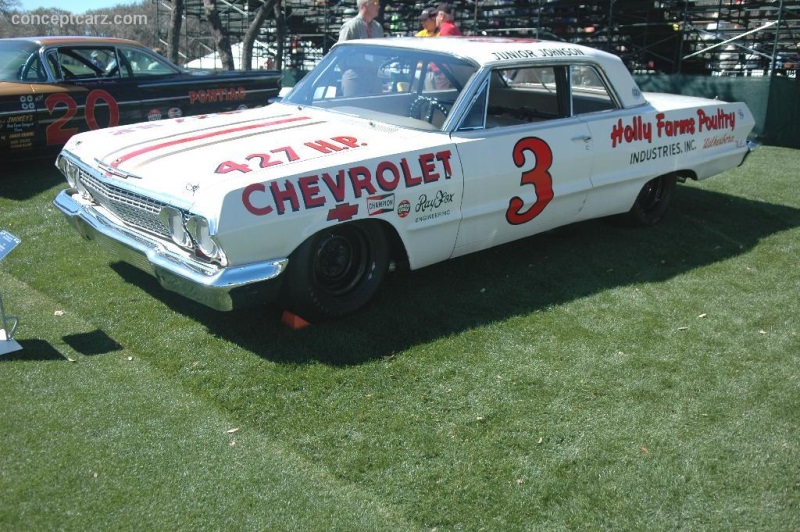
Powering the Impala was the legendary 427 'Mystery Motor' that featured a new design cylinder head (called the Porcupine as the angled valves and rockers 'stuck out every which way') and a four-bolt main block. Unfortunately, mechanical problems robbed Johnson and the Impala of victory when leading the 1963 Daytona 500. For most of the races that year, Johnson's Impala was on the pole and by the end of the season, Impalas had scored eight victories during their first and only year of competition.
Chevrolet had learned a valuable lesson from the 'Mystery Motor' program and applied what they had learned on the track back to the engine's design. Within a few short years, production Chevrolet 427 Mar IV big block engines would dominate a wide variety of racing venues throughout the world.
The current owner is The International Speedway Corporation, Daytona, Florida.
![]() | ![]() | ![]() | Coupe |
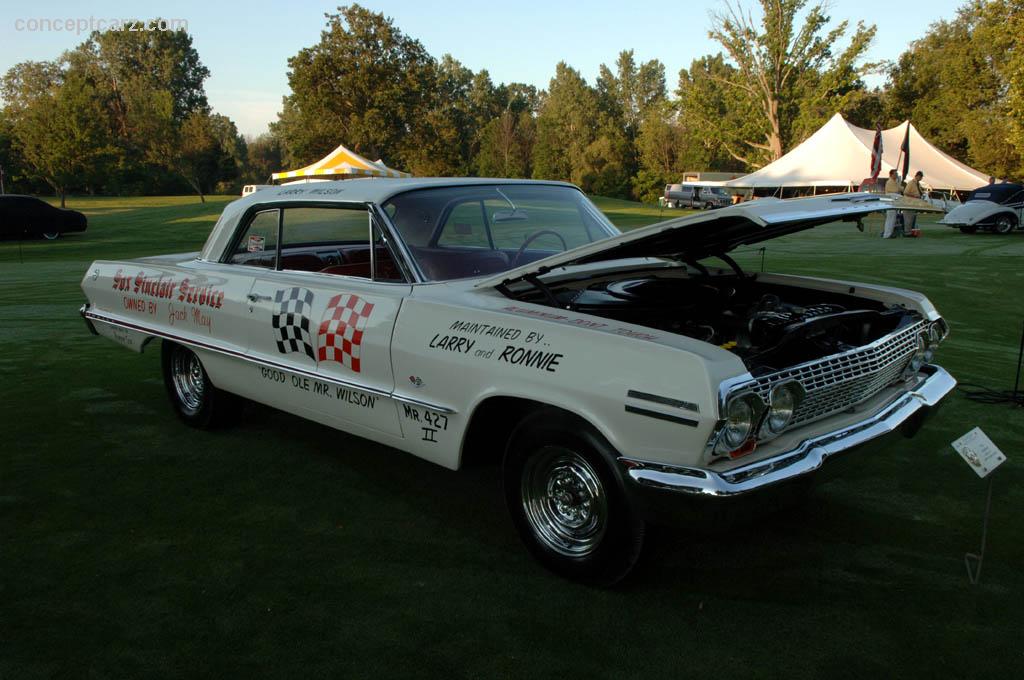
Zora Duntov and his group of engineers developed the 427 Z-11 engine and body package for drag racing. The Z-11 427 engine was the first 427 cubic-inch production engine offered by Chevrolet in a Regular Production Order (RPO) car.
The base price of a 1963 Impala was $2,774. Adding the price of the RPO Z-11 option of $1,240 brings the total price just over $4,000, not including destination charges, taxes, etc.
This car was raced by Ronnie Sox (of Sox and Martin Fame). It was used as their match race car and was billed as the 'World's Fastest Z-11,' turning low 11.20 ET's. It in fact was capable of times as fast at 10.80 ET in the ¼ mile and indeed was extremely fast for its day. The car has factory aluminum hood, fenders, bumpers, brackets and other components.
![]() | ![]() | Coupe |
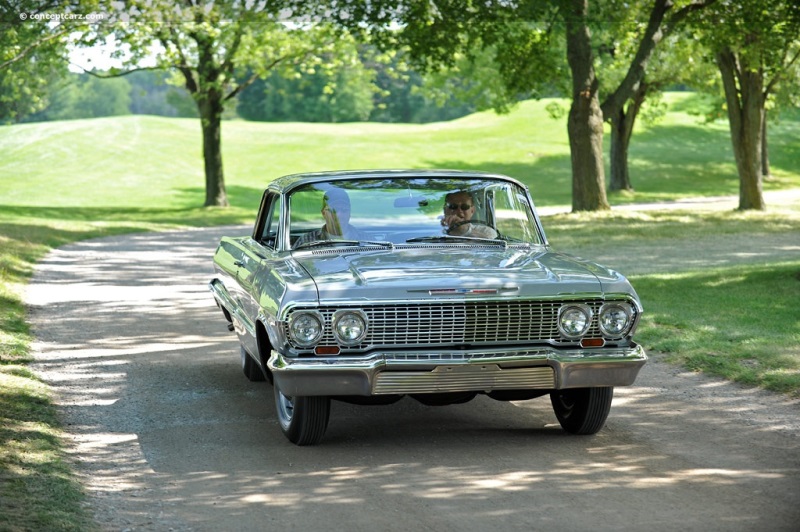
The RPO Z-11 Impala cars were built to race. They were used by many of the top drag racing individuals of the time and used with great success on many occasions.
![]() | ![]() | ![]() | Coupe |
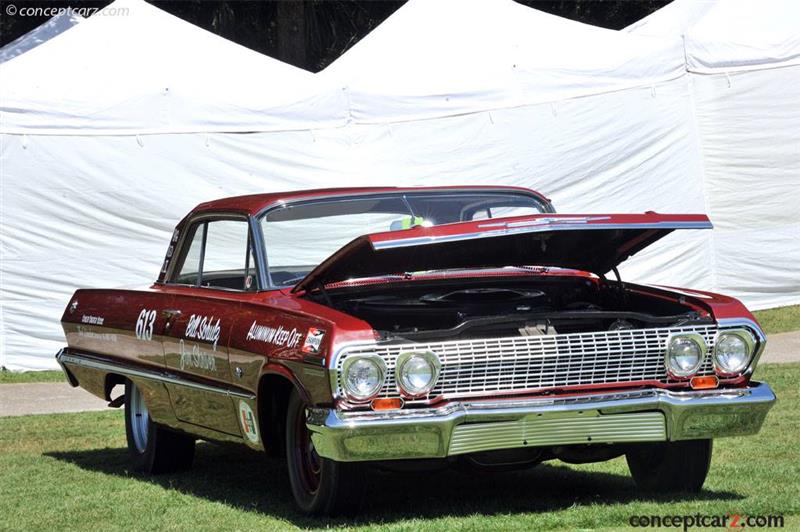
In the early days of A/FX racing, different combinations were tried and tested on racetracks each weekend. With Bill Jenkins doing the tuning and Dave Strickler driving, Chevy had a winning team.
Only 16 factory drag racing Impalas were produced in 1962, and 57 in 1963.
This car was one of the first Impalas to have the Z-11 drag racing option, and, raced by Strickler, won over 90-percent of its races including Indy '63. Strickler is remembered as a tireless racer who played a very important role in the early years of A/FX racing.Source - Vehicle Owner
The 1950's Impala was big, very big. It actually began its life as a top option level of the Bel Air. Due to sales being so well for this body style, Chevrolet decided to create the Impala as its own model. Its styling has been termed 'bat-winged' due to the rear-styling of the vehicle. A variety of engines were available ranging from an inline-6 cylinder up to a triple carburetor, 348 cubic-inches V8 capable of producing 315 horsepower. A fuel injected V8 became available in 1959.
From the front of the car, the design was fairly normal for the 1950's era. Extensive amounts of chrome littered the front end. Two headlights, located side-by-side, were placed on each sides of the vehicle. A front grill was used to help keep the engine cool. View the car from the side and it becomes immediately clear that this is a big vehicle. The length of the vehicle could be extended an additional 11 inches by adding the Continental spare tire cover to the rear of the car. Viewing the car from the rear, the car quickly ends up in a league of its own, with only a few other vehicles such as the Cadillac Series 62 / DeVille having such a radical rear-end. The vehicle featured rear-fins that resembled cats-eyes. To top it all off, this car was not-only long, it was also very wide.
Drum brakes were used and due to the weight of the vehicle, tended to wear out rather quickly. The Impala came in three different body styles including a four-door sedan, two-door coupe, and a convertible coupe. Even though the vehicle weighed 3650 lbs, it could achieve a zero-to-sixy run in about 9 seconds. Top speed was in the neighborhood of 130 miles-per-hour.
By Daniel Vaughan | Dec 2009
From the front of the car, the design was fairly normal for the 1950's era. Extensive amounts of chrome littered the front end. Two headlights, located side-by-side, were placed on each sides of the vehicle. A front grill was used to help keep the engine cool. View the car from the side and it becomes immediately clear that this is a big vehicle. The length of the vehicle could be extended an additional 11 inches by adding the Continental spare tire cover to the rear of the car. Viewing the car from the rear, the car quickly ends up in a league of its own, with only a few other vehicles such as the Cadillac Series 62 / DeVille having such a radical rear-end. The vehicle featured rear-fins that resembled cats-eyes. To top it all off, this car was not-only long, it was also very wide.
Drum brakes were used and due to the weight of the vehicle, tended to wear out rather quickly. The Impala came in three different body styles including a four-door sedan, two-door coupe, and a convertible coupe. Even though the vehicle weighed 3650 lbs, it could achieve a zero-to-sixy run in about 9 seconds. Top speed was in the neighborhood of 130 miles-per-hour.
By Daniel Vaughan | Dec 2009
Chevrolet Impala, 1958-1960
In 1958, Chevrolet decided to move upscale with a new trim level for the successful Bel Air. Called Impala, the upgrade package included enhanced interior and exterior styling, along with powertrain options potent enough to create one of the best performing large cars available at the time.The name of this new trim level had been used at Chevy before, when GM was showcasing dream cars in its 1956 Motorama shows. One auto created for this show by GM's design studio was the Chevrolet Corvette Impala. With a hardtop and room for five, this concept was created to show the possibility of producing a full model line for the Corvette. It had a traditional Corvette grille and swoopy lines with a sporty flair, free of the fins so popular on sedans.
Though the Corvette Impala never made it beyond concept car status, the Bel Air Impala retained some of its sporting intent. The priciest car in Chevrolet's fleet, the new flagship could be had with a 348c.i. V8 producing 315bhp.
Ironic given the clean lines of the Corvette Impala, the Bel Air Impala featured large fins and as much chrome as a contemporary roadside diner. Other new styling elements included a six taillight rear treatment, and a wide front view with four headlamps. The Impala package could be ordered only as a coupe or convertible, enhancing the sporting image of the car. While the base engine was a 145bhp straight six, every other available engine was a V8 displacing 283c.i. or 348c.i. With this plethora of performance-minded engine options, buyers knew theses vehicles were serious.
The Bel Air Impala was an easy seller. Despite its premium price, the public loved its looks and available power. Its sales volume was high enough to prompt Chevy to bring back the Impala for 1959 as a model line in its own right, free of Bel Air connections.
Available as a sedan, coupe, and convertible, the 1959 Impala was an even bigger hit. Its design was fresh and considered very stylish, with huge fins second in size only to Cadillac's. The Impala was named after an African antelope, hence the car's logo. Other animals were evidently taken into consideration as well during the designing of the Impala. The large tailfins were referred to as 'bat wings.' The long, narrow taillights, which tapered toward the center to sharp points, were called 'cat's eyes.'
Many consider the early Impala the first real muscle car. The 1958 models especially followed the formula of taking a big sedan, getting rid of a couple of doors, and shoehorning in the biggest V8 that'll fit under the hood.
For 1959, the performance slant of Impalas took on a hint of greater sophistication when an impressive new engine choice was made available. A 283c.i. V8 with an advanced fuel injection system was introduced. With more power than the cheapest 348c.i. engine, the fuel injected motor made a great choice. Unfortunately, it was never very popular and is a rare find today.
The 1960 Impala was a letdown for driving enthusiasts. Some of the distinct styling features were deleted, as was the availability of fuel injection. The Impala had taken a step away from its performance roots. It continued to sell incredibly well, though. In 1959, the Impala was already the bestselling Chevrolet. In 1960, it became America's bestselling car of any manufacturer.
Successful or not, the Impala was beginning to lose its direction in 1960. But hopeful enthusiasts were rewarded for their patience a year later when the 1961 Impala SS was introduced, bringing a brand new performance icon to Chevrolet. The Impala would go on to become the bestselling full-size car of all time.
Sources:
www.corvettes.nl, '1956 Chevrolet Impala Show Car.' Car Styling 7 Mar 2009 http://www.carstyling.ru/en/cars.1956_Chevrolet_Impala%20Show%20Car%20.html.
Patterson, Marit Anne. '1958 Chevrolet Impala Convertible.' Sports Car Market 08 Aug 2008 7 Mar 2009 http://www.hagerty.com/lifestyle/hobby_article.aspx?id=34714.
'Chevrolet Impala History.' Muscle Car Club 7 Mar 2009 http://www.musclecarclub.com/musclecars/chevrolet-impala/chevrolet-impala-history-1.shtml.
'1958 Chevrolet Impala.' 1958 Classic Chevrolet: 'A Whole New Look' 7 Mar 2009 http://58classicchevy.com/.By Evan Acuña
Considered to be ‘the best selling full-size car in the U.S.,' in 1960 the Chevy Impala was designed and built by the Chevrolet division of General Motors.
Originating as a sports coupe, the Impala began as a dreamcar for the 1956 General Motors Motorama.
The name Impala originated from a southern African antelope known for its speed and prowess. Introduced in 1958, the Impala was developed by chief engineer automotive executive for General Motors, Edward Cole.
Michigan born, Cole was the son of a dairy farmer whose lifelong aspiration was to become an automotive engineer. Beginning as a lab assistant for the General Motors Institute, Cole worked in engineering before gaining recognition and becoming promoted to chief engineer in 1952. Cole eventually became president of Chevrolet in 1967.
Introduced with a trim package, the new sporty model was unique with its six taillights. Eventually becoming the ‘best selling car in the Chevrolet product line', in 1959 it became a separate model in both two and four-door versions. Within the second year of production, production reached 473,000 units.
Continuing for a decade as the best-selling automobile in the U.S. Impala broke the record for sales with over 13 million units sold. The Impala held this record until 1977 setting an ‘all-time industry annual sales record of more than 1 million units.'
Introducing the largest impala, the 1971 redesign set the standard that has yet to be topped remaining Chevrolet's top-selling model until the late 1970's.
The design of the Impala SS (Super Sport) became the model often credited for the beginning of the muscle car era.
During the 1973 energy crisis that rocketed the nation, the impact of high rising gas prices put a damper on the industry. Impala sales plummeted and the redesign of the Impala to meet changing demands. Minimized in length, becoming more narrow and taller in stature, the new Impala showcased ‘the new image of the full-size American car – smaller, lighter, more efficient.'
Over the decades, the Impala has continued to remain an American trademark, enhanced by its ability to evolve with the times.
Introduced during the Los Angeles Auto Show in 2005, the 2006 Impala came complete with a base engine, a 3.5 L V6 that produced 211 hp. A completely revised interior, the 06 Impala was selected by Fleet car of the Year by both Automotive Fleet and Business magazines.By Jessica Donaldson
For more information and related vehicles, click hereOriginating as a sports coupe, the Impala began as a dreamcar for the 1956 General Motors Motorama.
The name Impala originated from a southern African antelope known for its speed and prowess. Introduced in 1958, the Impala was developed by chief engineer automotive executive for General Motors, Edward Cole.
Michigan born, Cole was the son of a dairy farmer whose lifelong aspiration was to become an automotive engineer. Beginning as a lab assistant for the General Motors Institute, Cole worked in engineering before gaining recognition and becoming promoted to chief engineer in 1952. Cole eventually became president of Chevrolet in 1967.
Introduced with a trim package, the new sporty model was unique with its six taillights. Eventually becoming the ‘best selling car in the Chevrolet product line', in 1959 it became a separate model in both two and four-door versions. Within the second year of production, production reached 473,000 units.
Continuing for a decade as the best-selling automobile in the U.S. Impala broke the record for sales with over 13 million units sold. The Impala held this record until 1977 setting an ‘all-time industry annual sales record of more than 1 million units.'
Introducing the largest impala, the 1971 redesign set the standard that has yet to be topped remaining Chevrolet's top-selling model until the late 1970's.
The design of the Impala SS (Super Sport) became the model often credited for the beginning of the muscle car era.
During the 1973 energy crisis that rocketed the nation, the impact of high rising gas prices put a damper on the industry. Impala sales plummeted and the redesign of the Impala to meet changing demands. Minimized in length, becoming more narrow and taller in stature, the new Impala showcased ‘the new image of the full-size American car – smaller, lighter, more efficient.'
Over the decades, the Impala has continued to remain an American trademark, enhanced by its ability to evolve with the times.
Introduced during the Los Angeles Auto Show in 2005, the 2006 Impala came complete with a base engine, a 3.5 L V6 that produced 211 hp. A completely revised interior, the 06 Impala was selected by Fleet car of the Year by both Automotive Fleet and Business magazines.By Jessica Donaldson
| Indy 500 Champion Al Unser, Jr. as the 2013 Grand Marshal | |
![]() | The 18th Annual Keels & Wheels Concours d'Elegance, benefiting The Boys & Girls Harbor, announced that two-time Indy winner Al Unser, Jr. will serve as the 2013 Grand Marshal. Unser will be on the grounds throughout the weekend of May 4-5, 2013 at the Lakewood Yacht Club in Seabrook, TX meeting participants and visitors, signing autographs, and participating in the awards programs. Unser has accumulated a tremendous record of success as a race car driver throughout the last 30 years. Continu...[Read more...] |
| The Houston Classic Weekend gets Fast and Loud | |
![]() | Houston, Texas. March 18, 2013. Organizers of The Houston Classic Weekend are gearing up again for one of the biggest motoring and luxury lifestyle weekends in Texas, staged at the award winning La Torretta Lake Resort & Spa in Montgomery. Running from May 3-5, The Houston Classic Weekend is a full-scale celebration of vintage motoring, with highlights including Worldwide Auctioneers' The Houston Classic Auction on Saturday, May 4, a world-class catalogue sale that is now in its second decade. T...[Read more...] |
| MARK REUSS NAMED DAYTONA 500 HONORARY PACE CAR DRIVER | |
![]() | DAYTONA BEACH, Fla. – Mark Reuss, General Motors North America president, who was instrumental in bringing the new Chevrolet SS to NASCAR, will be the honorary pace car driver Sunday for the 55th running of the Daytona 500. He will be behind the wheel of a 2014 production Chevrolet SS. 'Leading the Daytona 500 starting field to green driving a 2014 Chevrolet SS pace car on one of the most famous race tracks in the world will be a special honor for me,' Reuss said. 'I can't wait to...[Read more...] |
| Historic Stock Cars to Rev up their Engines at Rolex Monterey Motorsports Reunion | |
![]() | America's most popular form of motorsports will nudge its way onto the vintage race scene this summer when 27 historic stock cars participate in the Rolex Monterey Motorsports Reunion. Scheduled for August 17-19 at Mazda Raceway Laguna Seca on the beautiful Monterey Peninsula, the event will feature the Shelby Cobra as its traditionally feted annual marque, but the addition of the stock cars promises to add a new dimension to the hundreds of sports and race cars entered in the historic race. ...[Read more...] |
| Gooding & Company's Annual Pebble Beach Auctions | |
![]() | Gooding & Company, the acclaimed auction house celebrated for selling the world's most significant and valuable collector cars, will host its annual Pebble Beach Auctions on August 18th & 19th in association with the prestigious Pebble Beach Concours d'Elegance. Once again, Gooding & Company is poised to present an outstanding array of blue chip and concours-quality collector cars on its record-setting stage, including the elegant 1955 Maserati A6G/54 Frua Berlinetta owned by Grammy Award-winni...[Read more...] |
| View more Drag Racer vehicles |
| View more NASCAR/Stock Car vehicles |
| Similar Vehicles | |
![]() | 1963 Chevrolet Impala NASCAR |
![]() | 1962 Chevrolet Bel Air Series |
| Similar Automakers | |
| Cadillac | Chrysler |
| Dodge | Ford |
| GMC | Hummer |
| Jeep | Lincoln |
| Mercury | Pontiac |
| Saturn | |
| Similarly Sized Vehicles from 1963 |
| Chevrolet Bel Air Series |
| Chevrolet Biscayne Series |
| Chevrolet Impala NASCAR |
| Chevrolet Impala Series |
| Plymouth Belvedere |
| Chevrolet: 1961-1970 |
| Similar Automakers |
| Chevrolet History |
| Other models by Chevrolet |
| Manufacturer Website |
| ||||||||||||||||||||||||||||||||||||||||||||
1962 Impala Series | 1964 Impala Series ![]() |


1962 Impala Series


1963