Concept Cars Home
Image Left 1937 540K1939 540K Image Right
 

1938 Mercedes-Benz 540K news, pictures, and information
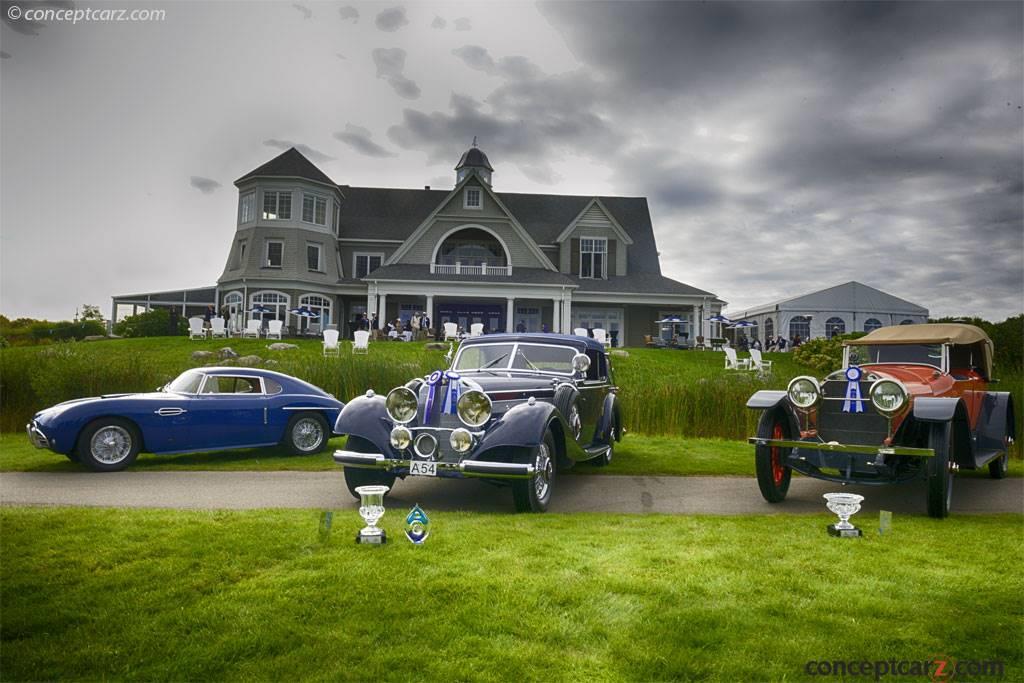
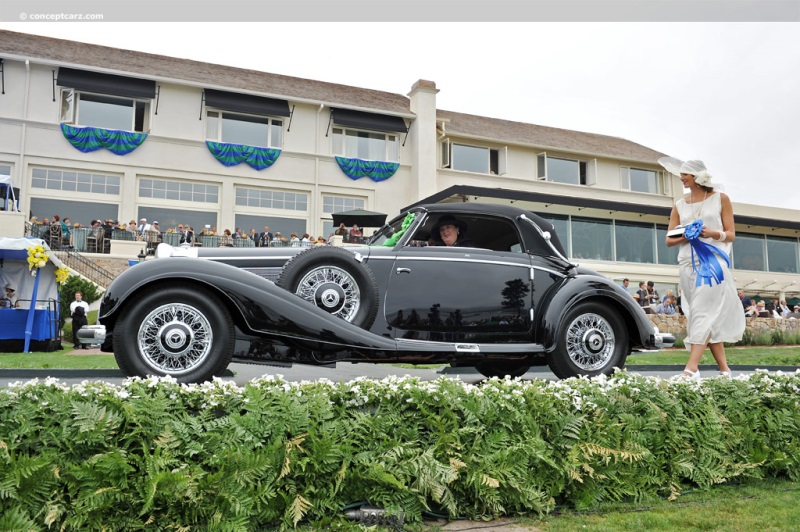
Sport Cabriolet
Coachwork: Erdmann & Rossi
Chassis Num: 232697
Engine Num: 154099
 
Sold for $946,000 at 2009 Gooding & Company.
The K series Mercedes of the 1920s were not for the faint of heart. In the wrong hands, they could be considered downright dangerous. Powered by engines that eventually rose to over seven liters of displacement producing over 250 horsepower they were formidable and fierce vehicles. Descendents of the SSK series included both the 500K and, later, the 540K series.

The 540K debuted in 1936. Touting state-of-the-art independent coil spring suspension, the 5.4-liter straight eight-cylinder engine made 115 horsepower normally and 180 with the supercharger engaged. Today, the 540K remains an awe-inspiring machine capable of speeds exceeding 100 mph.

The Berglass brothers, two Berlin bankers, purchased this car in 1936. The coachwork is by Erdmann & Rossi, with a number of special features such as the lengthened hood, a unique hinged V windshield and twin rear-mounted spares. The vehicle was shipped to the UK in 1938, just prior to the start of WWII. The car's subsequent history remains unknown, until the Goodman family of San Francisco, purchased it in mid 1970s. It was sold in unrestored condition at an estate sale in 1993.

In 1997 it was awarded a First Prize at the Amelia Island Concours d'Elegance, a class award at pebble Beach, and both a First in Class as well as the Most Significant Mercedes award at the 1998 Meadow Brook Concours d'Elegance.

In 2001 the car was privately sold to collector Thomas Taffett. Mr. Taffett kept the car for two years before selling it to the current owner. In 2009, this 540 K Sport Cabriolet was offered for sale at the Gooding & Company auction in Scottsdale, Arizona. The car was estimated to sell for $1,000,000 - $1,500,000. The lot was sold for a high bid of $946,000, including buyer's premium.
Chassis Num: 169333
 
Sold for $900,205 (€672,750) at 2013 Bonhams.
The Mercedes-Benz 540K Series automobiles were purchased by the elite in society - the leaders of industry, the rich and famous, the highest class citizen, the powerful and accomplished, the privileged, and the most demanding customers. Each vehicle took over 6000 man hours to complete and it utilized the finest materials available built in the most advanced facilities with state-of-the-art equipment, tools, and machinery. Under the bonnet was an eight-cylinder engine that produced 115 horsepower and 180 horsepower with the help of a supercharger. The driver had control of the supercharger and could apply the boost which gave the engine about 60% in short bursts. When the driver pushed the accelerator pedal to the floor, the supercharger was engaged automatically. The supercharger would let the occupants know that it was working by making a loud noise which was caused by the compressed, supercharger rotors, and the drive gears. This power was sent to the rear wheels through a four-speed manual gearbox that featured synchromesh on the top three gears. The vacuum-assisted hydraulic brakes kept the car under the drivers control. Top speed was over 105 mph with comfortable cruising speeds of 90 mph easily sustained. With style, performance, and status, these were the ultimate super-car of the 1930's. During the four years of production, less than 400 examples were created.

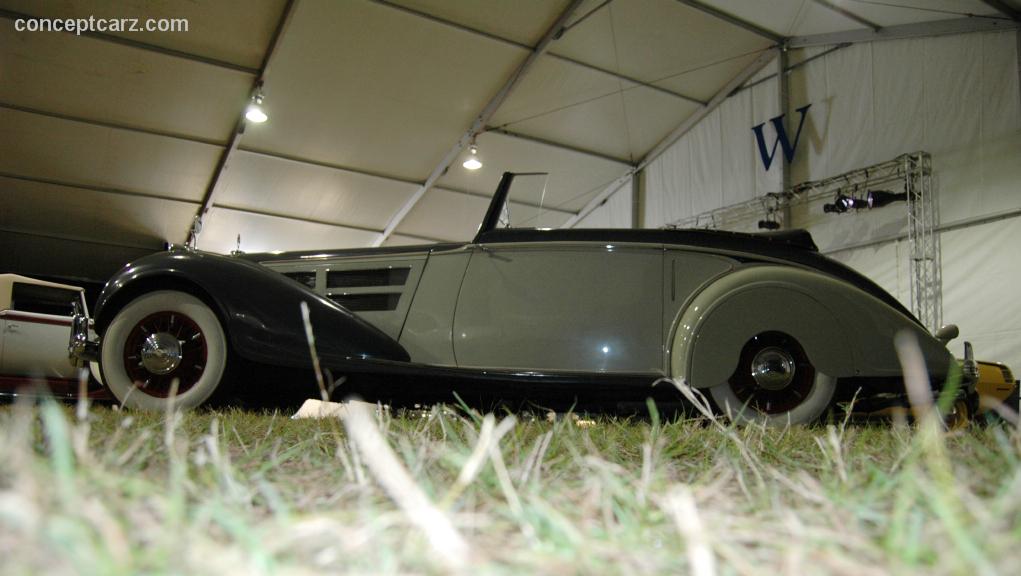
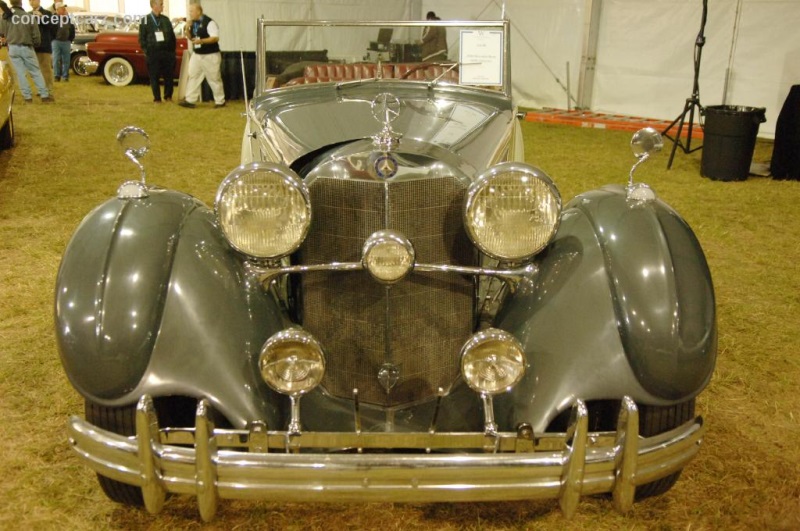
The 1938 Mercedes-Benz 540K Cabriolet finished in two-tone Grey livery with Burgundy wire wheels and matching interior was offered for sale at the 2006 Worldwide Group Auction held on Hilton Head Island. It was expected to fetch between $800,000-$950,000. It has had only three owners from new and is has a beautiful, one-of-a-kind body courtesy of Vanden Plas. The commission number is 271790. The semi-skirted rear wheels are a unique feature that adds ambiance to the vehicle. The sloping rear deck carefully guards a spare tire and provides cargo room for its occupants.

The first owner was Mr. Randolph Hearst who was the son of the publisher, William Randolph Hearst. The grandfather, George Hearst, had established the family's wealth through the California goldmines and a newspaper business. Randolph Hearst grew that wealth by expanding the newspaper business into a media and industrial empire.

Though there was interest in the vehicle at the auction, the highest bid failed to meet the reserve and the vehicle was left unsold.

By Daniel Vaughan | Nov 2006
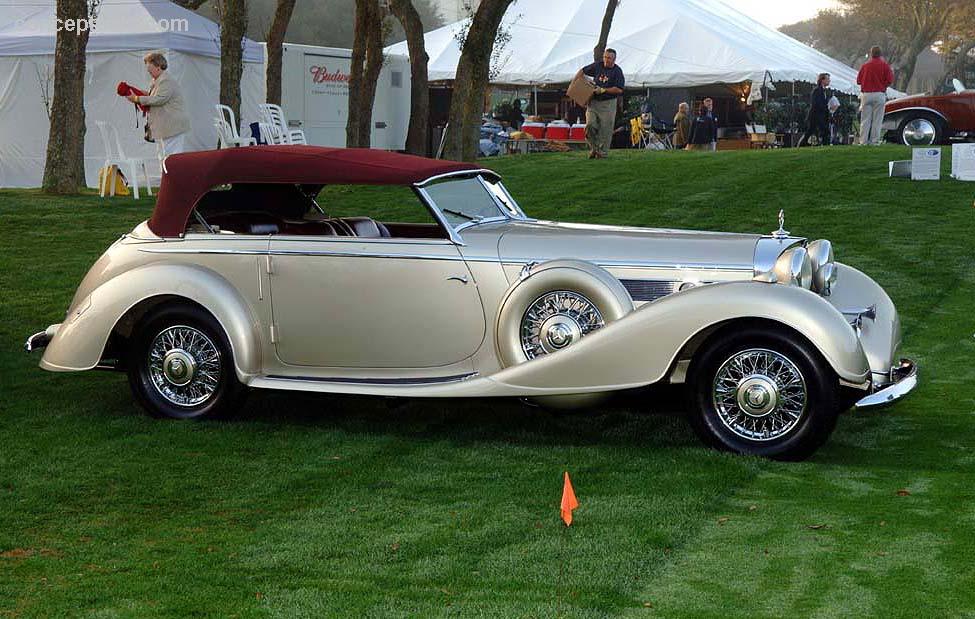
Special Tourer
Coachwork: Sindelfingen
 
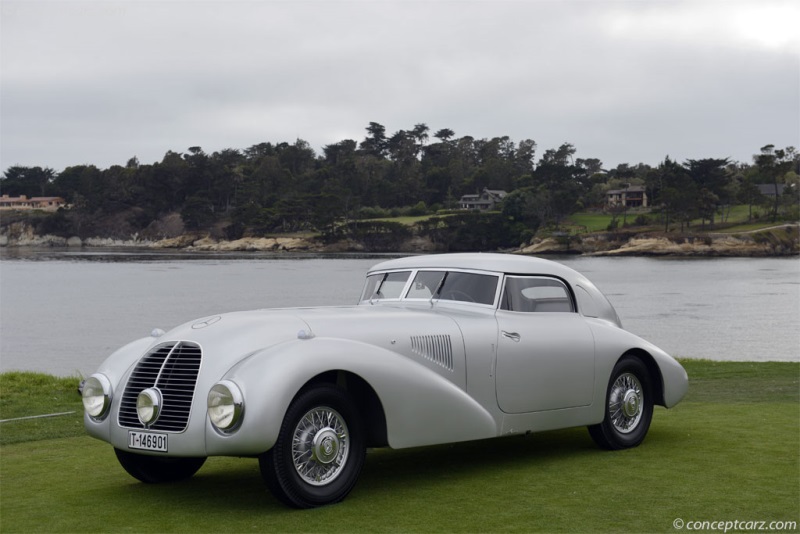
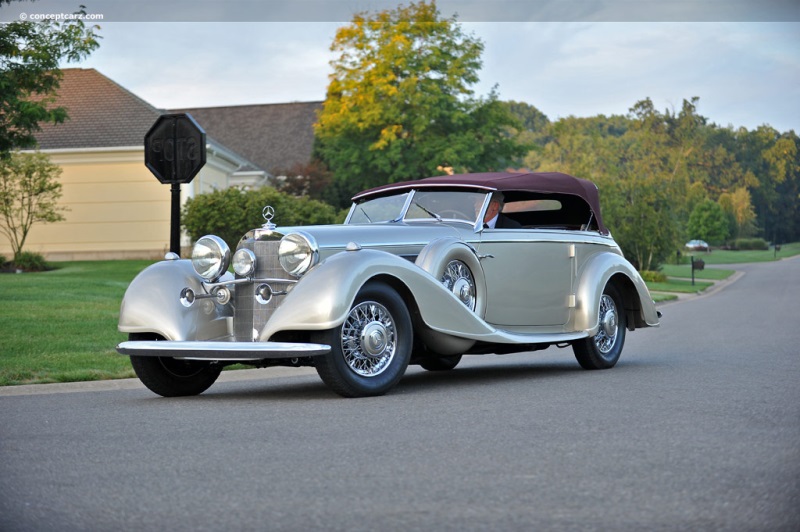
The spiritual descendant of the legendary Mercedes-Benz SS/SSK models, the 540K was introduced in October of 1936 as the successor to the remarkable 500K. With more than 180 hp available, they were advertised as the fastest production cars in the world. Highly advanced for their era, they also benefited from some of the most striking coachwork of the prewar era. These massive automobiles were fitted with a 5.4-liter overhead valve, inline eight-cylinder engine driver-activated and gear-driven Rootes-type supercharger, twin pressurized updraft carburetors, four-speed transmission, four-wheel fully independent suspension and vacuum-assisted hydraulic brakes. Although Sindelfingen built a variety of Cabriolet bodies, a handful of special bodies were also built. This example is one of the most striking of these; it combines the four-passenger capabilities of the Cabriolet B with the elegant design cues of the legendary Special Roadster, including the magnificent 'vee' windshield. Less obvious but equally important is the sleek, disappearing top. The result is one of the most attractive bodies ever offered on the 540K chassis, and the rarest. Over 30 Special Roadsters were built, but it is believed that only two Sport Tourers were built, and this one is the only known survivor.

Thanks to the use of the supercharger, the 540K Mercedes models were part of a small set of passenger cars of the 1930's that were able to reach and exceed 100 mph (160 km/h). The use of supercharging earned Mercedes a legendary reputation in racing car circles. The 500K and 540K used racing technology, but were elegant and luxurious passenger cars. The bodies of the nicest examples of the 540 are the result of Mercedes internal work and not, as it was common in the times, of cooperation with external body-makers. They were produced in the Sindelfingen plant that had 1,500 employees and a production capacity of 500 bodies a month. The most luxurious bodies were treated with special care by a sort of 'special department.' There were numerous types of bodies available, from a coupe with a fixed roof to seven-seat formal sedans. Following WWII, this car was stored by an enthusiast in Dresden to hide it from Soviet officials. The man's house had a basement garage and after securing the car in it, he bricked up the entrance and filled the driveway with topsoil, planting a rose garden above it. With the fall of the Berlin wall, he felt it was safe to bring the car out and sell it to earn badly needed retirement funds. At the time, the car was highly original, but significantly deteriorated by age. The restoration of the car was completed in 2005.
Roadster
Designer: Friedrich Geiger
 
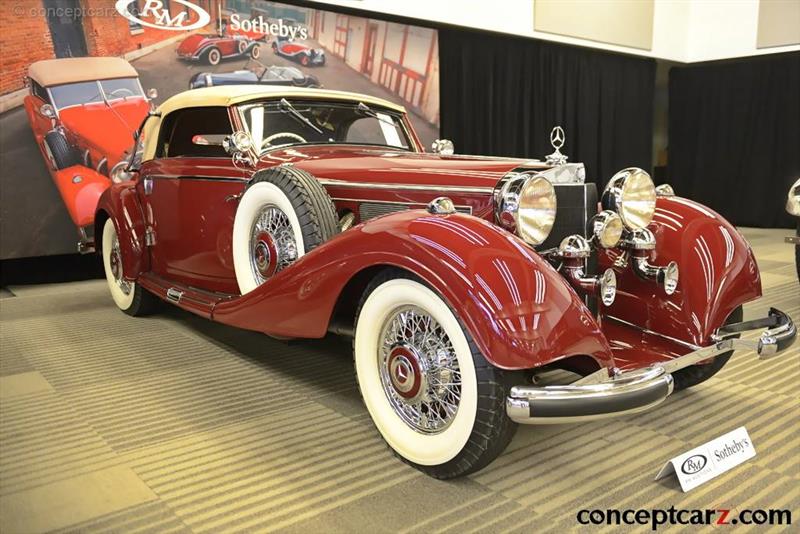
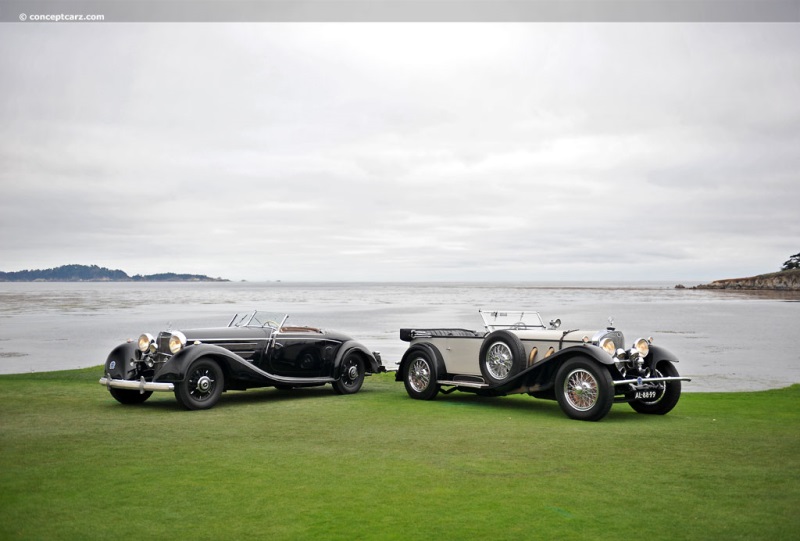
This German built automobile was designed by Friedrich Geiger. In the mid-1930s, the 500K and then the 540K reigned atop the Mercedes-Benz car line, and their most fabulous iteration was the Special Roadster. The 1937 Mercedes-Benz 540K Roadster was the centerpiece of the 1937 Berlin Motor Show. This car was the choice of royalty and celebrities. This automobile is called a 'special roadster' with styling that epitomizes everything classic about style, power and sophistication. Styling features included an extended hood, a raked, V-shaped radiator and external exhaust. This car is truly unique.
Cabriolet A
Coachwork: Sindelfingen
Chassis Num: 169316
 
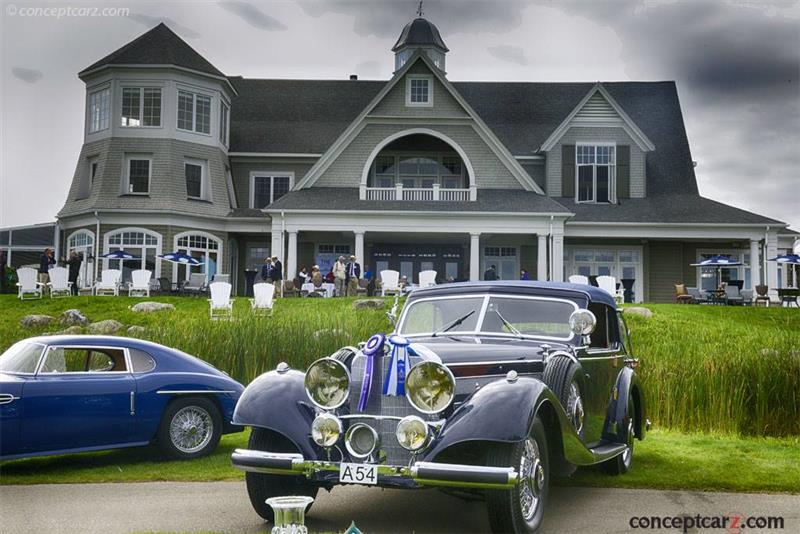
With an appearance that one journalist of the 1930s described as having 'aggressive styling and Teutonic arrogance,' the 540K was indeed an awe-inspiring automobile. The 5.4-liter OHV straight eight engine with Roots blower was the final evolution of the 380/500/540K series delivering a breathtaking 180 horsepower with the blower engaged. it was advertised as the fastest production automobile in the world with well over 100 mph maximum speed and the ability to cruise the new German Autobahn effortlessly at 85 mph. In 1937, any automobile that could achieve triple digits was immediately legendary. This example is a seldom seen right-hand drive version built for sale in Great Britain. The English owner of the car drove it to Italy, and while he was there, World War II erupted. He fled to England, leaving the car behind. An American soldier 'liberated' the car, brought it to the United states, and sold it to a friend of J.B. Nethercutt's, from whom J.B. purchased it.
Special Tourer
Coachwork: Sindelfingen
 
Prior to World War II, Mercedes-Benz reached the zenith of luxury car creation with their 540K series of car. Coming from a long heritage of powerful 6-cylinder supercharged cars, beginning with the S-Type and SSK, the 8 cylinder 540K was the culmination of years of development and refinement. Ferdinand Porsche started the development of the S-Type and SSK and Hans Nibel continued it into the 380K and 500K. The 540K was introduced in 1936 and developed 180 horsepower when the supercharged was engaged. Only 419 examples were constructed.

At 128-inches, the 540K had a 12-inch longer wheelbase than its predecessors. The longer wheelbase allowed the hood to be extended and the radiator pushed back. This gave the designer more liberty with the front fender shape. The factory coachworks Sindelfingen Werks produced a variety of custom and semi-custom bodies. Many of the Cabriolet type bodies suffered in appearance from the awkward look of the top when it was down. The finest bodies had disappearing tops, such as the Special Roadster. About 30 Special Roadsters were built.

Even rarer than the Special Roadster is this Special Tourer. With four passengers, the top is very difficult to engineer to completely disappear. Only two such cars were built and this is the only survivor. This car has been restored to its exact original configuration with all patterns taken from the original upholstery and top. It is repainted in the original subtle Champagne Silver.
Special Roadster
 
Although over 17 feet long, the Special Roadster seats just two passengers. Equipped with a supercharger, the blower produced a 7 psi boost, adding a further 65 BHP at 3400 RPM resulting in a top speed of over 110 mph. About 400 540Ks were built, but just 26 of those were Special Roadsters, each priced at 28,000 Reichsmarks - about $12,000.
Cabriolet A
Coachwork: Sindelfingen
Chassis Num: 169396
 
Sold for $1,312,500 at 2013 Bonhams.
The Mercedes-Benz 540K was a development of the 500K and shared the same independent suspension chassis. The 540K was one of the first models developed under Mercedes' new chief engineer, Max Sailer. Powering the 540K was a 5.4-liter supercharged straight-eight engine featuring the company's Roots-type supercharger system in which pressing the accelerator pedal to the flood would simultaneously engage the compress. it would also close off the alternative atmospheric intake to the carburetor. This system had been developed, tested, and proven on the Dr. Porsche-conceived S-Type cars.

Making its debut in October of 1936 at the Paris Salon, the 540K offered 115bhp in un-supercharged form, or 180bhp with the compressor engaged. The gearbox was a four-speed, but with a direct top gear rather than the overdrive ratio used on the earlier 500K. Braking was handled by servo-assisted hydraulic drums.

The Mercedes-Benz 540K was one of the genuine 100mph road cars available during the 1930s. In supercharged form (and at a cost of around 11mpg petrol consumption), the 540 could approach speeds of 110 mph. (85mph when the supercharger was disengaged).

In 1938, a revised 540K was introduced featuring an oval-section chassis tube instead of channel frame members. In keeping with the company's successful racing practice, the engine adopted sodium-cooled valves.

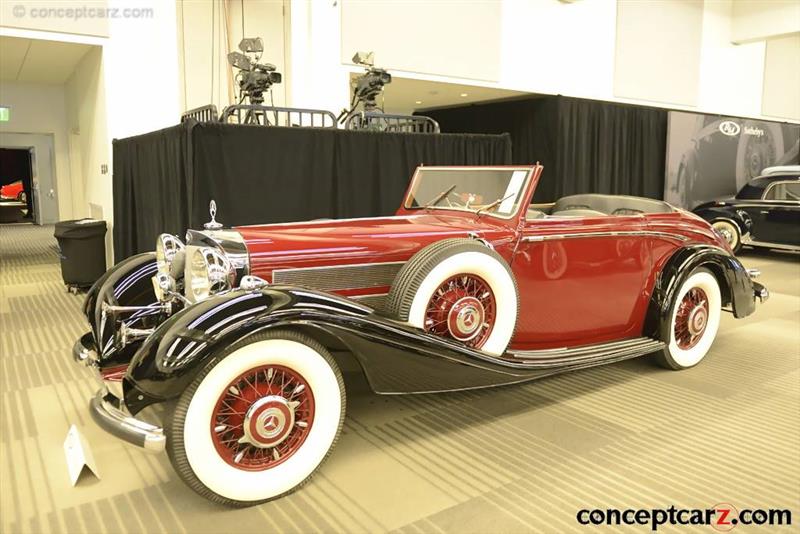
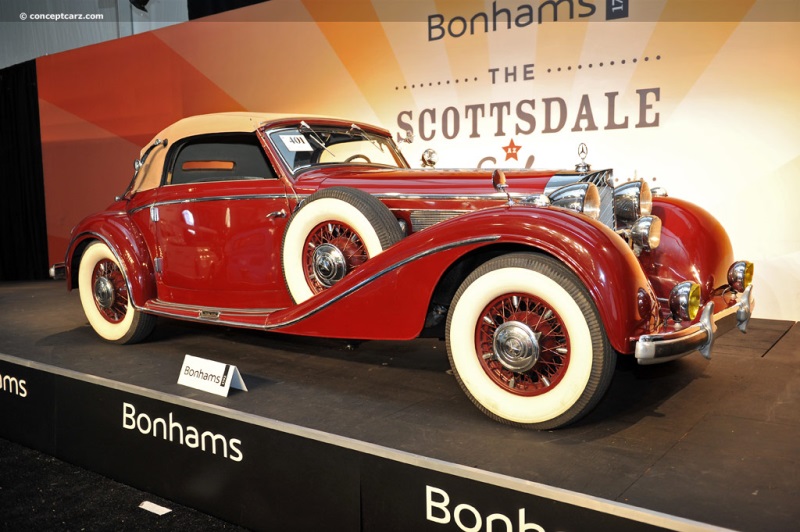
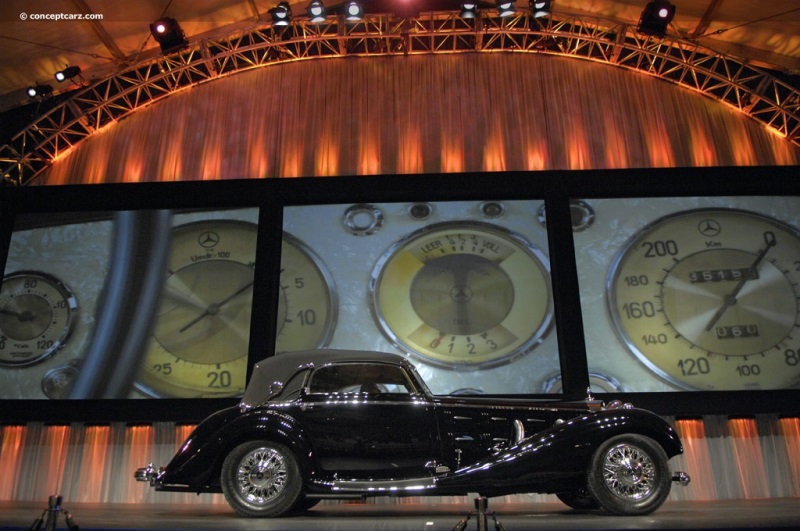
This example is a Cabriolet 'A' with two-door, 2+1 seater coachwork built by Mercedes' own Sindelfingen coachwork. The design was handled by Hermann Ahrens, design chief at Sindelfingen. It rides on wire wheels, twin side-mounted spares, exposed landau irons, twin horns and a center spotlight.

The order number for this car was 262498 and it was one of at least two cars in this series delivered to Mercedes-Benz of Paris at that time. The car was completed early in 1938 and transferred to Paris on March 20th of 1938. Though its very early history is not known, it was brought to the United States by an Army officer, Colonel William H. Kendall of Sarasota, Florida. Col. Kendall retained the car until 1970, when ownership passed to Paul Karassik. Mr. Karassik would keep the car for more than four decades. A short time after Mr. Karassik purchased the car, he treated it to a refurbishing with new paint in the deep burgundy tone which it still wears. The original leather was re-dyed and a new top was fitted.

Period features include a round faced Becker Radio, fabric radiator cover, and a fold away luggage rack.

There were just 97 examples of the 540K produced in 1936. 145 were built in 1937, 95 in 1938 and 69 in 1939. An additional three more cars were built up to July 1942. It is believed that around 83 examples were the Cabriolet A body style.

In 2013, the car was offered for sale at the Bonhams Auction in Scottsdale, Arizona. As bidding came to a close, the car had been sold for the sum of $1,312,500 including buyer's premium.

By Daniel Vaughan | Feb 2013
The Mercedes-Benz 500K was introduced in 1934 with the 'K' representing a Kompressor which is German for supercharger. In non-aspirated form, the engine produced 100 horsepower. With the adoption of the Kompressor the horsepower jumped to an impressive 160 making them one of the fastest grand touring cars of their time. The vehicles rode on a 116 inch wheelbase.

In 1936 the 540K was introduced which increased power even further. The base version produced 115 horsepower while the supercharged increased horsepower to 180. The engine bay was lengthened and the wheelbase was extended by twelve inches which allowed for more stately and elegant vehicles. Chrome accents were used throughout added to the visual appeal. The vehicles were elegant, powerful, and produced in limited numbers. Production continued until 1940 with only 419 examples being produced.

The Mercedes-Benz were among the most desirable and elegant vehicles of their day. They were constructed of the finest materials available. The craftsmanship is legendary and undeniable excellent. Most of the chassis received coachwork by the Mercedes-Benz in-house coachworks facility named the Sindelfingen Body Works. The others were sent to coachbuilders such as Erdmann & Rossi.

When completed, the vehicles carried a price tag that only few could afford. During World War II many were hidden and protected along with other priceless works-of-art.

Though the 540K models were all built to the same mechanical and chassis configurations, they varied based on their coachwork designs making many unique creations. Configurations varied such as four-seat cabriolets, long-tail roadsters, and high-door luxury styles. The vehicles were tailored to the buyer's requirements and requests.

With production low and craftsmanship at their peak, these vehicles are well sought after in modern times. They continue to win 'Best in Show' and class awards at various concourses throughout the country.

By Daniel Vaughan | Aug 2006
Two new – and very different – Mercedes models were displayed at the Berlin Motor Show in March 1934. One was the 130, Mercedes-Benz's first production car wîth a rear-mounted four-cylinder engine which developed 26 hp from a displacement of 1.3 liters. The other was the 500 K, an imposing, elegant sports car wîth supercharged eight-cylinder engine; wîth the supercharger engaged, it developed 160 hp from a displacement of 5,018 cc.
The 500 K was the successor to the 380 presented only one year earlier, and a descendant of the tremendously powerful, supercharged S, SS, SSK and SSKL sports cars – genuine muscle cars, as we would call them today, and virtually invincible in motor sport.

The first 500 K – 'K' for Kompressor = supercharger, to distinguish it from the 500 sedan without supercharger – had been designed as an elegant two- or four-seater sports car wîth roadster and cabriolet bodies tailored at the Daimler-Benz plant in Sindelfingen. With this model, the company bid farewell to the Roaring Twenties and the Big Four mentioned earlier. The latter had still had extremely firm chassis wîth rigid axles and leaf springs, i.e. hardly any damping at all, and their bodies were plain and above all functional, not to say uncomfortable.

The new supercharged Mercedes sports car appealed to well-heeled buyers because it was not only powerful but also more elegant, more comfortable and easier to handle than its predecessors – features welcomed in particular by the growing number of lady drivers.

Daimler-Benz had laid the foundations for this type of car as early as 1933 by introducing the 380, the first Mercedes-Benz sports car wîth swing axle. It was the first car that pampered its occupants wîth independent wheel suspension; the latter featured a sensational world first, a double-wishbone front axle that combined wîth the double-joint swing axle introduced in the 170 as early as 1931.

In this ground-breaking design, wheel location, springing and damping were for the first time separated from each other, creating a new level of precision in straightline stability. In its essence, this front axle, fitted like the rear axle wîth coil springs, has remained the design model for generations of automobiles throughout the world to this day, and it also featured in the 500 K, of course.

It was the customers' craving for power, however, that prompted the replacement of the 380, not exactly a lame duck wîth its supercharged 140 hp, by the 500 K only one year later. The newcomer's engine generated 160 hp wîth the supercharger engaged; even without the supercharger in action, it still had an impressive output of 100 hp at 3400 rpm. Depending on fuel quality, which varied greatly in those days, the compression ratio was between 1:5.5 and 1:6.5. The fuel was apportioned to the cylinders by a Mercedes-Benz double updraught carburetor. The driver engaged the double-vane Roots supercharger by depressing the accelerator pedal beyond a pressure point.

With the exception of first gear, both the standard four-speed and the optional five-speed transmissions were synchronized. A single-plate dry clutch linked the engine wîth the powertrain which transmitted engine power to the rear wheels. The car rolled along on wire-spoke wheels which were as elegant as they were robust.

All these features combined to permit a top speed of 160 kilometers per hour – a dream for sports cars in that day and age. The penalty was paid in the form of fuel consumption: between 27 and 30 liters were blown through the carburetor on 100 kilometers. The 110-liter tank in the rear gave the car a decent radius of action.

To meet the individual wishes of the demanding customers, three chassis variants were available for the 500 K: two long versions wîth a 3,290 millimeter wheelbase, differing in terms of powertrain and bodywork layout, and a short version wîth 2,980 millimeters.

The long variant, the so-called normal chassis wîth the radiator directly above the front axle, served as the backbone for the four-seater cabriolets 'B' (with four side windows) and 'C' (with two side windows) and, at a later stage, also for touring cars and sedans.

The roadsters, the two-seater cabriolet 'A' (with two side windows) and the ultra-modern, streamlined Motorway Courier, the first car wîth curved side windows and classified by the manufacturer as a sports sedan, were set up on a chassis on which radiator, engine, cockpit and all rearward modules were moved 185 millimeters back from the front axle. This configuration was a concession to the zeitgeist, a small trick that created the visual impression of a particularly long front-end and, therefore, the desired sporting appeal.

The most ravishing model of this species was the two-seater 500 K special roadster launched in 1936, a masterpiece in terms of its styling, wîth inimitably powerful and elegant lines. It has been filling onlookers wîth enthusiasm to this day, reflecting, as it does, the spirit of its day and age as well as the design perfection of the 500 K models. Its price tag – 28,000 Reichsmark – was 6,000 marks above the average price of 'simpler' models. People were able to buy a generously furnished house for that money.

The short-wheelbase chassis was used only for a few two-seaters wîth special bodies. On these models, the radiator was back right above the front axle, and the models carried the designations 500 K sports roadster, sports cabriolet and sports coupe.

The 500 K's chassis complete wîth helical-spindle §teering had been adopted – though in further refined form – from the preceding 380: the new double-wishbone axle wîth coil springs at the front and the double-joint swing axle - complemented by double coil springs and additional transverse balancing spring – at the rear. The vacuum-boosted service brake acted hydraulically on all four wheels, the mechanical parking brake on the rear wheels. The chassis weighed as much as 1,700 kilograms; the complete car tipped the scales at 2,300 kilograms and the permissible gross weight was around 2,700 kilograms.

No matter what version of the 500 K you look at, the elegance of its body sends people into raptures even today: every single one had been given its own, unparalleled personality by the ingenious coachbuilders in Sindelfingen. Only few customers opted for bodywork tailored by independent bodybuilders to their own wishes (the price lists quoted the chassis as individual items), especially since the Sindelfingers rose above themselves in accommodating the customers' special wishes, for instance for individual fender versions, rear-end designs or interior appointments. Within two years, 342 units of the 500 K were produced.

In response to the virtually insatiable craving for performance on the part of well-heeled customers all over the world, the 500 K was replaced in 1936 by the 540 K wîth supercharged 180 hp engine. This model was sold to 319 motoring enthusiasts.

The history of supercharged Mercedes-Benz cars goes back to World War II and has its roots in aeroengine production. Daimler-Motoren-Gesellschaft had introduced mechanical air compressors which supercharged the engines and thereby compensated for the power loss of aeroengines at higher altitudes, ensuring their stable performance.

The first Mercedes models wîth supercharged engines were displayed at the Berlin Motor Show in 1921 – between bicycles wîth auxiliary engines and mini-cars. They caused quite a stir among automotive experts. With the supercharger, an engine booster had been introduced which, from 1926, catapulted Mercedes passenger, sports and racing cars into a new dimension of performance.

Source - Mercedes-Benz
For more information and related vehicles, click here

Auctions America Readies for Highly Anticipated Spring Carlisle Collector Car Weekend
• Auctions America returns to Carlisle, Pennsylvania for its annual Spring Carlisle sale, April 25-26 • Two-day sale lifts the gavel on a diverse roster of approximately 300 quality collector cars • Notable highlights include a rare 1959 Chevrolet Corvette 'Big-Brake' Fuel-Injected Roadster, a 1970 Chevrolet Chevelle SS LS5 Convertible and a 1999 Bentley Azure Convertible • Sale held during Carlisle Events' highly anticipated Spring Carlisle Collector Car Swap Meet & Corral weekend, April 24...[Read more...]
VICARI AUCTION COMPANY OFFERS RARE '62 & '63 Z06 CORVETTES AT 2013 CRUISIN' NOCONA
In a recent rare find, two classic Chevrolet Corvettes (one '62 and one '63) - stored for decades-are being made available by the Vicari Auction Company. Both vehicles will cross the block during 2013 Cruisin' Nocona, a north Texas collector car auction and classic car poker cruise set for April 19th and 20th in historic Nocona, Texas. The Corvettes are virtually all-original, and have been stored in Texas by a classic-vehicle aficionado and collector since the 1980s. 'These...[Read more...]
Auctions America's 2013 Auburn Spring Event Offers Ultimate Collector Car Weekend
• Auctions America presents the first of two annual Auburn sales, May 9 – 11 at historic Auburn Auction Park in Auburn, Indiana • Multi-day sale lifts gavel on 600 quality collector cars and an assortment of memorabilia • Notable early highlights include selection of Hudsons from the respected John Soneff Collection • Weekend also features inaugural Antique Automobile Club of America Central Division National Spring Meet, and an extensive car corral and swap meet presented by Carlisle Events...[Read more...]
The Champion in Touring Car Racing : The BMW M3
In August 1985, a rumour surfaced in motor magazine Auto-Deutschland which emanated from a new sports car. An A Group Car from BMW that was a thoroughbred racing car according to the rules but was also to be produced in a version licensed to drive on open roads for everyday use. Speculation about this dream car that could take to normal roads and was intended for the 'Most dynamic among BMW 3 Series drivers' was right on target. But the pundits missed the mark about the motor-sport car by a mile...[Read more...]
Auctions America By RM's 2012 Auburn Spring Auction
'Variety' is the buzzword for this year's Auctions America by RM June 1-3 Auburn Spring auction, which will offer a huge range of collector vehicles and an enormous private collection of automotive memorabilia. More than 600 American muscle cars, Classics, foreign sports cars and hot rods will cross the block at the historic Auburn Auction Park, the company's national headquarters in Auburn, Indiana. 'Last year was our first spring event at the park,' said Auctions America by RM's President ...[Read more...]

Arrow Right 1938 Mercedes-Benz models
Mercedes-Benz W154

Similar Automakers
AudiBMW
InfinitiJaguar
Land RoverLexus
Similarly Sized Vehicles from 1938
Buick Y-Job Concept
Rolls-Royce Phantom III

 
Mercedes-Benz: 1931-1940
Similar Automakers
Other models by Mercedes-Benz
Manufacturer Website

Related Articles and Event Coverage
Bonhams - The Scottsdale Auction
Glenmoor Gathering of Significant Automobiles
Pebble Beach Concours d'Elegance
61st Pebble Beach Concours d'Elegance
Concours d'Elegance of America at St. John's
Amelia Island Concours d'Elegance
The Scottsdale Auction : Gooding & Company
Amelia Island Concours d'Elegance
Meadow Brook Concours d'Elegance
Ault Park Concours d'Elegance
Amelia Island Concours d'Elegance
Worldwide Group Auction at Hilton Head Island
2006 Meadow Brook Concours d'Elegance
2005 Pebble Beach Concours d'Elegance
2005 Amelia Island Concours d'Elegance

Mercedes-Benz
Monthly Sales FiguresVolume
May 201325,561 
April 201325,490 
March 201326,175 
February 201323,268 
January 201323,578 
December 201230,376 
November 201231,945 
October 201225,644 
September 201223,156 
August 201222,686 
July 201219,311 
June 201222,231 
(More Details)

 
170
180 Series
190
200 W21
220
250
28/95HP
280
290
300
300D
320
37/90Hp
370 S
380
400
450
500
540K
560
600
630K
710 SS
770
B-Class
C-Class
CL-Class
CLK GTR
CLS
E-Class
G-Class
GL-Class
GLK Class
M-Class
McLaren SLR
Model S
R-Class
R107
S-Class
Simplex
SL-Class
SLK
SLS AMG
SSK
Vision S500
W123
W126
W154
W196 R Streamliner

Image Left 1937 540K1939 540K Image Right
© 1998-2012. All rights reserved. The material may not be published, broadcast, rewritten, or redistributed.