Concept Cars Home
 

1955 Kurtis 500SX news, pictures, and information

Roadster
Chassis Num: 3
 
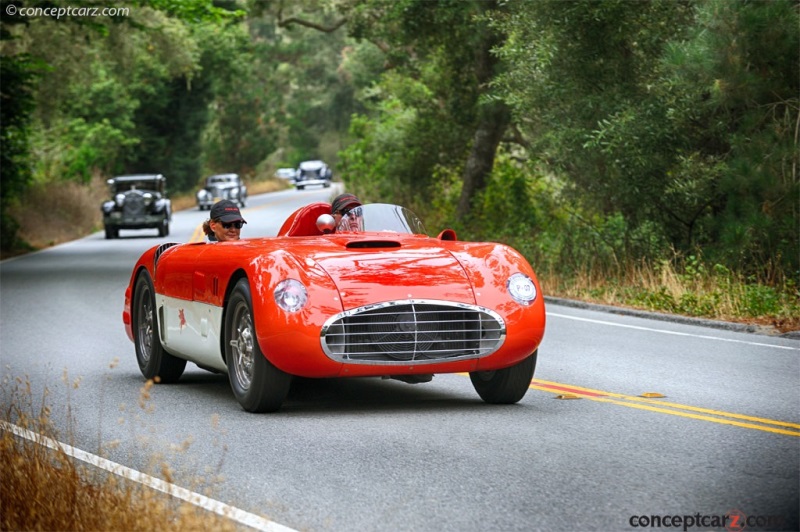
Los Angeles mega dealer Bill Murphy purchased this rare 500X Kurtis sports car in August 1955. It is serial number 3 of 6 500X cars built by Frank Kurtis and the Kurtis-Kraft Company. Sam Hanks, an Indy driver and employee at Bill Murphy Buick, was the car's assistant engineer, crew chief and pre-race shake down driver. In the two years the car raced - September 1955 through September 1957 - it scored 9 overall wins and 18 class wins at tracks throughout Southern California from Torrey Pines to Riverside.

The Murphy Kurtis has the same basic design feature of the Kurtis Indy roadster of the era - 4120 chrome moly tubing for the frame, 4-bar torsion suspension, hand-formed aluminum panels and Halibrand quick change rear end and magnesium wheels. A 364 cubic-inch Buick nailhead engine with Hilborn fuel injection supplies the power and is coupled to a Jaguar 4-speed XK-140 transmission.

The 500SX sat at Murphy's dealership for two decades until it was purchased in 1979 by Rich Siefried. The Kurtis resumed its winning record at the 1980 Monterey Historics and it also won the Pebble Beach Cup.

This example has the original engine, drive train, body and frame members with only fresh paint and upholstery added.
Roadster
Chassis Num: SX-001
 
Sold for $852,500 at 2007 Barrett-Jackson.
Sold for $500,000 at 2011 RM Auctions.
The cars built by Frank Kurtis enjoyed overwhelming success at the Indy 500 during the early 1950s. At the 1953 race, 21 Kurtis cars finished in the money, and 56 entries were Kurtis-Kraft, though not all qualified. Cars built by Kurtis won Indianapolis in 1950, '51, '53, '54 and '55 and filled out the top 10 places in the other years.

He proved he could be successful in the racing arena, but the question remained as to if he enjoy the same success selling sports cars to the public. In 1949, he created an aerodynamic two-seater and produced 36 examples before selling his design to Earl 'Mad Man' Muntz, who stretched the wheelbase into a large four-seater.

In 1951, Kurtis created the 500KK kit chassis. It had a tube frame, solid axles and torsion bar suspension. These kits were designed to carry a number of fiberglass bodies, from Glasspar, Woodill, Allied and Victress of have the minimalistic Indy configuration with fenders as an add-on. The chassis was available in sizes that ranged from 88-inches to 100 inches. Power was from a wide range of engines including Ford flatheads, Cadillac V8s, and Chrysler's new Hemi.

In 1954, a complete version of the KK became available, known as the 500S, with aluminum body and cycle fenders. In total, 21 examples were built. These vehicles proved to be very competitive on the racing circuit.

In an attempt to cater to a larger market, Kurtis tried again with a Corvette-like roadster, the 500M in 1954. This model had a fiberglass body with recessed side panels, often in contrasting colors, and steel panels around the passenger compartment. Kurtis produced 25 examples of the 500M before production ceased in 1955. A joint business deal with McCullough proved disastrous and bankrupted the company. Kurtis ceased building cars in 1957.

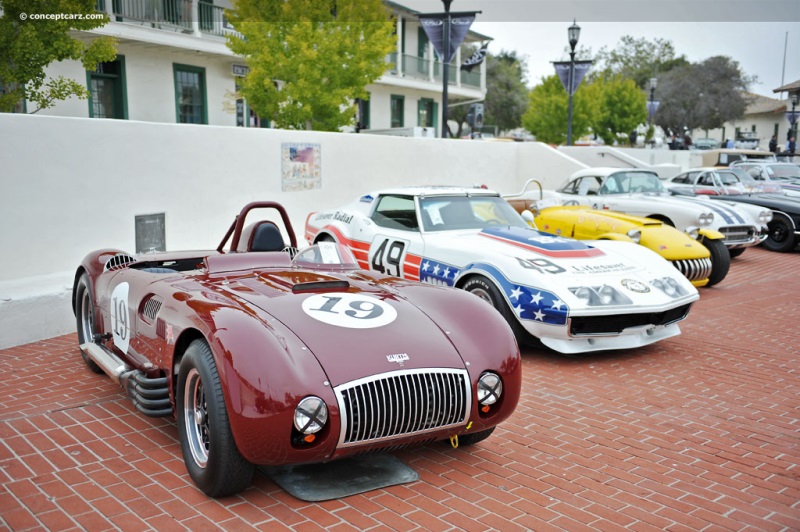
It is believed that 12 500SX chassis were completed and generally agreed that six were sold as rolling chassis and four as kits. Four 500SXs were reportedly completed by the factory. In similar fashion to Bill Vukovich's 1953 Indy 500 winning chassis, they had solid axles and four torsion bars, which were individually adjustable for ride height and handling. Wheels were Halibrand magnesium, and the cars had a quick-change rear end, disc brakes, Borg-Warner or Jaguar four-speed transmissions and a choice of engines.

Different from the earlier cars, the left suspension bracket was able to rotate while the right was fixed firmly in place. The battery and fuel tank were moved as far back as possible to create the best possible weight distribution. The frame was a fully tubular space truss, widened at the cockpit for FIA sports car rules. The body was from aluminum panels that could be removed quickly with Dzus fasteners. The passenger side of the car was the only side that had a door. The total weight was a mere 2200 pounds and the cost was in the neighborhood of $6,000 without an engine.

Chassis SX-001
This example was ordered new by Albert Hosking of El Monte Cadillac in California. The build was chronicled in the February 1955 issue of Hot Rod magazine. SX-001 was later sold to Mickey Thompson, the racer who at one time held almost 200 FIA International and USAC national speed records.

Thompson and Jerry Unser raced SX-001 with its original Cadillac motor until Thompson's Pontiac sponsorship led him to change it in the late 1950s, and the car has been Pontiac-powered since then. SX-001 was raced by Paul Cunningham into the 1960s.

The current owner discovered the car in 1996 and commissioned a ground-up restoration in 2002 to exacting standards. The car was found complete, but without an engine and transmission. The search for a correct motor turned up what can only be termed the Holy Grail for this car, which was bought from a noted Indy 500 collector who had saved it for just such an occasion.

Frank Kurtis built an Indy roadster for the Firestone Tire and Rubber Company for high-speed testing in 1958. The engine was a one-off Pontiac motor built by Chicago race engineer Ray Nichels. A limited number of the engines were planned for racing, but production never went past the original unit. It is a 370 cubic-inch OHV V-8 with Hillborn-injection and a dry sump. There are gear-driven Offenhauser water pump and oil pump, Iskanderian camshaft and roller lifters, polished and ported heads, big valves and stronger springs. Also, there are high-compression pistons, steel main bearing caps, Vertex magneto and a magnesium front timing cover, oil pan and rocker covers.

The body is completely original. There is a Borg-Warner T10 transmission, leather upholstery, and has been fitted with modern safety equipment including a built-in fire system, fuel cell, kill switch, rear rain light and safety belts.
In 2011, the car was offered for sale in Monterey, Ca. presented by RM Auctions. It was estimated to sell for $800,000-$1,000,000. As bidding came to a close, the car had been sold for the sum of $500,000, including buyer's premium.

By Daniel Vaughan | Oct 2011
Roadster
 
This 1955 Kurtis 500SX was the fourth 'SX' manufactured. The first six cars, built as rollers not kits, carried an 'SX' designation. The remaining few 'kits' manufactured probably were Xs. This example was 'reportedly' the only LWB model produced.

In late 1955, this car was purchased from Frank Kurtis (Kurtis Kraft) by Joe Zidar of Denver, CO, and it was known as the 'Zidar Special.' The car was raced primarily on the West Coast at such tracks as Riverside, Pomona, Laguna Seca, and as far East as Las Vegas.

The aluminum-bodied car is powered by a 321 cubic-inch V8 engine and uses Hilborn mechanical fuel injection. The on-board hand pump pressurizes the fuel tank and primes the injection system. The wheels are a pin drive, Rudge style knock-off, made of magnesium and were manufactured by Halibrand. The brakes are four-wheel disc plus one hydraulically operated disc emergency brake. Solid axle front and rear are used with a quick-change rear end.
Roadster
 
This 1955 Kurtis 500 SX was sold to the Cambell Brothers (boat manufacturers) in the LA valley. Instead of using the Sutton body, a mistrace body was fitted. The car was later rebodied as the 'Alligator' and won the 1965 SCCA C modified class with Hooper driving.
The Kurtis Kraft 500X began in the mid-1950s and was the successor to the 500M. The basis for the 500X was from the KK500C Indianapolis car. The car rested on a wheelbase that measured 96-inches and powered by an American V-8 engine. The transmission was a four-speed Jaguar unit with Zidar adapters. The entire package was clothed in aluminum panels that were easily removable thanks to the Dzus fasteners. The cycle fenders of the 500S were eliminated. The design was aerodynamic and lightweight.

In total, there were an estimated 12 500X cars built. Half were rolling chassis without the engines. Four were built as kits.

By Daniel Vaughan | Oct 2011
Mercedes-Benz Pays Homage to a Regional Classic at the 2013 Greenwich Concours d'Elegance
The all-new 2014 E-Class Wagon Debuts Alongside a 1957 300c Mercedes-Benz USA debuts the all-new 2014 E-Class Wagon alongside one of its predecessors, a pristine 1957 300c at the 18th Annual Greenwich Concours d'Elegance from June 1-2, 2013. The event features rare vehicles from past and present and benefits Americares, the private, non-profit relief and humanitarian aid organization. With the background of the breathtaking Greenwich seaside, Mercedes-Benz highlights one of the Nort...[Read more...]
Firestone Returns As Presenting Sponsor of RRDC Evening With Brian Redman in Long Beach
The Firestone brand will return as presenting sponsor of the Road Racing Drivers Club's fifth annual West Coast banquet honoring auto racing's most influential leaders. This year, on Thursday, April 18, prior to the running of the Toyota Grand Prix of Long Beach, the 'RRDC Evening with Brian Redman presented by Firestone' will highlight the career of one of the sport's most popular, talented and successful race-car drivers. This is the Firestone brand's fourth straight year as a supporter of the...[Read more...]
Corvette Shines in the Big Apple
All-new Corvette Stingray comes to New York City 60 years to the day after Motorama debut 2013-01-16 Sixty years ago tomorrow, spectators lined New York City's posh Park Avenue, waiting to get a glimpse of the ground-breaking Chevrolet Corvette on display at the General Motors' Motorama show. On Thursday, the Corvette will be back in The Big Apple, marking the historic milestone with the all-new 2014 Chevrolet Corvette Stingray. The all-new Corvette Stingray debuted earlier...[Read more...]
Corvette's Chassis Innovations Refined on the Race Track
Zora Arkus-Duntov's racing-bred development legacy continues to improve Corvette It's been said that racing improves the breed, and when it comes to the Chevrolet Corvette, nearly six decades of checkered flags are the proof. As Corvette marks its 60th anniversary in 2013, the design of the chassis, suspension and other drivetrain features are rooted in the rigors of competition. 'Candidly, Corvette was not a high-performance car until Zora Arkus-Duntov fitted it with a V-8, and be...[Read more...]
Carroll Shelby, Ford Family for More Than Half a Century
Carroll Shelby was a member of the Ford family for the better part of 60 years, producing stunning performance vehicles from concepts to production models. He once said his energy and passion for performance products were always strongest when he was working with Ford. Shelby most recently collaborated with the company on the 2013 Ford Shelby GT500 Mustang, the most powerful production V8 in the world. Working with SVT engineers at Sebring and the Arizona Proving Grounds, at times he drov...[Read more...]
4000
500M
Kraft 500S
Kraft Midget

© 1998-2012. All rights reserved. The material may not be published, broadcast, rewritten, or redistributed.