1936 Auburn 852 pictures and wallpaper 1936 Auburn 852 pictures and wallpaper 1936 Auburn 852 pictures and wallpaper 1936 Auburn 852 pictures and wallpaper 1936 Auburn 852 pictures and wallpaper
1936 Auburn 852 pictures and wallpaper 1936 Auburn 852 pictures and wallpaper 1936 Auburn 852 pictures and wallpaper


1936 Auburn 852 news, pictures, and information

View more photos
Speedster
Designer: Gordon Buehrig
Chassis Num: 2914E
 
The Auburgn 851/852 vehicles were stunning. With Ab Jenkins behind the wheel, a 851 Speedster traveled at 100 mpg average speed for 12 hours making him the first American to this endurance record. In commemoration of this accomplishment, each vehicle was given a dash plaque bearing Ab Jenkins' signature stating that the vehicle was capable of achieving the 100 mph barrier.

Though these vehicles were the complete package, encompassing a daring style, durable engine, and superior performance, they failed to amass a profit. It is estimated that at the $2245 sticker price, the company lost $300.

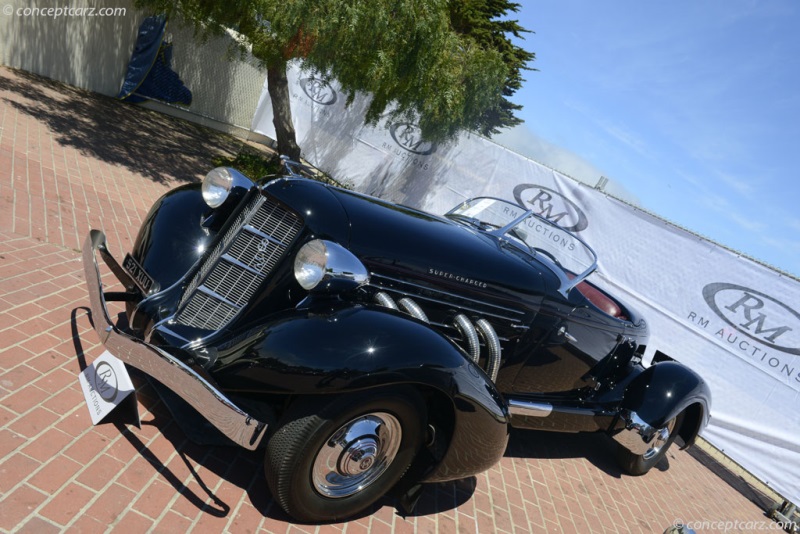
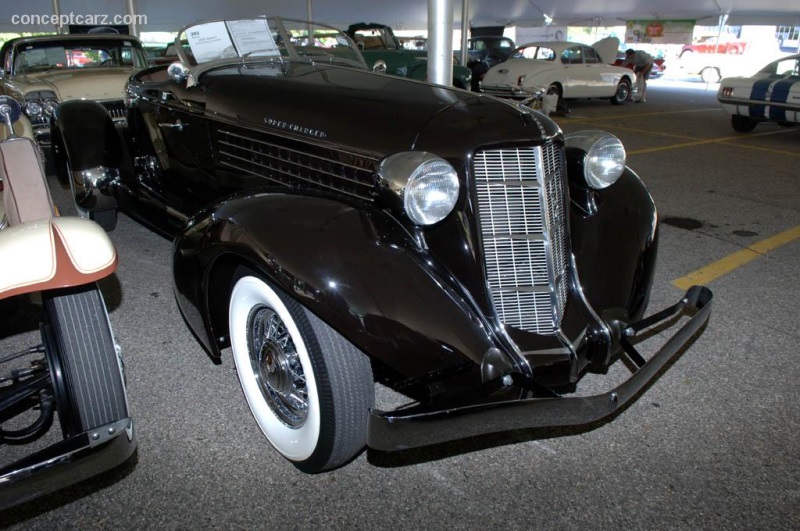
This 1936 Auburn 852SC Boattail Speedster with chassis number 2914E was estimated to fetch between $350,000 - $450,000 at the 2006 RM Auctions at Meadow Brook. After some interest from buyers, the bid achieved $240,000. This was not enough to satisfy the reserve and the vehicle was not sold.

It is equipped with a 280 cubic-inch side valve eight-cylinder engine with Schwitzer-Cummins supercharger that produces 150 horsepower. It sits on a 127 inch wheelbase and is suspended in place by leaf spring and solid axle front suspension. In the rear are leaf springs and a live rear axle. Brakes are four-wheel hydraulic drums.

In 2003 it was entered in the Meadow Brook Concours d'Elegance where it received the coveted Peoples Choice Award. It has also been awarded an AACA National First Prize.
View more photos
Speedster
Designer: Gordon Buehrig
 
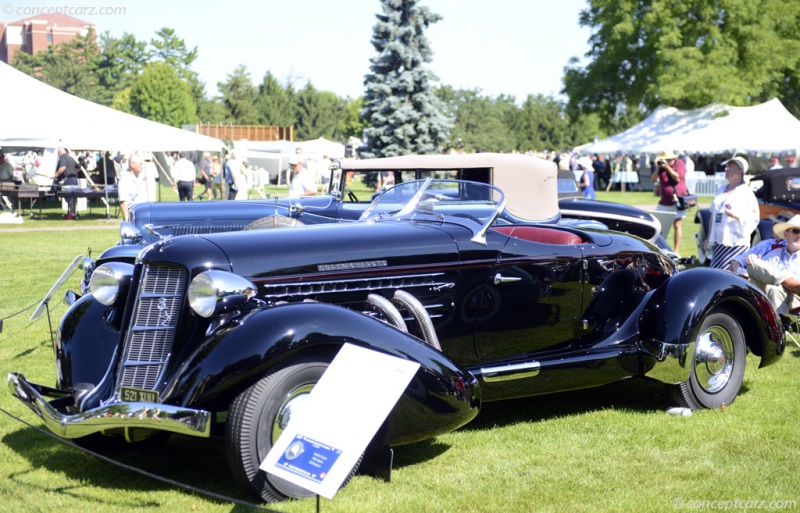
Priced at $2,245, the elegant Auburn Speedster marketed in 1935-1936 was a 'loss leader' intended to stimulate showroom traffic. The Auburn Speedster was a two-seat roadster introduced in 1928. After Auburn discontinued its V12 models, Gordon Buehrig was called in to design a car from leftover Speedster bodies. The long-hooded front was made to conform to the new 851 sedans he had already designed, and the rear retained the original Speedster's pointed 'boat tail,' which, along with pontoon fenders, Vee-type windshield, cutout doors and four showy chrome-plated exhaust pipes on the left side, contributed to a rakish appearance. The Speedster for 1936 - Auburn's last year - was identical except for the '852', rather than the '851' on the radiator. With racing driver Ab Jenkins at the wheel, the Auburn Speedster set more than 70 speed records and, at one time, held all U.S. stock-car speed records up to 24 hours and 15,000 miles. A dashboard plaque on each car contained a signed guarantee by Jenkins that it had been driven to more than 100 mph before shipment. This example has been extensively restored, both cosmetically and mechanically, and has won many of the competitions in which it has been entered.
View more photos
Speedster
Designer: Gordon Buehrig
Chassis Num: 852-34631E
Engine Num: GH4742
 
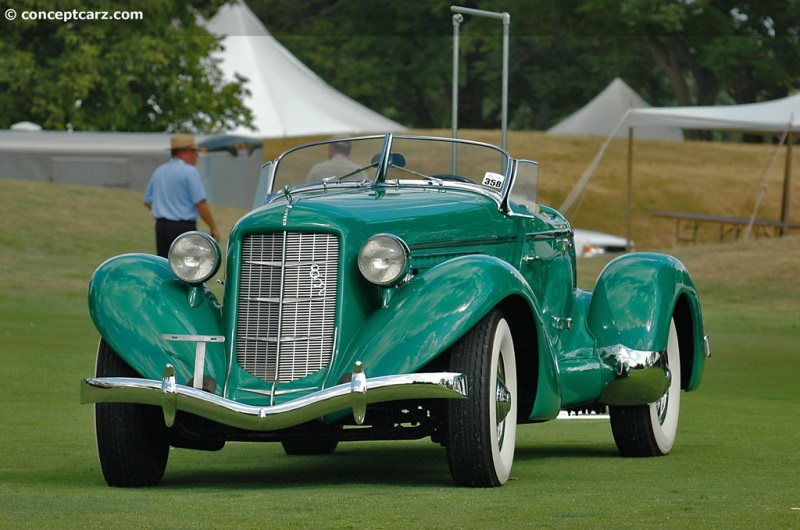
This 1936 Auburn Model 852 Straight Eight Supercharged 'Boattail' Speedster was offered for sale at the 2007 Christie's auction of 'Exceptional Motor Cars at the Monterey Jet Center.' It has a turquoise exterior with beige leather interior. It is powered by a Lycoming eight-cylinder engine with side-valves, and a Schwitzer-Cummins supercharger. The 279.9 cubic-inch engine is capable of producing 150 horsepower.

The Art Deco designed 852 was a flamboyantly designed vehicle that featured a racked windshield and tapered tail, accented with chrome trim throughout.

A.B. Jenkins drove a stock Auburn on the Bonneville Salt Flats to an American class speed record and proving the vehicles potential. Sadly, the company officially closed its doors in October of 1937.

This turquoise Speedster has been treated to restoration, though it was completed in the 1980s. The restoration still appears very fresh in modern times. At auction the car was offered without reserve and estimated to fetch between $250,000 - $450,000. That estimate proved to be accurate, as a willing buyer was found. Including the buyer's premium, the car found a new owner for the price of $423,500.

This year marked the end of the Auburn automobiles. The Auburn line for 1936 consisted of three six-cylinder models and four eight-cylinder models. This 1936 Auburn 852 Supercharged Dual Ratio speedster is an extraordinary example of the most significant pre-World War II automobiles built.

While little is known of its early history, the vehicle was part of the famous Blackhawk Collection in the late 1990s before being sold to a European collector. The vehicle remained in the European collection until August of 2007 when it was sold to its current owner.

Chassis number 34631E ahs been expertly and correctly restored from an excellent and original example. It is fitted with engine number GH4742 which retains its original Columbia two-speed, dual ratio rear end.

The original wire wheels have been fitted with appropriate polished wheel disc and whitewall tires.
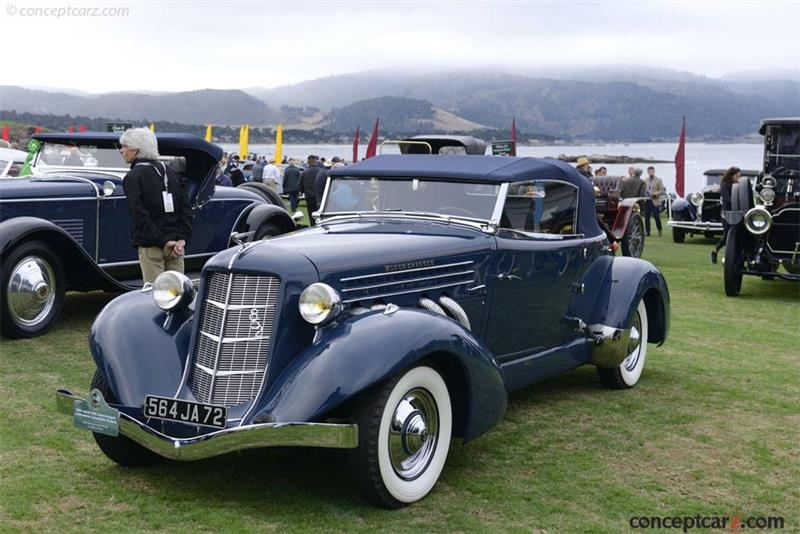
Cabriolet
Chassis Num: 35872F
Engine Num: GH 5615
 
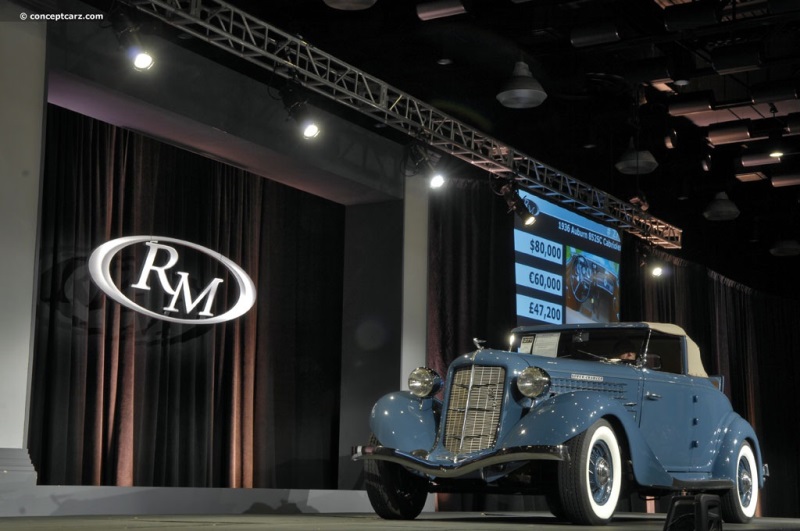
This 1936 Auburn 852SC Cabriolet was in a prominent Texas collection for many years where it was well maintained and cared for. The current owner purchased the car in 2004 and brought it to auction in 2008. It has recently been repainted and given a new interior. It is finished in light blue and has a tan convertible top. There is a chrome exhaust, a rear-mounted spare tire, and blue painted wire wheels with chrome-plated hubcaps riding on wide whitewall tires. The interior is brown leather upholstery and there is a rumble seat in the rear.

In 2008, this car was brought to the 2nd Annual Vintage Motor Cars of Hershey presented by RM Auctions where it was estimated to sell for $100,000 - $125,000. Those estimates were proven accurate when bidding reached $104,500 including buyer's premium. The lot was sold.
View more photos
Speedster
Designer: Gordon Buehrig
Chassis Num: 5266
 
Ab Jenkins took an Auburn to the Bonneville salt flats in July of 1935 where he set 70 records including posting a flying mile at 104.17 mph, 1,000 miles at 102.77 mph, and averaging 102.9 mph for 12 hours. In recognition of this accomplishment, Auburn affixed a plaque on the dash of every 851 and 852 Speedster stating that Jenkins had exceeded 100 mph with it.

The eye-catching styling and proven performance inspired more replicas and tributes than any other All-American automobile.

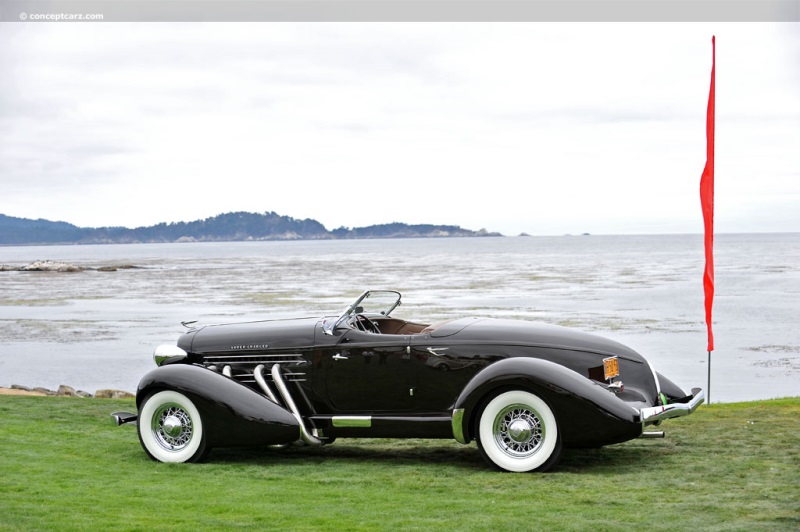
This example is a 1936 Auburn 852 Supercharged Dual Ratio Speedster. It has been in the care of its current owner for the past twenty-plus years, since the mid-Eighties. It has a Senior National First Prize badge dated from 1976. It is finished in bright red with beige leather upholstery. It rides on wide white wall tires on body colored steel wheels with hubcaps and trim rings. It is well equipped with a beige cloth soft top and matching side curtains packed appropriately in the tiny trunk next to the matching spare wheel and tire.

The car has been restored since new. Power is from a 279.9 cubic-inch eight-cylinder L-head inline engine with supercharged, rated at 150 horsepower, and riding on a 127-inch wheelbase. There is a three-speed gearbox and four-wheel hydraulic brakes.

In 2009, this 852 SC Dual Ratio Boattail Speedster was offered for sale at the Houston Classic Auction in Seabrook, Texas, presented by Worldwide Auctioneers. The lot was estimated to sell for $360,000 - $390,000. As bidding came to a close, the lot had failed to sell after achieving a high bid of $300,000.
The success of the vehicles and the survival of the company up to this point were due mostly to Erret Lobban Cord. The Auburn Company had come into existence in 1877 producing wagons. In 1903 the direction of the company switched to creating automobiles, their first being a one-cylinder chain-driven runabout. The styling and diversity of the vehicles evolved over the years, as did the mechanical capabilities and technological innovations. The Great Depression had taken its toll on the Auburn Company and was headed to receivership when it was rescued by William Wrigley. Cord was recruited to assume the duties of general manager. This fast-talking, energetic, sales man, though less than thirty years old, was the right man for the job. By applying new paint to a parking lot of excess vehicles, Cord was able to sell over 750 cars in just a few months. This earned him the title of vice president and in 1926 he became president and primary stockholder of the Auburn Company.

Throughout the next few years, the Auburn/Cord Company would experience highs and lows. The L-29 featured front-wheel drive, a first in the industry.

Designer Gordon Buehrig and engine designer Augie Duesenberg were tasked with creating a new design for 1935. A V-12 Speedster was used as a starting point. The front-end, cowl, and bonnet were completely reworked. It was given a convertible body-style that was low and complimented its small side windows. The masculine look of the Auburn 851 was due in part to its teardrop headlamps, chrome exhaust pipes, pontoon fenders, and newly styled grille and hood.

Under the hood lurked a 279 cubic-inch eight-cylinder engine. An existing six-cylinder engine had been outfitted with two additional cylinders while keeping the bore and stroke the same. The result was a 115 horsepower in natural aspiration form and 150 when outfitted with the Schwitzer-Cummings supercharger.

The vehicle was put through its paces at a 24-hour endurance run in the Bonneville Salt Flats with driver, Ab Jenkins proving the vehicle was capable of exceeding 100 miles per hour.

The car was introduced in 1935 and expectations were high but sales were low. Just over 5,000 examples were sold during its initial production year. For 1936 the name was switched to 852 and this did nothing to help sales, with just 1850 vehicles sold.

Unfortunately, in 1936 the Auburn Company went out of business. The Auburn 851's exclusivity is guaranteed by it limited production. It is a wonderful creation and hinted at what might have been if the company would have stayed in business. It was unique and distinctive.
© 1998-2009. All rights reserved. This material may not be published, broadcast, rewritten, or redistributed.