1952 Allard J2
1952 Allard J2 Navigation
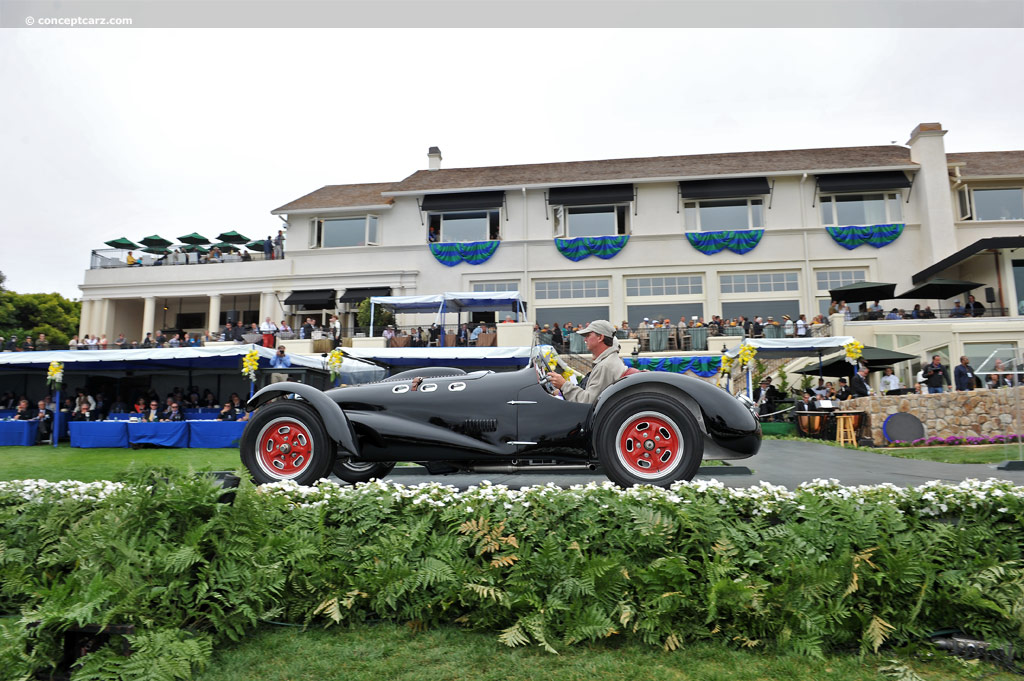
Between 1946 and 1959, Sydney Allard (an avid automobile racer and Ford dealer in London) produced approximately 1,900 vehicles, most were family cars for the domestic market, with 200 being the J-Series Allards, intended for competition.
Sidney Allard's 1950s sports cars were a combination of a lightweight chassis powered by a large-displacement engine, most notably a Cadillac or Chrysler. These roadster-bodied Allard J2 models were built to accept large American V-8 powerplants and their drivetrains. Zero-to-sixty mph was accomplished in under six seconds with a top speed in excess of 150 mph. Although they were built to be driven on the street, they were purpose-built for racing, with success achieved in the budding SCCA circuit in the United States.
Allard built the J2 for the American market and equipped them with a new independent rear suspension, and a choice of different American engines. The J2 were shipped across the Atlantic without engines and fitted with powerplants when they arrived in the United States. They were an evolution from a long line of sports racers produced by Allard. During the production lifespan, just 89 examples of the J2 Allards were built.
by Daniel Vaughan | Oct 2019
Sidney Allard's 1950s sports cars were a combination of a lightweight chassis powered by a large-displacement engine, most notably a Cadillac or Chrysler. These roadster-bodied Allard J2 models were built to accept large American V-8 powerplants and their drivetrains. Zero-to-sixty mph was accomplished in under six seconds with a top speed in excess of 150 mph. Although they were built to be driven on the street, they were purpose-built for racing, with success achieved in the budding SCCA circuit in the United States.
Allard built the J2 for the American market and equipped them with a new independent rear suspension, and a choice of different American engines. The J2 were shipped across the Atlantic without engines and fitted with powerplants when they arrived in the United States. They were an evolution from a long line of sports racers produced by Allard. During the production lifespan, just 89 examples of the J2 Allards were built.
by Daniel Vaughan | Oct 2019
Related Reading : Allard J2 History
In 1929 Sydney Herbert Allard began working in the Adlards Motors garage, an official Ford dealer, preparing racers for international motor racing. His Allard Specials quickly proved their potential and Allards reputation began to build. After racing motorcycles and three-wheeled Morgans, he began racing four-wheeled vehicles. During World War II, the Allard Motor Company repaired military vehicles.....
Continue Reading >>
Continue Reading >>
- 1952 Allard J2 Menu
- Article
- Image gallery
- Valuation
- Specifications
- Profiles
Allard
Similar Automakers
Similarly Sized Vehicles
from 1952


1952 Allard J2 Vehicle Profiles

Recent Vehicle Additions


Related Automotive News

'Hidden Treasure' Porsche Icon at Bonhams Amelia Island Auction
550 SPYDER WITH PERIOD RACE HISTORY OFFERED FOR FIRST TIME IN 50 YEARS
One of the most important Porsche models ever produced will headline Bonhams Amelia Island Sale on March 3 in Florida, being offered after 50 years of ownership and displayed...

RM Sotheby's Announces Diverse Final Entries Set For Online Only: Open Roads, North America
ONLINE ONLY AUCTION TO FEATURE NEARLY 100 MOTOR CARS HEADLINED BY AS-NEW SHELBY 427 SC COBRA SANCTION II
OPEN FOR BIDDING 23-30 JULY
RM Sothebys announces latest entries for Online Only Open Roads, North America, led by 1965 Sh...

RM Sotheby's Assembles Full Ford GT Lineage for Monterey
1965 FORD GT40 ROADSTER PROTOTYPE
PAIR OF 2005 FORD GT MODELS OFFERED WITHOUT RESERVE
2017 FORD GT IN BERYLLIUM ORANGE
JOINED BY TRIO OF SHELBYS FROM THE FONVIELLE COLLECTION
RM Sothebys announces complete Ford GT model lineup for Monterey...

THE FINEST CARRERA MODELS AND RARITIES FROM ITALY TO FEATURE PROMINENTLY AT BONHAMS SCOTTSDALE AUCTION
Impressive line-up of German and Italian sports cars headlines January sale in Arizona Select consignments still sought
Bonhams fifth annual Scottsdale auction will feature, among many exciting automobiles, an incredible selection of sports...

ACURA TO INFUSE ITS PRESENCE THROUGHOUT THE 2015 MONTEREY AUTOMOTIVE WEEK
Next-generation NSX supercar to be featured throughout the week
Acura to be the premier automotive sponsor of The Quail, A Motorsports Gathering
Championship-winning Comptech Racing Acura-Spice GTP Lights race car to make brands inaugural run at...