1964 Mustang | 1966 Mustang ![]() |
1965 Shelby Mustang GT 350 R Competition news, pictures, and information | ||
| Tweet | ||
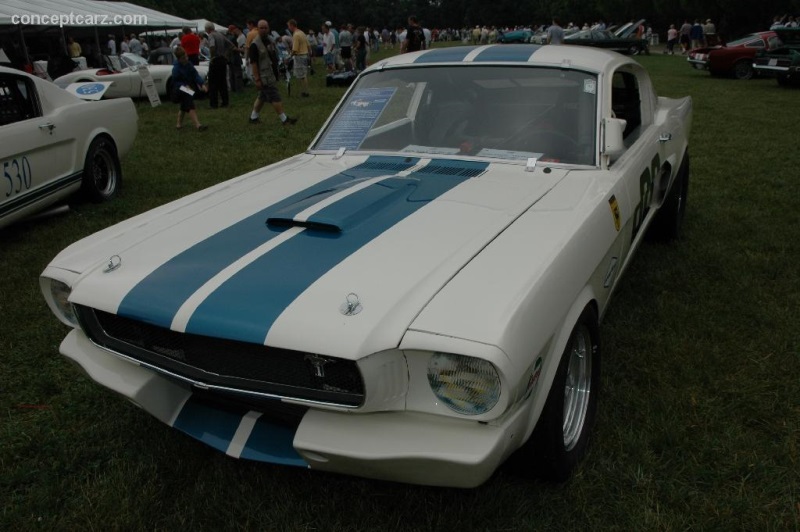
![]() | ![]() | ![]() | HardTop Chassis Num: 5S159 |
In 1980, Cummings and Levetto drove 5S159 at the 24-Hours of Daytona and finished in 28'th place. The car was raced under sponsorship of 'The Cummings Marque Inc.', named for the body shop owned by Donald Cummings. By placing 28'th, 5S159 became only the second Shelby Mustang to finish the 24 Hours of Daytona. The other car was also owned and campaigned by Donald Cummings.
At the 1982 SCCA Nationals at Sebring FL, Cummings finished 3'rd in GT-1, driving 5S159.
Driven as a rental by Greg Walker, 5S159 won the 1983 Ford Cup Championship.
The car was subsequently rented to Al Witham and raced extensively in 1984 and 1985.
Purchased by Steve Prewitt in 1989 or 1990, 5S159 was painted red, white, and blue and was raced at many SVRA events unit being sold to Howard Harris in 1996.
Howard Harris had 5S159 painted to its current configuration and raced in extensively at many SVRA events unit it was sold to Mike Cavanaugh of Cincinnati, OH in 2005.
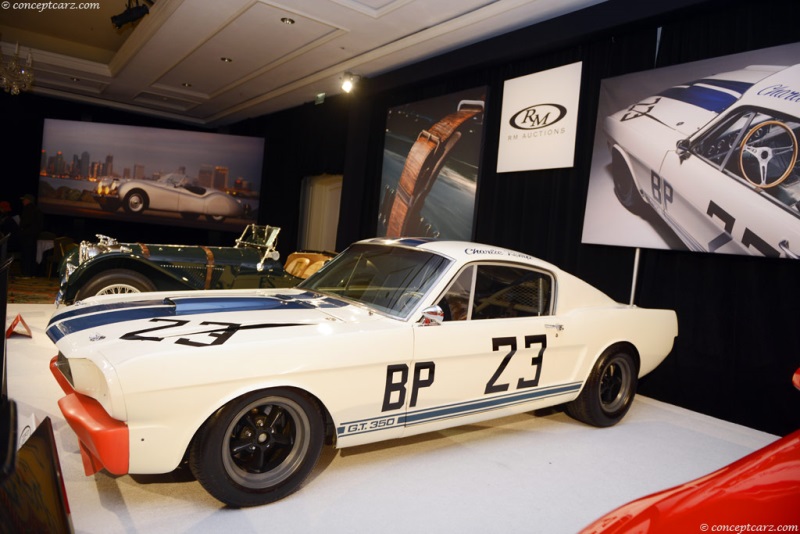
![]() | ![]() | ![]() | HardTop Chassis Num: SFM5R106 |
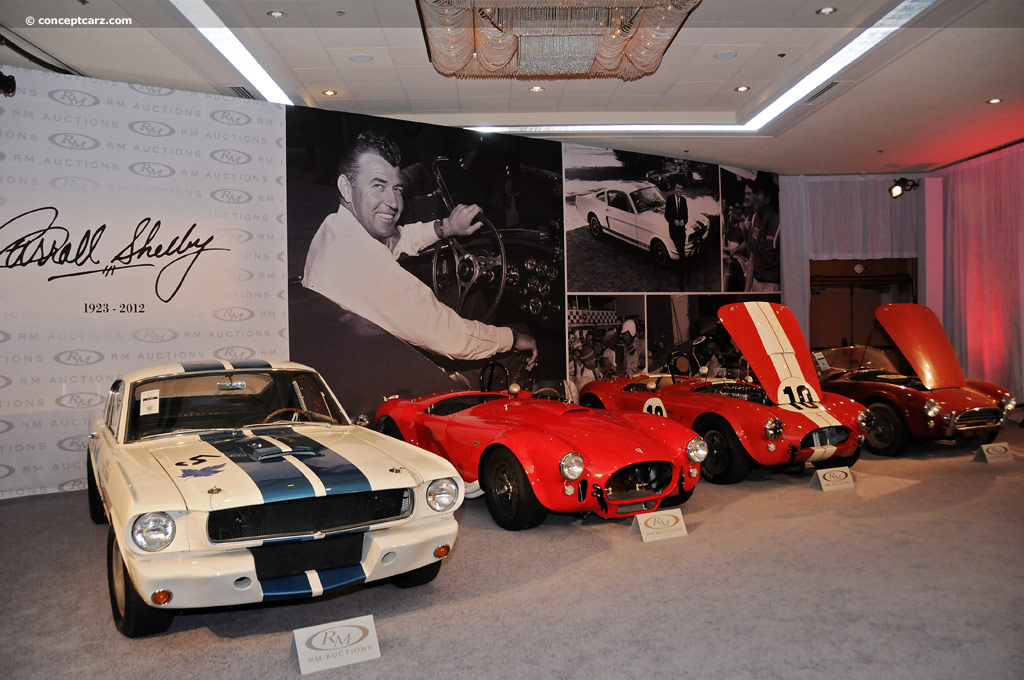
| Sold for $990,000 at 2012 RM Auctions. | |||
There would only be a total of 522 of the homologated Shelby GT350 to ever be produced from Shelby's plant in Venice, California in order that the GT350 could take part in SCCA/B production competition. However, even among the GT350 family, there would be a purer bloodline. Considered the 'most exciting version', the GT350R would go on to dominate SCCA's B/Production class winning the road racing championship for three straight years.
But what was the 'R' version of the GT350? According to the Shelby American Automobile Club Registry, it all started with the 'R' version as it is quoted as saying, 'Unlike most production race cars which are created by modifying the street version, the GT350 road car was in fact a detuned R-Model.' Therefore, the racing bloodline fostered, or gave birth, to its more sedated version of itself.
Each of Shelby's GT350 R models would be heavily-modified once they arrived for the Shelby American crew to transform. Some would have parts and components removed. Some would already arrive without the parts and components even installed. Shelby was against the clock having to build 100 examples of the model to conform to the homologation rules. However, when finished, each example was a turn-key race car ready to go to the track and compete at the highest level.
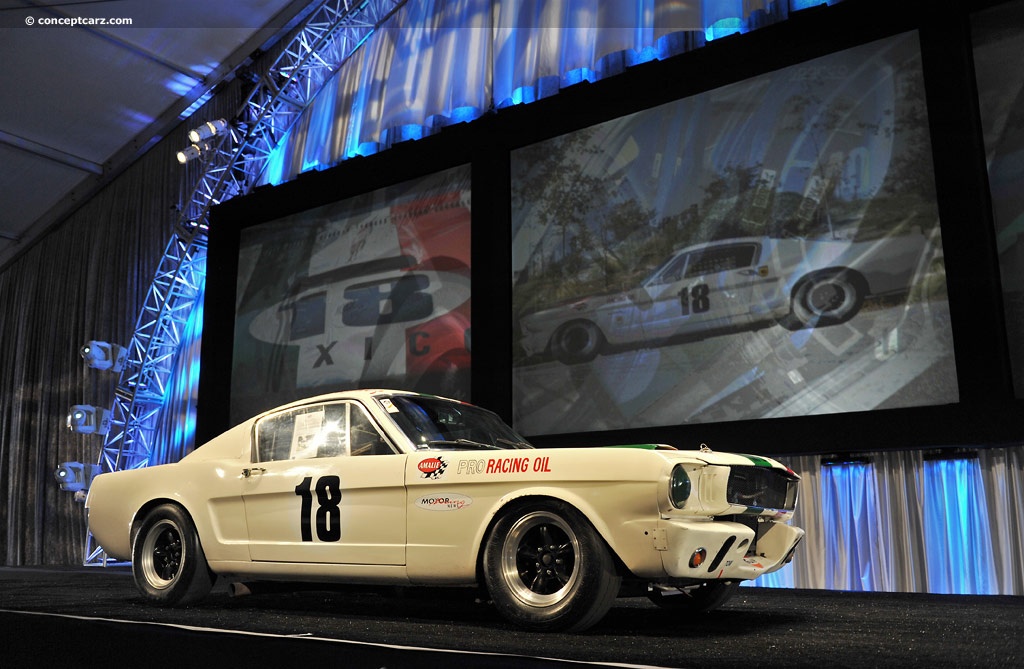
Once such example to be built for the racetrack would be SFM5R106. Considered one of the most original examples of the GT350R in existence, chassis SFM5R106 would begin its life as a GT350R when the order was received on the 21st of December, 1964. Production of the chassis would begin in Mach of 1965 and would finally be completed in June. When completed, the chassis would be mated with engine number 52127 and would produce no less than 325 hp.
Originally ordered by Jack Loftus in August of 1965, the car would be shipped from Los Angeles via TWA and would arrive at Jack Loftus Ford in Hinsdale, Illinois with its extra wide rear end and a price to match.
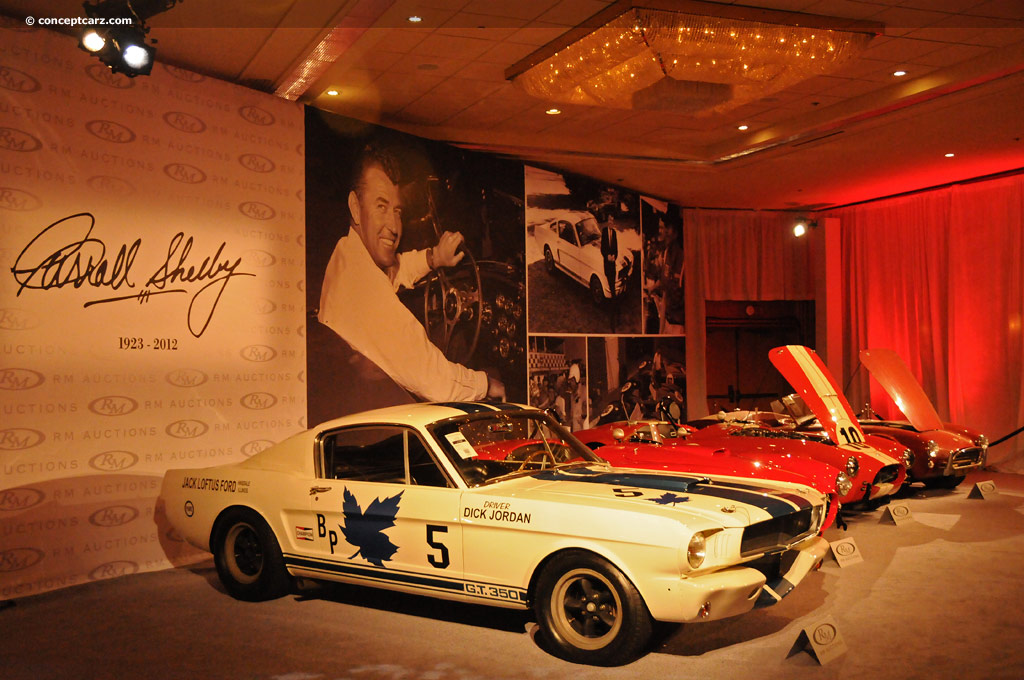
While the car was on its way to Loftus Ford in Hinsdale, one Richard Jordan would be finishing up the Carroll Shelby School of High Performance Driving in Riverside, California. Having completed the school, Mr. Jordan would return to his home of Downers Grove, Illinois and would come to purchase SFM5R106.
Once united, the two would set about racing at circuits all throughout the Midwest. Taking part in the Midwestern SCCA national events until the early 1970s, Richard Jordan would take part in a number of events from Elkhart Lake to Clermont to Wilmot Raceway. Many circuits would see the likes of Mr. Jordan and his Shelby GT350R.
Upon retiring from racing, Mr. Jordan wouldn't find it within himself to part with the car. Instead, he would determine to lock the car away in storage for a long period of time. It wouldn't be until 1986 when the car would emerge from its hiding place. A period of 21 years after Mr. Jordan originally purchased the car. As a result, it remained one of the very few, if not the only one, to have had only one owner in its history.
One year later, 1987, the car would be sold and Paul Zimmons of Potomac, Maryland would become the car's proud owner. He would have the car restored and would then take part in the Competition Class at SAAC-18 at Watkins Glen in 1993 where it would win the Gold Award.
Its winning tradition would continue when Paul Andrews, the car's next owner, entered the car in the SAAC-25 at Lime Rock Park in 2000. In that event the car would come away winning the Second Place Popular Vote.
Cared for and maintained by such people as Anthony Tomasi, Dave Christenholz and Colin Comer, SFM5R106 has always been well loved and highly maintained. The fact the car has only 4,800 original miles is perhaps the best demonstration of the love and care the car's owners have always bestowed upon the Shelby.
Complete with an impressive array of documentation, including photographs, titles, registrations and invoices there are still so many things about SFM5R106 that can be deemed as 'original'. Even in its present livery, 'original' is the only word that can adequately describe this particular GT350R. Still sporting its original Plexiglas and racing wheels, this chassis, which is being offered from a private collection, would make its way to the RM Auctions event in Monterey in 2012. And at that auction, and because of the rare and original nature of the car, the Shelby GT350R, chassis SFM5R106, would be expected to draw between $900,000 and $1,300,000.
Sources:
'Lot No. 134: 1965 Shelby GT350R', (http://www.rmauctions.com/FeatureCars.cfm?SaleCode=mo12&CarID=r174). RM Auctions. http://www.rmauctions.com/FeatureCars.cfm?SaleCode=mo12&CarID=r174. Retrieved 1 January 2013.
'1965 Shelby Mustang GT350 News, Pictures and Information', (http://www.conceptcarz.com/vehicle/z1909/Ford-Mustang--GT350.aspx). Conceptcarz.com: From Concept to Production. http://www.conceptcarz.com/vehicle/z1909/Ford-Mustang--GT350.aspx. Retrieved 1 January 2013.By Jeremy McMullen
![]() | ![]() | ![]() | HardTop Chassis Num: SFM5R108 |
| Sold for $748,000 at 2006 Gooding & Company. | |||
The first obstacles to tackle were to convert the car into a two-seater and improve its engine and suspension. A minimum of 100 cars had to be constructed to satisfy homologation requirements. The 100 car rule was proving a little difficult to satisfy, so the decision was made to create both a racing and a street version. A common suspension was used for both versions. The racing version was given a competition engine. Ken Miles worked on developing the vehicles suspension while Bob Bondurant worked on the vehicles handling. Peter Brock, of Shelby American, was given two fastback cars to develop an identity for the new car that would be identifiable to the public.
Since the 100 car rule had to be satisfied in a short amount of time, the project was put under significant pressure to be completed. The cars had to be completed by January of 1965 in order to compete that season. The cars were given 289 cubic-inch Ford V8 engines and matted to a four-speed Borg-Warner aluminum gearbox. The rear end's were 9-inches and had a 3.89 gear ratio. The Ford and Shelby duo had meet the homologation requirements and were given permission to race in SCCA competition for the 1965 season.
The last fifteen cars, with chassis numbers 94 through 108, of the first batch were created into the racing versions. The standard versions produced 271 horsepower. The fifteen racing vehicles had no side or rear window glass, heater, defroster, interior upholstery, interior headliner, insulation or sound deadening material, or exhaust. All non-essential items had been removed to reduce the vehicles weight.
The second batch of racers had chassis numbers 209 through 213. The final four racers had chassis numbers 527 through 540. This totaled 34 and 26 are believed to have survived in modern times.
The 350 R produced between 325-360 horsepower with a single four-barrel Holley carburetor. Additional improvements to the engine included Aluminum hi-rise intake manifolds borrowed from the Cobra. The wheels were American Racing five-spoke magnesium measuring 15x7. Additional welding to the body increased the body's strength. The front and rear bumpers were removed and a fiberglass apron was added. A hood scoop was added to increase the engines breathing and cooling capacity. Some of the cars had Mustang bucket seats while others, mostly the earliest of cars, were given fiberglass racing seats.
There is sometimes confusion on how the vehicle got its name, the '350'. Shelby had asked Phil Remington what the distance was between the race shop and the production shop. Remington had replied, '350 feet'. The name of the car was given GT 350 and the racing versions had an 'R' attached to the end of its name. Other stories have the birth of the name coming from the engine output or the square root of the total floor area in both factories.
The first Ford Shelby Mustang GT 350 R was sent to the Green Valley Raceway in Texas for Ken Miles to compete in the B-Production race held on Valentines Day. In its inaugural debut, it crossed the finish line ahead of the competition. The car was later made into the Shelby team's test car and used by Jerry Titus to test components in racing conditions. In 1965, Titus won the B-Production Championship.
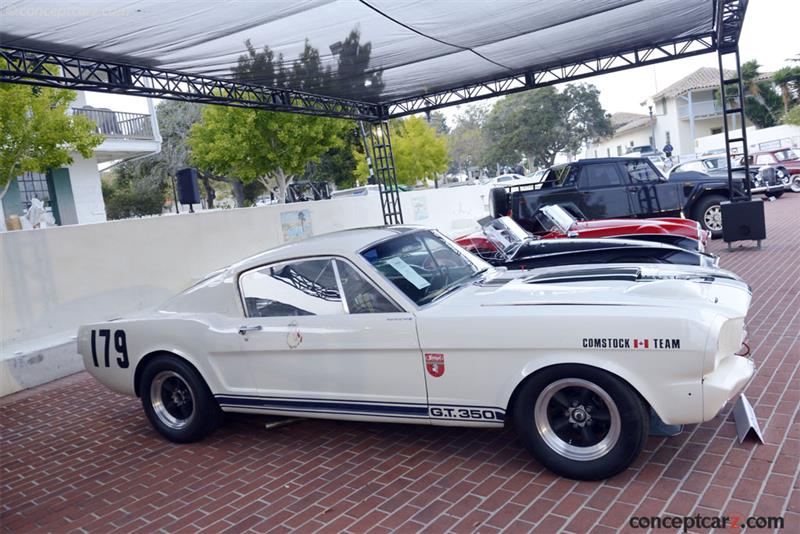
Some of the earliest privateers to order the GT 350 R were Scuderia Filipinetti, Bob Johnson, and Comstock racing. Mark Donohue drove chassis number 105 and had tremendous success with the vehicle. Many of the cars did rather well in each event that they were entered, often beating their rivals, the Chevrolet Corvette.
The last batch of five cars were hard to sell. The price tag of $5,995 was not cheap but it was a very fair price for such a potent racer. These cars were eventually sold to a group of Peru individuals who ran the cars in competition mostly against each other.
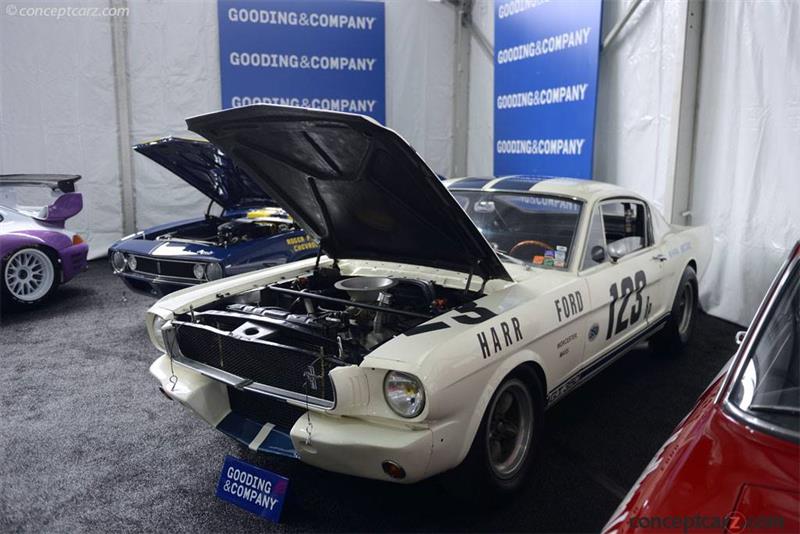
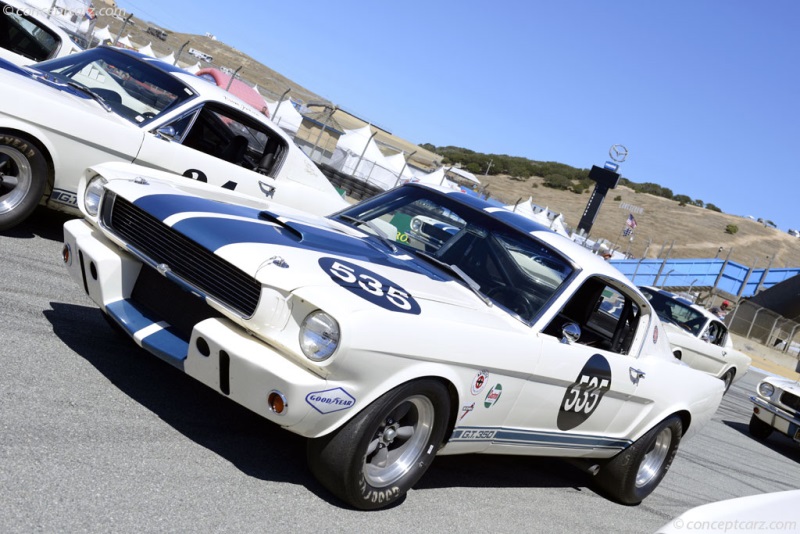
In 1965, the GT 350 R won five of SCCA's six divisions. Jerry Titus won the Championship run-offs at Daytona and became the B-Production Champion. He was followed by many other Mustang GT350Rs. Bob Johnson finished second; Tom Yeager in sixth and Mark Donohue finished in 10th. The following year, the GT 350R repeated its victory this time with Walt Hane driving the winning car and being crowned the B-Production Champion.
This 1965 Ford Shelby Mustang GT 350 R Model with chassis number 5R 108 was offered for sale at the 2006 Gooding & Company Auction held in Pebble Beach, Ca. It is powered by a 289 cubic-inch V8 and produces 350 horsepower. It has a four-speed manual gearbox with front disc and rear drum brakes. The vehicle sits atop a 108-inch wheelbase and suspended in place by a independent front and live-rear axle suspension.
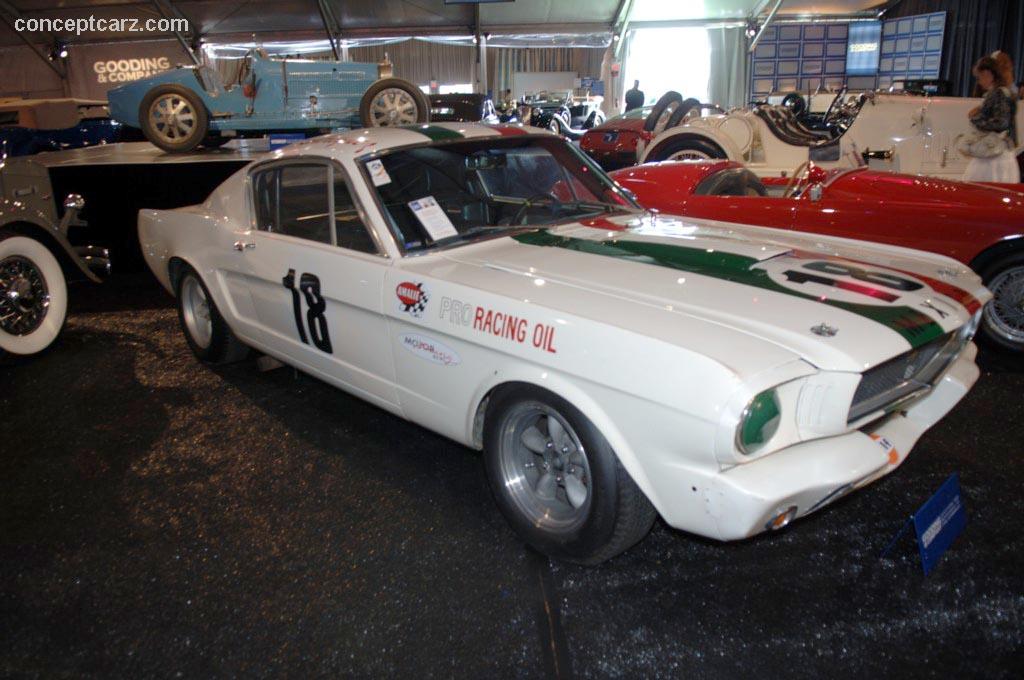
This vehicle was delivered as a chassis to the factory on December 18th of 1964. It was made ready for competition in September. Its first owner was Bill Steele of Texas who immediately entered the car in racing competition. At the SCCA national meeting at Green Valley, the car was driven by Mexican Grand Prix and sports car driver, Pedro Rodriguez. Rodriguez beat the factory prototype, chassis number 5R 002, of Jerry Titus and went on to win the B-Production race.
The vehicles next owner was Freddy van Beuren, Jr. who had the car given a green-and-red stripe in Mexican livery. van Beuren won the SCCA Southwest Division title in 1966 and was 3rd at the Riverside run-offs. It was entered into the Daytona 24 Hours race where it completed 313 laps before retiring prematurely. It was raced at Sebring where it was driven by van Beuren and Paul Jett to a sixteenth place finish, and first in the 'Up to 5-Liter' category.
In 1967, van Beuren drove the car at the B-Production Championship at Daytona where he emerged victorious.
It was later sold to Sidney Finkel who raced the car through 1972 and later put it into storage for 10 years. It was later purchased and restored to its Mexican Livery and 1967 Championship winning-state. Since that time it has passed through several more owners and has been a faithful visitor and participant at many historic and vintage racing events.
At auction, this very historically significant GT 350 R was still finished in its Mexican Racing Livery and wearing number 18. The name 'Pedro Rodriguez' can be found on the roof of the vehicle just above the drivers-side door. Bidding was strong, with the final winning bid being $748,000.
By Daniel Vaughan | Mar 2007
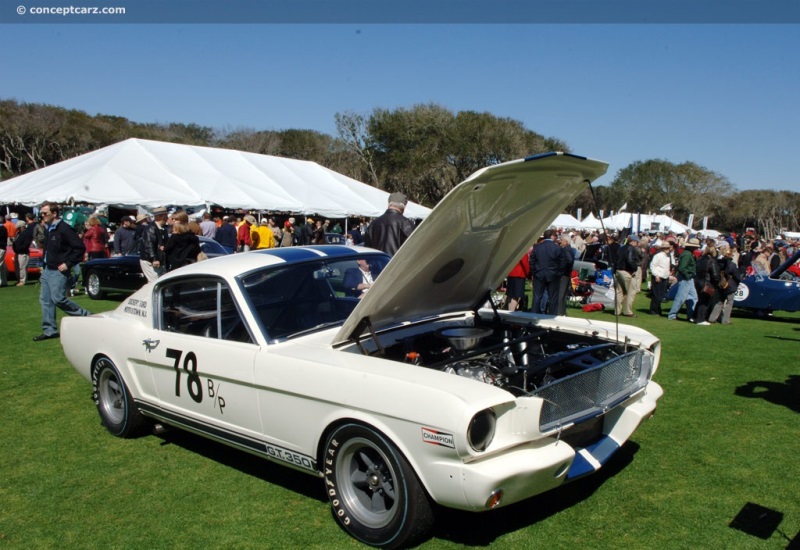
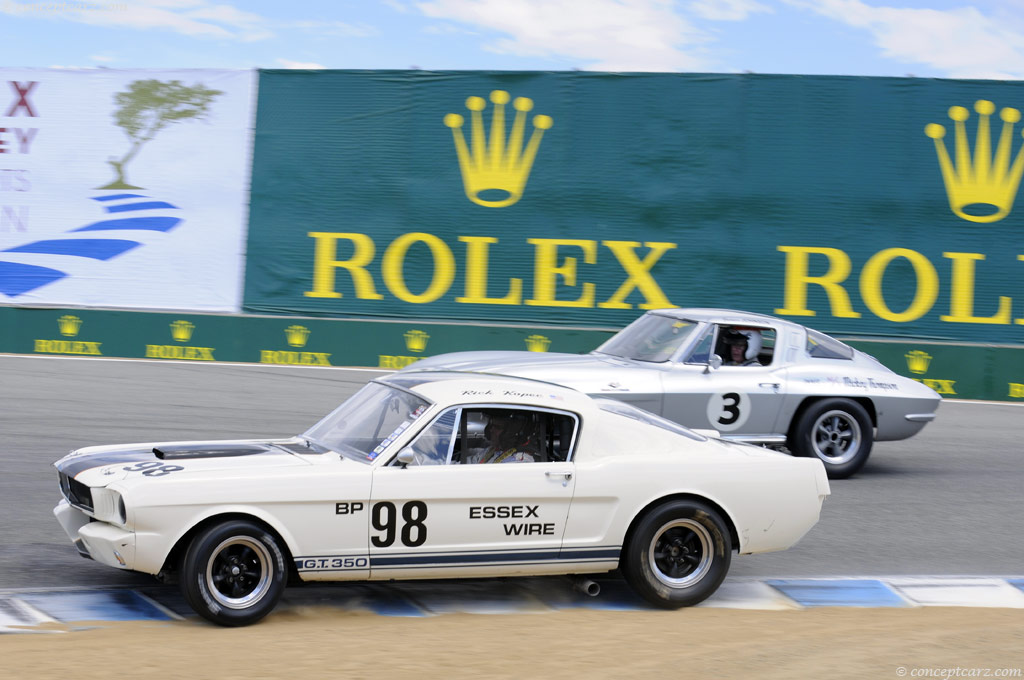
![]() | ![]() | ![]() | HardTop Chassis Num: 5R098 |
| Sold for $852,500 at 2007 RM Auctions. | |||
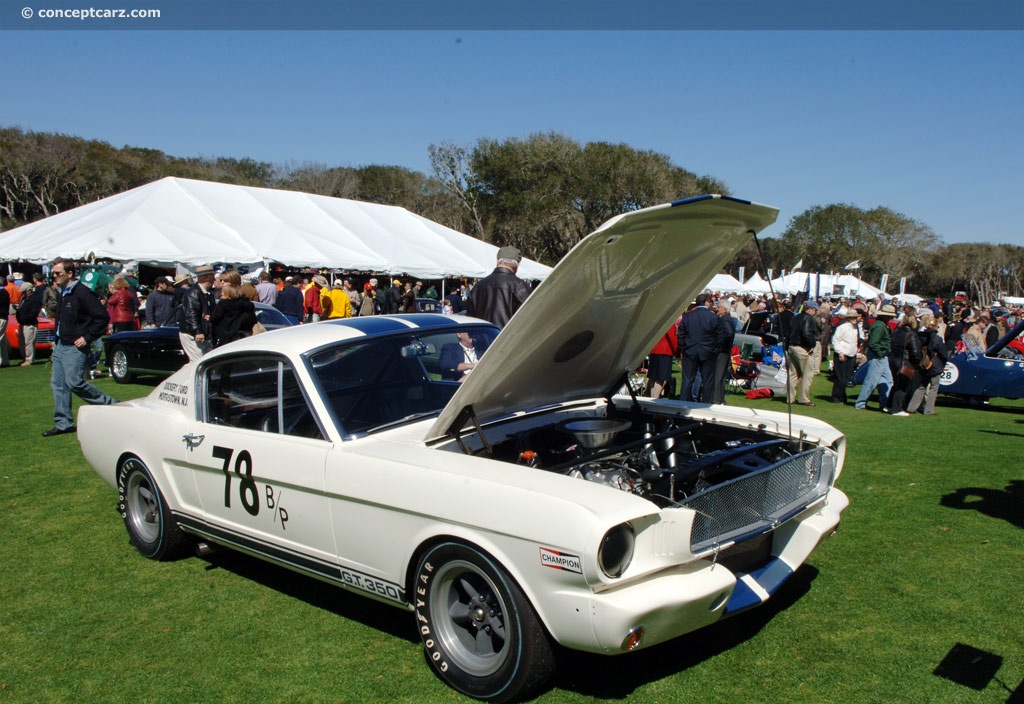
The car was later acquired by a Canadian racer who used it in several Canadian races but crashed the car in 1969. The crashed car was placed in a Ontario barn where it would remain for a number of years. Mr. Rick Kopec of Connecticut, author of all things Shelby and SAAC National Director, purchased the car in 1981 sight unseen. It took seven years, but the car was restored to its period correct Essex specifications. It was raced by Mr. Kopec in over 100 SVRA, HSR, VSCCA, and HMSA events at over 50 tracks. It has been awarded numerous awards and participated in many vintage races driven by Cantwell, Peter Brock, Lew Spencer, and Bob Bondurant. Carroll Shelby drove the car at Lime Rock in 1992 and gave charity rides in it at Watkins Glen.
It is a well known car that has won or finished in the top spots at most major raceways in the United States. In 2007 the car was brought to the Monterey Sports & Classic Car Auction presented by RM Auctions, where it had an estimated value of $800,000 - $1,000,000. It is powered by a 289 cubic-inch Hi-Po V8 engine that produces 350 horsepower. There is a four-speed manual gearbox, front disc and rear drum brakes. It is a car with a brilliant racing history and a pedigree that that is prominent and exclusive. At auction the estimated value proved to be accurate as the lot was sold for $852,500.
By Daniel Vaughan | Dec 2007
![]() | HardTop |
![]() | ![]() | ![]() | HardTop Chassis Num: SFM5R106 |
| Sold for $990,000 at 2012 RM Auctions. | |||
At the time, Carroll Shelby was involved in building Cobras and supporting a busy racing effort, including the Ford GT40 MKII and the USRRC/USAC King Cobras. Realizing Mr. Shelby was very busy, most of the work for the Shelby Mustangs were done by Ford in-house.
SCCA required that a minimum of 100 cars be built before the beginning of the year. Ford agreed to supply Mustangs to Shelby's specifications, and Shelby picked through the Ford parts catalogue to specify the basic package that would lend itself to road racing. A few fairly simple upgrades were made in the Shelby American shop, a project headed by Chuck Cantwell. The production cars and all the R-models were specially built in sequence at Ford's San Jose, California factory in Wimbledon White with black interiors and 271 horsepower K-code engines, aluminum case Borg Warner T-10M four-speed transmissions, nine-inch rear axle with Fairlane station wagon drum brakes. Also included were 'export' shock tower brace, and sintered metallic brake pads and lining. The hoods, rear seats, radios and exhaust systems were left in the San Jose shop. An additional 15 cars were made even more special, as they arrived at Shelby without side or rear windows, heaters, defroster, upholstery, headliners, insulation, or sound deadening. These were the first R-models.
All of the Mustang GT350s essentially received the same suspension modifications. The front suspension upper A-arm chassis pivots were lowered an inch and Koni shocks were installed, along with a one-inch front sway bar and quick ratio steering kits. The K-shaped 'export' brace was augmented with another bar joining the tops of the shock towers. The leaf spring suspended rear axles got traction bars and Detroit 'no-spin' locking differentials.
The hoods were constructed from fiberglass with coil air intake scoops. Inside were wood-rim steering wheels, and a fiberglass shelf where the rear seats had been. Batteries were mounted in the trunk for better weight distribution and a Shelby tack and oil pressure gauge were installed in a dash top mounted pod. Keeping the drivers safe were three-inch competition style lap belts.
After meeting the homologation requirements and receiving permission for the Shelby Mustangs to race in SCCA competition, Shelby American began work on creating truly special versions that could dominate the races. Using the production GT350 as a base, Shelby worked on improving handling, increasing power, and improving reliability. The least of these concerns was the handling; the Shelby Mustangs had excellent handling.
Valley Porting Services extensively modified the engine's heads. A Holley four-barrel carburetor on a Cobra high-rise aluminum intake manifold was installed, with Tri-Y headers built by Cyclone handling the exhaust. Horsepower rose to 325 to 360 depending on tuning. The front and rear fenders were flared to accept American Racing 15x7 five-spoke wheels. Since the engines output increased, an oil cooler was mounted behind the special high capacity radiators. More air flow was required, so the R-models were given a new front body apron constructed from fiberglass with a deep air intake flanked by brake cooling air scoops.
An additional 25 pounds were saved by using Plexiglas side windows with aluminum frames. A special Plexiglas rear window was formed, which fitted the rear light opening with a two-inch gap at the top to exhaust air from the interior and smooth air flow over the rear body. Another benefit was an additional (report) five miles per hour to the vehicle's top speed. A four-point roll bar was installed, along with a large 34-gallon baffled fuel tank fabricated from the bottoms of two standard Mustang tanks.
The Shelby Mustang R-models could be purchased from the Ford dealer and taken straight to SCCA where it could compete against the highest level of competition.
This example, chassis SFM5R106, was sent to Shelby American on December 21st of 1964 for its conversion into a GT350 R. Work began in March and ended in June. When the work was completed, the engine was rated at 325 horsepower. The car was ordered by Jack Loftus in August of 1965 and the completed car was shipped from the Los Angeles Airport to O'Hare International Airport, via TWA, for delivery to Jack Loftus Ford, of Hinsdale, Illinois, with an extra 4.11 rear end. The total cost for this GT350 R was $6,105, more than twice that of regular, stock Ford Mustang.
The original owner of this car was Richard Jordan, of Downers Grove, Illinois. Prior to taking the car racing, Grove participated in Carroll Shelby School of High Performance Driving at Riverside, California. Mr. Jordan used the GT350R in Midwestern SCCA national events until the early-1970s.
After its racing career, Jordan placed the car into storage, where it remained until 1986. Paul Zimmons of Potomac, Maryland purchased the car in 1987 and restored the car before it won the Gold Award in the Competition Class at SAAC-18, in Watkins Glen in 1993. Paul Andrews of New Jersey later became the cars next owner. He also used the car in competition, winning Second Place Popular Vote at SAAC-25, at Lime Rock Park in 2000. Since that time, the car has been owned by Anthony Tomasi of Wilmington, Massachusetts, then Dave Christenholz of Paradise Valley, Arizona, and more recently, in 2007, by Colin Comer. When Mr. Comer acquired the car, it had just 4,800 original miles from new, all accumulated on race tracks, and rode on its original magnesium American wheels. Current, the car has only 4,858 miles on its odometer.
The current owner has continued to preserve this time capsule.
In 2012, the car was offered for sale at RM Auction's Monterey sale. It was estimated to sell for $900,000 - $1,300,000. As bidding came to a close, the car had been sold for the sum of $990,000 inclusive of buyer's premium.
By Daniel Vaughan | Dec 2012
![]() | ![]() | ![]() | HardTop Chassis Num: SFM5R102 |
It is believed that the GR350R given to Johnson on May 11th, 1965, was one of only four factory team cars which joined the ranks of 001, 002, and 096. 001 and 002 were prototypes raced by Jerry Titus and Chuck Cantwell. Four days after received the car, Johnson entered into SCCA races at Cumberland, Maryland. He qualified fourth but his position was protested by Don Yenko who had entered a Corvette. As a result, Johnson found himself at the back of the pack. When the checkered flag fell, Johnson had maneuvered his machine to a second overall finish and first in B/Production.
The GT350R's were a special breed of racing cars. They were equipped with dual S-W electric fuel pumps, baffled steel high capacity oil pans built by Avaid, modified steel valve covers were breathers, and competition bucket seats.
At Meadowdale, Johnson finished first in class and second overall. At Mid-Ohio on June 13th, he finished first in class and overall, his best finish to that point in a GT350R. On July 5th, he finished first and class and fourth overall. Six days later he was back at Mid-Ohio where he scored a second in class. The following month he was at Lynndale Farms where he finished second overall and in class. He had accumulated a total of 51 point in the division which was enough to earn him an SCCA B/Production National Champion. This amazing accomplishment was achieved even with a late start to the season. To add to this, the GT350R's swept the SCCA B/Production Championship, taking five of the six divisions.
On November 28 at the American Road Race of Champions in Daytona, there were seven GT350R's all racing for top honors in the B/Production field. A heated and competitive battle, including the beefed up Shelby Mustangs, Cobras, and Jaguar XKE's had their drivers struggling for position. Johnson finished second in class behind Titus.
At the conclusion of the race, Johnson returned 5R102 to Shelby American where it was rebuilt and sold to Ron Dykes. Dykes raced it on November of 1966 at the second ARRC in Daytona but failed to finish. Barrey Robles, the next owner, was invited to the 1967 ARRC in Daytona race but he failed to find sponsorship. In 1969 it was raced to a Cal Club SCCA Regional Championship in B/Production. It was retired from active racing 1971.
It has undergone a restoration and is currently in its 1965 SCCA National Championship configuration, including Shelby team Wimbledon white with blue stripes.
By Daniel Vaughan | Mar 2011
The Mustang was introduced at the 1965 New York World's Fair, Mustang Mania instantly swept the country, and a new automotive market §egmènt was created - the 2+2 or better known as the 'ponycar.' Though its mechanical underpinnings descended from the Falcon, the Mustang was completely different. It was a compact, tight, clean package weighing in at a modest 2,550 pounds - a departure from the ever-enlarging American cars of the day. The classic long-hood short-rear-deck combined wîth a forward-leaning grille, elegant blade bumpers, sculptured body sides, fully exposed wheel openings and restrained use of bright trim gave the car a unique look that belied its affordability. Its looks were backed up wîth power, providing three optional V8 engines wîth up to 271 horsepower. Other options included automatic transmission, power §teering and brakes, styled chrome wheels and air conditioning. Not surprisingly, the entry-level modes were a minority of the production.To say that the first Mustang was a success is an understatement. Following the introduction, the Mustang was on the cover of both Time and Newsweek. A week before introduction, Ford ran ads wîth the air times for the first television commercials, which all three networks broadcasted simultaneously. Mustang was selected as the Official Pace Car for the 1964 Indianapolis 500, and more than 22,000 orders were taken the first day. By its first anniversary, over 418,000 Mustangs had been sold, breaking the all-time record for first year sales of a new nameplate.
The original platform was used, wîth numerous modifications, up to 1973. The Pinto-based Mustang II was built from 1974 until 1978. A new fox body platform began in 1979 and was largely unchanged through 1993. In 1994 the SN-95, a modified version of the Fox body, debuted and was produced until 2004. The 2005 Mustang is built on the first entirely new platform in 25 years.
1964 1/2 - 1973 The Growing Years - In More Ways Than One.
Úntil 1967, Mustang had this new market all to itself. For 1965 a new 2+2 Fastback model added as was the GT Equipment Group. Both performance and aesthetically minded, this group included front disk brakes; grille-mounted fog lights, 5-gauge instrumentation, GT stripes and badges and special dual 'trumpet' exhaust outlets. 1966 brought a huge shot in the arm to the ponycar moniker - the first Shelby GT 350. Built on the 2+2 Fastback by famed racer/car builder Carroll Shelby, these cars featured race-tuned engines and suspensions. By mid-1966, Mustang passed the one-million sales mark.On the track, the Mustang name was quickly establishing itself in many motorsports arenas. In 1965, Mustang assumed the role as Ford's rally car. Carroll Shelby, famed builder of the Cobra, created race-ready cars for SCCA's production class B competition against the likes of Chevrolet's Corvette and the Jaguar E-Type. Shelby's goal was accomplished when the GT 350 took the B-Production Championship from Corvette. Shelby Mustangs were also successful in the world of drag racing. Ford campaigned several highly modified A/FX altered Mustangs equipped wîth 427 'Cammer' motors in National Hot Rod Association drag racing events. 1966 brought the creation of the SCCA Trans Am professional racing series for V-8 sedans of 305 cubic inches or less. Mustang took the Trans Am Manufacturers' Cup in 1966. The Shelby GT 350 repeated the previous year's success as B-Production Champion.
With the introduction of Chevy's Camaro, Pontiac's Firebird, and Ford's sister division 2+2, the Mercury Cougar, the rest of the both brought serious competition to the Mustang and further legitimized the 2+2 'ponycar' market. Ford foresaw the coming competition, and designed the 1967 Mustang to accommodate its 390 cubic-inch V8. In addition to the mechanical changes, the Mustang was restyled inside and out. This began the era of the growing Mustang, as it gained a couple inches in length and width nearly every year until 1973. A GT 350 H was introduced, a special edition made specifically for Hertz Rent-A-Car outlets. Stories of 'Rent-A-Racers' being returned wîth telltale signs of racing use are still told today. The options list grew as well, and Ford's largest engine quickly went from the 390 to the 428 Cobra Jet. Shelby also upped the ante wîth the GT 500 in 1967 and the GT 500 KR ('King of the Road') in 1968. The GT 350 also continued on. In racing, despite new competition from the Camaro, Plymouth Barracuda, and Mercury Cougar, Mustang again won the Trans Am Manufacturers' Cup. Capping the year, Shelby's GT 350 once again took the SCCA B-Production crown. Perhaps the most famous Mustang of the time was the 1968 Highland Green 390 Mustang fastback driven by Steve McQueen in the movie Bullitt. Many still consider the final chase scene to be the best ever filmed.
The car again grew larger and heavier in 1969, and the grille sprouted four headlights. Also introduced in 1969, the Boss 302 - brain child of former GM designer Larry Shinoda - was a special version of Ford's 302 cubic-inch engine wîth larger canted valve heads for better efficiency and more power. The rarest Mustang by far was the Boss 429, built for the sole purpose of qualifying the new 'Semi-Hemi' engine for NASCAR racing. Only 857 Boss 429 Mustangs were built. More competition arrived in 1970 wîth the Dodge Challenger and a redesigned Plymouth Barracuda. The Boss 429 was discontinued after only 499 copies were made. 1970 also marked the end of the GT 350 and GT 500.
1970 would be Ford's last year for factory-sponsored racing until the 1980s. The Trans Am series boasted the most competitive field ever in both the driving talent and the cars. Ford's Boss 302 team, led by Parnelli Jones and George Follmer, took on AMC's Mark Donahue, Camaro driver Jim Hall, Pontiac's Jerry Titus, Dan Gurney's All American Racers and their Plymouth Barracuda, Sam Posey in the all-new Dodge Challenger. The competition was fierce and well matched throughout the series. In the end, the Mustang team was triumphant allowing Ford to go out on top.
By 1971, the car had become nearly 8 inches longer and 6 inches wider than the original 1965 model. Mustang was now a full-fledged muscle car, moving beyond the 2+2 market niche it created. The Grande and Mach 1 returned, however, the Boss 302 was replaced by the Boss 351. Engine choices ranged from six cylinder economy to the mighty 429 Super Cobra Jet V-8. Many forces converged by 1973 that signaled a change from the fast-and-furious start of the 2+2. Soaring gas and insurance costs and the addition of emissions and safety equipment brought the muscle car era to an end, and Ford began positioning the Mustang as a luxury car. The end of 1973 would begin a hiatus for both the V-8 engine and the convertible.
1974 - 1978 A Mustang Trapped in a Pinto's Body.
Lee Iacocca, then president of Ford and instrumental in the design of the first Mustang, had long been unhappy wîth Mustang's direction. The car got progressively bigger and sales dipped. Any questions about returning to a smaller Mustang were answered by the first OPEC oil embargo in 1973, which spurred an immediate run on fuel-efficient cars. The Mustang II was introduced mid year in 1973 as a 1974 model. Built on the Pinto platform, the Mustang II was substantially smaller than the prior model and even smaller than the original. Rack and pinion §teering and front disk brakes were made standard. Engine choices were limited to a 2.3 liter four cylinder and a 2.8 V-6. This would be the first year for a four and the only year without an available V-8. The coup and fastback would soldier on without the convertible - which would not return for twelve years. The Mach 1 continued on, but had dropped from nearly 7 robust lines (429 cubic inches) to 2.8 liters and 105 horsepower. The formula seemed to work, however - Mustang II got over 20 MPG and sold 385,000 for the model year.
1975 brought the return of the 302 (5.0 Liter) V-8 however at only 122 horsepower. Other than increasing this to 139 horsepower in the Cobra II, most changes through 1978 were limited to trim and option packages. After its initial year, sales remained consistent at around 150,000 to 190,000 and earned the marque a new lease on life.
1979-1993 The Speed of a Horse wîth the Smarts of a Fox.
Based on the Ford Fairmont, the 'Fox' body would be the longest running platform in Mustang history. As an example, the doors of a 1979 can be interchanged wîth those of a 1993. The Fox body also brought modern design and a renewed commitment to performance. A 2.3 Liter four cylinder was again standard wîth upgrades of a turbocharged four, 2.8 Liter V6 and 5.0 Liter V8. Mustang paced the 1979 Indianapolis 500 and nearly 370,000 units were sold.1981 saw the addition of the T-Roof Convertible and 1982 brought the return of the GT wîth a revised 5.0 High-Output V-8 rated at 157 horsepower. Ford's resurgent racing program blasted out of the gates wîth International MotorSports Association (IMSA) GT racing, where the turbocharged Miller Mustang, driven by Klaus Ludwig, came within a 10th of a second of winning its first race over the dominant Porsche 935 Turbos. Ludwig was only getting started. He handed the vaunted Porsches defeat wîth back-to-back victories at Brainerd and Sears Point. Elsewhere, Tom Gloy put a Mustang in the Trans-Am winner's circle for the first time in a decade when he won the 1981 season finale at Sears Point. In SCCA road racing, Mustang became the first domestic car ever to win the Showroom Stock national championship when Ron Smaldone drove his turbo Mustang to victory at Road Atlanta.
The big news for 1983 was the mid-year introduction of the first true Mustang convertible in a decade, which accounted for 20,000 sales in the short 6 month season. On the performance front, the 5.0 V8 bumped up to 205 horsepower. For Mustang's 20th Anniversary, in 1984, Ford offered the most interesting line up in years. The GT was back in hatchback and convertible, and a new European-inspired Mustang SVO debuted. Developed by the Special Vehicle Operations department, the limited edition model was powered by a fuel injected intercooled 175 horsepower four cylinder engine. The SVO also featured unique exterior appointments, an upgraded interior, and was also the most expensive model.
By 1984, Ford had staked out the IMSA GTO series as Mustang turf. Jack Roush, the Carroll Shelby of the eighties, came on the scene wîth hot racers. A Roush-prepared Mustang won the GTO class in the three-hour IMSA 1984 season finale at Daytona. It was the beginning of Mustangs reign as the king of GTO. The following February, Mustang won the GTO classes at Daytona 24 Hours - the first of three consecutive victories in the season-opening marathon.
Mustang received a facelift for 1985, and horsepower continued to climb. The 5.0 H.O V-8 was increased to 210, and the SVO squeezed 205 horsepower out of a 2.3 liter engine. This would be the rarest SVO model as only 1,954 were built. The V-8 switched to fuel injection in 1986, the year that restyling of both the interior and exterior, and a bump in the GT horsepower to 255. The Roush Mustangs carried on the winning tradition in 1986 wîth eight more GTO wins and another manufacturers' title. In drag racing, Rickie Smith drove his Motorcraft Mustangs to the semifinals or better at all 11 races on the International Hot Rod Association schedule, and took the IHRA Pro Stock world championship.
1998 was a pivotal year in Mustang history. Ford planned to change the Mustang to a front wheel drive derivative of the Mazda MX-6. An uprising in the Mustang enthusiast community ensued, as did some pointed questions from the automotive press. Thousands of letters decrying the idea of a 'Maztang' or 'Musda' beseiged Ford's product planners and the new car went on to be the Probe. Ford scrapped the idea at the last minute, cementing the Mustang heritage for the future. The decision however locked in the Fox platform for the next five years.
From 1989 to 1992 changes were limited to wheel and tire combinations and the introduction of 'Special Edition' models in non-standard colors. 1993 would be the final year of the original Fox body Mustang. Ford re-introduced the Cobra, rated at 235 horsepower and distinguished by unique front and rear bodywork. 107 Cobra R models were built which included track tuned suspension and deleted the rear seat, radio, fog lights and other components to reduce weight.
1994-2004 Refining the Breed.
Mustang celebrated its 30th Anniversary wîth an all new body and interior for 1994, calling on design cues from the Mustang's first decade. The 2.3 liter four was retired and the 3.8 V-6 became the base engine. The GT retained the 5.0 V-8 and the SVT Cobra returned, now wîth 240 horsepower. The Mustang Cobra served as pace car for the 1994 Indianapolis 500 and a limited series of the Rio Red pace car replicas were sold.
Mustang was an immediate hit and remained unchanged while Ford continued to fill orders. Another Cobra R was released, this time wîth a 300 horsepower 351 cubic inch (5.4 liter) V-8 and Tremec 5 speed manual transmission The R model was sold nearly race-ready wîth a revised suspension and fuel cell. The rear seat, radio, air-conditioning, power windows and seats were deleted to save weight. Only 250 units were built which became instant collector's items.
In 1989 the Trans-Am series was again attractive to American muscle, though the cars only look like a Mustang - the underpinnings were that of a purpose-built race chassis built to modern motorsports standards. ( posted on conceptcarz.com) The Mustang dominated in 1995, 1996, 1997 and again in 1999. Ironically, the 1999 driver, who had switched to a Jaguar, kept the classic Ford pushrod V-8 underfoot and kept winning.
1996 ushered in Ford's long-anticipated modular engine program, which saw replacement of the venerable 5.0 wîth a 4.6 liter overhead cam V8 wîth 225 horsepower on tap. The Cobra utilized a dual overhead cam aluminum block version rated at 305 horsepower. A limited edition 'Mystic Cobra' was built wîth color shifting paint that changed from black to green to purple to gold as the light hit the car. The paint alone cost about $2,000.00 per car. The Mustang carried over basically unchanged from 1997 and 1998.
Mustang's 35th year was marked wîth a new sharp-edged body. The base V-6 was now rated at 195 horsepower (more than the original 5.0 H.O. of 1982). The GTs 4.6 was upgraded to 260 horsepower, while the dual cam Cobra was now pumping out 320. One of the benefits of the redesign was the inclusion of a fully independent rear suspension on the Cobra, the first for a production model. The Pittsburgh Vintage Grand Prix marked the occasion by making Mustang the spotlight car of the America car show.
For 2000, the only Cobra for the year was a new R model. Wilder than any previous Mustang, the R featured a dual overhead cam 5.4 liter monster rated at 385 horsepower. A six-speed gearbox and 18-inch wheels and tires moved the power to the ground. Outside, the R was immediately recognizable by its domed hood, front air dam and rear wing spoiler. Only 300 Cobra Rs were built. The remaining Mustangs carried over from the prior year.
SVT was back wîth a new Cobra in the spring of 2002. Once again SVT topped their previous efforts wîth a supercharged dual cam 4.6 that Ford rated at 390 horsepower. Testers found this number to be greatly understated, as the actual output was closer to 425. The Cobra models also carried a SVT 10th anniversary badge.
The Mach 1 returned as a special edition for 2003 for the first time since 1978, and featured a functional ram air 'shaker' hood scoop and a modern interpretation of the Magnum 500 wheels used on the original 1969 models. The GT and base models continued unchanged.
2005 A new beginning wîth a nod to the past.
Built on its own platform which borrows slightly from the Lincoln LS, the body shape combines styling cues from some of the most memorable Mustangs of the past. From the front, 1967-1969 Mustangs come to mind. The side quarter windows recall the 1966 Shelby GT 350 and the rear retains the tri-part tail lights and faux gas filler which was a Mustang trademark from 1964-1/2 to 1973. On the performance side, the GT now comes wîth a three valve per cylinder 4.6 wîth 300 horsepower. The base motor is now a 4.0 rated at 210 horsepower. Ford has previewed the 2007 Shelby Cobra GT 500 which is slated for late 2006. As shown, the GT 500 includes a supercharged 5.4 liter engine rated at 450 horsepower making it the most powerful Mustang ever built.41 years have passed since April 17, 1964. As in the beginning, Mustang stands alone having outlived all of the challengers created in its wake, and have revolutionized an entire §egmènt of the American automotive market. Its fans can expect many more happy years for the original ponycar.
With a long and VERY lucrative background, the Ford Mustang has a history like no other vehicle. There has been a longstanding bit of rivalry between the Ford Motor Company and the Chevy division from GM, since both companies operated on the same market. Ford introduced the Falcon in response to Chevy's release of the Corvair, and fortunately sold much better, similar to what the Thunderbird did to the Corvette in the 1950's.
Chevy's next move was to introduce the Corvair Monza, a sporty, compact vehicle that the public loved. To combat this new threat, Ford had to produce a brand new vehicle with not only a sporty image, but sporty actions that would attract the younger generation. Called the 'Pony Car', the Mustang was unveiled to the public on April 13, 1964 and was advertised as 'the car to be designed by you'. Knowing that baby boomers would be ruling the 1960's, and that they would want a car as vastly different from their parents' as possible, Ford designed a production vehicle that would wow this generation. Except for the Corvette, compared to every other American car then in production, the Mustang was stunning and gorgeously sleek. Wanting it to be an affordable vehicle, much of the Mustang's engineering would be shared with an existing Ford product.
The young vice president at Ford, Lee Iacocca is responsible for this iconic legend. Requests were made to him to bring back the two-seater Thunderbird, and in 1962 he built the Mustang I-prototype; which was a V4 two-seater. What was introduced in 1963 ended up being a four-seater that was met with overwhelming acclaim and the vehicle was taken into production. A variety of the Mustang's components, including the drivetrain, were 'borrowed' from the Falcon to reduce the cost of production. The Ford Mustang was launched at the World Exhibition of NY in the spring of 1964.
During its development, the Ford Mustang was extensively advertised to attract the maximum amount of appeal before it actually hit the streets. Ford ran simultaneous commercials on all three major television networks in 1964 and the response was overwhelming. The Mustang was the hot new thing, and everyone wanted their own. The standard Mustang cost around $2,400, and more than 22,000 Mustang's were sold on the first day. 100,000 Mustangs were sold in the first four months, 418,000 in the first year, and the 1,000,000th Mustang was sold in 1966.
Available in only two models originally, the 1964 ½ as it was dubbed, came as either a coupe or a convertible. Both of these models showcased a lengthened hood, a shortened rear deck, chrome grille with a running horse, full wheel covers and chrome wrap-around bumpers. A characteristic standard on the Mustang for years was the three taillights on both sides. The interior of the Mustang was just as sporty as the exterior, with two seats in the front and a tiny backseat.
The 1965 Mustang debuted as a simple sports vehicle powered by a 170 cid six cylinder and a pair of V8's. The name Mustang was taken from a fighter plane, the P-51 Mustang.
The horse motif quickly became the emblem for the mustang as preliminary allusions were made to the horse. Ford was enjoying its high volume sales and visibility, while buyers loved its low price, short trunk styling, long hood and variety of options. Halfway through 1964 Ford introduced the sporty 2+2 fastback body style that joined the hardtop coupe and convertible.
For the 1965 model year, the Fastback model was introduced and in April of this same year, the GT model was unveiled. For this year alone, over 500,000 Mustangs were produced.
Only minor cosmetic updates were made in 1966, while the choice of available interior colors and styles were increased to 34 variety options. To further separate the Mustang from its Falcon roots, the gauge cluster was redone, and the 260 cid V8 was replaced with 2 and 4 barrel version of the 289 cid V8. From 1965 through March 1rst 1966 the Shelby GT-350 Mustang dominated on the racing track. The Shelby was available in 4 different colors and received automatic transmission. Unique examples were prepared for Hertz Rent a Car for rental to weekend drag racers. Through 1968 a Paxton supercharger; which boosted horsepower as much as 40%, was available on the GT-350.
The following year the 1967 Mustang received a larger grille and simulated air-scoops. This year's version was a much more aggressive model that featured much more accurate to the available engines. Much bulkier sheetmetal below the beltline was added, along with a concave tail panel along with a full fastback roofline for the fastback body style. A big block 390 was introduced by Ford to compete with the all new Chevy Camaro SS396. The 390 was slightly detuned, but its popularity sealed the end of the 289 cid engine, which was dropped from the lineup. The GT/CS California Special was introduced in 1968 and received a new dashboard with two large meters, and three little ones. The GT350 continued to be powered by a modified 289 V8, though output dropped to 290bhp. The brand new GT500 was powered by a reworked 428V8. Featuring plenty of luxury options, the 1967 Shelby's were considered to be 'much more civilized', and appealed greatly to buyers. These were the final Shelby Mustangs actually built by Shelby-American, all future models would be built by Ford with little involvement by Shelby.
For the 1968 model year, the Mustang received side trim, a much simpler grille and a limited number of 427 engines. These engines cranked out 390bhp, though they were slightly detuned, they had amazing street popularity. The 428 Cobra Jet engine was introduced on April 1, 1968. Based on the regular 428, the Cobra Jet included larger valve heads, an oil-pan windage tray and the race 427's intake manifold. The output was listed at 335bhp and it featured ram-air induction and breathed through a functional hood scoop. Shelby's remained in the lineup and were joined by an available convertible model that was renamed the Shelby Cobra. The GT350 received a 302 cid 250 bhp engine in place of its 289 cid 306 bhp engine. The GT-500 was deleted and replaced by the GT-500KR ('King of the Road') halfway through the year. This new model came with the new Ram Air 428 Cobra Jet, still underrated at 335 bhp. A total of 249,447 2D Hardtop models were produced this year, 42,581 fastback models, and 25,376 convertibles.
The 1969 Mustang was much larger, longer by nearly 4 inches, and much heavier. A running horse, similar to the one of the front fenders of the first generation appeared in place of the corral, and new inner headlights were introduced. New models introduced this year were the Grande, the Mach 1, the Boss 429 and the Boss 302. The Grande model was based solely on the hardtop coupe and was a luxurious model both inside and out. The Mach 1 was a vehicle with its racing side accentuated, while the Mach 1 featured a plus interior, air scoops, a tough Windsor engine, a matblack hood and heavy striping. Arriving standard with a 351 cid V8, the Mach 1 could also be had with the 428 Cobra Jet, which now came in three states of tune, the first being a non-Ram Air version, the second was the Ram-Air version and the and the Super Cobra Jet which came with the Drag Pack option.
The Boss Mustangs were named after stylist Larry Shinoda's nickname for Ford president Semon 'Bunkie' Knudson. The Boss 302 Mustang was an exclusive model that was introduced to give Ford an opportunity to use the vehicle on the Trans-Am races. Before Ford was allowed to run the Boss 302 on the racing circuit, Ford had to sell a thousand vehicles to the public, according to the Trans-Am regulations. The Boss 302 was Ford's response to Chevy's Camaro Z/28 in Trans Am racing. The Boss 429 package came complete with a race ready 429 cid V8 with ram air induction, an aluminum high riser and header type exhaust manifolds. Unfortunately, the Boss 429s were a complete disappointment on the streets where their dependence on high revs hurt their street starts, and the original batch had incorrect valve springs that would stop winding at 4500rpm rather than 6000rpm. They did featured good handling, and the Boss 429 lasted through 1970. A total of 72,458 Mach 1's were produced this year, along with 14,746 convertibles, 22,182 Grande Hardtop Coupes, 1,934 Boss 302's and 858 of the Boss 429.
For the 1970 model year, the Boss 302 and 429 continued on, while the 428 Cobra Jet remained as the top engine choice for the Mach 1 Mustang. The 429 Cobra Jet was new for 1970 and standard in the Boss 429. The Super Cobra Jet was rated for 375 bhp while the 429 Cobra Jet was rated at 370 bhp. 1970 was the final year for the Shelby Cobra's. A total of 40,970 Mach 1's were produced, 7,643 convertibles, 13,581 Grande Hardtop Coupes, 6,318 Boss 302's and 498 Boss 429s.
For the 1970 Mustang, Ford went back to just two headlights, replacing the outboard lights with attractive scoops that fed nothing at all. The phony side scoops were also deleted on all models. The 351 V8's were now produced at Ford's Cleveland plant rather than the Windsor, Ontario facility and were of a slightly different design. Sales for the 1970 model year dipped to 190,727 Mustangs.
The 1971 Mustang was extended by 2.1 inches of length, 2.8 inches of width, a 100lbs were added and an additional inch of wheelbase was added. Ford's decade of 'Total Performance' was reaching its end. Taken off of the lineup this year was the Shelby models, the Boss 302 and the Boss 429 models. The remaining engine choices were not great, as the 351 engine was detuned from 300 bhp to 285 bhp while the 429 Cobra Jet dropped 5 bhp down to 370 bhp.
The Mach 1 Mustang and the all-new Boss 351 model was dominated the performance end for Mustang in 1970. The Mach 1 featured the 351 Cleveland V8 as its standard engine and it came with 285bhp though a 330bhp version was also available. The top power choice was the 429 Super Cobra Jet Ram Air, while the 429 Cobra Jet sported 370bhp. The 429 Super Cobra Jet Ram Air had 11.3:1 compression and had 375bhp. This would the Boss 351's only season as Ford's performance was continuously declining. The 351 weighed less, and featured a race bred 351 engine that had a radical solid-lifter cam, 11.0:1 compression, ram-air induction. It also came with a Hurst four-speed transmission and 3.91:1 Traction-Lok differential. Only 149,678 Mustangs were sold in 1971, 41,049 less than the previous year.
1972 led to all power ratings being listed in net ratings which included all accessories. The end of Ford Mustang performance, this led to some drastic drops in power listings, which included the drop of all big block options. The Mach 1 ended up being the only model with any performance, as the Boss 351 was dropped. A total of 27,675 Mach 1's were produced, and 6,401 convertibles. The top engine option for 1972 was a 275bhp 351 Cleveland.
For 1973 emission controls were only tightened more, and all engine choices' power ratings were dropped. Mandatory bumpers that could withstand a 5mph collision were the result of new federal guidelines. These bumpers did not do much to improve the look of the Mustang. Producing just 156bhp, the top engine was a 351 V8. Sales picked up for 1973 and a total of 134,867 Mustangs were sold, Ford realized that it was time to rethink the Mustang.
The fifth generation of the Ford Mustang was introduced in 1974. Unfortunately the Mustang II was considered by many to be too small, underpowered, feature poor handling, but surprisingly, it sold very well. Baby boomers were turning to smaller imported cars, and emissions regulations made the high-compression, high-horsepower V8's rather unstable. Ford decided to make the Mustang a smaller, more fuel-efficient car to keep up with the market.
The 1974 Mustang II was unveiled without the Falcon components that had been a standard from day one. The all-new Mustang was placed atop the basic structure and suspension of its subcompact Pinto. Still a unibody design, the Pinto was smaller than the Falcon, but basically similar, and the front suspension was still a double wishbone design while the rear suspension was still bolted to its solid rear axle to a pair of leaf springs. The chassis of the Pinto did have a rack-and-pinion steering gear instead of the Falcon's re-circulating ball, and the front disc brakes were standard.
With an overall length of only 175 inches, the Mustang II rode on a very small 96.2 inch wheelbase and weighed about 400 lbs less than the previous years version. Though a smaller size, the Mustang II actually featured traditional Mustang styling features like the scalloped sides, the running horses in the grille and the three-piece taillights. The Mustang II was available as either a fastback hatchback or a notchback coupe. Prices ranged from $3,134 for the base coupe and $3,674 for a Mach 1 hatchback.
The 1974 Mustang II was the first Mustang to ever be offered with a four-cylinder engine and without a V8. Rated at a lowly 88 horsepower, the base engine was a single-overhead cam four that displaced 2.3 liters. The German-built 'Cologne' 2.8 liter OHV V6 was the only optional engine and it only produced a disappointing 105 horsepower. The first Mustang II was considered to be very underpowered. The standard four-speed manual or a three-speed automatic were the only two transmissions available.
For this year, a 'Ghia' notchback and Mach 1 fastback were made available. The Ghia featured a vinyl top and special interior trim that was 'fancy'. The Mach 1 came with the V6. Despite being an unpopular vehicle today, this more economical Mustang II was sold an amazingly 385,993 units for 1974.
For 1975 the V8 was returned to the Mustang lineup. Achieving 122 horsepower, the 5.0-liter V8 had only a two-barrel carb and exhaled through a cataylic converter. The automatic transmission was the only transmission available behind the V8. A new 'MPG' coupe was added to the 1975 model lineup. Unfortunately the Mustang II wasn't as popular as its predecessors and production dipped to 188,586.
The following year not many changes were made, and all the variations from the 1975 model year followed along with the addition of a new 'Stallion' appearance package that was available on the fastback. The Cobra II package was also introduced this year and added a large rear spoiler, a fake hood scoop and blue stripes across white paint to a V8-powered fastback. It looked impressive, though the Cobra II wasn't any faster than other similarly powered Mustang IIs. Also new this year was the now 134-horsepower V8 made available with a four-speed manual transmission, with an output of the standard four surging to 92 horsepower while the V6's rating jumped to 102 horsepower. Sales for 1976 peaked at 187,567 units.
The 1977 Mustang II was only featured minor trim changes from the previous year. The Cobra II did receive a variety of new colors available. The options list now included T-top removable glass roof panels and simulated wire wheel covers. The V6 power dropped to 93 hp, and the four down to 89hp. Production was dropped down to 153,117 units for 1977.
The extreme 'King Cobra' version was introduced in 1978 and featured some snazzy graphics along with a hood scoop turned backward. The only changes for the Mustang II for this year were minor updates to the trim. Production for 1978 surprisingly peaked at 192,410 units.
The sixth generation of the Ford Mustang was unveiled in 1979 and was built atop the shortened chassis of the Ford Fairmont 'Fox' body that had been introduced the year before. The Pinto parts were replaced with the unibody structure of the Fox platform, but that's where the similarities ended. A modified MacPherson strut system was the new front suspension that mounted a spring separate from the strut itself, while a new link and coil spring rear suspension held up the back of the car. This basic suspension system would remain in use on the Ford Mustang until the 2003 mode lyear.
The 1979 Mustang could be purchased as a coupe or a fastback hatchback. Measuring at 179.1 inches, the new Mustang rode on a 100.4-inch wheelbase. This model featured much more room than previous Mustangs due to a more upright-oriented cockpit and flatter doors that allowed for more shoulder and hip room. Not really recognizable as previous models, the new Mustang was attractive, angular and handsome. Four square headlights appeared, but no running horse in the shovel nose grille, and the sides also no longer featured the signature side scallop. The taillights were also divided into six segments instead of three.
The same three engines from the 1978 Mustang II could be found on the 1979 model. Rated at 88 hp was the 2.3-liter SOHC, the 4.9-liter V8 achieved 140 horsepower, while the 2.8-liter Cologne V6 made 109 HP. New this year was a turbocharged version of the four that was capable of 140 hp, but unfortunately this version had epic boost lag and very bad reliability. The previous 200-cubic-inch; 3.3-liter OHV straight six was reintroduced and achieved 94 hp. Three-speed automatic was optional, while four-speed manual transmissions were standard behind all engines.
1979 was a very popular year for the Mustang! Around 369,936 models were built this year and the most desirable of all models this year ended up being the 6,000 Indy pace car replica fastbacks. This model came with a unique hood scoop, a snazzy rear spoiler, a unique front air dam, Recaro front seats and black and silver paint with orange graphics. This car could be purchased with either turbo four or V8 power that came with the TRX wheel and tire package. A 'Cobra' package was available on the hatchback and featured a fake hood scoop, though no pillars and the Gria trim returned to the coupe.
Though very few visual changes were made for the 1980 model year for the Mustang, several options were changed that affected this years lineup that made this year a bad year for Mustang. The 2.8-liter V6 and the 5.0-liter V8 were both deleted from the line, while the only six available was the pathetic 3.3-liter straight six. The only V8 was a new version of Ford's small-block that displaced 255 cubic inches, and could only shrug out 119 hp. This was considered to be the worst V8 engine ever offered in a Mustang. The Turbo four became the most powerful engine available in 1980.
The 1980 Cobra package included all of the spoilers and scoops used on the previous year's pace car, along with a gaudy oversized cobra hood decal. A total of 271,322 units were sold.
In 1981 a five-speed manual transmission finally became available for the Ford Mustang as an option behind the regular and turbocharged fours. The T-Top roof returned to the options list for the Mustang this year. Sale dipped down to 182,552 vehicles.
Finally in 1982 things started to improve for the Ford Mustang. A new 'High Output' version of the 5.0-liter V8 was unveiled and could achieve an impressive 157 hp with 2-barrel carburetion in a revived Mustang GT hatchback. The 1982 Mustang GT was backed be a four-speed manual transmission. Three progressively more luxurious series were introduced also this year, the L, GL and GLX. For a brief time, the turbo four was deleted, while the base four, iron lump straight six and the 4.2-liter V8 all continued on through 1982. A 'Special Service Package' notchback coupe was introduced (though not sold to the public) and was equipped with the Mustang GT's 157-horsepower V8 and four-speed transmission. This was a pursuit vehicle for the California Highway Patrol, and the CHP purchased 400 of these vehicles. These models continued in production until 1993 when Ford ended production.
In 1983 an all-new grille with Ford's Blue Oval logo placed at its center. The Mustang convertible returned to the lineup in the form of a conversion performed by ASC, Inc. on coupe bodies. This convertible was available in either GLX or GT trim and came with power operation, rear-quarter windows that rolled down and a real glass rear window.
Also in this year, the Mustang drivetrain was revamped. The straight six the 4.2 liter V8 were completely deleted while an updated version of the turbocharged 2.3-liter SOHC four was reintroduced to the lineup, this time with electronic fuel injection that improved the turbo lag and increased engine longevity. The 5.0-liter HO V8 now came with a four-barrel carburetor and was rated at 175 hp. The V8 engine was now available with the fabulous Borg-Warner T5 five-speed manual transmission. The six-cylinder option was the new 'Essex' 3.8-liter V6 that achieved 112 horsepower. Despite all of these modifications, 1983 wasn't the greatest year for the Ford Mustang, and only a total of 120,873 Mustangs were sold, and this included 23,428 convertibles.
Not too many changes were made for the 1984 model year, as most was a carryover. With 165 hp, a fuel-injected version of the HO V8 was available with the automatic transmission. Back for one final year, the turbo four was now rated at 145 horsepower in the Mustang GT. The suspension tuning was revised a bit, and halfway through the 1984 model year, Ford introduced a GT-350 20th anniversary package for convertibles and hatchbacks.
The big news for this year was introduction of the sophisticated SVO Mustang. Showcasing a very unique look, the SVO didn't have a grille on its front end and it featured single square headlamps. Powered by an inter-cooled version of the turbocharged 2.3-liter four, it was rated at a very impressive175 hp. The SVO was equipped nicely and featured 16-inch wheels on five-lug hubs with four-wheel disc brakes. Unfortunately it was priced very high at $15,596 and it was no match in speed to the V8-powered Mustang GT. Sales were not impressive.
In 1985 an all-new grille design was introduced and it featured a single large slit between the two pairs of headlights. The Mustang GT received a new set of 15-inch cast-aluminum wheels with P225/60VR15 Goodyear Eagle 'Gatorback' tires. The 5.0 HO engine now could achieve 210 hp in four-barrel carbureted form. The turbocharged four was taken off the Mustang GT options list, meanwhile the SVO continued in the lineup.
The only induction system on the 1986 5.0 HO was fuel injection, output was 200 hp in the Mustang GT with both the five-speed manual and four-speed automatic. This year real dual exhaust was introduced and now there where two catalytic converters so each engine bank featured its own exhaust right to the tail pipes. The SVO had an output of 200 hp and its turbo four was recalibrated.
The V6 engine option was deleted in 1987, which resulted in the deletion of the expensive SVO. Trim levels were down to just LX and GT, the coupe in LX was only the hatchback and convertible available in both trims. The GT received its own grille-less face, specific taillights, rear spoiler, turbine wheels and urethane side skirts. The LX and GT models also received a new interior that included an improved dashboard that placed all of the instruments in a pod directly in front of the driver. Now even the 2.3-liter, SOHC four-cylinder engine now featured fuel injection and could get 90 hp. The 5.0-liter HO was now updated and could achieve 225 hp regardless of transmission. The 1988 and '89 Mustangs remained basically unchanged from 1987, while the '5.0 Mustang' also remained mechanically unchanged through 1993.
For the 1990 model year Ford was seriously contemplating re-engineering the vehicle to accept a driver-side airbag, but they chose to spend the money and installed the airbag, meanwhile eliminating the tilt steering column in the process. The following year an all-new five-spoke, 16-inch wheel was available on both LX and GT 5.0-liter Mustangs. This model continued on the next year, with only a few 'limited edition' models offered.
In 1993 the Mustang GT and basic Mustang LX remained virtually unchanged. The 5.0-liter engine's output was updated to 205 horsepower and an all-new special-edition Mustang, the SVT Cobra was introduced! Extremely attractive, the SVT Cobra featured 1983 Mustang taillights, the front air dam from the GT, 17-inch wheels and a new grille with the running horse emblem prominently displayed. The 5.0-liter inside the Cobra was updated to achieve 235 horsepower, while the larger wheels, tires and four-wheel disc brakes 'all expanded the other parameters of performance'. Ford was able to sell 114,228 Fox-based Mustangs during this year, even after 15 years in production. A total of 4,993 Cobra's were produced during the '93 model year, while an additional 107 'Cobra R's' were produced. These models were track ready versions of the Cobra that were built without normal luxuries like a backseat or even a radio.
The seventh generation of the Ford Mustang was introduced in 1994 and continued on until 1998. This new Mustang was very obviously influenced by the styling themes of previous Mustangs. The galloping horse was once again placed in the grille, and the side scallop was returned while the taillights were split into three segments, horizontally rather than vertically. The interior featured a twin-pod dashboard that utilized the dashes between '64 ½ and '73. A two-door coupe with a semi-fastback roof and a convertible where the only two body styles offered.
For this year, the Fox platform was thoroughly reinforced, but the basic modified MacPherson strut front and coil sprung solid rear axle remained the same. ABS was optional and four-wheel disc brakes were now used throughout the line. The new convertible featured the drop top, and this was the first Mustang convertible since 1973 that was actually conceived as a convertible and not a conversion. The structure was much stiffer and the car now handled than the previous year's model.
Only two engine options were available for 1994, Base Mustangs received a fuel-injected development of the 3.8-liter Essex V6 rated at 145 horsepower. The GT received an updated version of 5.0-liter V8 with a flatter intake manifold that was rated at 215 horsepower. Both of these engines could be joined to either five-speed manual or four-speed automatic transmissions. The 1994 Mustang GT could be purchased with either 16-inch or 17-inch wheels and tires, and it was found to be the most dependable and best handling Mustang.
The Mustang was picked to pace the Indianapolis 500 for the third time in its history. Ford used its SVT; Special Vehicle Team to create another Cobra version of the Mustang. The end result of the teams effort was a slightly modified GT that featured 17-inch wheels, and due to a set of Ford's 'GT40' cylinder heads and a different intake, a 5.0-liter V8 that produced 240 horsepower. The Cobra was easily recognized by its blistered hood, front fascia with round foglamps, rear spoiler and snake logos on the fenders and in their grilles. The Cobra used to pace the 500 was a convertible, while the Cobra coupe was much more common. In 1994 alone 1,000 Cobra convertibles were sold, while 5,009 Cobra coupes were sold this year.
A big hit, the new Mustang was sold into a market that wasn't the same as it had been in 1965. A total of 123,198 Mustangs were sold during the 1994 model year.
Not many changes were made in 1995 as the concept was basically very fresh and quite popular. A new GTS model was introduced this year, and was basically the Mustang GT's drivetrain in a very plain Mustang shell. Sales were increased to 190,994 units for this year and that included 48,264 convertibles along with another 5,006 SVT Cobras.
For 1996 the 5.0-liter V8 was replaced with Ford's 4.6 liter, SOHC V8 in the Mustang GT. This engine was rated at the same 215 horsepower as the outgoing 5.0. The 4.6 started a whole new trend in Mustang history as the old small-block Ford V8 engine was deleted after 31 years of faithful service. The 3.8-liter V6 was re-rated to 150 horsepower and transmission choices remained the five-speed manual or four-speed automatic.
For 1995 several 250 Cobra R models were introduced, powered by a 5.8-liter version of the Ford small-block V8 that achieved 300 horsepower. Unfortunately they weren't very popular due to the lack of creature comforts like AC, radio and a rear seat.
The following year Ford added new taillights for the Mustang that were divided vertically into three segments. The only other minor update was revised front fender badges on the GT heralding the 4.6 engine. A majorly updated version of the SVT Cobra was introduced in this same year and it came complete with an all-aluminum, DOHC, 32-valve version of the 4.6-liter engine. The hood featured a new bulge to accommodate the tall engine. This SVT Cobra came with 305 horsepower and performed so much better than the previous model, this was the most powerful V8 in a Mustang since the Boss 351 back in 1971. In 1996 Cobra production peaked at 7,496 coupes and 2,510 convertibles.
For the 1997 model year, the Mustang was available in a variety of new colors, and it sported new upholstery and a new security system. A total of 108,344 Mustangs were produced this year, 6,961 of them were Cobra coupes, and 3,088 Cobra convertibles. The Cobra received updated five-spoke wheels, revisions to the 4.6-liter V8 that increased output to 225 horsepower.
The 1998 Mustang was basically a carryover, and sales increased nicely to a total of 175,522 produced for the year. Out of that amount, 5,174 of those were Cobra coupes and 3,480 Cobra convertibles.
For 1999 the Mustang entered into its eighth generation of production and to celebrate, received an updated front and rear fascia along with new sharply creased fenders. A new 'corral' was also added around the galloping horse in the Mustang's grille. The interior and chassis basically remained the same; the only big change for this year was that all 1999 Mustangs received special 35th anniversary badges on their front fenders. Horsepower ratings were largely increased though for this year as significant revisions were made to both the base Mustang's 3.8-liter V6 and the GT's 4.6-liter V8. The V6 was now capable of 190 horsepower while the V8 was at an impressive 260. The five-speed manual or four-speed automatic transmission options remained the same.
The updated Cobra was intended to be the pride and joy for the Mustang in 1999. The first independent rear suspension was utilized for the first time on a Mustang, and it was basically a trailing arm system that incorporated lightweight aluminum control arms that rode in its individual cradle, which bolted in place of the solid rear axle still used on other Mustangs. The rear suspension was now in great shape, but unfortunately the updated 4.6-liter, DOHC, 32-valve V8 was originally rated at 320 hp but many owners found that their engines often made less than 300 hp. Cobra owners posted a class-action suit and demanded refunds or new engines, and Ford scrambled desperately to satisfy their customers. Cobra production was suspended during the 2000 model year, only a total of 8.095 Cobra's were produced in 1999 and only 454 for 2000.
For 2000, the Mustang remained mostly the same except for the addition of new fender badges. Powered by a 5.4-liter, iron-block version of the DOHC, 32-valve engine that rated at an incredible 385 hp, a very small number (300) of 'Cobra R' models were introduced this year. They came very basic, and very pricey, with a hefty pricetag of $55,845, and lacking any comforts like AC, or a backseat, surprisingly, these models sold out immediately. 2000 was a great year for the Mustang, and a total of 215,393 units were sold.
2001, the Cobra returned! Also new this year was Mustang's attempt at a bit of nostalgia with its special 'Bullitt' edition Mustang GT coupe that was designed to evoke memories of the 1968 Mustang driven by Steve McQueen in the film of the same name. Based on the regular GT, the Bullitt featured a lowered suspension, new five-spoke wheels, and a fuel-filler door designed to look similar to an aircraft's. The interior of the Bullitt featured special upholstery and unique graphics on the instrumentation, an aluminum ball shift knob and aluminum-finished pedals, all reminiscent of the '68 GT. The engine could achieve 265 hp and featured a large throttle body. The Bullitt could be purchased in blue, black or dark green. A fabulous success, all 5,000 models were sold immediately.
For 2002 the popular wheels from the Bullitt made its way to the options list for the regular Mustang, but this was the only change for this year. The following year, a much more powerful Cobra was introduced, along with an all-new limited edition Mach 1 model. Pumping out an astonishing 390 hp, the new Cobra utilized a supercharged version of the 4.6-liter, DOHC, 32-valve V8. This baby was the quickest and fastest Mustang EVER built by Ford.
The new Mach 1 introduced in 2002 was basically mechanically identical to the '98 Cobra in specification. It did use a normally aspirated version of the 4.6-liter, DOHC engine that was now rated at 305 hp, a solid rear axle and five-speed manual transmission. The 'Shaker' hood scoop returned on the Mach 1. Other features were a flat, black painted hood and 17-inch versions of the Magnum 500 wheels from the 1960's.
For 2004 the Mustang celebrated 40 years of production and placed a 40th anniversary badge on each '04 Mustang. An Anniversary package could be bought, and it included beige stripes, crimson paint, beige wheels and monogrammed floor mats. Ford introduced a completely redesigned Mustang at the 2004 North American International Auto Show, dubbed 'S-197'. Based on an all-new D2C platform, the 'S-197' was developed under the direction of Chief Engineer Hau Thai-Tang and exterior styling designer Sid Ramnarace.
2005 heralded the ninth generation of the Ford Mustang, and the all-new Mustang debuted first as a concept. Finally the Fox platform was put to bed and replaced with the DEW98 platform that was already being used for the Lincoln LS and the Thunderbird. Wanting to pay tribute to the many classic models in its history, the new Mustang featured the side sculpting, the fastback roofline and taillights, reminiscent of the '65 Mustang, while the canted nose with its large grille and round headlights was much like the '67 to '69 Mustangs.
The interior of the '05 Mustang was also very similar to the old model, with a dual-hooded dash with optional aluminum accent panels it was much like the '67-'68 Mustang. The big speedo and tach, round steering wheel hub and circular air vents were also reminiscent to old models. The backlighting was changeable and at the simple press of a button could be changed from white, blue, green to orange hues. The seating in the Mustang was now switched up, going from the 'sitting on an ottoman' seating position, was replaced with a seat where one sits more in, rather than on the seats. The manual gearshifter of the past was now replaced with a remote-linkage setup that puts the stick within easy reach.
The GT featured 300 hp and 315 lb-ft of torque, along the 4.6-liter, all aluminum V8 sports three valves per cylinder along with variable valve timing. The V6 six-shooter can achieve 200 hp, featured 235 lb-ft of torque and came with the option of five-speed manual or four-speed automatic. The GT came with five gears, and the option of either automatic or manual gearbox. The newest Mustang is quite sprightly, mostly due to the new suspension and lighter-weight components, along with repositioned and lighter coil springs. Larger brakes were also added, along with a more stout rear axle with more effective control arms.
This current generation is manufactured at the AutoAlliance International plan in Flat Rock, Michigan.By Jessica Donaldson
| Shelby Performance Parts Introduces Wide Body Kits For 2005-2009 Mustang | |
![]() | Shelby Performance Parts (SPP), a division of Shelby American, a wholly owned subsidiary of Carroll Shelby International Inc. (CSBI.PK), is now offering the highly sought-after Shelby Wide Body Kit for 2005-2009 Mustang and Shelby models. The Shelby Wide Body package was unveiled on the 2013 Shelby GT500 Super Snake at the North American International Auto Show in Detroit this January, and is now available through SPP, giving customers the option to buy the kit and have it installed by a local s...[Read more...] |
| Firestone Returns As Presenting Sponsor of RRDC Evening With Brian Redman in Long Beach | |
![]() | The Firestone brand will return as presenting sponsor of the Road Racing Drivers Club's fifth annual West Coast banquet honoring auto racing's most influential leaders. This year, on Thursday, April 18, prior to the running of the Toyota Grand Prix of Long Beach, the 'RRDC Evening with Brian Redman presented by Firestone' will highlight the career of one of the sport's most popular, talented and successful race-car drivers. This is the Firestone brand's fourth straight year as a supporter of the...[Read more...] |
| 1967 Can-Am Road America: The Beginning of the 'Bruce and Denny Show' | |
![]() | While Formula One will be forever considered the pinnacle of motorsport, from a period between 1966 and 1986 there existed a series that would likely be the closest to 'anything goes' as any motor racing series could truly get. Based upon the FIA Group 7 cars but allowed to showcase unlimited engine sizes and unfettered aerodynamics, the Can-Am cars would have to be considered the pinnacle of motorsport technology and power of their era. And for more than a couple of years there would be one tea...[Read more...] |
| The WeatherTech® CHICAGO REGION SCCA JUNE SPRINTS® | |
![]() | Winning the Sports Car Club of America (SCCA) June Sprints at Road America has been every sports car driver's dream since the thrilling first event in 1956. That's when a tall, curly-haired chicken farmer from Texas named Carroll Shelby drove all night to make the race, jumped into the cockpit of a Ferrari 121 LM without even changing out of his work clothes - striped farmer's overalls - and won the 152-mile feature. No one back then knew that his win would set the tone for his momentous racing ...[Read more...] |
| Carroll Shelby, Ford Family for More Than Half a Century | |
![]() | Carroll Shelby was a member of the Ford family for the better part of 60 years, producing stunning performance vehicles from concepts to production models. He once said his energy and passion for performance products were always strongest when he was working with Ford. Shelby most recently collaborated with the company on the 2013 Ford Shelby GT500 Mustang, the most powerful production V8 in the world. Working with SVT engineers at Sebring and the Arizona Proving Grounds, at times he drov...[Read more...] |
1965
Shelby
models |
| Shelby Cobra 289 |
| Shelby Cobra 427 |
| Shelby Cobra Daytona |
| Similarly Sized Vehicles from 1965 |
| Aston Martin DB6 |
| Aston Martin DB6 Volante |
| Bizzarrini 5300 GT |
| BMW 3200CS |
| Bristol 409 |
| Chaparral 2 |
| Ford Falcon |
| Ford Mustang |
| Ford Mustang GT350 |
| ISO Rivolta |
| Similarly Priced Vehicles from 1965 |
| Chrysler 300L ($4,088-$4,542) |
Average Auction Sale: $501,191 |
| Shelby: 1961-1970 |
| Similar Automakers |
| Other models by Shelby |
| CanAm Cobra Mustang Series 1 |
1964 Mustang | 1966 Mustang ![]() |


1964 Mustang


1965