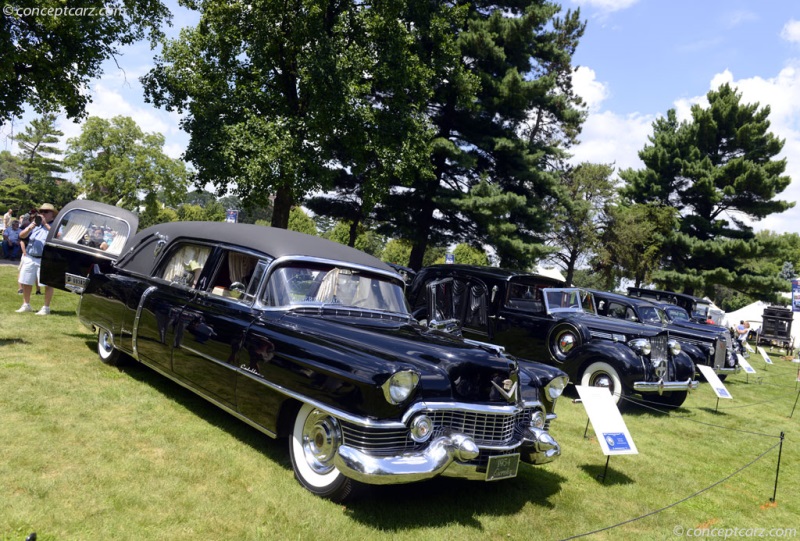
1955 Series 75 ![]() |
1954 Cadillac Series 75 Imperial news, pictures, and information | ||
| Tweet | ||
Both the Cadillac Series 70 and Series 75 were Cadillac's full-size V8-powered vehicles for over twenty years.
The Series 70 replaced the 1935 335-D as Cadillac's mainstream vehicle. Introduced at the same time, the Series 60 was available as a much less expensive vehicle. The Series 80 was almost identical to the Series 70, but rather than using the new Monobloc V8 engine, it came with Cadillac's V12.
Eventually the short wheelbase Series 70 was replaced by the Series 62 in 1941. Meanwhile, the long wheelbase 75 series became part of the Fleetwood line.
With a 135 hp (101 kW) engine that was both more powerful and less expensive, the Series 70 should have been an instant hit with the public. Unfortunately even the with the stylish body by Fleetwood wasn't enough to compare with the exorbitant price of $2,500 and up during the depression era.
In 1936, only 5,248 were sold.
Available in three basic models that shared the same engine and 3-speed transmission, the series 70 was available in 36-70, 36-75 and 36-75 Commercial. In 1937 minor body style changes were made. The 36-70 came with a 131 inch wheelbase and reached an overall length of 206.25. The 36-75 reached 213.5 in length and had a 138 inch wheelbase. The 36-75 Commercial model came with 156 inches in wheelbase, and also reached 213.5 in overall length.
For the 1942 model year, the Series lineup remained the same as in 1941. Front fenders on all models except the Series 75 became extended into the front doors.
As the grille became more massive it included round parking lights and rectangular fog light sockets, and had fewer bars. Series 75 had the new grille in 1942, but retained the 1941 fender treatment. The 75's received a rounded nose on the hood louvers as a detail trim change.
Though they adopted the new 1942 front-end styling, the 75's retained the 1941's short, square fenders and triple chrome strips behind the wheels. These same square-rigged lines continued through 1949.
In 1941, Fleetwood had two designated series, the Fleetwood Sixty Special and the Fleetwood Seventy-Five sedans. The Sixty special was built on 126-inch chassis and was more of a luxurious vehicle for those who strived for appearances and distinction.
The Seventy-Five sedans were built on a 136-inch wheelbase, and had seating room for five, seven or nine passengers. The 75 Sedan came with an option of the electrically powered glass ‘Imperial Division'. It was also available on a 1630inch wheelbase commercial chassis.
The most expensive Seventy-Five Formal sedan which seated seven was available at $4,045.
Installed with Cadillac's 368 in³ V12 engine, the Series 80 was produced for 1936 and 1937 only and was simply a model 70 or 75 with an updated engine. The Series 80 had an output of 150 hp (112 kW).
After the war, the Series 75 returned as Cadillac's largest model. Keeping the same 346 in³ L-head V8 as other Cadillac's that year, it retained most of the pre-war styling and rode on the long 136 inch wheelbase.
In 1949, the new Cadillac OHV V8 was introduced with only minor trim differences and a 331 in³ engine that produced 160 hp (119 kW)
The following year an all-new Series 75 was introduced and would replace the final pre-war design at Cadillac. This new model offered 7-passenger seating via jump seats, achieved a new 146.75 in wheelbase and had an engine output of 190 hp (142 kW).
In 1954 the wheelbase had moved up to 149.8 and had reached an engine output of 230 hp (172 kW). The following year the engine output jumped to 250 hp.
The series 75 reached a production number of 1527.
The 5 passenger touring sedan was longer and heavier than the 60 series car, which gives the car a sleek elegant look. The Cadillac 75 series was an ideal tour or parade car.
The Cadillac Imperial Business Sedan was a nine passenger sedan introduced in 1947. Only 80 of these vehicles were produced that year.By Jessica Donaldson
The Series 70 replaced the 1935 335-D as Cadillac's mainstream vehicle. Introduced at the same time, the Series 60 was available as a much less expensive vehicle. The Series 80 was almost identical to the Series 70, but rather than using the new Monobloc V8 engine, it came with Cadillac's V12.
Eventually the short wheelbase Series 70 was replaced by the Series 62 in 1941. Meanwhile, the long wheelbase 75 series became part of the Fleetwood line.
With a 135 hp (101 kW) engine that was both more powerful and less expensive, the Series 70 should have been an instant hit with the public. Unfortunately even the with the stylish body by Fleetwood wasn't enough to compare with the exorbitant price of $2,500 and up during the depression era.
In 1936, only 5,248 were sold.
Available in three basic models that shared the same engine and 3-speed transmission, the series 70 was available in 36-70, 36-75 and 36-75 Commercial. In 1937 minor body style changes were made. The 36-70 came with a 131 inch wheelbase and reached an overall length of 206.25. The 36-75 reached 213.5 in length and had a 138 inch wheelbase. The 36-75 Commercial model came with 156 inches in wheelbase, and also reached 213.5 in overall length.
For the 1942 model year, the Series lineup remained the same as in 1941. Front fenders on all models except the Series 75 became extended into the front doors.
As the grille became more massive it included round parking lights and rectangular fog light sockets, and had fewer bars. Series 75 had the new grille in 1942, but retained the 1941 fender treatment. The 75's received a rounded nose on the hood louvers as a detail trim change.
Though they adopted the new 1942 front-end styling, the 75's retained the 1941's short, square fenders and triple chrome strips behind the wheels. These same square-rigged lines continued through 1949.
In 1941, Fleetwood had two designated series, the Fleetwood Sixty Special and the Fleetwood Seventy-Five sedans. The Sixty special was built on 126-inch chassis and was more of a luxurious vehicle for those who strived for appearances and distinction.
The Seventy-Five sedans were built on a 136-inch wheelbase, and had seating room for five, seven or nine passengers. The 75 Sedan came with an option of the electrically powered glass ‘Imperial Division'. It was also available on a 1630inch wheelbase commercial chassis.
The most expensive Seventy-Five Formal sedan which seated seven was available at $4,045.
Installed with Cadillac's 368 in³ V12 engine, the Series 80 was produced for 1936 and 1937 only and was simply a model 70 or 75 with an updated engine. The Series 80 had an output of 150 hp (112 kW).
After the war, the Series 75 returned as Cadillac's largest model. Keeping the same 346 in³ L-head V8 as other Cadillac's that year, it retained most of the pre-war styling and rode on the long 136 inch wheelbase.
In 1949, the new Cadillac OHV V8 was introduced with only minor trim differences and a 331 in³ engine that produced 160 hp (119 kW)
The following year an all-new Series 75 was introduced and would replace the final pre-war design at Cadillac. This new model offered 7-passenger seating via jump seats, achieved a new 146.75 in wheelbase and had an engine output of 190 hp (142 kW).
In 1954 the wheelbase had moved up to 149.8 and had reached an engine output of 230 hp (172 kW). The following year the engine output jumped to 250 hp.
The series 75 reached a production number of 1527.
The 5 passenger touring sedan was longer and heavier than the 60 series car, which gives the car a sleek elegant look. The Cadillac 75 series was an ideal tour or parade car.
The Cadillac Imperial Business Sedan was a nine passenger sedan introduced in 1947. Only 80 of these vehicles were produced that year.By Jessica Donaldson
The Cadillac Series 75 was the marque's flagship V8 from 1936 onwards, though the lower priced series easily outsold it. Production of the full-size V8 powered Cadillac's would continue from the 1930s through the 1950s. It served as a replacement for the outgoing 355-D and was introduced around the same time as the less-expensive Series 60 model. Outwardly, the Series 80, including the 85, were similar in appearance with the main difference being underhood. The Series 80/85 featured a V12 engine while the Series 70/75 had a V8. The V8 produced 135 horsepower while the V12's output was 150 hp.
In 1941, the short wheelbase Series 70 was replaced by the Series 62 and the long wheelbase Series 75 was integrated into the Fleetwood line. Cadillac would continue the '75' name until the mid 1960s.
The V8 Series 70 of the mid 1930s were powered by a Monoblock V8 engine that displaced 346 cubic-inches and produced 135 horsepower. A total of 5,248 examples were sold in 1936. There were three body-styles available for the Series 70 from 1936 through 1937 consisting of a 131-inch wheelbase for the 36-70, a 138-inch version of the 36-75 and a large 156-inch platform for the 36-75 Commercial version.
There were a wide variety of body-styles to select from and all wore badges of Cadillac's in-house coachbuilder Fleetwood. The list ranged from two-passenger coupes to seven-passenger town cars with 14 cataloged styles offered.
The Fleetwood Metal Body Company had a history that dated back to 1905 when they were formed in Fleetwood, Pennsylvania. During their early years, some of their best customers were Packard, Pierce-Arrow and Cadillac. Lawrence Fisher, head of GM's Fisher Body Company and later president of Cadillac was pleased with Fleetwood's coach-building work and felt the union between the two companies was appropriate. The company was purchased by Cadillac in 1925 and the sales and design offices were moved to Detroit. Additional plants were built in Pennsylvania for body production and Fleetwood continued to accept body-requests from non-GM companies.
A Fleetwood plant was built in 1929 in Detroit, adjacent to the Fisher Body facility, and by 1931 all production had migrated to this location. Later, the production was absorbed by General Motors Art & Colour and Fisher Body. The Fleetwood name persisted for many decades, often referring to limited and low-production styles.
In 1939 the Cadillac V8 models were given a new frontal look with a matching textured grille. On either side were two side grilles. The engine still displaced 346 cubic-inches but further tuning had increased the horsepower output and its compression.
The Series 72 was a Fleetwood car that rode on a shorter, 138-inch wheelbase.
Production ceased during the Second World War and resumed in 1946. When it did, the Series 75 became Cadillac's largest model offered; now riding on a 136-inch wheelbase. The 346 L-head V8 engine was the same as was most of its basic styling. Just like most other automakers, a 'new' model would not be introduced for several years.
For the Series 75, this did not occur until 1950. It had a 146.7 inch wheelbase with seating for seven. Engine options included a 346- and 365-cubic-inch V8.
The wheelbase size was again increased by 1954, now measuring 149.8 inches. To carry the extra weight Cadillac increased the horsepower to 230. The following year it rose again to 250 hp, with an optional dual-four barrel carburetor version offered that produced 270 horsepower. 1956 saw another increase in horsepower, now ranging from 285 to just over 300.
Another restyling occurred in 1957 and would remain until 1965. By now, the name '75' had all but disappeared. Horsepower hovered around the 300 to 325 range depending on the engine and the setup. The long version of the Fleetwood became known as the Series 6700 in accordance with the new Cadillac naming scheme.
By Daniel Vaughan | Apr 2008
In 1941, the short wheelbase Series 70 was replaced by the Series 62 and the long wheelbase Series 75 was integrated into the Fleetwood line. Cadillac would continue the '75' name until the mid 1960s.
The V8 Series 70 of the mid 1930s were powered by a Monoblock V8 engine that displaced 346 cubic-inches and produced 135 horsepower. A total of 5,248 examples were sold in 1936. There were three body-styles available for the Series 70 from 1936 through 1937 consisting of a 131-inch wheelbase for the 36-70, a 138-inch version of the 36-75 and a large 156-inch platform for the 36-75 Commercial version.
There were a wide variety of body-styles to select from and all wore badges of Cadillac's in-house coachbuilder Fleetwood. The list ranged from two-passenger coupes to seven-passenger town cars with 14 cataloged styles offered.
The Fleetwood Metal Body Company had a history that dated back to 1905 when they were formed in Fleetwood, Pennsylvania. During their early years, some of their best customers were Packard, Pierce-Arrow and Cadillac. Lawrence Fisher, head of GM's Fisher Body Company and later president of Cadillac was pleased with Fleetwood's coach-building work and felt the union between the two companies was appropriate. The company was purchased by Cadillac in 1925 and the sales and design offices were moved to Detroit. Additional plants were built in Pennsylvania for body production and Fleetwood continued to accept body-requests from non-GM companies.
A Fleetwood plant was built in 1929 in Detroit, adjacent to the Fisher Body facility, and by 1931 all production had migrated to this location. Later, the production was absorbed by General Motors Art & Colour and Fisher Body. The Fleetwood name persisted for many decades, often referring to limited and low-production styles.
In 1939 the Cadillac V8 models were given a new frontal look with a matching textured grille. On either side were two side grilles. The engine still displaced 346 cubic-inches but further tuning had increased the horsepower output and its compression.
The Series 72 was a Fleetwood car that rode on a shorter, 138-inch wheelbase.
Production ceased during the Second World War and resumed in 1946. When it did, the Series 75 became Cadillac's largest model offered; now riding on a 136-inch wheelbase. The 346 L-head V8 engine was the same as was most of its basic styling. Just like most other automakers, a 'new' model would not be introduced for several years.
For the Series 75, this did not occur until 1950. It had a 146.7 inch wheelbase with seating for seven. Engine options included a 346- and 365-cubic-inch V8.
The wheelbase size was again increased by 1954, now measuring 149.8 inches. To carry the extra weight Cadillac increased the horsepower to 230. The following year it rose again to 250 hp, with an optional dual-four barrel carburetor version offered that produced 270 horsepower. 1956 saw another increase in horsepower, now ranging from 285 to just over 300.
Another restyling occurred in 1957 and would remain until 1965. By now, the name '75' had all but disappeared. Horsepower hovered around the 300 to 325 range depending on the engine and the setup. The long version of the Fleetwood became known as the Series 6700 in accordance with the new Cadillac naming scheme.
By Daniel Vaughan | Apr 2008
| SUPERIOR DESIGN AND PERFORMANCE: BREMBO PRESENTS THE NEW 'EXTREMA' CALIPER | |
![]() | Well known as a benchmark setter in the field of brake systems, Brembo has always been synonymous with performance and innovation: concepts perfectly reflected in the new brake system designed for the supercar 'Made in Maranello', the successor to the Ferrari Enzo, unveiled today at the Geneva Motor Show. In developing the new 'Extrema' caliper, Brembo affirms its DNA as an experimenter and researcher of solutions that continue to raise the already high standards of the company's products. ...[Read more...] |
1954
Cadillac
models |
| Cadillac Series 62 |
| Cadillac Series Sixty Special Fleetwood | 1954 Cadillac Concepts |
| Cadillac Series 62 PF Concept |
| Similar Automakers | |
| Chevrolet | Chrysler |
| Dodge | Ford |
| GMC | Hummer |
| Jeep | Lincoln |
| Mercury | Pontiac |
| Saturn | |
| Similarly Sized Vehicles from 1954 |
| Cadillac Series 62 |
| Cadillac Series 62 PF Concept |
| Mercury Monterey XM-800 Concept |
| Similarly Priced Vehicles from 1954 |
| Aston Martin DB2/4 ($5,950-$5,950) |
Average Auction Sale: $14,300 |
| Cadillac: 1951-1960 |
| Similar Automakers |
| Cadillac History |
| Other models by Cadillac |
| Manufacturer Website |
| Related Articles and Event Coverage |
| 2005 Concours d'Elegance of the Eastern United States |
| ||||||||||||||||||||||||||||||||||||||||||||
1955 Series 75 ![]() |


1954