1960 Lotus 18 Formula Junior

1960 Lotus 18 Formula Junior Navigation
The Lotus Type 18 was the company's first mid-engined Grand Prix car design. It was introduced for the 1960 season and, depending on its specification, was used in Formula Junior, Formula Two, and Formula One. 1960 was the final year of the 2½-Litre Formula 1, adopting the 1½-Litre displacement the following season. The Type 18 was more successful than Colin Champman's previous front-engined formula cars (including the 12 and 16), scoring a victory at the 1960 Monaco Grand Prix where it was driven by Stirling Moss. The Type 18 and Moss repeated this victory the following year. Moss also won the United States Grand Prix in 1960 which helped Lotus finish second in the constructors' championship. Moss won the 1961 Nürburgring while Innes Ireland won in the USA to help Lotus finish second in the constructors' championship in 1961. Grand Prix Specification
The Lotus Type 18 used a steel spaceframe (nearly spaceframe) chassis made up of heavily-triangulated tubes, suspended by double wishbones in the front with inboard coil-over spring/damper units. The rear employed lower wishbones, top links, and radius rods with outboard coil-over spring/damper units. The lightweight body panels were bolted to the frame with the 2,467cc Coventry Climax FPF four-cylinder DOHC engine positioned behind the driver. Used in the Type 16, the engine's displacement grew to 2,497cc in 1960 and produced 239 horsepower at 6,750 RPM. Complying with 1961 racing regulations, the 2.5-liter engine was replaced by a smaller 1.5-liter Climax FPF MK.II unit with a 82mm bore and stroke of 71 mm. The transmission was a sequential manual unit that had been initially developed for the Lotus Type 12 by Richard Ansdale and Harry Mundy. Keith Duckworth improved the reliability of the transmission for the Type 15 and 16. The transmission and ZF limited-slip differential were combined in a common Magnesium alloy housing to form a transaxle, which also served as the mounting points for the rear inboard brakes. The Lotus Type 18 weighed a mere 980 lbs and stood just 28 inches high, complemented by the semi-reclining position of the driver. Formula Junior Specifiation
Formula Junior was designed as a 'feeder' racing class for Formula 1 and other more senior forms of motorsports in the early 1960s. Lotus's first foray into this hotly contested series was the spaceframe Type 18 where it proved to be the class of the field, with Team Lotus works drivers Jim Clark and Trevor Taylor dominating the 1960 season.
Monoposto
Chassis #: 18-FJ-727The Formula Junior version of the Type 18 used either a 998cc Cosworth MK.III or a Downton BMC 'A' Series displacing 948cc. With less output compared to the Grand Prix version, the FJ version had Alfin drum brakes on all four corners and smaller gauge chassis tubing. It used a Renault Dauphine-derived 4-speed close-ratio transaxle, with a Volkswagen gearbox with Hewland 4 speed gears optional. An advantage of the Volkswagen/Hewland transmission was the ability to change gear ratios from behind the gearbox without removing the unit from the car. The most successful of the Ford-engined Formula Junior tuning companies were those of Cosworth Engineering, which could safely rev to 9,500 RPM, and breathed through twin-choke Weber 40 DCOE 40 carburetors. Approximately 125 examples of the Lotus 18 were built. It was repalced by the Type 21 which was an evolution of the Type 18, with a streamlined body, a tubular spaceframe structure, fiberglass body panels, all round disc brakes, and powered by a 1.5-liter Coventry Climax FPF 4-cylinder. The Type 21 was the first Lotus car driven by the Works team to victory in Formula One Grand Prix competition.
by Daniel Vaughan | Jan 2022
The Lotus Type 18 used a steel spaceframe (nearly spaceframe) chassis made up of heavily-triangulated tubes, suspended by double wishbones in the front with inboard coil-over spring/damper units. The rear employed lower wishbones, top links, and radius rods with outboard coil-over spring/damper units. The lightweight body panels were bolted to the frame with the 2,467cc Coventry Climax FPF four-cylinder DOHC engine positioned behind the driver. Used in the Type 16, the engine's displacement grew to 2,497cc in 1960 and produced 239 horsepower at 6,750 RPM. Complying with 1961 racing regulations, the 2.5-liter engine was replaced by a smaller 1.5-liter Climax FPF MK.II unit with a 82mm bore and stroke of 71 mm. The transmission was a sequential manual unit that had been initially developed for the Lotus Type 12 by Richard Ansdale and Harry Mundy. Keith Duckworth improved the reliability of the transmission for the Type 15 and 16. The transmission and ZF limited-slip differential were combined in a common Magnesium alloy housing to form a transaxle, which also served as the mounting points for the rear inboard brakes. The Lotus Type 18 weighed a mere 980 lbs and stood just 28 inches high, complemented by the semi-reclining position of the driver. Formula Junior Specifiation
Formula Junior was designed as a 'feeder' racing class for Formula 1 and other more senior forms of motorsports in the early 1960s. Lotus's first foray into this hotly contested series was the spaceframe Type 18 where it proved to be the class of the field, with Team Lotus works drivers Jim Clark and Trevor Taylor dominating the 1960 season.
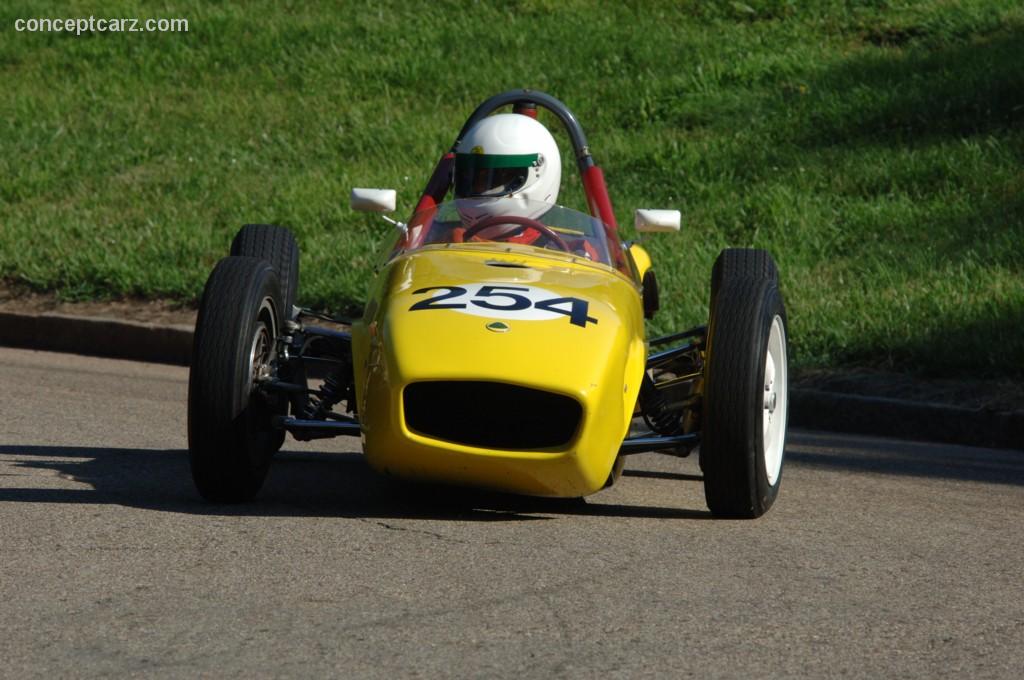
Monoposto
Chassis #: 18-FJ-727
by Daniel Vaughan | Jan 2022
Related Reading : Lotus 18 FJ History
The Lotus 18 was the first mid-engined vehicle built by Lotus. The design was created by Colin Chapman, the founder of Lotus, specifically for Formula 1 and Formula 2 racing. The mid-engined design brought the Lotus racing efforts to another level and greatly improved their ability to compete in the fiercely competitive formula series. The lightweight, powerful, and simple design was the correct....
Continue Reading >>
Continue Reading >>
- 1960 Lotus 18 Formula Junior Menu
- Article
- Image gallery
- Valuation
- Specifications
- Profiles




1960 Lotus 18 Formula Junior Vehicle Profiles
Recent Vehicle Additions


Related Automotive News

Ignition Festival Gathers The Greatest Collection Of Formula One Cars Ever To Be Seen In Scotland
IGNITION Festival of Motoring is delighted to reveal the greatest-ever collection of Formula 1 cars to grace Scottish shores. Cars previously driven by the crème de le crème of Formula One including Jenson Button, Michael Schumacher, Ayrton Senna, Jim...
RRDC VOTES IN 37 NEW MEMBERS FOR 2013
HILLIARD, Ohio (Nov. 7, 2013) - Thirty-seven race-car drivers and motorsports professionals have been voted into the Road Racing Drivers Club in 2013. The group includes 13 Regular Members from the open-wheel and sports-car racing ranks, 20 Associate...

1961 Monaco Grand Prix: Outdueled by a Legend
Powering his way around Tabac, Richie Ginther would find that his time had run out. He had doggedly fought and wrestled his way around the tight, twisty streets of Monaco in pursuit of Moss. The British veteran had an answer for everything but it required...

1965 Mexico Grand Prix: Ginther Finally Gets It!
Richie Ginther had come so close so many times in the past but had always been outshone by someone else for victory. Now with the new Honda Team, it seemed anybody other than Ginther would win. But all of that would change on the 24th of October, 1965.
Ginthers...

1962 Monaco Grand Prix: McLaren Carries the Cooper Flag back to the Top
By the beginning of the 1962 Formula One season Jack Brabham had left Cooper to form his own racing team. It seemed the glories days of the double World Championship were well and truly behind them. However, left in Brabhams stead would be a man very...