1963 Impala Series | 1963 Impala Z11 | 1963 Impala NASCAR | 1965 Impala Series ![]() |
1964 Chevrolet Impala Series news, pictures, and information | ||
| Tweet | ||
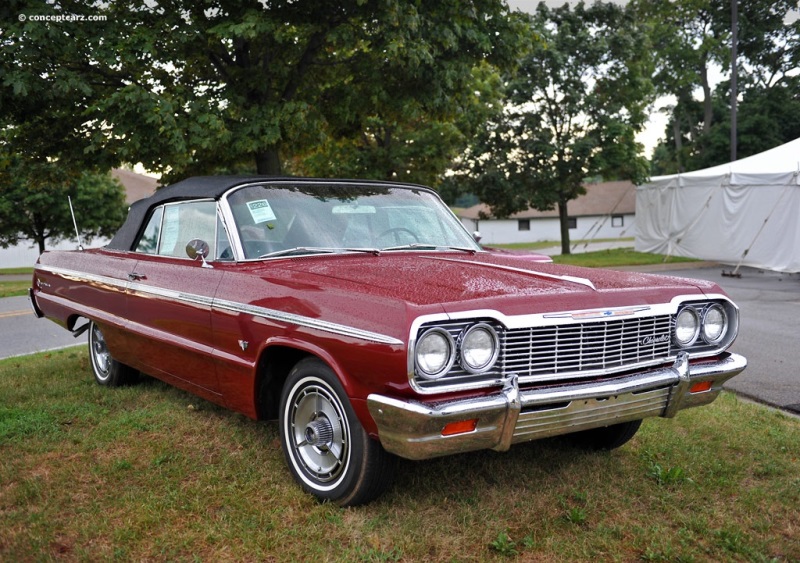
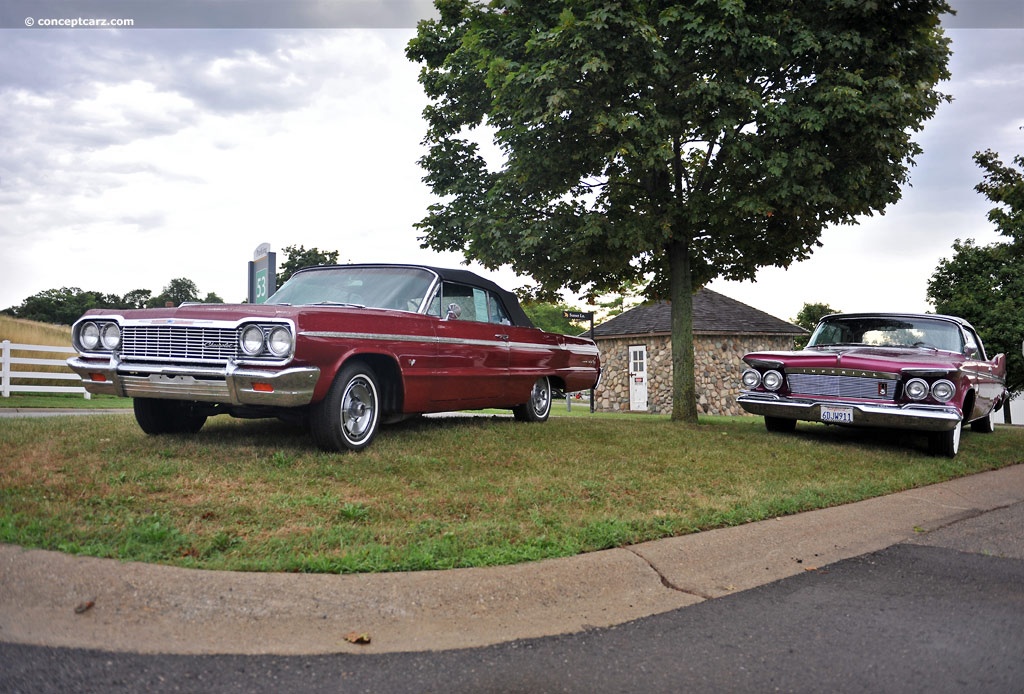
![]() | ![]() | ![]() | Series 1800 V8 Convertible Chassis Num: 41467Y241925 |
| Sold for $27,500 at 2010 RM Auctions. | |||
The SS, representing Super Sport, was considered a separate series for the first time rather than an Impala option package. The SS trim included tri-bar wheel covers, rear cove molding, instrument panel and console, SS badges on the exterior and engine-tuned trim on the side moldings.
For 1964, Chevrolet produced nearly 890,000 Impalas, with approximately 185,000 wearing SS badges, and 81,897 were convertibles.
This maroon Impala Super Sport with black vinyl interior is powered by a small-block 327/365-horsepower V8 engine mated to a four-speed manual transmission. It has power steering, AM-FM radio, dash-mounted tachometer, and bucket seats with floor console.
In 2010, this Impala SS was offered for sale at the Vintage Motor Cars of Meadow Brook event presented by RM Auctions. The car was estimated to sell for $30,000 - $50,000. As bidding came to a close, the car had been sold for the sum of $27,500 including buyer's premium.
By Daniel Vaughan | Aug 2010
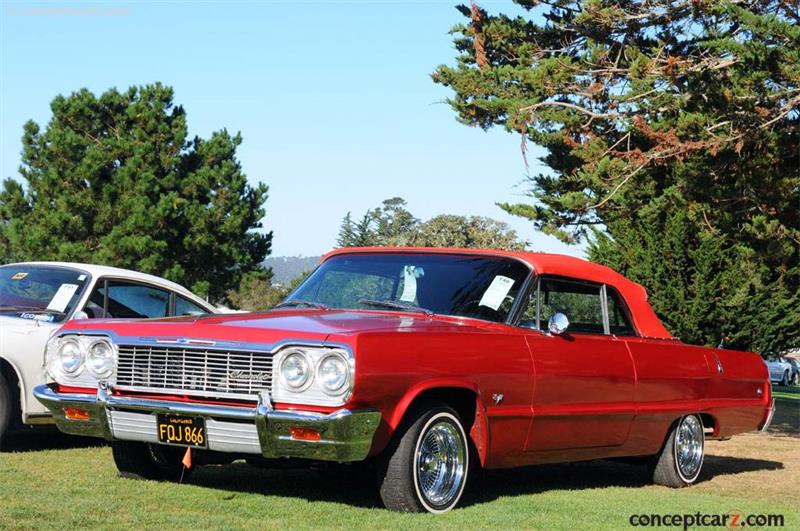
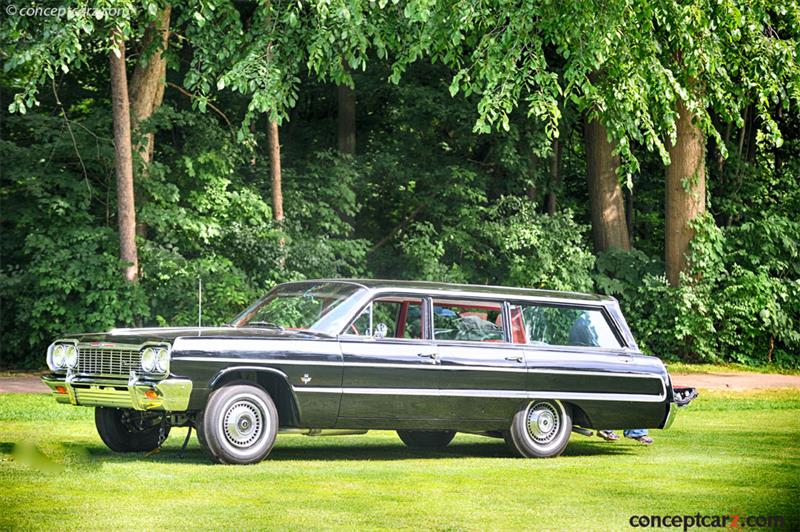
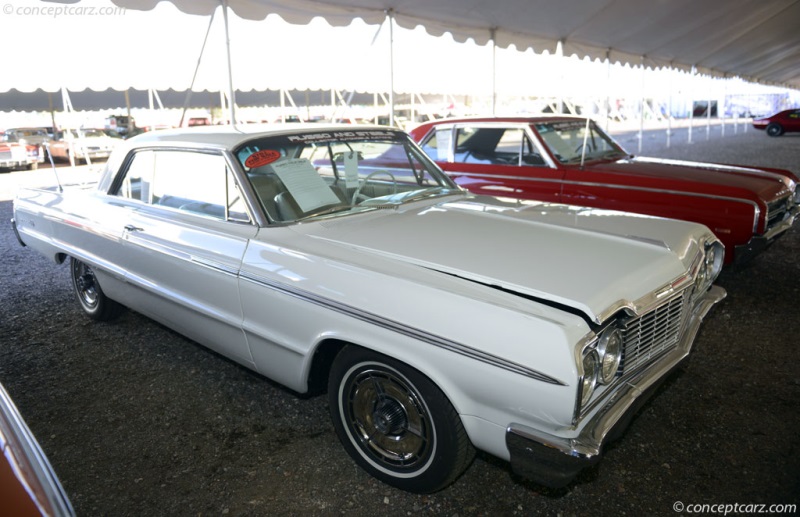
The 1964 Chevrolet Impala came in two flavors, the base and the Super Sport. The base model came in six bodystyles including a convertible, sedan, hardtop sport sedan, hardtop sport coupe, and two station wagons. The Super Sport was either a convertible or a hardtop sport coupe.
The Impala had most of the features found on the lower-priced Chevy's, plus foam cushion seats, aluminum front seat end panels, electric clock, nameplate molding, parking brake warning light, Impala center emblem on steering wheel, chrome-backed rearview mirror, dual dome lights, paddle-type armrests in front and rear, and an automatic luggage compartment light. They also had interior garnish moldings around the rear window and upper side window. The inside featured cloth and leather grain vinyl with bright-accented all-vinyl door panels. There was Impala lettering and emblem on the rear fenders and bright belt moldings.
Powering the Impala was an overhead valve six-cylinder engine that produced 120 horsepower. A 283 cubic-inch V8 offered nearly 200 horsepower. A 327 and 409 was also available with horsepower ranging from 250 to 425 horsepower.
The Super Sport (SS) model was - as the name implies - a sporty model. They had leather grained vinyl upholster with individual buck seats in the front and a locking compartment in a center console. Exterior features included a wider upper body molding, Impala lettering and SS badge on the rear fenders, and another badge on the deck lid. Full wheel covers of specific Super Sport design was another SS distinction.
For 1964, Chevrolet produced roughly 185,325 Impala Super Sport models. Around 73,600 six-cylinder Impalas were built and 616,000 were Impala V8s.
By Daniel Vaughan | Feb 2012
The Impala had most of the features found on the lower-priced Chevy's, plus foam cushion seats, aluminum front seat end panels, electric clock, nameplate molding, parking brake warning light, Impala center emblem on steering wheel, chrome-backed rearview mirror, dual dome lights, paddle-type armrests in front and rear, and an automatic luggage compartment light. They also had interior garnish moldings around the rear window and upper side window. The inside featured cloth and leather grain vinyl with bright-accented all-vinyl door panels. There was Impala lettering and emblem on the rear fenders and bright belt moldings.
Powering the Impala was an overhead valve six-cylinder engine that produced 120 horsepower. A 283 cubic-inch V8 offered nearly 200 horsepower. A 327 and 409 was also available with horsepower ranging from 250 to 425 horsepower.
The Super Sport (SS) model was - as the name implies - a sporty model. They had leather grained vinyl upholster with individual buck seats in the front and a locking compartment in a center console. Exterior features included a wider upper body molding, Impala lettering and SS badge on the rear fenders, and another badge on the deck lid. Full wheel covers of specific Super Sport design was another SS distinction.
For 1964, Chevrolet produced roughly 185,325 Impala Super Sport models. Around 73,600 six-cylinder Impalas were built and 616,000 were Impala V8s.
By Daniel Vaughan | Feb 2012
The 1950's Impala was big, very big. It actually began its life as a top option level of the Bel Air. Due to sales being so well for this body style, Chevrolet decided to create the Impala as its own model. Its styling has been termed 'bat-winged' due to the rear-styling of the vehicle. A variety of engines were available ranging from an inline-6 cylinder up to a triple carburetor, 348 cubic-inches V8 capable of producing 315 horsepower. A fuel injected V8 became available in 1959.
From the front of the car, the design was fairly normal for the 1950's era. Extensive amounts of chrome littered the front end. Two headlights, located side-by-side, were placed on each sides of the vehicle. A front grill was used to help keep the engine cool. View the car from the side and it becomes immediately clear that this is a big vehicle. The length of the vehicle could be extended an additional 11 inches by adding the Continental spare tire cover to the rear of the car. Viewing the car from the rear, the car quickly ends up in a league of its own, with only a few other vehicles such as the Cadillac Series 62 / DeVille having such a radical rear-end. The vehicle featured rear-fins that resembled cats-eyes. To top it all off, this car was not-only long, it was also very wide.
Drum brakes were used and due to the weight of the vehicle, tended to wear out rather quickly. The Impala came in three different body styles including a four-door sedan, two-door coupe, and a convertible coupe. Even though the vehicle weighed 3650 lbs, it could achieve a zero-to-sixy run in about 9 seconds. Top speed was in the neighborhood of 130 miles-per-hour.
By Daniel Vaughan | Dec 2009
From the front of the car, the design was fairly normal for the 1950's era. Extensive amounts of chrome littered the front end. Two headlights, located side-by-side, were placed on each sides of the vehicle. A front grill was used to help keep the engine cool. View the car from the side and it becomes immediately clear that this is a big vehicle. The length of the vehicle could be extended an additional 11 inches by adding the Continental spare tire cover to the rear of the car. Viewing the car from the rear, the car quickly ends up in a league of its own, with only a few other vehicles such as the Cadillac Series 62 / DeVille having such a radical rear-end. The vehicle featured rear-fins that resembled cats-eyes. To top it all off, this car was not-only long, it was also very wide.
Drum brakes were used and due to the weight of the vehicle, tended to wear out rather quickly. The Impala came in three different body styles including a four-door sedan, two-door coupe, and a convertible coupe. Even though the vehicle weighed 3650 lbs, it could achieve a zero-to-sixy run in about 9 seconds. Top speed was in the neighborhood of 130 miles-per-hour.
By Daniel Vaughan | Dec 2009
Chevrolet Impala, 1958-1960
In 1958, Chevrolet decided to move upscale with a new trim level for the successful Bel Air. Called Impala, the upgrade package included enhanced interior and exterior styling, along with powertrain options potent enough to create one of the best performing large cars available at the time.The name of this new trim level had been used at Chevy before, when GM was showcasing dream cars in its 1956 Motorama shows. One auto created for this show by GM's design studio was the Chevrolet Corvette Impala. With a hardtop and room for five, this concept was created to show the possibility of producing a full model line for the Corvette. It had a traditional Corvette grille and swoopy lines with a sporty flair, free of the fins so popular on sedans.
Though the Corvette Impala never made it beyond concept car status, the Bel Air Impala retained some of its sporting intent. The priciest car in Chevrolet's fleet, the new flagship could be had with a 348c.i. V8 producing 315bhp.
Ironic given the clean lines of the Corvette Impala, the Bel Air Impala featured large fins and as much chrome as a contemporary roadside diner. Other new styling elements included a six taillight rear treatment, and a wide front view with four headlamps. The Impala package could be ordered only as a coupe or convertible, enhancing the sporting image of the car. While the base engine was a 145bhp straight six, every other available engine was a V8 displacing 283c.i. or 348c.i. With this plethora of performance-minded engine options, buyers knew theses vehicles were serious.
The Bel Air Impala was an easy seller. Despite its premium price, the public loved its looks and available power. Its sales volume was high enough to prompt Chevy to bring back the Impala for 1959 as a model line in its own right, free of Bel Air connections.
Available as a sedan, coupe, and convertible, the 1959 Impala was an even bigger hit. Its design was fresh and considered very stylish, with huge fins second in size only to Cadillac's. The Impala was named after an African antelope, hence the car's logo. Other animals were evidently taken into consideration as well during the designing of the Impala. The large tailfins were referred to as 'bat wings.' The long, narrow taillights, which tapered toward the center to sharp points, were called 'cat's eyes.'
Many consider the early Impala the first real muscle car. The 1958 models especially followed the formula of taking a big sedan, getting rid of a couple of doors, and shoehorning in the biggest V8 that'll fit under the hood.
For 1959, the performance slant of Impalas took on a hint of greater sophistication when an impressive new engine choice was made available. A 283c.i. V8 with an advanced fuel injection system was introduced. With more power than the cheapest 348c.i. engine, the fuel injected motor made a great choice. Unfortunately, it was never very popular and is a rare find today.
The 1960 Impala was a letdown for driving enthusiasts. Some of the distinct styling features were deleted, as was the availability of fuel injection. The Impala had taken a step away from its performance roots. It continued to sell incredibly well, though. In 1959, the Impala was already the bestselling Chevrolet. In 1960, it became America's bestselling car of any manufacturer.
Successful or not, the Impala was beginning to lose its direction in 1960. But hopeful enthusiasts were rewarded for their patience a year later when the 1961 Impala SS was introduced, bringing a brand new performance icon to Chevrolet. The Impala would go on to become the bestselling full-size car of all time.
Sources:
www.corvettes.nl, '1956 Chevrolet Impala Show Car.' Car Styling 7 Mar 2009 http://www.carstyling.ru/en/cars.1956_Chevrolet_Impala%20Show%20Car%20.html.
Patterson, Marit Anne. '1958 Chevrolet Impala Convertible.' Sports Car Market 08 Aug 2008 7 Mar 2009 http://www.hagerty.com/lifestyle/hobby_article.aspx?id=34714.
'Chevrolet Impala History.' Muscle Car Club 7 Mar 2009 http://www.musclecarclub.com/musclecars/chevrolet-impala/chevrolet-impala-history-1.shtml.
'1958 Chevrolet Impala.' 1958 Classic Chevrolet: 'A Whole New Look' 7 Mar 2009 http://58classicchevy.com/.By Evan Acuña
Considered to be ‘the best selling full-size car in the U.S.,' in 1960 the Chevy Impala was designed and built by the Chevrolet division of General Motors.
Originating as a sports coupe, the Impala began as a dreamcar for the 1956 General Motors Motorama.
The name Impala originated from a southern African antelope known for its speed and prowess. Introduced in 1958, the Impala was developed by chief engineer automotive executive for General Motors, Edward Cole.
Michigan born, Cole was the son of a dairy farmer whose lifelong aspiration was to become an automotive engineer. Beginning as a lab assistant for the General Motors Institute, Cole worked in engineering before gaining recognition and becoming promoted to chief engineer in 1952. Cole eventually became president of Chevrolet in 1967.
Introduced with a trim package, the new sporty model was unique with its six taillights. Eventually becoming the ‘best selling car in the Chevrolet product line', in 1959 it became a separate model in both two and four-door versions. Within the second year of production, production reached 473,000 units.
Continuing for a decade as the best-selling automobile in the U.S. Impala broke the record for sales with over 13 million units sold. The Impala held this record until 1977 setting an ‘all-time industry annual sales record of more than 1 million units.'
Introducing the largest impala, the 1971 redesign set the standard that has yet to be topped remaining Chevrolet's top-selling model until the late 1970's.
The design of the Impala SS (Super Sport) became the model often credited for the beginning of the muscle car era.
During the 1973 energy crisis that rocketed the nation, the impact of high rising gas prices put a damper on the industry. Impala sales plummeted and the redesign of the Impala to meet changing demands. Minimized in length, becoming more narrow and taller in stature, the new Impala showcased ‘the new image of the full-size American car – smaller, lighter, more efficient.'
Over the decades, the Impala has continued to remain an American trademark, enhanced by its ability to evolve with the times.
Introduced during the Los Angeles Auto Show in 2005, the 2006 Impala came complete with a base engine, a 3.5 L V6 that produced 211 hp. A completely revised interior, the 06 Impala was selected by Fleet car of the Year by both Automotive Fleet and Business magazines.By Jessica Donaldson
For more information and related vehicles, click hereOriginating as a sports coupe, the Impala began as a dreamcar for the 1956 General Motors Motorama.
The name Impala originated from a southern African antelope known for its speed and prowess. Introduced in 1958, the Impala was developed by chief engineer automotive executive for General Motors, Edward Cole.
Michigan born, Cole was the son of a dairy farmer whose lifelong aspiration was to become an automotive engineer. Beginning as a lab assistant for the General Motors Institute, Cole worked in engineering before gaining recognition and becoming promoted to chief engineer in 1952. Cole eventually became president of Chevrolet in 1967.
Introduced with a trim package, the new sporty model was unique with its six taillights. Eventually becoming the ‘best selling car in the Chevrolet product line', in 1959 it became a separate model in both two and four-door versions. Within the second year of production, production reached 473,000 units.
Continuing for a decade as the best-selling automobile in the U.S. Impala broke the record for sales with over 13 million units sold. The Impala held this record until 1977 setting an ‘all-time industry annual sales record of more than 1 million units.'
Introducing the largest impala, the 1971 redesign set the standard that has yet to be topped remaining Chevrolet's top-selling model until the late 1970's.
The design of the Impala SS (Super Sport) became the model often credited for the beginning of the muscle car era.
During the 1973 energy crisis that rocketed the nation, the impact of high rising gas prices put a damper on the industry. Impala sales plummeted and the redesign of the Impala to meet changing demands. Minimized in length, becoming more narrow and taller in stature, the new Impala showcased ‘the new image of the full-size American car – smaller, lighter, more efficient.'
Over the decades, the Impala has continued to remain an American trademark, enhanced by its ability to evolve with the times.
Introduced during the Los Angeles Auto Show in 2005, the 2006 Impala came complete with a base engine, a 3.5 L V6 that produced 211 hp. A completely revised interior, the 06 Impala was selected by Fleet car of the Year by both Automotive Fleet and Business magazines.By Jessica Donaldson
| 'Motor Klassik Award 2013': Five Awards for Mercedes-Benz | |
![]() | • Victory in the categories 'Classics up to 1930', 'Classics 1947-1961', and '2012 Auction Car' • Classics of the future: G-Class wins in the 'Off-Roader' category and the CLS Shooting Brake wins for the 'Luxury Segment' • More than 22,000 'Motor Klassik' readers voted for their favourite vehicles The readers of 'Motor Klassik' classic car magazine have decided: in the 'Motor Klassik Award 2013' a Mercedes-Benz vehicle has won in all of five categories. 'In this vote, t...[Read more...] |
| Auctions America Readies for Highly Anticipated Spring Carlisle Collector Car Weekend | |
![]() | • Auctions America returns to Carlisle, Pennsylvania for its annual Spring Carlisle sale, April 25-26 • Two-day sale lifts the gavel on a diverse roster of approximately 300 quality collector cars • Notable highlights include a rare 1959 Chevrolet Corvette 'Big-Brake' Fuel-Injected Roadster, a 1970 Chevrolet Chevelle SS LS5 Convertible and a 1999 Bentley Azure Convertible • Sale held during Carlisle Events' highly anticipated Spring Carlisle Collector Car Swap Meet & Corral weekend, April 24...[Read more...] |
| VICARI AUCTION COMPANY OFFERS RARE '62 & '63 Z06 CORVETTES AT 2013 CRUISIN' NOCONA | |
![]() | In a recent rare find, two classic Chevrolet Corvettes (one '62 and one '63) - stored for decades-are being made available by the Vicari Auction Company. Both vehicles will cross the block during 2013 Cruisin' Nocona, a north Texas collector car auction and classic car poker cruise set for April 19th and 20th in historic Nocona, Texas. The Corvettes are virtually all-original, and have been stored in Texas by a classic-vehicle aficionado and collector since the 1980s. 'These...[Read more...] |
| WORLD'S GREATEST SUPERCARS BATTLE FOR NEW FASTEST LAP AT PAGEANT OF POWER | |
![]() | •Cholmondeley Pageant of Power (15-17 June, www.cpop.co.uk) announces new Supercar class •New racing category will see Lamborghini Aventador, BAC Mono, new Porsche 911 and many more competing for the lap record •Unique opportunity to see ultra-rare road cars in action, including the Aston Martin One-77, Bugatti Veyron Super Sport and Ferrari Enzo Some of the finest modern supercars, including models from Bugatti, Lamborghini, Bentley, Aston Martin and Maserati, will take to the track at ...[Read more...] |
| 2012 Keeneland Concours d'Elegance Features Packard Automobiles | |
![]() | The 9th annual Keeneland Concours d'Elegance will once again bring more than 150 classic and collector automobiles and motorcycles to the grounds of the historic Keeneland Race Course on Saturday, July 21, 2012. This year's featured marque is Packard, and collectors from across the country will compete for trophies in 18 classes of classic, vintage and exotic autos and motorcycles. Packard autos will be divided into pre-war and post-war classes. Other featured classes include the Motorcycle P...[Read more...] |
| Similar Automakers | |
| Cadillac | Chrysler |
| Dodge | Ford |
| GMC | Hummer |
| Jeep | Lincoln |
| Mercury | Pontiac |
| Saturn | |
| Chevrolet: 1961-1970 |
| Similar Automakers |
| Chevrolet History |
| Other models by Chevrolet |
| Manufacturer Website |
| ||||||||||||||||||||||||||||||||||||||||||||
1963 Impala Series | 1963 Impala Z11 | 1963 Impala NASCAR | 1965 Impala Series ![]() |


1963 Impala Series


1964