Concept Cars Home
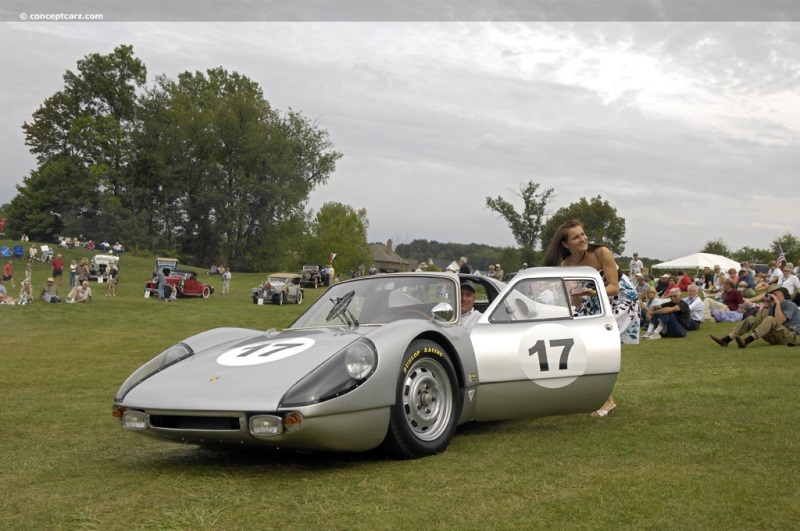
Image Left 1963 904 GTS Prototype
 

1964 Porsche 904 news, pictures, and information

Coupe
 
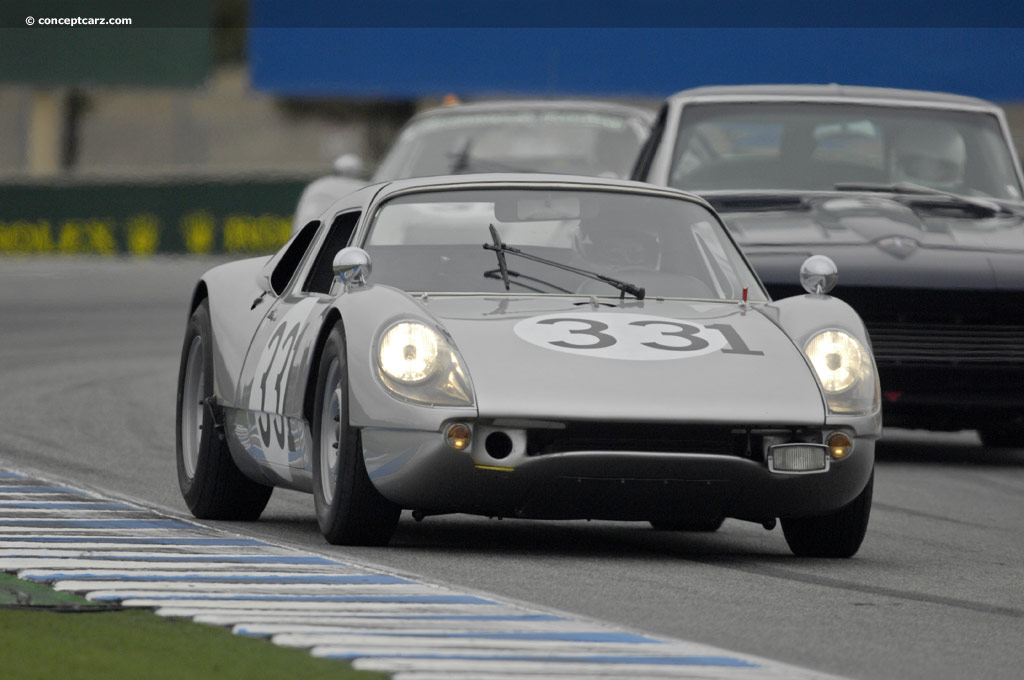
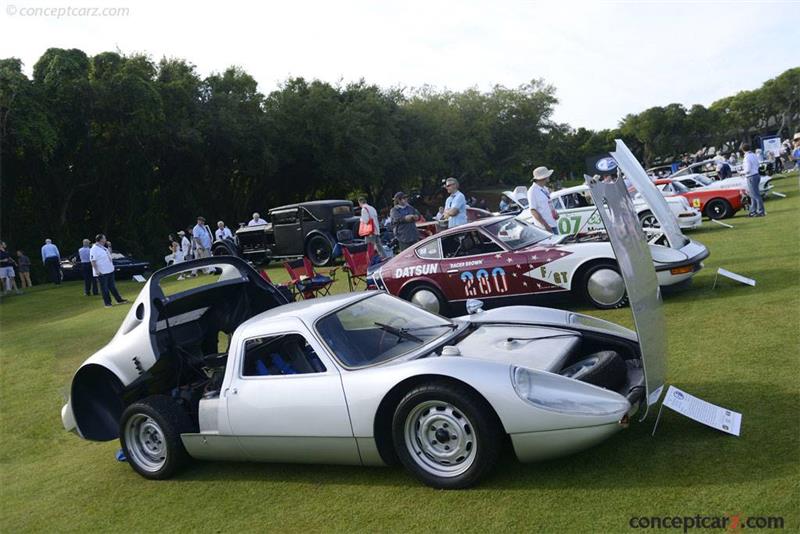
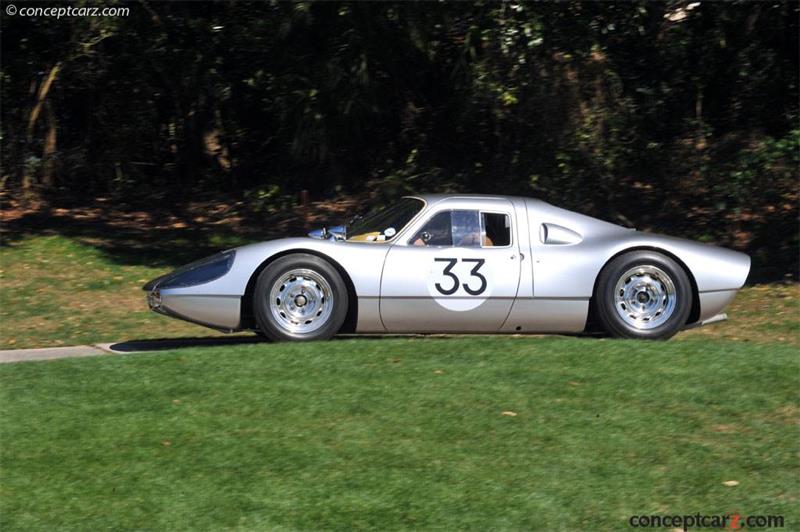
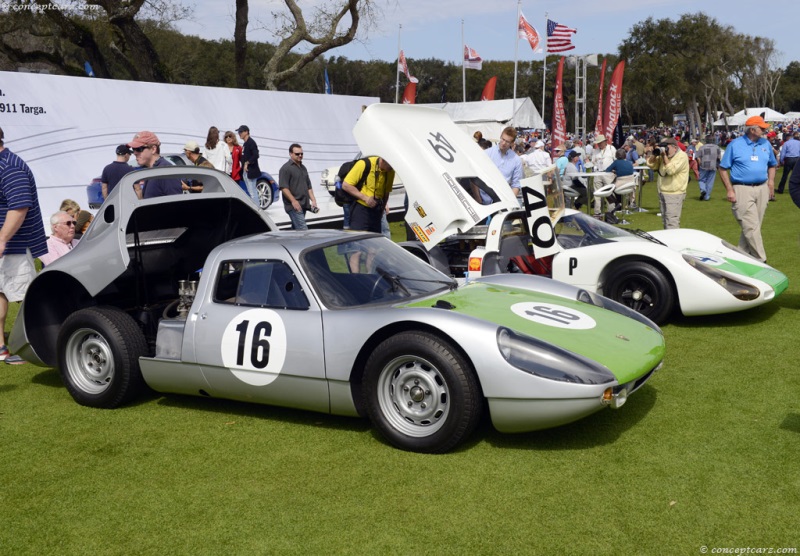
The Porsche 904 GTS was Porsche's first foray into fiberglass construction of a production sports car. The 904 was really a dual purpose car that could be raced on weekends and driven on public roads, as this one was. The body is FPR bonded to square tube frame and is a mid-engine configuration. Depending on who was doing the fiberglass lay-up, the cars weighed approximately 1700 pounds and had a top speed of 163 MPH. The one hundred or so 904s were built with the 2-liter, four-cam, four-cylinder engines putting out 180 HP with the street configuration and 198 (DIN) HP in the racing configuration. Several were built with six-cylinder engines and at least one with an eight-cylinder engine. This car was raced by Amelia Island Board member, George Drolsom, who teamed with the late Peter Gregg to finish third in class in the 1966 Daytona 24 hour race. At the time, the car was owned and entered by Brumos Porsche.
Coupe
Chassis Num: 906-002
 
High bid of $1,575,000 at 2012 RM Auctions. (did not sell)
Porsche introduced its 904 sport car racing coupe in 1963, and was a direct successor to their RS61, which itself has roots to the 718 'RSK' of 1957. The RSK was a further development of the original 550 and subsequent 550A.

The Porsche 550 utilized a space-frame design that would continue to be used through RS61 production. This meant they had large main frame rails of steel, which were attached to the front and rear suspension. An alloy body was comprised of some stressed but mostly un-stressed panels.

The all-new Carrera GTS had a central steel, 'back-bone' chassis with mid-engine placement. Both an outer and inner, rigid and fully bonded GRP body was then fastened for maximum rigidity.

The Carrera GTS was designed to compete in FIA's GT class. Client racing and street legal versions were introduced in 1964, in order to satisfy FIA Group 3 homologation regulations which stated 100 examples were required to be built.

Chassis number 906-002 is the second of Porsche's 904/6 factory team cars. They built a total of six similar 904/6 Works team cars (chassis numbers 001, 002, 005, 006, 011, and 012). All examples currently survive in varying states except for chassis number 906-005, which was destroyed during testing and development in 1965.

906-002 was a test and development car for 1963, 1964, and 1965. In December of 1954, it went through extensive testing program in Italy at Monza, where several Solex carburetor tests were conducted with Herbert Linge, alongside sister 904/6, chassis number 906-001, which was fitted with various Weber carburetor set-ups in comparison. Several different tire tests were also conducted and both 001 and 002.

As the close of the 1965 season, the car was offered by the Porsche factory for public sale. Michel Weber purchased the car on May 10th of 1966. It was raced in Germany, France, Italy, and Austria throughout the year's European Mountain (Hill Climb) Championship season. With Weber at the wheel, the car scored multiple podium finishes throughout the season, including two first place finishes.

At the close of the 1966 season, Weber loaned the car to the Swiss driving team of Ruedi Jauslin and Peter Ditzler for use by their team, Scuderia Basilea. The car was entered in several races in 1967 events but did not show up with the car until very late in the season. At the October 29th, 1967 running of the Three Hours of Hockenheim, the two finished Secon in Class. On December 10th of 1967, Ditzler drove the car himself in the Hockenheim Finale Race scoring a Third Overall.

Weber retired the car at the end of the 1967 season and put it up for sale. U.S. Air Force Major Berny Barns became the car's next caretaker. Harro Schneider of German purchased the car in 1970 and kept it until 1979, selling it to Lohr & Becker, also of Germany. Dr. Friedhelm Tang purchased the car in 1987 and kept it until 1999, when it was sold to Brazilian Lara Resende. Frederic de la Noce purchased it in 2002 and kept it until 2011.

In 2012, this car was offered for sale at RM Auctions Monterey, California sale. It was estimated to sell for $1,800,000 - $2,200,000. Bidding reached $1,575,000 but was not enough to satisfy the vehicle's reserve. It would leave the auction unsold.

By Daniel Vaughan | Nov 2012
Coupe
 
By the early 1960's race cars had become specialized tools, to meet new challenges, thus Porsche launched the 904 GTS. Ferdinand Porsche, grandson of the founder, is credited with the design. This was the last competition car to use a modified street engine and the first to use a fiberglass body.

This car was delivered new to Sonauto, in Paris in 1964. It was damaged after the 'Coupe the Alps' in 1965, and returned to Porsche for repair. The entire body and frame were replaced, using the final version of the 904, as such, it was stronger and lighter now. Porsche was not yet equipped to repair the fiberglass steel unibodies and there were several instances of full body replacements being done.

The car has survived a four year long competition history. It remains in as raced condition. The later series, lighter and stronger body, combined with street cams, installed in a 1998 restoration, make it a wonderful car to rally, tour or vintage race.
Coupe
Chassis Num: 054
 
This car is one of approximately 120 Porsche 904s produced. Because of time constrains and weight considerations, the Porsche factory decided to use fiberglass for the bodies. The bodies were then glued to the chassis, which later proved to improve the overall rigidity of the car. The original owner, Gunther Selbach, raced the car modestly at such venues as the Nurburgring and DMV Avus-Rennen, and in the early 1970s the second owner imported the car to the US. It was wrecked shortly thereafter, with extensive damage to the frame and suspension. With the help of Porsche AG and Porsche Cars of North America, the current owner was able to obtain the frame blueprints, and a complete restoration was started in the spring of 2000. The restoration was finally completed in 2007.

The 904 was Porsche's first fiberglass bodied race car. The bodies were outsourced and manufactured by Heinkel (the same company that produced the first jet Fighter for Germany during World War II). The lightweight bodies were bonded/glued to the frames. The engine is an air-cooled 2-liter 4-cam flat four-cylinder that produces 180 horsepower. Production was approximately 116 units.

This car was raced by its original owner Gunther Selbach and placed competitively at races such as Nurburgring and DMV Avus-Rennen.
Coupe
 
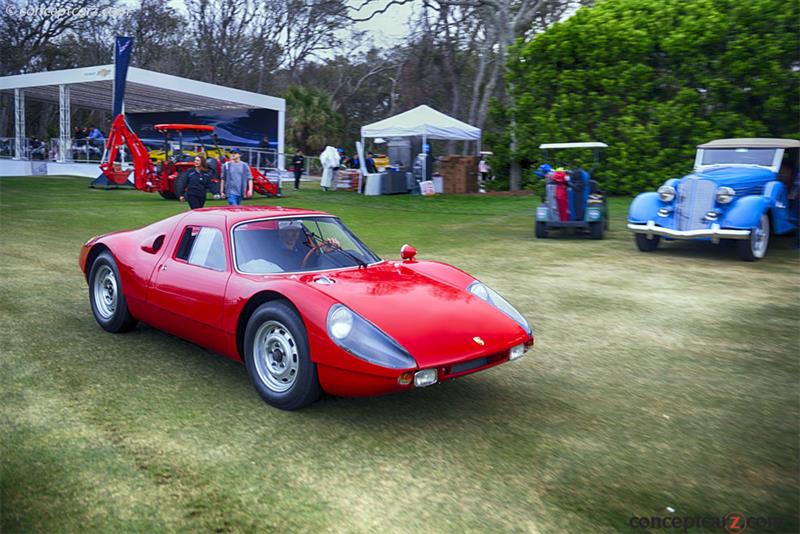
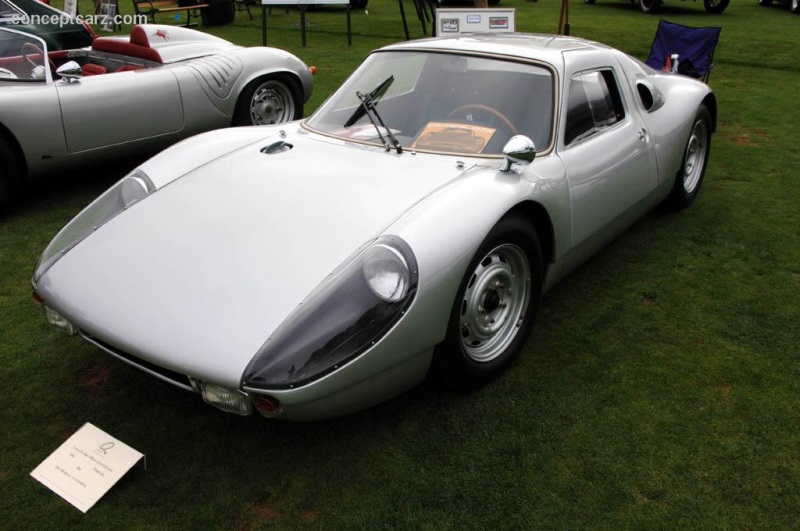
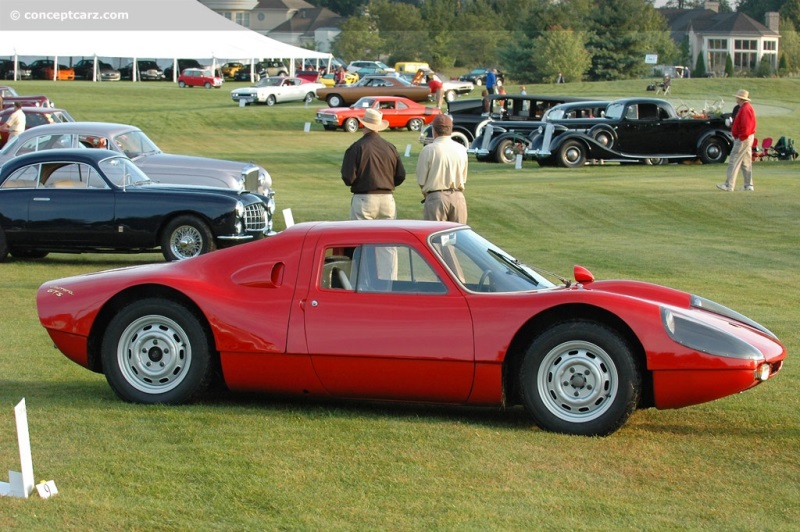
Often recognized as the most beautiful Porsche ever built, the 904 was the first fiberglass car to bear that legendary name. It was designed by Ferdinand 'Butzi' Porsche, grandson of the eponymous scion of the company.

Only one hundred twenty 904s were ever built. Most were powered by the highest development of the legendary Fuhrmann four cam Carrera engine.

This example may be one of the most original 904 extant today. It was purchased by the current owner from the original owner nearly forty years ago. It has its original engine, interior and the vast majority of its original paint.
Coupe
Chassis Num: 904-017
 
Sold for $1,045,000 at 2011 Gooding & Company.
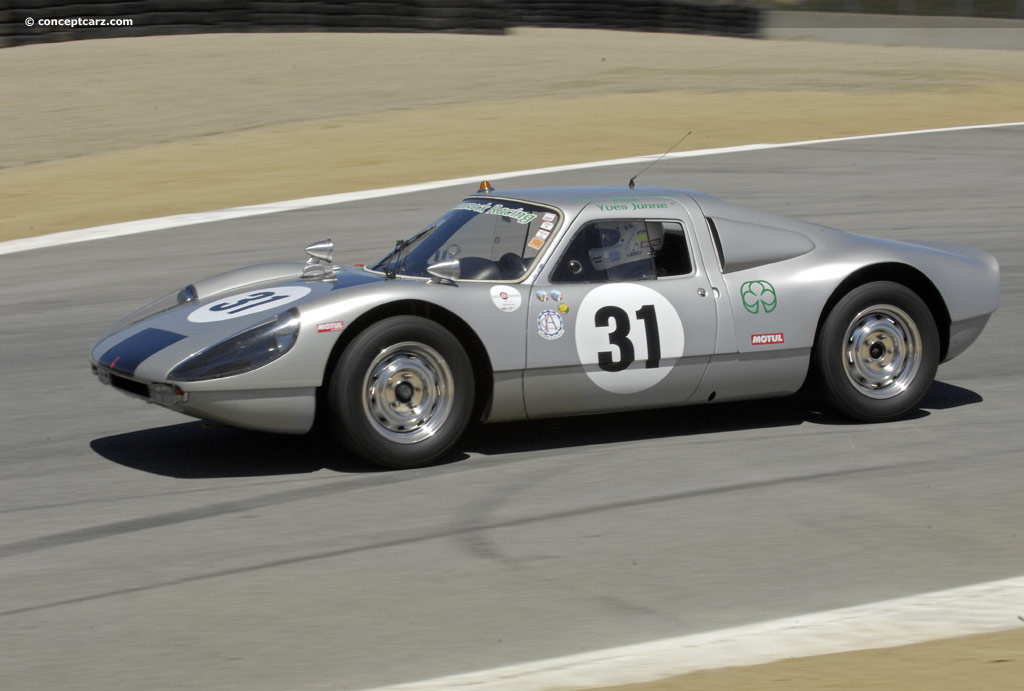
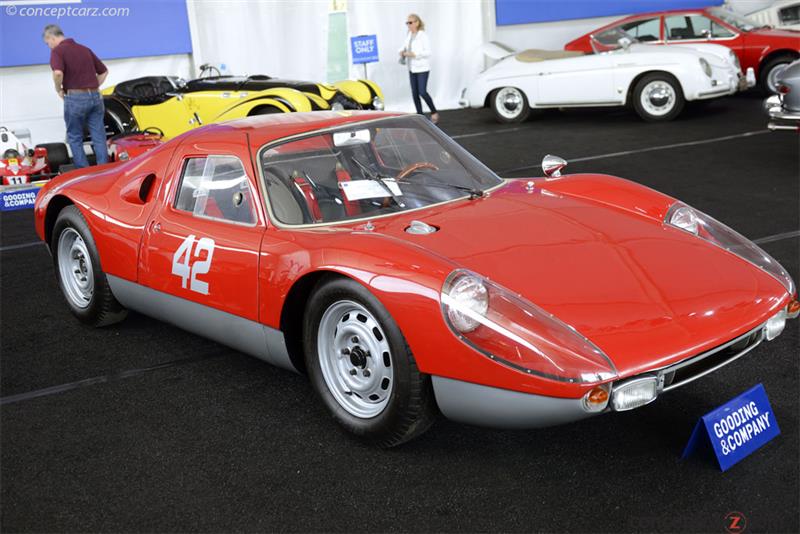
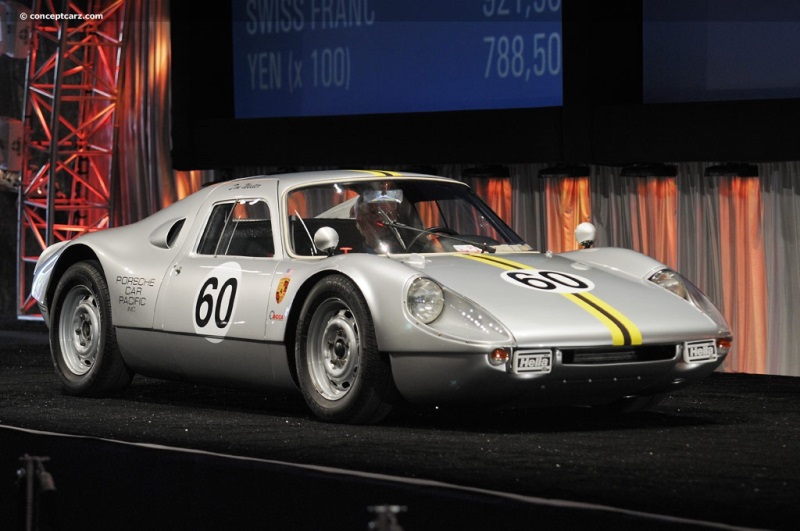
Chassis number 904-017 is one of the earlier 904 Carrera GTS models produced. It has enjoyed a brilliant racing career and is a well-documented example with known ownership history from new. The car was completed on February 10th of 1964 and was one of just 31 examples sent to the United States. It left the factory painted in silver with a blue velour interior and powered by a four-cam racing engine. It was sent to Reynold C. Johnson's Porsche Car Pacific, the official Porsche and VW distributor that had served Northern California, Nevada and Utah since 1954. Shortly after its arrival, it was sold to local Porsche dealer and racer Don Wester of Monterey, California. Wester had been driving Porsche vehicles since the early 1950s while stationed in Europe with the Air Force. When he returned to the US, he attended the General Motors Institute and drove a 1954 356A Coupe as his 'daily driver.' Just two short years later, he began racing seriously, with his fist win at Elkhart Lake in 1957 while piloting a Carrera Speedster.

Wester later moved to Monterey and opened a Porsche and VW service shop before he - along with his brother - established Wester Motors on Del Monte Avenue. Later, he was invited by the Porsche factory to co-drive a Carrera Abarth at Sebring with Bob Holbert.

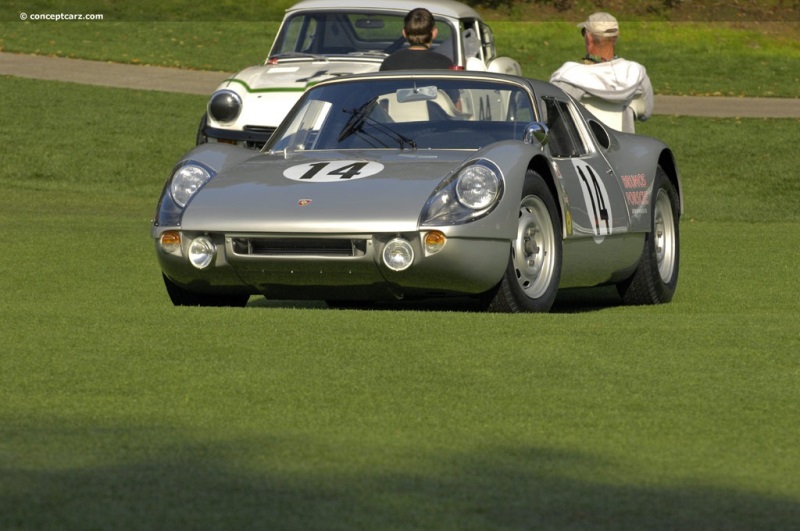
The Porsche 904 had sleek, fiberglass bodywork, a Formula One-derived suspension, a high-output four-cam engine, disc brakes, and a new five-speed gearbox.

Wester's first outing with the Porsche Car Pacific 904 took place on April 12th of 1964, at the 45-minute feature race at Vacaville. It wore number 60 and was equipped with American Racing mag wheels. Wester and his new Porsche led the entire race, until the car was pushed too hard, resulting in a spin that ended their day prematurely.

After the race, the car was made ready for future events, with modifications including an air deflector. The car was re-painted with a central stripe in yellow and black - colors that Wester chose as his 'racing colors.'

At Riverside Raceway in Souther California on April 26th, the car finished 7th overall and 4th in class at the USRRC Sports Race. Later in the day, Wester drove the 904 to a 4th overall and 2nd in class in the GT Race.

The following weekend, the 904 raced at Laguna Seca in the USRRC GT Race where it finished 4th overall and 1st in class.

A week later, Wester raced in the USRRC GT Championship at Pacifica Raceways in Kent, Washington, finishing 4th overall and 1st in class.

They returned to California in June for the Stockton road races. On Saturday, the car finished 2nd in the Production race behind Ed Leslie's Cobra. The next day, Wester attempted to pass Leslie for an overall victory, but made contact with the Cobra, forcing the 904 off-course and out of the race.

After the race, the car was given a new rear lid and was completely refinished in new livery, similar to the style of Wester's old RS Spyder. It was painted light yellow throughout with a center black stripe.

The car's first race in its new livery was on July 11th of 1964 at the Cotati SCCA Divisional Road Races. It raced in the A/B Production race where it placed 2nd behind Ed Leslie in a Competition cobra. The next day, Wester again finished in 2nd, this time behind Chuck Parsons' Cobra.

On August 9th of 1964, the car raced at San Francisco's Candlestick Park. Wester finished the season with the 904 finishing in first.

Over the winter months, the car was given engine and brake upgrades from the factory in preparation for another season. The first race in 1965 was on April 3rd at Contra Costa. In the SCCA regional A/B Production Race, Wester captured another overall victory, this time ahead of two 289 Cobras. Later in the day, the 904 battled in the E-Modified Race, earning an impressive 2nd place finish.

In June, it raced at the Stockton SCCA National in the 45-minute A-D Production race. Even after going off-course as a result of a brush with Jerry Titus' GT350R, the 904 managed another outright victory, even lapping all but the 2nd and 3rd place finishers.

On August 18th, the car achieved one of its most memorable victories, when Wester and the Porsche averaged 89.3 mph over the length of the race and beat Phil Hill in a Shelby Cobra and Augie Pabst in a Ferrari GTO.

The car earned another overall win at Vacaville in the SCCA National A-D Production Race. This was the last race for 904-017, and it would finish the season with Wester 3rd overall in the SCCA's Pacific Coast Division A-Production Class.

The 904 was replaced by the 906 at the end of the 1965 racing season. It was sold to Robert W. Hansen, the business manager of Porsche Car Pacific. Ownership then passed to Walter Bischoff of Stanton, California who registered it for road use and kept it until 1969. The next care taker was Bill Randle of Denver, Colorado. Mr. Randle used the car for street use and occasionally participated in local club racing. A year after purchasing the car, it was sold to Grady Clay for the sum of $6,000.

By this point in the car's history, it had been painted a light pastel blue but remained in good, original condition. Mr. Clay retained the car for 17 years. In 1987, Mr. Clay sold the car to Robert Pass of St. Louis, who later sold through Motor Classic Corporation in New York to Harry Bytzek, a Toronto-based Porsche enthusiast.

Mr. Bytzek had the car for only a brief period of time, but did use it successfully in vintage events at Watkins Glen and Shannonville. In the late 1980s, the car was traded to Dick Barbour, the famed Porsche racer an collector. The current owner purchased the car from Mr. Barbour in December of 1989.

Through the 1990s, the car was actively raced in many West Coast vintage racing events. After participating in the 1991 Monterey Historics, the car was treated to a restoration.

In 2000, the 904 was sent to Europe where it raced in the Tour Auto. After nearly a week of competitive driving, it finished in 14th overall.

Upon returning to the US, the car continued to expand its racing resume, competing in many historic racing events.

In 2011, the car was offered for sale at the Gooding & Company auction where it was sold for the sum of $1,045,000, which included buyer's premium.

By Daniel Vaughan | Feb 2011
Coupe
Chassis Num: 904-083
 
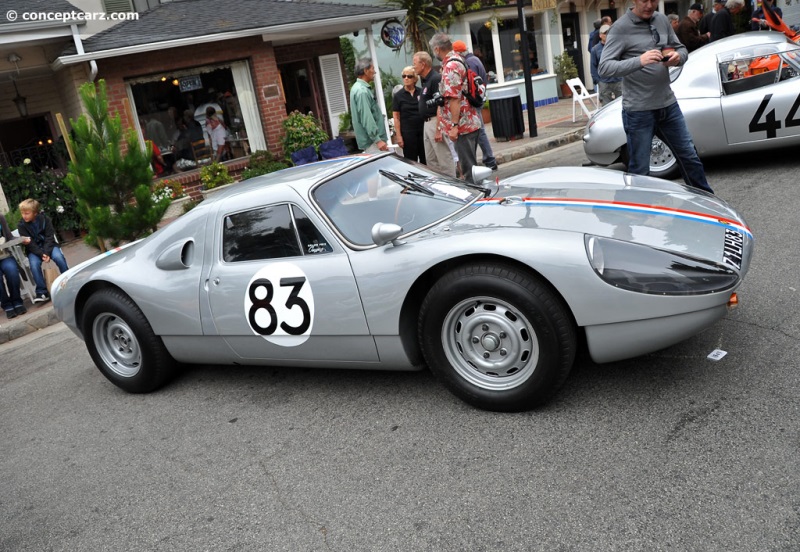
Porsche chassis number 904-083 was delivered to French Porsche distributor, Sonauto, in Paris on April 20th, 1964. It was successfully rallied in Europe, including the 1965 Coupe des Alpes where the owner, a Mr. Barbier, came 2nd overall. With help from Porsche 'Werkswagen', from 1966 through 1968, new owner Cyr Febbraio achieved several top 10 rally finishes. The car features a number of 1965 specification changes such as an outside, center fuel filler and shorter doors with pull-up windows. Its silver livery is correct as is the French-flag-center-stripe added in 1965. The car has been entered in recent years in several European classic endurance road race events.
Coupe
Chassis Num: 005
 
This car has the most extensive history of any racing Porsche in private ownership today. 005 was entered in all of the important races by the Porsche factory, in the years 1964-1966. Its most notable victory was the 1964 Targa Florio where it finished 1st overall, driven by Colin Davis and Count Antonio Pucci.

This car ran all of the Manufacturers Championship races in the years 1964 through 1966. It achieved many high overall placing including class wins at Sebring in 1965, Spa in 1965, and Daytona in 1966, where it won its class and finished seventh overall driven by its current owner, Joe Buzzetta and Gerhard Mitter. The car was also the European Hillclimb Champion, driven by Herbert Muller, winning every hillclimb it entered.

904-005 also won the 2-liter prototype category at the 24-Hours of Daytona in 1966 finishing 7th overall driven by Gerhard Mitter and its present owner Joe Buzzetta.
Chassis Num: 064
 
Originally sold to Jeff 'Seep' Greger. He raced 904-064 with great success in the 1964 and 1965 European Hill climb Championship.
Coupe
Chassis Num: 906-011
 
This Porsche 904-6 is one of six 2-liter 6-cylinder prototype coupes originally built as 1965 Porsche factory Werkes cars. All six of these cars were given serial numbers beginning with 906. Only four survive today. 906-011 participated in the 1965 Le Mans Trials piloted by factory driver Gerhardt Mitter. That same year it finished 9th in the 1000 km of Nurburgring driven by Mitter & Davis. It achieved a 3rd at the Grand Prix of Solitude at Stuttgart driven by Herbert Linge and managed a 2nd place at Course de Cote in France driven by Mitter.

In 1968, Porsche sold this car to Vasek Polak in Southern California without an engine. It competed with a 4-cylinder, 4-cam engine in numerous SCCA competitions in A-Production and GT class at tracks such as Riverside, Laguna Seca, Sears Point, Pacific Raceways, Road America, Sebring, Daytona and Watkins Glen.

In 1985 the car went through a complete restoration by Kevin Jeanette (Gunnar Racing) and its 2-liter, 6-cylinder heritage was re-established. Since 1986 906-011 has been campaigned continuously in vintage race events, including several Monterey Historics appearances, the Rennsport Reunion III and Tour Auto in Europe.
Porsche's range-topping sports cars have often been at home on both road and racetrack. But while today's, say, GT3 RS is a formidable track day weapon, it's still more of a road car setup for track use than the other way around. The RS is not too loud to be driven to the country club. It offers great visibility from the driver's seat. It is reliable and robust enough to be used daily.

That balance of everyday affability and potent potential is a recipe that Porsche has perfected over its sixty years of sports car manufacturing. The truly memorable Porsches, though, had that balance point shifted closer to the racing car extreme. For proof, look at the stunning Porsche 904. The 904 was sold as a road car to a few lucky drivers. Was it balanced? Impeccably so. With its front fuel tank full, the 904 distributed its featherweight mass wonderfully with only a slight (52%) rear weight bias. Was it useable? Sure. Two opening doors, four spinning wheels—what else could one really need in an automobile? Porsche made precious few other concessions to usability with this car.

Okay, so maybe the 904 wasn't the most balanced car for splitting time between track and street. But that's why the 904 is such a magical car. It was a dedicated racing machine with looks and sounds to match, and it didn't aspire to the ideal of all-around usability to which Porsche's latest supercars seem drawn. The 904 was a track car that, with hardened nerves, owners could drive to their racecourse of choice or to an antisocial night on the town. It was arguably the last real racing car built by Porsche that could legally (though not sensibly) be driven to work everyday. The 904 offered its owners the chance to experience the raw, visceral exhilaration of a sparse instrument of utter precision on their favorite back roads as well as on the track.

The story of how the 904 came to fruition is similar to that of how many of the other most exciting road cars came to be. It was produced to homologate a racing car. Porsche needed to supersede its successful 356-based racers, the Carrera Abarth and the Carrera 2, with an even more capable car to ward off looming competition from Simca, Alfa Romeo, and other tiny terrors—and the 904 was designed to do just that.

Three prototypes of the 904 were finished in 1963. The cars offered a first for Porsche: fiberglass bodies, designed by 'Butzi' Porsche, grandson of Ferdinand and designer of the iconic 911. The bodies were bonded to steel ladder chassis, creating a car that was both rigid and, at 1,433lbs, terrifically light. Those bodies were also spectacular to behold. The 904 is often, and justifiably, considered the best-looking Porsche of all time. Its uncluttered shape, with its sparing use of air intakes and lack of aerodynamic aids, was uncompromising and perfectly free of faddish gimmicks. It was pure functionality, a timeless triumph of science over decadence—and yet its low-slung proportions still announced an animalistic urgency that effortlessly seduced admirers anywhere it went. It had none of the Beetle-based flourishes of the 356 and even 911, and was a more evolved and purposeful shape. The 904 represented the visual distillation of Porsche's racing philosophy, and was the stylistic forbear of a long line of exciting mid-engined racers by Porsche.

To meet eligibility requirements for GT racing in the under-2-liter class, Porsche needed to produce 100 examples of its gorgeous 904 over the course of a year. Porsche would eventually produce 120 examples. The bulk of the production run was spoken for quickly, allowing Porsche to easily homologate the car. The road version was marketed as the Carrera GTS and not the 904, for the same legal reasons that prevented Porsche from naming the 911 the 901 as they had initially intended. Peugeot had copyrighted for its cars the use of all three-digit numbers with '0' in the middle (504, 505, 607, etc.), thus subtly changing the history of Porsche nomenclature.

A mid-mounted, air-cooled flat four with aluminum block and heads powered the 904. Behind it, a ZF 5-speed transaxle with integrated limited-slip differential sent power to the rear wheels. The 1,966cc engine produced 180bhp at 7,000rpm thanks in part to its twin Weber carburetors and four camshafts. Disc brakes, rack-and-pinion steering, and double-wishbone suspension did their parts to endow the 904 with the stopping power and handling needed to cope with its speed. A small handful of 904/6 models were produced with the new Porsche 6-cylinder engine.

Excellent drivers like Briggs Cunningham and Lake Underwood, who piloted a 904 to a first-place finish in the prototype class at Sebring in 1964, realized the potential of the car. An outright victory at the 1964 Targa Florio, a class win at Le Mans, and second place in the Monte Carlo rally were among the racing highlights. The 904 was not just a street-legal racing car—it was a successful street-legal racing car. The Porsche 904/Carrera GTS was a stunning competitor that enabled brave owners to experience the undiluted thrills of a racetrack winner on their own terms.

Sources:

Melissen, Wouter. 'Porsche 904 GTS.' Ultimatecarpage.com 15 Nov 2004: n. pag. Web. 23 Dec 2010. http://www.ultimatecarpage.com/car/640/Porsche-904-GTS.html.

Schrager, Jim. '1963 Porsche 904 GTS Prototype.' Sports Car Market 31 Jan 2007: n. pag. Web. 23 Dec 2010. http://www.sportscarmarket.com/car-reviews/german/1986-1963-porsche-904-gts-prototype.

By Evan Acuña
The Porsche 904, also known as the Porsche Carrera GTS, was designed by Ferdinand 'Butsi' Porsche and introduced in 1963. GT Homologation rules stated that at least 100 examples needed to be produced in a twelve month time period. Porsche knew that selling 100 race cars would be difficult so they built the 904 as a street legal race car. Three prototypes were built and tested vigorously near the close of 1963. Modifications and enhancements were applied and the 908 was officially displayed to the public in November of 1963. In less than a month after its debut, almost all 90 examples were spoken for and by April of 1964, the 100 units had been constructed.

The flat-four cylinder engine was placed in the middle of the car and powered the rear transaxle. A 5-speed manual gearbox was matted to the 356 Carrera 2 derived engine and modified to produce 180 horsepower. The potent engine and low weight of the vehicle, 1430 pounds, the vehicle was able to achieve a top speed of 160 miles-per-hour. A flat-six engine, in development at the time and being built for the 901/911 model, was intended to be used but was not ready in time. Some 904's did receive a six and eight cylinder engine throughout its 2 year production life span, these vehicles were referred to as 904/6 and 904/8. Not enough of these larger engine versions were built to be homologated so they raced in the prototype class.

The body production was handled by Heinkel, an airplane manufacturer who was able to produce two per day. To increase the rigidity of the chassis, the frame was bonded to the body.

In 1964, 100 examples were produced. There was such a demand for the 904 that an additional 20 examples were produced in 1965.

By Daniel Vaughan | Mar 2008
For more information and related vehicles, click here

Stars of American Racing Panel Discussion for upcoming Savannah Speed Classic
The Hilton Head Island Motoring Festival & Concours d'Elegance, one of the nation's signature automobile events, is proud to announce the addition of legendary racing stars, to the already packed Savannah Speed Classic agenda. The scenic river-view site of Hutchinson Island in Savannah will be alive with not only the roar of vintage race cars, off-road drives through the woods, Hot Lap rides at speed, but some of history's greatest automotive influences including Hurley Haywood, Brian Redman, To...[Read more...]
1967 Can-Am Road America: The Beginning of the 'Bruce and Denny Show'
While Formula One will be forever considered the pinnacle of motorsport, from a period between 1966 and 1986 there existed a series that would likely be the closest to 'anything goes' as any motor racing series could truly get. Based upon the FIA Group 7 cars but allowed to showcase unlimited engine sizes and unfettered aerodynamics, the Can-Am cars would have to be considered the pinnacle of motorsport technology and power of their era. And for more than a couple of years there would be one tea...[Read more...]
Carroll Shelby, Ford Family for More Than Half a Century
Carroll Shelby was a member of the Ford family for the better part of 60 years, producing stunning performance vehicles from concepts to production models. He once said his energy and passion for performance products were always strongest when he was working with Ford. Shelby most recently collaborated with the company on the 2013 Ford Shelby GT500 Mustang, the most powerful production V8 in the world. Working with SVT engineers at Sebring and the Arizona Proving Grounds, at times he drov...[Read more...]
1956 24 Hours of Le Mans: The Rise of Two Counts
The 1955 24 Hours of Le Mans would end up being the darkest day in all of motorsport when Pierre Levegh launched off the back of Lance Macklin's Austin-Healey and crashed into a barrier sending large portions of the car flying through the air acting like guillotines to the record crowd crammed along the main straight. It would be estimated that more than eighty would lose their life as a result, scores more would be severely injured. Yet, despite the graphic horror of the event the race would co...[Read more...]
1958 Moroccan Grand Prix: British All the Way
After years of frustration, and well past his life-expectancy, Mike Hawthorn would be on the verge of his first World Championship. This was more than likely Hawthorn's last and best hope at a World Championship title. Just one last race, and a fellow Brit, would separate Hawthorn from his World Championship. Emotionally, Hawthorn was done. The last few seasons had seen Hawthorn fail to experience anywhere near the level of success he had even in his rookie year of 1952. In 1952, with an unde...[Read more...]

View more Targa Florio vehicles

Arrow Right 1964 Porsche models
Porsche 356
Porsche 356 Carrera 2
Porsche 901 Prototype
Porsche 904 Replica
Porsche 911
Porsche Platypus

Similar Automakers
Aston MartinBentley
BugattiDevon
FerrariGTA
KoenigseggLamborghini
LotusMaserati
MaybachMcLaren
Rolls-RoyceSpyker
Tesla
Similarly Sized Vehicles from 1964
Alfa Romeo 2600 Bertone
Alfa Romeo Giulia 1600 Series 105
Alfa Romeo Giulia 1600 Sprint Speciale
Amphicar 770
Elva Courier MKIV
Ferrari 250 LM
Ferrari 275 P
Fiat 1500GT
MG MGB
Morgan Plus 4 Plus

 
Porsche: 1961-1970
Similar Automakers
Porsche History
Other models by Porsche
Manufacturer Website

Related Articles and Event Coverage
Rolex Monterey Motorsports Reunion
Amelia Island Concours d'Elegance
RM Auctions - Monterey
Carmel By The Sea Concours
2011 Rolex Monterey Motorsports Reunion
Portland Historic Races
The Scottsdale Auction - Gooding & Company
Glenmoor Gathering of Significant Automobiles
Rolex Monterey Historic Automobile Races
32nd Annual Ault Park Concours d'Elegance
Amelia Island Concours d'Elegance
Monterey Historic Races at Laguna Seca
31st Annual Ault Park Concours d'Elegance
Amelia Island Concours d'Elegance
Zippo U.S. Vintage Grand Prix at Watkins Glen
The Quail: A Motorsports Gathering
2005 50TH Annual Porsche Parade. Hershey Pennsylvania

Porsche
Monthly Sales FiguresVolume
April 20134,032 
March 20133,487 
February 20132,805 
January 20133,358 
December 20122,952 
November 20123,865 
October 20123,211 
September 20122,736 
August 20123,026 
July 20122,803 
June 20123,002 
May 20122,852 
(More Details)

 
356
550/718 Sports Racing Cars
597
904
906
907
908
911
912
914
917
924
928
934/935
944
956 and 962
968
Boxster
Carrera GT
Cayenne
Cayman
GT3
Panamera
Type 959

Image Left 1963 904 GTS Prototype
© 1998-2012. All rights reserved. The material may not be published, broadcast, rewritten, or redistributed.