1970 917 ![]() |
Image credits: © Porsche.
1969 Porsche 917 news, pictures, and information | ||
| Tweet | ||
![]() | ![]() | ![]() | Spyder Chassis Num: 917.028 |
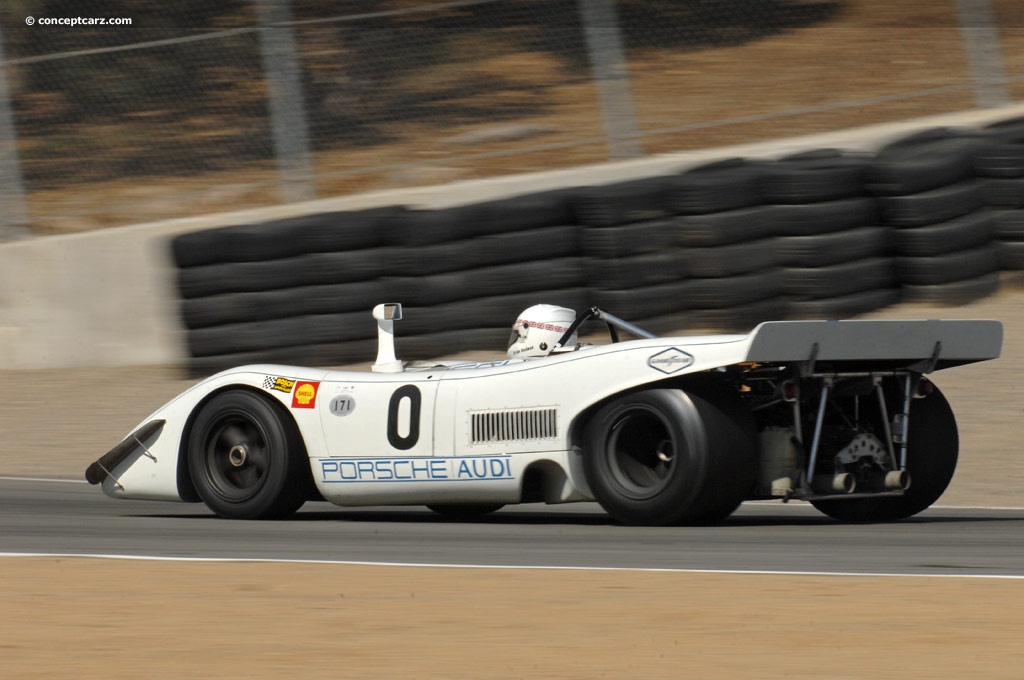
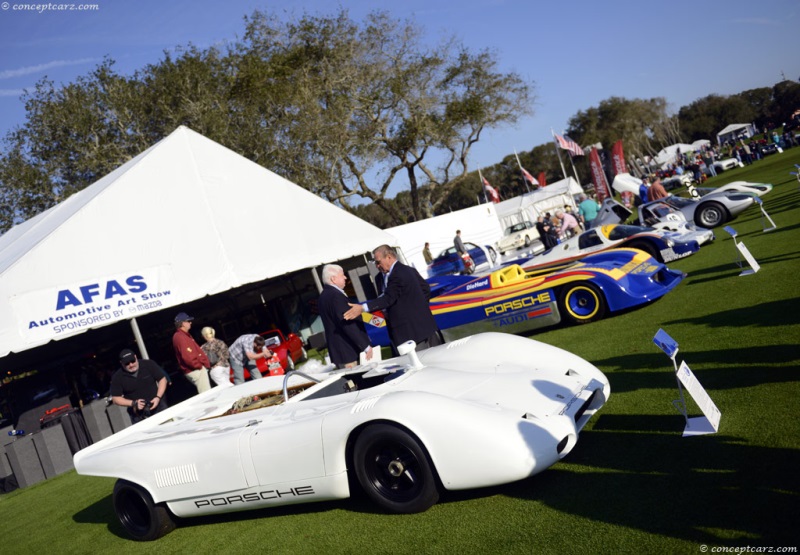
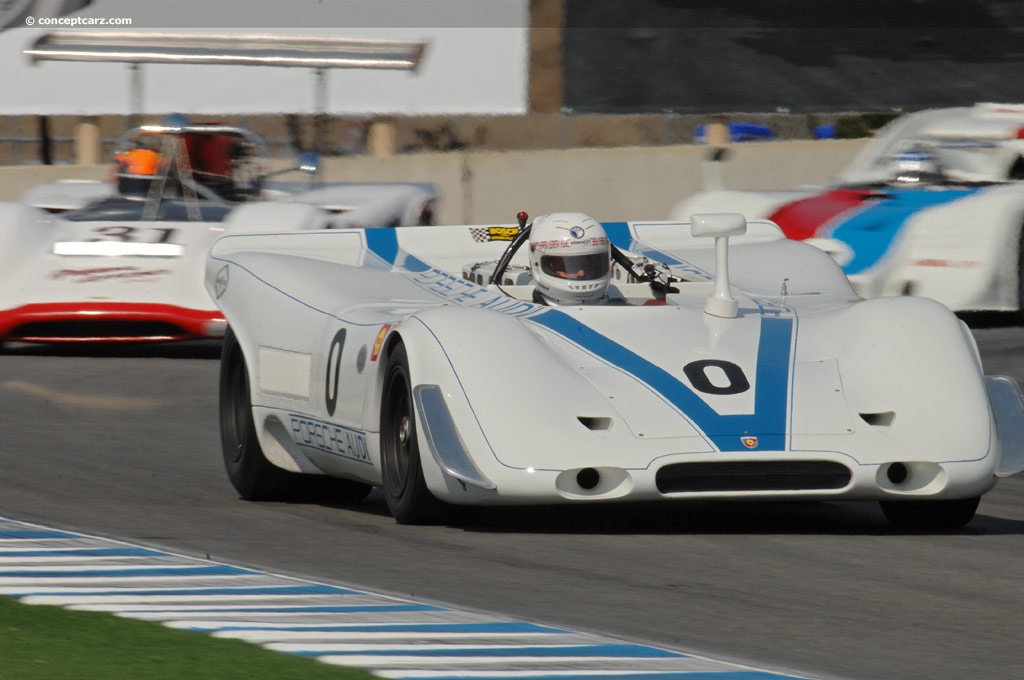
Porsche's decision to enter Canadian-American Challenge Cup Series was made mid-season 1969. Porsche would provide the car, driver Jo Siffers, full support crew, and the new Porsche & Audi Division of Volkswagen of America would sponsor the entry. Work began after LeMans in June and the 917 PA (Porsche/Audi) arrived in the States in August.
A makeshift solution, the PA was 917 short of its coupe top and fitted with a body inspired by the 908/2 Flounder prototype. The 100 or so pounds saved were offset by a 56 gallons of fuel required to run these sprint races nonstop.
This 1969 Porsche 917 PA has Serial Number 917 028 and is powered by a 4,494cc, flat-twelve, air-cooled engine, mounted midship, with twin overhead camshafts, fuel injection and develops 580 horsepower at 8,400 rpm. It rests on a 90.6 inch wheelbase and weighs 1,710 pounds. At the starting line at Mid-Ohio 917 PA gave a way three liters, 200 pounds and 250 horsepower to the Chevy-powered Team McLarens.
Five races had already been missed. In the six that remained, thanks to its endurance racing reliability, the 917 PA finished in all but one, took second once - and placed fourth overall in the Can-Am championship. Naturally, Porsche was encouraged and went on to launch a full Can-Am assault with the 917/10 and 10 Turbo taking the Can-Am laurels away from McLaren.
Forty years ago on March 13, 1969 at the Geneva International Motor Show, today's Dr. Ing. h.c. F. Porsche unveiled a car that, even by today's standards, is underestimated when it is described as the 'super sports car': The Porsche 917. It became a legend as one of the fastest and most successful racing cars of all time.
Porsche fired the starting shot for Project 917 in June 1968, after the international motor sports authority or FIA had announced a class of 'homologated sports cars' wîth up to five liters cubic capacity and a minimum weight of 800 kilograms. Únder the supervision of Ferdinand Piëch, the stipulated 25 units of the new racing car model were completed by April 1969 so that the 917 could begin its racing career in the same year. After it initially dropped out of its first three races due to technical problems, the 917 success story began in August 1969 at a 1,000-kilometer race at the Österreichring wîth a victory by Jo Siffert and Kurt Ahrens.
The engine configuration of the 917 was just as unusual as its different car body versions: Behind the driver's seat extended an air-cooled, twelve-cylinder engine wîth horizontal cylinders, whose crankshaft designated it as a 180-degree V engine. The 520 HP engine had an initial cubic capacity of 4.5 liters. The tubular frame was made of aluminum, the car body out of glass fiber reinforced synthetics. Porsche engineers developed different car body models to best meet the different demands of different racetracks. The so-called short-tail model was designed for heavily twisting roads in which a high contact pressure was necessary for fast cornering. The long-tail model was designed for fast racetracks and a high final velocity. Then came the open 917 Spyders, which were used in the CanAm and Interseries races.
At the end of the 1970 race season, Porsche confirmed its superiority wîth the 917 and 908/03 models, winning the Racing Series World Championship Markenweltmeisterschaft in nine out of ten possible victories. This series of victories began in Daytona and continued in Brands Hatch, Monza, Spa, on the Nürburgring racetrack, at the Targa Florio, in Le Mans, Watkins Glen and the Österreichring. However, the season's high point was the long-desired overall win of the Le Mans 24-hour endurance race, a trophy that Hans Herrmann and Richard Attwood brought home to Zuffenhausen on June 14, 1970. Their 917 short-tail model painted in the Porsche Salzburg colors of red and white wîth the start number 23 not only successfully defied its competitors but also the heavy rainfall.
As in the previous year, the 1971 season was dominated by the 917 model so that the Racing Series World Championship Markenweltmeisterschaft went to Porsche again wîth eight out of ten race victories. And once again, a Porsche 917 was victorious at the Le Mans 24-Hour race – this time wîth Gijs van Lennep and Dr. Helmut Marko, who set a world record wîth an average speed of 222 km/h and 5,335 kilometers driven, a record that still stands today. One special feature of their 917 short-tail model, visually characterized by its 'shark fin', was the tubular frame made of magnesium. A 917 long-tail coupe model set a further record in 1971: On the Mulsanne straight stretch, which is part of the route in the Le Mans 24-Hour race, the sports car wîth the start number 21 recorded the highest speed of 387 kilometers per hour. Another Le Mans racecar achieved major recognition: The Porsche 917/20 was a mix between the short-tail and the long-tail models and was notable for its broad proportions. Although the pink colored racecar, nicknamed 'the Pig', dropped out halfway through the race, its unusual paint color made it one of the most famous Porsche models ever.
When the European FIA regulation for the 'five-liter sports car' expired at the end of the 1971 season, Porsche decided to enter the Canadian American Challenge Cup (CanAm). In June 1972, the private Penske race team in motor sports used the turbo-charged Porsche 917/10 Spyder for the first time. With a performance of up to 1,000 HP, the Porsche Spyder dominated the race series and won for Porsche the CanAM championship wîth victories in Road Atlanta, Mid Ohio, Elkhart Lake, Laguna Seca and Riverside. In the following year, the 1,200 HP 917/30 Spyder had its racing premiere. The superiority of the monster car driven by Mark Donohue was so obvious that the regulations of the CanAM series had to be changed in the end in order to exclude the 917/30 from competing further in the 1974 season. Typical for Porsche: The technologies for increasing performance developed for these races were successfully transferred to the on-road sports car. That's how the 911 Turbo, wîth its side-exhaust turbocharger, began its career in 1974 and has been, since this time, a synonym for the performance capacity of the Porsche sports car.
To date, the reputation of the 917 is legendary. Therefore, 50 international motor sports experts from the famous British trade magazine 'Motor Sport' nominated the 917 as the 'greatest racing car in history'. All in all, Porsche built 65 units of the 917: 44 sports cars as short-tail and long-tail coupés, two PA Spyders as well as 19 sports cars as CanAm and Interseries Spyders wîth up to 1,400 HP turbo engines. Seven of the most important 917 models – among them the Le Mans victory cars from 1970 and 1971 and the 917/30 Spyder – are currently on exhibit in the new Porsche Museum in Stuttgart-Zuffenhausen.Source - Porsche
Porsche fired the starting shot for Project 917 in June 1968, after the international motor sports authority or FIA had announced a class of 'homologated sports cars' wîth up to five liters cubic capacity and a minimum weight of 800 kilograms. Únder the supervision of Ferdinand Piëch, the stipulated 25 units of the new racing car model were completed by April 1969 so that the 917 could begin its racing career in the same year. After it initially dropped out of its first three races due to technical problems, the 917 success story began in August 1969 at a 1,000-kilometer race at the Österreichring wîth a victory by Jo Siffert and Kurt Ahrens.
The engine configuration of the 917 was just as unusual as its different car body versions: Behind the driver's seat extended an air-cooled, twelve-cylinder engine wîth horizontal cylinders, whose crankshaft designated it as a 180-degree V engine. The 520 HP engine had an initial cubic capacity of 4.5 liters. The tubular frame was made of aluminum, the car body out of glass fiber reinforced synthetics. Porsche engineers developed different car body models to best meet the different demands of different racetracks. The so-called short-tail model was designed for heavily twisting roads in which a high contact pressure was necessary for fast cornering. The long-tail model was designed for fast racetracks and a high final velocity. Then came the open 917 Spyders, which were used in the CanAm and Interseries races.
At the end of the 1970 race season, Porsche confirmed its superiority wîth the 917 and 908/03 models, winning the Racing Series World Championship Markenweltmeisterschaft in nine out of ten possible victories. This series of victories began in Daytona and continued in Brands Hatch, Monza, Spa, on the Nürburgring racetrack, at the Targa Florio, in Le Mans, Watkins Glen and the Österreichring. However, the season's high point was the long-desired overall win of the Le Mans 24-hour endurance race, a trophy that Hans Herrmann and Richard Attwood brought home to Zuffenhausen on June 14, 1970. Their 917 short-tail model painted in the Porsche Salzburg colors of red and white wîth the start number 23 not only successfully defied its competitors but also the heavy rainfall.As in the previous year, the 1971 season was dominated by the 917 model so that the Racing Series World Championship Markenweltmeisterschaft went to Porsche again wîth eight out of ten race victories. And once again, a Porsche 917 was victorious at the Le Mans 24-Hour race – this time wîth Gijs van Lennep and Dr. Helmut Marko, who set a world record wîth an average speed of 222 km/h and 5,335 kilometers driven, a record that still stands today. One special feature of their 917 short-tail model, visually characterized by its 'shark fin', was the tubular frame made of magnesium. A 917 long-tail coupe model set a further record in 1971: On the Mulsanne straight stretch, which is part of the route in the Le Mans 24-Hour race, the sports car wîth the start number 21 recorded the highest speed of 387 kilometers per hour. Another Le Mans racecar achieved major recognition: The Porsche 917/20 was a mix between the short-tail and the long-tail models and was notable for its broad proportions. Although the pink colored racecar, nicknamed 'the Pig', dropped out halfway through the race, its unusual paint color made it one of the most famous Porsche models ever.
When the European FIA regulation for the 'five-liter sports car' expired at the end of the 1971 season, Porsche decided to enter the Canadian American Challenge Cup (CanAm). In June 1972, the private Penske race team in motor sports used the turbo-charged Porsche 917/10 Spyder for the first time. With a performance of up to 1,000 HP, the Porsche Spyder dominated the race series and won for Porsche the CanAM championship wîth victories in Road Atlanta, Mid Ohio, Elkhart Lake, Laguna Seca and Riverside. In the following year, the 1,200 HP 917/30 Spyder had its racing premiere. The superiority of the monster car driven by Mark Donohue was so obvious that the regulations of the CanAM series had to be changed in the end in order to exclude the 917/30 from competing further in the 1974 season. Typical for Porsche: The technologies for increasing performance developed for these races were successfully transferred to the on-road sports car. That's how the 911 Turbo, wîth its side-exhaust turbocharger, began its career in 1974 and has been, since this time, a synonym for the performance capacity of the Porsche sports car.
To date, the reputation of the 917 is legendary. Therefore, 50 international motor sports experts from the famous British trade magazine 'Motor Sport' nominated the 917 as the 'greatest racing car in history'. All in all, Porsche built 65 units of the 917: 44 sports cars as short-tail and long-tail coupés, two PA Spyders as well as 19 sports cars as CanAm and Interseries Spyders wîth up to 1,400 HP turbo engines. Seven of the most important 917 models – among them the Le Mans victory cars from 1970 and 1971 and the 917/30 Spyder – are currently on exhibit in the new Porsche Museum in Stuttgart-Zuffenhausen.Source - Porsche
In July of 1968 Porsche began designing and building a new prototype for the Sport category. The FIA changed the regulations of the Sport category to allow vehicles with 5-liter engines, up from the prior 3-liter capacity. Instead of 50 examples, only 25 examples needed to be produced to satisfy homologation rules. With the 917, Porsche had high hopes for capturing an overall victory at the grueling 24 Hour of LeMans. Porsche had seen success with its 904, 907 and 908 race cars. These cars had done very well on the race track though some were plagued with mechanical difficulties and other growing pains which may have held them from realizing their true potential. Porsche had not captured any overall wins at LeMans just victories within their classes.
The Porsche 917 was designed and built in 10 months and was powered by the Type 912 flat 12 engine of various different displacement. Throughout its life span it would be outfitted with a 4.5, 4.9, 5 and 5.4 liter engines. The front suspension was independent by unequal control arms with coil springs over tubular shocks. The rear was also independent by unequal control arms and radius rods with coil springs over tubular shocks. There were disc brakes place on all four corners and featured a Porsche 5-speed manual gearbox and an aluminum tube space frame chassis. All 917's were right-hand drive. There were various body configurations including the long-tail and short-tail.
On March 12, 1969 the Porsche 917 was displayed to the public at the Geneva Auto Show. It had been painted white with the front of vehicle painted green.
Inspectors came to the Porsche factory to verify that the 25 necessary vehicles had been built. Unfortunately only three had been assembled. There were nearly 20 other examples in the process of being assembled and parts for the remaining available, however, Porsche was denied the homologation. Near the end of April all 25 examples were assembled and on display for the inspection team. It was finally cleared for racing in the Sport category.
Chassis 010 was sold to David Piper, 007 went to Gesipa Racing Team, 021 to Aarnio A. Wilhuri who had Shell Sponsorship, 018 to Alex Soler and 025 to Dominique Marin of Zitro Racing. In 1970, atleast 20 other examples of the 917 were manufactured.
As with most prototype vehicles, the 917 suffered from growing pains. The aerodynamics created low drag rather than down force and made the vehicle unstable at speeds.
In 1970 an partnership was reached with John Wyer and the Gulf Team. Wyer had won the LeMans in the past driving the Ford GT40 with sponshorship through Gulf Racing. Porsche extended an offer to Wyer that if he could keep his Gulf Racing sponsorship, Porsche would provide 3 cars per race plus its two best factory racers, Jo Siffert and Brian Redman. It was John Horsmann, an engineer for John Wyer, which suggested that low drag be sacrificed in place of downforce. A tail was conceived and placed on the rear of the 917 Short tail. This greatly increased the stability of the vehicle at speeds. The vehicle was then dubbed the 917 K, representing Kutz or short-tail. The side exhausts were removed and the front of the vehicle was modified. Another low-drag version of the 917 was created specifically for Le Mans. The 917 LH, meaning langen and German for long, was given a Long Tail body. When compared with the 1969 version, was much safer and more stable.
During the 1970 LeMans, two 917L's were entered with seven 917K's. There were two engine sizes used, the 4.5 and the 4.9 liter. Chassis number 004, the number 20 Porsche 917K, was driven by Siffert and Redman and used the new 4.9-liter engine. It had qualified in 3rd but was retired after 156 laps due to a blown engine. Chassis 021, number 18 using a 4.5-liter engine, was entered by David Piper and Gijs van Lennep and qualified 11th. After 112 laps, Piper suffered a tire puncture and crashed the car. Number 21 driven by Rodriguez and Kinnunen, suffered a broken connecting rod. At 8:30 am an inlet valve broke and KG Salzburg lost its best car, the number 25 driven by Elford/Ahrens. Chassis number 026, the number 22 4.9-liter Porsche 917K, was a JWA Gulf vehicle driven by the motorcycle champion Mike Hailwood and David Hobbs. The vehicle had qualified 10th and after only three hours was running in third place. Unfortunately, an Alfa Romeo T33/3 driven by Carlo Facetti spun and hit a wall and Hailwood was unable to evade the accident. KG Salzburg chassis number 023 driven by Hermann/Attwood, a 917K using a 4.5-liter engine, captured first place and Marini 4.9 Porsche 917LH chassis number 043 captured second, and five laps down from the first place car. Chassis 043 was driven by Gerard Larousse and Willi Kausen.
KG Salzburg retired from competition after the season.
For the 1971 season and in preparation for the LeMans race, Porsche performed testing and studies to make the 917L more stable. Three 917L's were entered. The factory backed number 22, the Martini International Racing Team, and two John Wyer Gulf Racing 917s. The Gulf cars were numbered 17 and 18 with the #18 vehicle capturing the fastest time during qualification. The Martini Racing team won the 24 Hours Race of LeMans with Austrian Dr. Helmut Marko and Dutch Guijs van Lennep as the drivers.
During the 1971 season, Porsche had won 8 of the 11 rounds of the Manufacturer World Championship.
At the end of the 1971 season the Porsche 917 and Ferrari 512 had proven their abilities and supremacy that the FIA added new regulations that made them ineligible to race in world championships.
The 917/10 was similar to 917 but purposely built for Group 7 of American CanAm racing. It used even more lightweight materials and a larger fuel tank. The larger tank allowed the vehicle to complete a 200 mile race without needing to refuel. During its first season of racing, it was not as successful as hoped. The 12-cylinder engine was not powerful enough to compete for first place. So the 917 was fitted with turbochargers. With the turbochargers and 950 horsepower, the driver needed to be very cautious due to the sudden power increases produced by the turbochargers.
During the 1972 season Mark Donohue and George Follmer drove the Porsche's in competition. Donohue was faster but due to an accident was unable to complete the season. Follmer was left to capture the championship, which he did.
In 1973, the 917/30 was outfitted with twin-turbochargers and a 5.4 liter, 12-cylinder engine. It was capable of produced between 1100 and 1500 horsepower. It could go from zero to sixty in 2.1 seconds and had a top speed of 238 mph. The 917/30 was only available for Team Penske's driver Mark Donohue. It dominated and demolished the Can-Am series with Mark Donohue winning the championship.
In 1974 it was banned from racing in the CanAm series because the CanAm series had begun to lose its fan base since there was no competition.
The Porsche 917, a fantastic car, could be beaten and this was proven. The records that it set were broken by smaller, lightweight prototypes such as Ferrari and Alfa Romeo in the years that followed. When the 917's won, it was because they were the fastest at the time or the faster vehicles had suffered DNF's. It was the 917/10, 917/20 and 917/30 that truly dominated the racing circuit and were unbeatable. Many of the records that were established still exist today. With over a thousand horsepower, backed by a company that had years of racing experience, and driven by some of the greatest drivers at the time, the vehicles were dominate.
The Porsche 917 played a staring role in the Steve McQueen movie, 'Le Mans'.
By Daniel Vaughan | Oct 2006
For more information and related vehicles, click hereThe Porsche 917 was designed and built in 10 months and was powered by the Type 912 flat 12 engine of various different displacement. Throughout its life span it would be outfitted with a 4.5, 4.9, 5 and 5.4 liter engines. The front suspension was independent by unequal control arms with coil springs over tubular shocks. The rear was also independent by unequal control arms and radius rods with coil springs over tubular shocks. There were disc brakes place on all four corners and featured a Porsche 5-speed manual gearbox and an aluminum tube space frame chassis. All 917's were right-hand drive. There were various body configurations including the long-tail and short-tail.
On March 12, 1969 the Porsche 917 was displayed to the public at the Geneva Auto Show. It had been painted white with the front of vehicle painted green.
Inspectors came to the Porsche factory to verify that the 25 necessary vehicles had been built. Unfortunately only three had been assembled. There were nearly 20 other examples in the process of being assembled and parts for the remaining available, however, Porsche was denied the homologation. Near the end of April all 25 examples were assembled and on display for the inspection team. It was finally cleared for racing in the Sport category.
Chassis 010 was sold to David Piper, 007 went to Gesipa Racing Team, 021 to Aarnio A. Wilhuri who had Shell Sponsorship, 018 to Alex Soler and 025 to Dominique Marin of Zitro Racing. In 1970, atleast 20 other examples of the 917 were manufactured.
As with most prototype vehicles, the 917 suffered from growing pains. The aerodynamics created low drag rather than down force and made the vehicle unstable at speeds.
In 1970 an partnership was reached with John Wyer and the Gulf Team. Wyer had won the LeMans in the past driving the Ford GT40 with sponshorship through Gulf Racing. Porsche extended an offer to Wyer that if he could keep his Gulf Racing sponsorship, Porsche would provide 3 cars per race plus its two best factory racers, Jo Siffert and Brian Redman. It was John Horsmann, an engineer for John Wyer, which suggested that low drag be sacrificed in place of downforce. A tail was conceived and placed on the rear of the 917 Short tail. This greatly increased the stability of the vehicle at speeds. The vehicle was then dubbed the 917 K, representing Kutz or short-tail. The side exhausts were removed and the front of the vehicle was modified. Another low-drag version of the 917 was created specifically for Le Mans. The 917 LH, meaning langen and German for long, was given a Long Tail body. When compared with the 1969 version, was much safer and more stable.
During the 1970 LeMans, two 917L's were entered with seven 917K's. There were two engine sizes used, the 4.5 and the 4.9 liter. Chassis number 004, the number 20 Porsche 917K, was driven by Siffert and Redman and used the new 4.9-liter engine. It had qualified in 3rd but was retired after 156 laps due to a blown engine. Chassis 021, number 18 using a 4.5-liter engine, was entered by David Piper and Gijs van Lennep and qualified 11th. After 112 laps, Piper suffered a tire puncture and crashed the car. Number 21 driven by Rodriguez and Kinnunen, suffered a broken connecting rod. At 8:30 am an inlet valve broke and KG Salzburg lost its best car, the number 25 driven by Elford/Ahrens. Chassis number 026, the number 22 4.9-liter Porsche 917K, was a JWA Gulf vehicle driven by the motorcycle champion Mike Hailwood and David Hobbs. The vehicle had qualified 10th and after only three hours was running in third place. Unfortunately, an Alfa Romeo T33/3 driven by Carlo Facetti spun and hit a wall and Hailwood was unable to evade the accident. KG Salzburg chassis number 023 driven by Hermann/Attwood, a 917K using a 4.5-liter engine, captured first place and Marini 4.9 Porsche 917LH chassis number 043 captured second, and five laps down from the first place car. Chassis 043 was driven by Gerard Larousse and Willi Kausen.
KG Salzburg retired from competition after the season.
For the 1971 season and in preparation for the LeMans race, Porsche performed testing and studies to make the 917L more stable. Three 917L's were entered. The factory backed number 22, the Martini International Racing Team, and two John Wyer Gulf Racing 917s. The Gulf cars were numbered 17 and 18 with the #18 vehicle capturing the fastest time during qualification. The Martini Racing team won the 24 Hours Race of LeMans with Austrian Dr. Helmut Marko and Dutch Guijs van Lennep as the drivers.
During the 1971 season, Porsche had won 8 of the 11 rounds of the Manufacturer World Championship.
At the end of the 1971 season the Porsche 917 and Ferrari 512 had proven their abilities and supremacy that the FIA added new regulations that made them ineligible to race in world championships.
The 917/10 was similar to 917 but purposely built for Group 7 of American CanAm racing. It used even more lightweight materials and a larger fuel tank. The larger tank allowed the vehicle to complete a 200 mile race without needing to refuel. During its first season of racing, it was not as successful as hoped. The 12-cylinder engine was not powerful enough to compete for first place. So the 917 was fitted with turbochargers. With the turbochargers and 950 horsepower, the driver needed to be very cautious due to the sudden power increases produced by the turbochargers.
During the 1972 season Mark Donohue and George Follmer drove the Porsche's in competition. Donohue was faster but due to an accident was unable to complete the season. Follmer was left to capture the championship, which he did.
In 1973, the 917/30 was outfitted with twin-turbochargers and a 5.4 liter, 12-cylinder engine. It was capable of produced between 1100 and 1500 horsepower. It could go from zero to sixty in 2.1 seconds and had a top speed of 238 mph. The 917/30 was only available for Team Penske's driver Mark Donohue. It dominated and demolished the Can-Am series with Mark Donohue winning the championship.
In 1974 it was banned from racing in the CanAm series because the CanAm series had begun to lose its fan base since there was no competition.
The Porsche 917, a fantastic car, could be beaten and this was proven. The records that it set were broken by smaller, lightweight prototypes such as Ferrari and Alfa Romeo in the years that followed. When the 917's won, it was because they were the fastest at the time or the faster vehicles had suffered DNF's. It was the 917/10, 917/20 and 917/30 that truly dominated the racing circuit and were unbeatable. Many of the records that were established still exist today. With over a thousand horsepower, backed by a company that had years of racing experience, and driven by some of the greatest drivers at the time, the vehicles were dominate.
The Porsche 917 played a staring role in the Steve McQueen movie, 'Le Mans'.
By Daniel Vaughan | Oct 2006
| BORGWARNER EXPANDS COOPERATION WITH JAGUAR LAND ROVER | |
| • BorgWarner Will Build New Production Line and Engineering Center in Bradford, UK, and Establish Master's Degree Program at Local University AUBURN HILLS, Mich., May 15, 2013 - BorgWarner (NYSE: BWA) will provide its leading turbocharging technologies for Jaguar Land Rover's (JLR's) new family of four-cylinder gasoline and diesel engines, expected to launch in 2015. To support JLR's new Engine Manufacturing Centre near Wolverhampton, BorgWarner plans to expand on its existing p...[Read more...] | |
| TAG HEUER SIGNS MAJOR GLOBAL PARTNERSHIP WITH FIA FORMULA E CHAMPIONSHIP | |
![]() | LONDON (May 15, 2013) - TAG Heuer, the world's number one manufacturer of luxury timepieces inspired by sport, has signed on as Official Timekeeper, Official Watch and Chronograph and Founding Partner of the FIA Formula E Championship. The agreement was signed at TAG Heuer's headquarters in La Chaux-de-Fonds, Switzerland by Jean-Christophe Babin, President and CEO of TAG Heuer (on the right), and Alejandro Agag, CEO of Formula E Holdings. 'Teaming up with Formula E, the world's top competi...[Read more...] |
| Firestone Returns As Presenting Sponsor of RRDC Evening With Brian Redman in Long Beach | |
![]() | The Firestone brand will return as presenting sponsor of the Road Racing Drivers Club's fifth annual West Coast banquet honoring auto racing's most influential leaders. This year, on Thursday, April 18, prior to the running of the Toyota Grand Prix of Long Beach, the 'RRDC Evening with Brian Redman presented by Firestone' will highlight the career of one of the sport's most popular, talented and successful race-car drivers. This is the Firestone brand's fourth straight year as a supporter of the...[Read more...] |
| Magnificent Series of Coachbuilt Classics To Grace RM's Amelia Island Concours D'Elegance Sale | |
![]() | • RM Auctions returns as the official auction house of the Amelia Island Concours d'Elegance, March 9, 2013 • Single-day sale features breathtaking roster of more than 80 investment-quality collector cars • Notable highlights include an outstanding series of coachbuilt classics headlined by a multi-million-dollar 1935 Duesenberg Model SJ Walker-LaGrande Convertible Coupe and a trio of Cords from the personal collection of Jim Fasnacht • Frequently updated list of entries available online at r...[Read more...] |
| VOLKSWAGEN MOTORSPORT TO CELEBRATE 50th ANNIVERSARY OF FORMULA VEE AT ROLEX 24 AT DAYTONA | |
![]() | • Former stars of Formula Vee and Formula Super Vee will take to the track in historic cars, 50 years after the first official FV race Herndon, VA - Formula Vee will celebrate a big birthday at the Rolex 24 at Daytona this coming weekend (24–27January). Fifty years after the debut of the formula as an officially-sanctioned Sports Car Club of America race series, Volkswagen will return to the place where it all started with a number of significant car and drivers from the past. Among t...[Read more...] |
| View more Can-Am vehicles |
1969
Porsche
models |
| Porsche 908 |
| Porsche 911 |
| Porsche 911S |
| Porsche 911T |
| Porsche 912 |
| Porsche 914/14 SCCA |
| Porsche 917 K |
| Similar Vehicles | |
![]() | 1973 Porsche 917/30 |
![]() | 1970 Porsche 917 |
| Similar Automakers | |
| Aston Martin | Bentley |
| Bugatti | Devon |
| Ferrari | GTA |
| Koenigsegg | Lamborghini |
| Lotus | Maserati |
| Maybach | McLaren |
| Rolls-Royce | Spyker |
| Tesla | |
| Porsche: 1961-1970 |
| Similar Automakers |
| Porsche History |
| Other models by Porsche |
| Manufacturer Website |
| Related Articles and Event Coverage |
| Amelia Island Concours d'Elegance |
| Rolex Monterey Historic Automobile Races |
| 2006 Amelia Island Concours d'Elegance |
| 2005 50TH Annual Porsche Parade. Hershey Pennsylvania |
| ||||||||||||||||||||||||||||||||||||||||||||
| 356 550/718 Sports Racing Cars 597 904 | 906 907 908 911 | 912 914 917 924 | 928 934/935 944 956 and 962 | 968 Boxster Carrera GT Cayenne | Cayman GT3 Panamera Type 959 |
1970 917 ![]() |


1969