Concept Cars Home
 

1967 Ferrari 330 P4 news, pictures, and information

Coupe
 
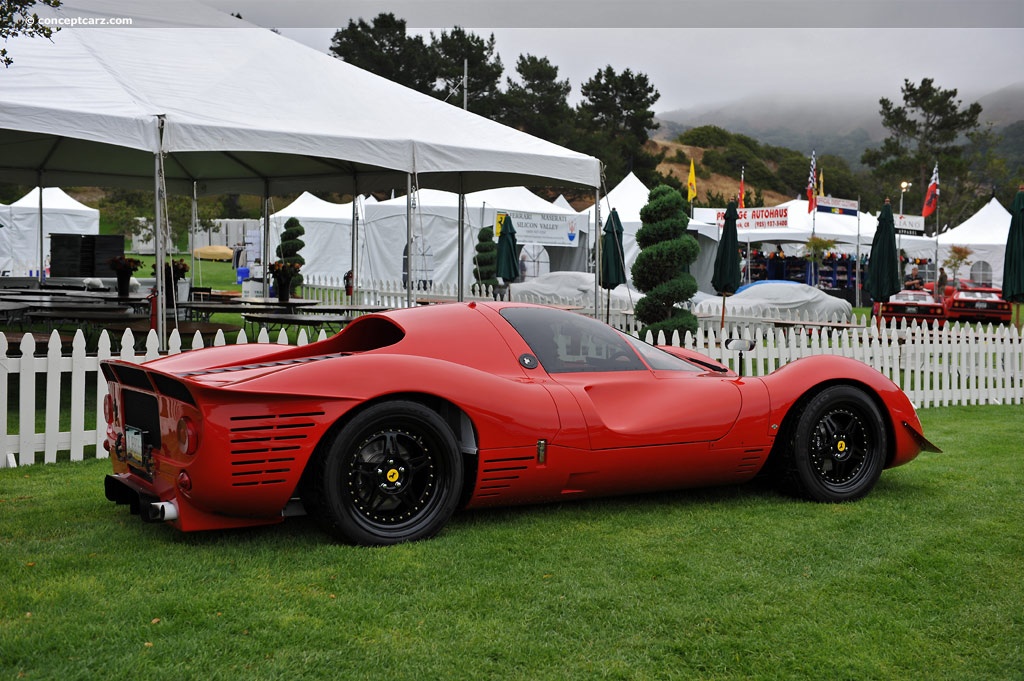
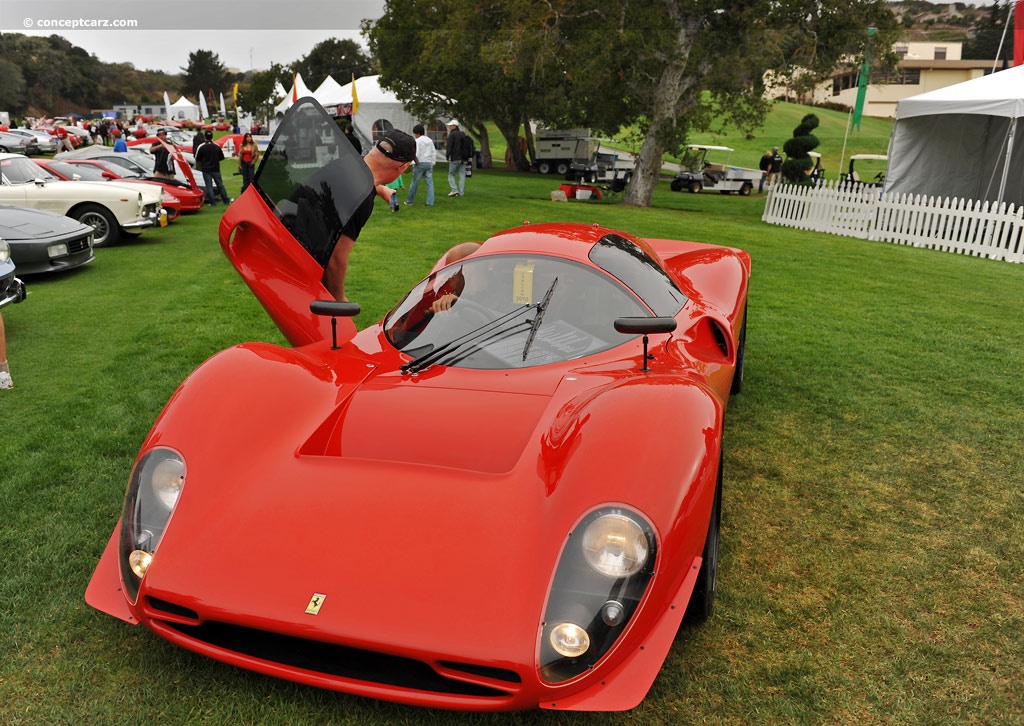
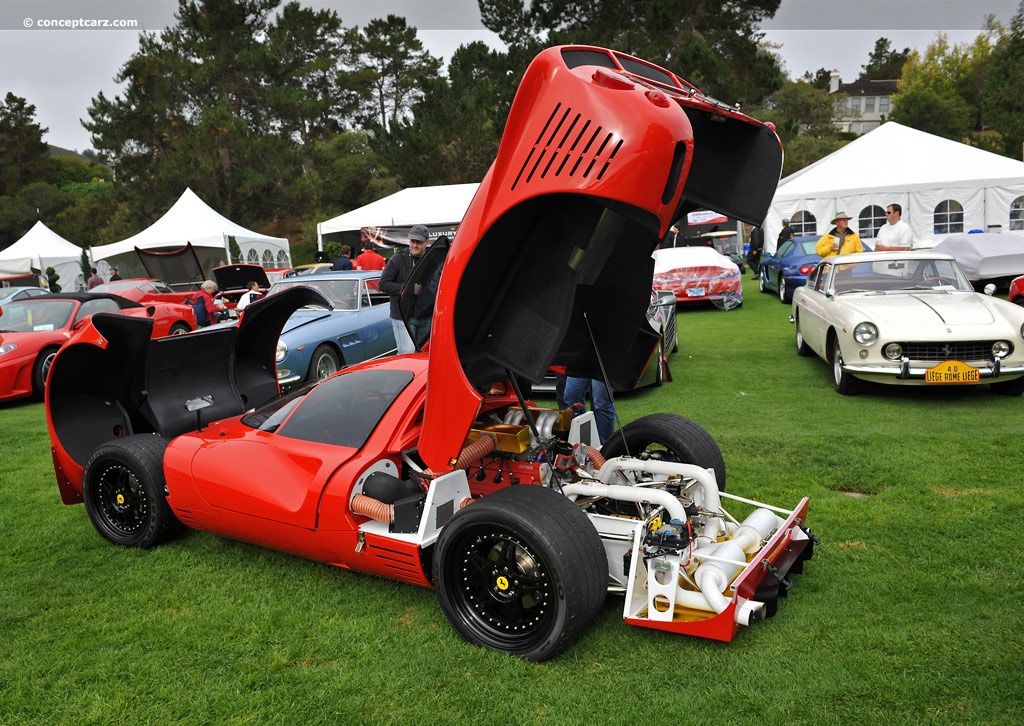
This Ferrari 330-P4 is a tribute car. It has a 3.0-liter Ferrari V8 converted to dry sump and fitted with a SS exhaust with electric by-pass. There is a five-speed Porsche 915 transaxle and a fiberglass and Kevlar composite body. Additional modifications include six-piston front calipers with four-pistons in the rear. There is keyless entry, air conditioning, and digital dash.

The chassis received a completely re-engineered suspension, which includes inboard coil-overs and adjustable anti-roll bars, along with a reworked brake system, steering and drive train.

By Daniel Vaughan | Aug 2010
The Ferrari 330 P3/4 was one of the legendary contenders in the ferocious battle between Ford and Ferrari in the mid to late 1960's. Also called the 412 P, the Ferrari received its 330 P3/4 designation for sharing key components with both Ferrari's 330 P3 and 330 P4. Those latter two cars were instrumental in Ferrari's 1960's racing efforts, and were raced by the Ferrari works team. The 330 P3/4 was sold to private teams such as NART for competition purposes.

The 330 P3/4 can easily trace its heritage back to the first of its series, the 330 P. The 330 P was the first Ferrari to be pinned against a Ford GT40. When Ferrari and Ford first fought at Le Mans in 1964, the 330 P filled the podium while no Fords finished. Ferrari's 1-2-3 finish only encouraged Ford to put more time and money into developing its GT40, though, and the American giant prepared for a triumphant return.

While neither Ferrari and its revised 330 P2 nor Ford and its 7.0-liter GT40 realized much racing success in 1965, the following year was to be exciting and eventful. Ferrari replaced the 330 P2 with the P3 variant in 1966. Featuring such improvements over the preceding model as a stiffer chassis, ZF 5-speed transmission, and fuel injection, the 330 P3 was an impressive racer on paper. However, Ferrari could not provide enough essential development time for the gestation of the P3. Reliability problems resulted, and Ford was able to turn the tides entirely. All three spots on the Le Mans podium went to Ford in 1966, with no Ferraris completing the race.

Embarrassed and angered, Ferrari put forth all of the resources the little company could muster into the following variation of the 330. The P4 was ready for the 1967 racing season, and it was clearly the only car that could bring back some fortune to Ferrari. With a 36-valve cylinder head atop its 4-liter V12, the P4 made 450bhp. The nose of the car was elongated to reduce aerodynamic lift, a feature that also succeeded in making a beautiful car look even better. Though a Ford GT40 managed to place first at Le Mans for 1967, Ferrari placed its P4 racers in second and third places at the same event.

Ferrari's success was more notable at the 1967 Daytona race. Here, on Ford's home turf in the United States, Ferrari dominated. The prancing horses from Maranello captured a podium-filling finish. Two Ferrari 330 P4 cars took first and second, while the NART-entered 330 P3/4 took third.

The 330 P3/4 used a P3 engine mounted within a P4 body. Though not as impressive as the mechanically-advantaged P4, the P3/4 was a reliable improvement over the P3 that experienced success in the hands of skilled private teams. Its 4-liter V12, with a 24-valve cylinder head, produced 420bhp at a lofty 8,000rpm. The car was able to reach 200mph at Le Mans. Its 5-speed transaxle incorporated a limited-slip differential to better traction and handling. Independent suspension with coil springs at all corners combined with rack and pinion steering to offer excellent handling, and ventilated disc brakes for all wheels ensured that the P3/4 could scrub speed with authority. All of these mechanicals were wrapped within a tubular frame and surrounded by panels that used aluminum extensively for lightness and rigidity. Chassis 0844 was converted to an open-air P3/4 Spider for Can-Am racing.

The 330 P3/4 was a successful racer that provided private teams with a precise instrument with which to race and to win. It may not have been tied in with the famous drivers of Ferrari's renowned factory team, but its engineering and styling were both as beautiful as the rest of the 330 P series.

Sources:

Dron, Tony. 'Ferrari P3/4.' Classic Driver Web.5 Aug 2009. .

'Lot No. 220: 1967 Ferrari 330 P4.' RM Auctions Web.10 May 2009. .

By Evan Acuña
The Ferrari 330 series belonged to a long line of Ferrari road cars with front-mounted V12 engines, cars that were members of a bloodline whose history is still being written by the 612 Scaglietti and 599 GTB Fiorano. The 330's name derived from the then-familiar Ferrari practice of naming cars for their per-cylinder displacement in cubic centimeters, indicating that the engines used to power this series of cars displaced a total of 12x330cc, or about four liters. Preceded by the 275 and replaced by the 365, the 330 was caught right in the middle of a glorious era for Ferrari road cars.

The 330 spawned the vaunted 330 P series of mid-engined racers, which battled Ford's GT-40 in sports car racing throughout the mid-1960s. A successor to the legendary 250 GTO was also created using the 330 motor, named the 330 LMB. Ferrari produced only four of these latter models.

The 330 road cars were decidedly more relaxed and less exhilarating than the racing cars mentioned above, but their relatively high sales numbers and use of race-bred components meant that they were still important cars to Ferrari's history. Ferrari produced the 330 road cars primarily in four guises: the 330 America, the 330 GT 2+2, and the coupe/spider couple named 330 GTC and 330 GTS.

Ferrari introduced the 330 America first. It was a transitional model, essentially a 250 GTE 2+2 with the new 330 motor. The 330 GT 2+2 followed in 1964, and was a more thoroughly revised grand tourer built on a chassis stretched by 50mm compared to the America. This newer model, though still closely related to its predecessor, wore a controversial body design by the familiar Pininfarina. Its front end styling used an unconventional quad-headlight arrangement that mounted the two lights per side in clusters canted down toward the egg crate grille, creating an aggressive but cumbersome appearance of slanted eyes. The Mulliner Park Ward-bodied Rolls-Royce Silver Cloud III of the mid-1960s used a similar frontal treatment, also with questionable results.

A more harmonious front end debuted on the 1965 Ferrari 330 GT 2+2, reverting to a more traditional twin-headlight approach. Other changes for 1965 included the replacement of the four-speed with overdrive gearbox by a 5-speed unit, and the introduction of power steering and air conditioning as options. Production of the 330 GT 2+2 continued until late 1967, by which time Ferrari had produced some 1,075 examples of the model. This was an excellent figure for a 1960s Ferrari, especially when compared to the 50 examples of the transitional 330 America that the company produced.

At the Geneva Motor Show of 1966, Ferrari introduced a two-seater 330 coupe called the GTC. Also styled by Pininfarina, the GTC looked surprisingly sultry given that its design was an amalgamation of prior cues. From the front the GTC aspired to 500 Superfast or 400 Superamerica greatness, while from the back the car looked like a 275 GTS with a fixed roof. Somehow the look came together remarkably well, though, creating an iconic Ferrari design without the hand-me-down flavor that could have resulted from the borrowed styling features.

Later in 1966, at Paris, the spider version of the 330 appeared. Named 330 GTS and clearly an open version of the GTC, it too was a lovely design. Production of both the GTC and GTS ended in 1968, after Ferrari produced approximately 600 coupes and 100 spiders.

The engine common to all 330 series road cars was a 60-degree V12 of 3,967cc displacement. The block and heads were cast silumin, an aluminum and silicon alloy. A chain-driven single overhead camshaft per cylinder bank operated two inclined valves per cylinder that opened into hemispherical combustion chambers. Ferrari employed three Weber carburetors and an 8.8:1 compression ratio in the 330 motor to create a power plant that was capable of 300bhp at 6,600rpm in street tune. The V12 was bolted to a 5-speed gearbox in all 330 road cars, excepting the 330 America and early 330 GT 2+2, which used 4-speed gearboxes with overdrive.

Double wishbones and coil springs suspended the front end of all 330 road cars. The GTC and GTS used independent rear suspensions, but the 2+2 models retained live axles. Brakes were assisted four wheel discs on all models, using an unconventional dual-circuit design that incorporated two master cylinders and two servos.

Pininfarina styled and bodied all four standard versions of the 330 road car, though there were bespoke examples crafted by other coachbuilders including Michelotti and Drogo. The 330 chassis was made of tubular steel, and the Pininfarina bodies too were primarily steel, but with opening panels in aluminum.

As witnesses of Ferrari's finest days, the 330 series road cars have become historically important and commensurately collectible. The GTC and GTS remain the thoroughbred sophisticates of the series and command high prices. The 2+2 models, though, especially the oddly styled early 330 GT 2+2s, represent good value and are some of the most attainable machines to emit the distinctive mechanical symphony of a 1960s Ferrari V12.

Sources:

'Ferrari 330.' CarsfromItaly.net n. pag. Web. 27 Dec 2010. http://carsfromitaly.net/ferrari/index.html.

'Specifications.' 330 Register n. pag. Web. 27 Dec 2010. http://www.330register.com/models.cfm.

Tyer, Ben. 'Ferrari 330 GTC.' Supercars.net n. pag. Web. 27 Dec 2010. http://www.supercars.net/cars/551.html.

By Evan Acuña
For more information and related vehicles, click here

The New Scuderia Ferrari Watch Collection Was Launched At Baselworld 2013
Basel, Switzerland, May 2, 2013 / The new collection of Scuderia Ferrari watches was launched at Baselworld 2013. Scuderia Ferrari Orologi (SFO) is the new line for men and women which comprises bright, compelling, identifiable watch designs that take their inspiration from Scuderia Ferrari's revered racing team and single-seaters, bringing their energy, excitement and bold sporty style to Ferrari Fans and watch enthusiasts around the world. The collection will be sold globally through selec...[Read more...]
World's Rarest Muscle Car to Join a Spectacular Show Field at the 2nd Annual Concours d'Elegance of Texas
Houston, Texas. April 1, 2012. Organizers of the 2nd annual Concours d'Elegance of Texas have confirmed that the world's rarest muscle car, the only big block GT convertible ever built by Shelby American Inc., will be part of this year's spectacular show field on Sunday, May 5 at La Torretta Lake Resort & Spa. The 1967 Shelby GT500 Convertible was originally assigned to Carroll Shelby, the most expensive GT500 in Shelby American's company car inventory and the only Shelby GT Convertible f...[Read more...]
Unique Mystery Mustang Headlines Amelia's Unique WWTT* Class
'The Amelia's' *WHAT WERE THEY THINKING? Class is much more than a place for what some might label weird, odd or strange. The class, with a philosophy unique to 'The Amelia', is a place for significant and interesting cars that fit no class, category or commercial orthodoxy. Nearly half a century later, we still don't know what Ford was planning when they commissioned the creation of Bill and Chris Snyder's 1964 ½ 'shorty' Mustang. We do know that they created one man's dream car. We just...[Read more...]
The Ferraris of Sergio Pininfarina At The Ferrari Museum in Maranello
The Ferrari Museum in Maranello today inaugurated the Great Ferraris of Sergio Pininfarina exhibition which focuses on the years during which Sergio, the son of founder Battista 'Pinin' Farina, made a pivotal contribution to the creation of the Prancing Horse's most famous models. A collaboration that started in 1952 and which represents one of the great icons of the Made in Italy phenomenon. Present at the opening were Ferrari chairman Luca di Montezemolo, Paolo Pininfarina, president of th...[Read more...]
America's Favorite Sports Cars to Pace Belle Isle Grand Prix
•Camaro and Corvette setting sales pace for their segments •Forza Motorsport 4 fans compile 63 million miles in Corvettes and Camaros America's favorite sports cars will lead the return of motorsports to Detroit this weekend, when the Camaro ZL1 paces the Chevrolet Grand-Am 200 at Belle Isle on Saturday, and the Corvette 427 Convertible paces the Chevrolet Indy Grand Prix on Sunday. Both are essentially unchanged production models. 'With Corvette and Camaro, Chevrolet has two of the mos...[Read more...]

Arrow Right 1967 Ferrari models
Ferrari 275 GTB/4
Ferrari 275 GTB/4 Competition Speciale
Ferrari 275 GTS
Ferrari 275 GTS/NART
Ferrari 312 F1
Ferrari 330 GT 2+2
Ferrari 330 GT Michelotti
Ferrari 330 GTC
Ferrari 330 GTS
Ferrari 330 P3/4
Ferrari 350 Can-Am
Ferrari 365 California
Ferrari 365 GT
Ferrari 365 GTC Prototipo
Ferrari 412 P
Ferrari 500 Superfast
1967 Ferrari Concepts
Ferrari Dino 206 Competizione

Similar Vehicles
Ferrari 458 Italia Grand Am2011 Ferrari 458 Italia Grand Am

Similar Automakers
Aston MartinBentley
BugattiDevon
GTAKoenigsegg
LamborghiniLotus
MaseratiMaybach
McLarenPorsche
Rolls-RoyceSpyker
Tesla
 
Ferrari: 1961-1970
Similar Automakers
Other models by Ferrari

Related Articles and Event Coverage
Concorso Italiano - A Celebration of Italian Style


156
166
166 F2
195
196
212
246
250 GT
250 Monza
250 Testarossa
275
288
308
312
328
330
333 SP
335
342 America
348
360
365
375
400
410
410 S
456
458
500 F2
500 Superfast
500 TR
512
512 BB/LM
550
553
575
599
612 Scaglietti
625
California
Dino
Enzo
F12berlinetta
F355
F40
F430
F430 GTC
F50
FF
LaFerrari
Mondial
Mondial 500
Testarossa
Type 340

© 1998-2012. All rights reserved. The material may not be published, broadcast, rewritten, or redistributed.