History
The H.H. Franklin Manufacturing Company built the most successful American direct air-cooled cars from 1902 to 1934. John Wilkinson was the engineer who built the first Franklin car and whose design principles combining high quality with lightweight gave Franklin their distinct reputation for dependability and long life. All Franklins utilized air-cooled engines and double elliptical springs on all four wheels.
The Franklin Manufacturing Company initiated a strong advertising campaign that promoted their high-quality and lightweight vehicles. Their engineering was progressive and introduced many new features. Wilkinson used a wooden frame constructed of three-ply laminated ash. The benefits were two-fold; decreasing the weight of the vehicle and providing a better material to absorb shocks. Aluminum bodies also aided in his quest for reduced weight.
His belief was function over form, meaning that he favored a car's abilities rather than its beauty. This resulted in his cars having their own unique appearance. Since the cars required no radiator due to air-cooled methods, their front end was bound to look different than most other vehicles on the roadways. A 'barrel front' hood was adopted in 1904. By 1911 the cars were given a more modern appeal with flush-sided bodies and Renault-style 'coal scuttle' hood.
Model G
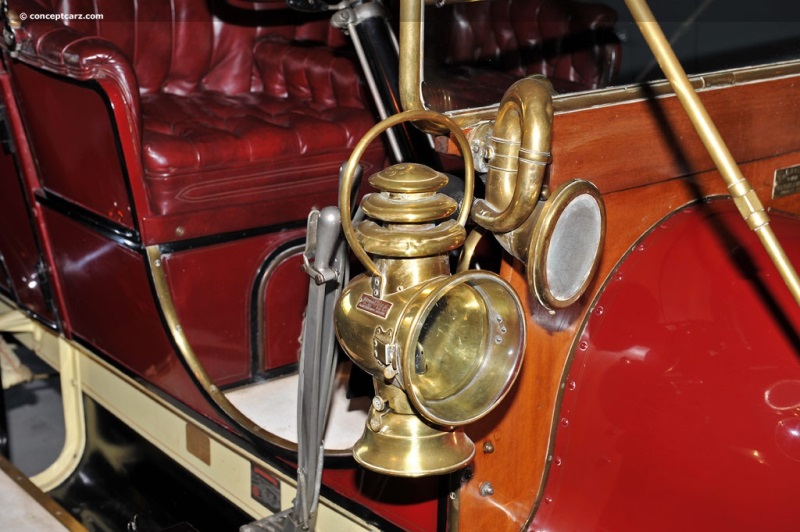
The Franklin Model G was produced from 1906 through 1913. The 5-passenger Tourer had a wheelbase that measured 88 inches and a price tag of $1800. The wheelbase increased to 90 inches the following year, though the four-cylinder 12-horsepower engine remained the same. A 2-passenger runabout joined the Model G lineup, and it was priced at $1800 while the Tourer increased in price by $50.
For 1908, the Model G engine received a boost in power, now rated at 16 horsepower. The body style selection continued to grow with the addition of a Brougham and a Landaulet. Pricing ranged from $1750 to $2500. The runabout was dropped in 1909 and replaced with a Cape Top Tourer with seating for four. The wheelbase grew slightly, to 91.5 inches. The engine now produced 18 horsepower.
For 1910, the Model G was available as a tourer or a 2- or 4-passenger runabout. Pricing ranged from $1750-$1800 and continued to be the company's least expensive model. Many of the company's other vehicles were priced from $2800 - $5000, making the Model G a relative bargain.
The wheelbase of the Model G grew in 1911, now reaching 100 inches for the Tourer. The Torpedo Phaeton, the only other body style available that year on the Model G, measured 108 inches. This would change the following year, as the Model G was again available in two different sizes, a 100-inch runabout or a larger 103-inch tourer. The Tourer had a 25-horsepower engine while the runabout had an 18-horsepower version.
The final year of production of the Franklin Model G was 1913. Engine size, price, and dimensions were the same as in 1912.
By Daniel Vaughan | Oct 2010
The Franklin Manufacturing Company initiated a strong advertising campaign that promoted their high-quality and lightweight vehicles. Their engineering was progressive and introduced many new features. Wilkinson used a wooden frame constructed of three-ply laminated ash. The benefits were two-fold; decreasing the weight of the vehicle and providing a better material to absorb shocks. Aluminum bodies also aided in his quest for reduced weight.
His belief was function over form, meaning that he favored a car's abilities rather than its beauty. This resulted in his cars having their own unique appearance. Since the cars required no radiator due to air-cooled methods, their front end was bound to look different than most other vehicles on the roadways. A 'barrel front' hood was adopted in 1904. By 1911 the cars were given a more modern appeal with flush-sided bodies and Renault-style 'coal scuttle' hood.
Model G
The Franklin Model G was produced from 1906 through 1913. The 5-passenger Tourer had a wheelbase that measured 88 inches and a price tag of $1800. The wheelbase increased to 90 inches the following year, though the four-cylinder 12-horsepower engine remained the same. A 2-passenger runabout joined the Model G lineup, and it was priced at $1800 while the Tourer increased in price by $50.
For 1908, the Model G engine received a boost in power, now rated at 16 horsepower. The body style selection continued to grow with the addition of a Brougham and a Landaulet. Pricing ranged from $1750 to $2500. The runabout was dropped in 1909 and replaced with a Cape Top Tourer with seating for four. The wheelbase grew slightly, to 91.5 inches. The engine now produced 18 horsepower.
For 1910, the Model G was available as a tourer or a 2- or 4-passenger runabout. Pricing ranged from $1750-$1800 and continued to be the company's least expensive model. Many of the company's other vehicles were priced from $2800 - $5000, making the Model G a relative bargain.
The wheelbase of the Model G grew in 1911, now reaching 100 inches for the Tourer. The Torpedo Phaeton, the only other body style available that year on the Model G, measured 108 inches. This would change the following year, as the Model G was again available in two different sizes, a 100-inch runabout or a larger 103-inch tourer. The Tourer had a 25-horsepower engine while the runabout had an 18-horsepower version.
The final year of production of the Franklin Model G was 1913. Engine size, price, and dimensions were the same as in 1912.
By Daniel Vaughan | Oct 2010


1906 Franklin Model G Vehicle Profiles
Recent Vehicle Additions


Performance and Specification Comparison
Price Comparison
Model G Specification Comparison by Year
Year
Production
Wheelbase
Engine
Prices
Related Automotive News

MASERATI AND RUXTON AMONG FEATURED MARQUES AT 2014 PEBBLE BEACH CONCOURS d'ELEGANCE
PEBBLE BEACH, Calif. (February 20, 2014) -- Maserati, a marque renowned for its racing greats as well as road cars offering both elegance and sporting performance, takes center stage at the 64th annual Pebble Beach Concours dElegance. The event,...

BESPOKE 911s METICULOUSLY RESTORED FOR CUSTOMERS BY SINGER VEHICLE DESIGN
Newest Handcrafted Customer Car by Singer Salutes50th Anniversary of Original 911, Evoking Passion for a True Automotive Icon
LOS ANGELES – November 20, 2013 – As Singer Vehicle Design (SVD) tonight hosts a Los Angeles viewing of its la...

Singer Vehicle Design Celebrates 50Th Year Of 911 With Latest ‘Re-Imagined' Debut At Quail
Newest Handcrafted Restored Customer Car by Singer Evokes Past Racing Glories of Porsche, With State-of-the-Art Content and Peerless Execution.
LOS ANGELES – August 1, 2013 – When Singer Vehicle Design (SVD) displays the latest handcraf...

BMW CONCEPT NINETY
Cernobbio. 90 years of BMW Motorrad, 90 years of two-wheeled history – hardly another motorcycle manufacturer can boast such a longstanding and successful heritage as BMW. The BMW R 90 S likewise has cause to celebrate the BMW Motorrad design icon turns...

Auctions America By RM's Spring Carlisle Auction Kicks off 2012 Northeastern U.S. Collector Car Season
Auctions America by RM will return to the Carlisle Expo Center in Carlisle, Pennsylvania, on April 26-27, 2012, to kick off the collector car season for the Northeastern U.S. with its Spring Carlisle auction.
Featuring nearly 300 American hot rods,...