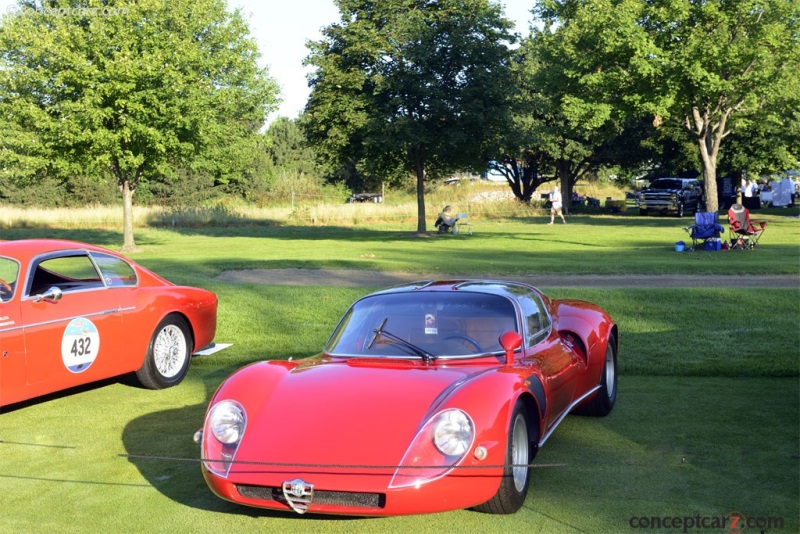
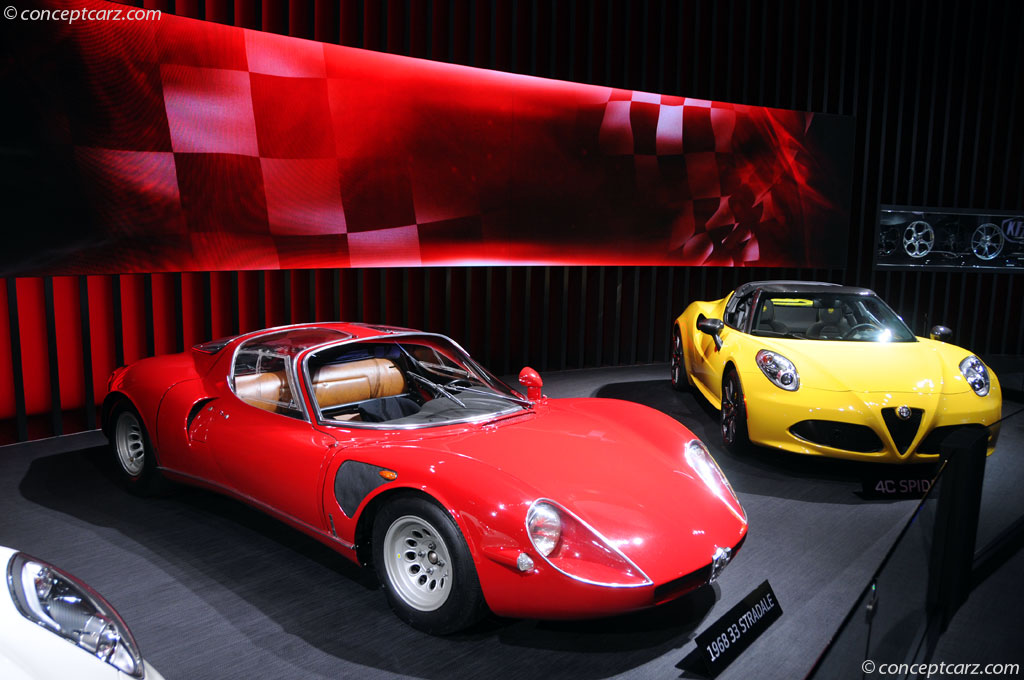
1968 Alfa Romeo Tipo 33 Stradale 1968 Alfa Romeo Tipo 33 Stradale 1968 Alfa Romeo Tipo 33 Stradale 1968 Alfa Romeo Tipo 33 Stradale
More Photographs    Engine Photos   

View more photos
Coupe
Designer: Franco Scaglione
 
The Alfa Romeo Type 33 was introduced during the 1967 season. As the years progressed, the models became known as the 33/2, to represent their engine displacement size and to distinguish them from the other variants. During the 1968 season, the 33 scored a few victories, but were mostly plagued by reliability issues. As the growing pains were resolved, the car a formidable force.

In 1967, a road-going version of the Type 33 was introduced, and it was known as the 'Stradale.' In many ways, it was identical to the racing version. To make the car manageable in normal driving situations, the Stradale sat atop a longer wheelbase and was powered by a de-tuned engine. The eight-cylinder engine displaced 2 liters and produced 230 horsepower. Top speed was still impressive, at around 175 mph.

It is believed that around four examples received coachwork by Italian coachbuilders, with a total of 18 examples being created. The low production numbers were results of the steep price tag for one of these supercars.

The example shown is a 1968 Alfa Romeo Tipo 33 Stradale Coupe with coachwork by Scaglione/Marazzi. It was on display at the 2006 Pebble Beach Concours d'Elegance.
The Alfa Romeo Tipo 33 name was used from 1967 through 1977 for Alfa Romeo sports racing prototypes and even a few road going cars. Alfa Romeo's history in sports car racing goes back to pre-World War vintage. They legacy continued in 1950 and 1951 as they won the first two Formula 1 World Championships. After this accomplishment, they retired from racing to focus on the production of road-going vehicles. Their absence from racing would be only for a short time, as their Zagato-bodied TZ1 was introduced in 1963. Its light alloy body, tubular frame, disc brakes, and independent suspension gave the vehicle superior handling and performance. The work had been managed by Carlo Chiti of Autodelta, a new competition department formed by Alfa Romeo. The Giula 1600 GTA soon followed and was a dominate force at many of their racing expeditions.

During the early 1960s, Alfa Romeo began designing a new racer which was given the codename '105.33'. The designs were later sent to Autodelta for further development. The '105' was later dropped and the vehicle became known as the '33' when it was introduced for the 1967 season. As the iterations of the Tipo 33 evolved, the names of the original cars became known as the '33/2', with the '2' representing their two-liter engines. Mounted mid-ship was a quad-cam V8 engine that was highly tuned to produce an impressive 270 horsepower. For its inaugural race at the Belgium hillclimb the Tipo 33/2 proved its potential by emerging victorious. The rest of the season was plagued by mechanical issues which made the racer unreliable.

Work and testing to evolve the Tipo 33 continued for the 1968 season. The bodywork and engine were slightly improved in an effort to resolve reliability issues and to improve the vehicles performance. Udo Schütz and Nino Vaccarella were able to navigate the 2-liter Tipo 33 at the 24 Hours of Daytona. A few other impressive victories and podium finishes followed throughout the season, but the Porsche rivals with their bigger engines often outpaced the Alfa Romeos. Alfa Romeo team finished third in the World Championship for 1968.

The Tipo 33/2 were able to secure many class victories but it was not powerful enough to contend for overall victories. Work began on a three-liter unit that would be able to contend with the competition. The V8 3-liter unit was given four valves per cylinder and adapted to an aluminum monocoque type chassis which had shrunk in size by 10 cm. At the 12 Hours of Sebring in 1969, Alfa Romeo debuted the 33/3. The racer had 400 horsepower and in the same class as the Ferrari 312P and the Porsche 908. The Alfa Romeo team would have a dismal season and often started the 33/2 in place of the 33/3.

For 1970 there were two bodystyles created, a long and short version. The long tail spider version was known as the Le Mans Spider. Worked continued to improve the vehicles reliability issues. The car was unable to contend with the dominate Porsche 917 and Ferrari 512.

In 1970 an Alfa Romeo Tipo 33/3 was in Steve McQueen's movie 'Le Mans'.

In 1971 the Tipo 33/3 was given a five-speed gearbox. Many of the issues had been resolved and the 33/3 had a rather successful season, finishing second in the Constructor's World Championship. Rolf Stommelen and Nanni Galli had driven their cars to class wins at the 1000km Buenos Aires. At Sebring, the class win victory was repeated. At the 1000km Brands Hatch, De Adamich and Pescarolo were able to outpace the Porsche 917's and secure an overall victory. Vaccarella and Hezemans won outright victories at the Targa Florio, the vehicles most impressive accomplishment of the season.

Near the close of the 1971 season, Autodelta introduced a new prototype racer dubbed the 33 TT3. The 'TT' meant Tellaio Tubulare - meaning tubular chassis for the vehicles spaceframe type chassis. Much had been learned from the prior racers and adapted to this new vehicle. The weight distribution was greatly improved by moving the driving position forward and relocating the gearbox ontop of the engine.

In 1973 a Carlo Chiti-designed 12-cylinder box engine was placed in the vehicle. Alfa Romeo's fitted with this engine were known as the 33 TT 12. With the increase in power, the Alfa Romeo team won many of the races in 1974 and by 1975 was dominating the competition. The Alfa Romeo team scored seven victories in eight championship races. They repeated their accomplishments in 1976 with the Tipo 33 SC 12.

The Tipo 33 SC 12 had a 2995cc 12-cylinder boxer engine that produced 520 horsepower. Alfa Romeo secured the Sports Car Championship in 1977. The final race of the season had been raced with a turbocharged version of the 12-cylinder engine which increased horsepower to 640.

Part of the reasons for Alfa Romeo's success with the Tipo 33 models were its continued development, excellent drivers and dwindling competition. Ferrari had left sports car racing in 1974 to compete in Formula One. FIA had added new regulations throughout the early 1970's which made formidable contenders such as the Porsche 917 and Ferrari 512 ineligible to compete.

1968 Alfa Romeo Tipo 33 Stradale

Year1968
MakeAlfa Romeo
ModelTipo 33 Stradale
Body StyleCoupe
Engine LocationMid
Drive TypeRear Wheel
Production Years for Series1967 - 1968
Body DesignerFranco Scaglione
Weight570 kg | 1256.9 lbs
Combined MPG0.00
Introduced At1967 Turin

Performance
0-60 mph5.5 seconds.
Top Speed280 km/h | 174 mph Similar top speeds

Engine  
Engine ConfigurationV
90-degree
Cylinders8
Aspiration/InductionNormal
Displacement2.00 L | 122 cu in. | 1999.6 cc.
Valves16 valves.
2 valves per cylinder.
ValvetrainDOHC
Horsepower230.00 BHP (169.3 KW) @ 8800.00 RPM
Torque200.00 NM (147.5 Ft-Lbs) @ 7000.00 RPM
HP to Weight Ratio5.5 LB / HP (Vehicles with similar ratio)
HP / Liter115.0 BHP / Liter
Compression Ratio10.0:1
Fuel TypeGasoline - Petrol
Fuel FeedFuel Injected
Spica mechanical fuel injection
Vehicles with similar horsepower and weight

Standard Transmission
Gears6
TransmissionManual
Colotti


View more photographs
Similar Automakers
Add Review
Other models by Alfa Romeo
View Specifications
AddThis Social Bookmark Button

Vehicle Ratings
StylingVehicle Styling Rating: 100%
PerformanceVehicle Performance Rating: 100%
InteriorVehicle Interior Rating: 90%
QualityVehicle Quality Rating: 100%
OverallVehicle Overall Rating: 100%
No. of Votes: 2
Rate the Vehicle
Add Review

Articles and Event Coverage
Pebble Beach Concours d'Elegance

Additional Resources and Links
Pebble Beach Concours d'Elegance Official Website

Topics
the most beautiful car ever

Replies: 0
Tuesday, October 30, 2007

1968 Alfa Romeo models
1750 Spider
Berlina 1750
Carabo
Carabo Type 33
Giulia GTA Jr.
Guilia GTV
Tipo 33/2

Recent Vehicle News
Alfa Romeo GT Veloce 2000Ferrari F355 BerlinettaLamborghini 350 GT
Cisitalia 202 Spider NuvolariBentley Speed Six SurbicoAudi Metroproject Quattro
Cadillac SixteenChrysler Imperial ConceptBMW Mille Miglia Concept
Volkswagen EOSRolls-Royce Pininfarina HyperionHamann 911 Turbo Stallion
Lamborghini Murcielago LP640 VersaceEdo Competition Gallardo SuperleggeraToyota Aygo Crazy Concept
2008 Lamborghini ReventonAudi R10 TDiLotus Elise SC Clark Type 25
BMW GINA Light VisionaryBreckland BeiraSpada Codatronca TS Concept
Maserati A8 GCS Touring CoupeBugatti Veyron Sang NoirBMW M1 Homage Concept
Maserati Quattroporte Bellagio Fastback