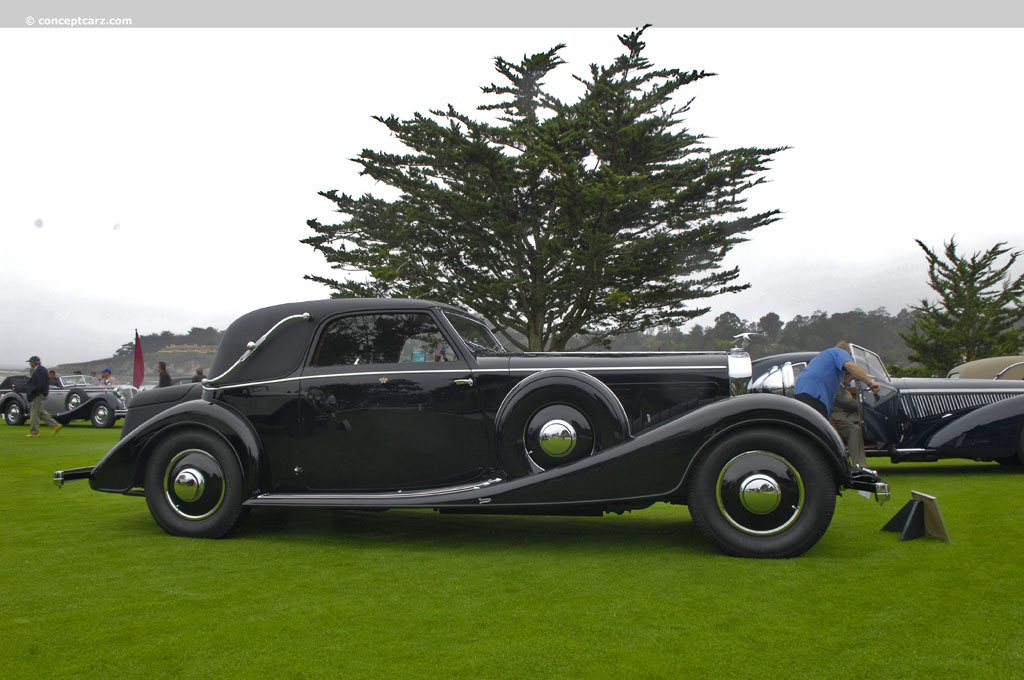
The Great Depression was responsible for the demise of many marques, especially those catering to the exclusive luxury car segment, yet Hispano-Suiza was able to survive, infused with the financial resources from its aircraft engine business. The automobile arm of the company continued, providing a public showcase for the marque. Its Paragon was known as the '54 CV, Type 68, and J12' and it remained in production through 1937 without making any money for its manufacturer, despite a steep price. Production was extremely exclusive, with around 120 examples built in total - all to the specific order of their clientele. 
Faux Cabriolet by Vanvooren
View info and historyHispano-Suiza had Swiss and Spanish origins along with a parallel manufacturing base in France. Emilio de la Cuadra, a Spanish army captain, started Hispano-Suiza in 1898. The Swiss engineer Marc Birkigt was hired to design their first gasoline-powered engine for the Barcelona-built Castro. By 1905, they were producing a series of large four- and six-cylinder engines for automobiles. Mr. Birkigt's later work included the T-head fours, a water-cooled V-8, overhead-camshaft engines, and the H6 model. During World War I, they provided engines for airplanes. Birkigt designed a series of pioneering aircraft engine innovations that included the first use of a cast engine block, propeller reduction gearing, and a hollow propeller shaft to allow the firing of a gun through the propeller. Inspired by the multi-cylinder wars going on in the United States, Mr. Birkigt began work in 1929 on what would become the J-12. Serving as a replacement for the Hispano-Suiza H6, the J12 was the largest and most expensive model created by Hispano-Suiza. It was built from 1931 to 1938 and was offered solely as a chassis. Its platform could be had in various dimensions including a wheelbase size of 135-, 146-, 150, and 158-inches. The 9,424cc overhead valve V-12 engine was paired with a three-speed manual transmission with synchromesh on the top two gears. The 60-degree engine had pushrod-operated overhead valves, a seven-bearing crankshaft, and a bore and stroke that both measured 100 mm (3.9 inches). With a compression ratio of 5.0:1, the engine delivered 220 horsepower at 3,000 RPM. At least two examples had an even larger 11.3-liter engine which offered 250 horsepower, and several J12 models were later upgraded to this specification.
Faux Cabriolet by Vanvooren
View info and historyEvery aspect of the Hispano-Suiza was over-engineered. It had dual Scintilla magnetos, fully adjustable servo-assisted brakes, vitreous enameled manifolds, and aluminum castings. It had silent operation, plenty of torque at low revolutions, remarkably quick steering, confidence-inspiring brakes, and throttle response similar to that of a sports car. Among the coachbuilders who clothed the Hispano-Suiza J12 include Vanvooren, Fernandez & Darrin, Binder, Saoutchik, Rippon, deVillars, D'Ieteren, Kellner, and Letourner et Marchand
by Daniel Vaughan | Sep 2022
Faux Cabriolet by Vanvooren
View info and history

Faux Cabriolet by Vanvooren
View info and history
by Daniel Vaughan | Sep 2022
Related Reading : Hispano Suiza J12 History
The French automaker Hispano-Suiza was among the elite in luxury car production and the leaders of style, innovation, and design. The reputation was solidified in history with the legendary H6 series including the H6B and H6C. Their destiny in history as one of the greatest producers of automobiles during the 1930s was secured with the introduction of the J-12 Type 68 in 1931. That was the same year....
Continue Reading >>
Continue Reading >>
Similar Automakers
Similarly Sized Vehicles
from 1933


1933 Hispano Suiza J12 Vehicle Profiles


Recent Vehicle Additions


Performance and Specification Comparison
J12 Specification Comparison by Year
Year
Production
Wheelbase
Engine
Prices
Related Automotive News

Three FCA US Vehicles, Dodge Brand Win Quality Awards In Strategic Vision's 24Th Annual Total Quality Impact™
Dodge named best Mass-market Brand in total quality
Dodge Durango leads Mid-size SUV segment in total quality, fifth win in six years
Jeep® Renegade named best-in-class Entry SUV
Ram 25003500 captures win for total quality among Heavy Duty Picku...

New Opel Astra Sports Tourer: Successful Station Wagon Rich in Tradition
Tenth generation Opel Caravan and Sports Tourer characterize the compact class
Rüsselsheim. Over 24 million Opel Kadett and Opel Astra cars sold is an impressive number and a notable achievement. Lined up one behind the other, all Opel...
Toyota Opens New Engine Plant in Porto Feliz, São Paulo
New Facility represents an investment of 18 billion JPY (US%24 170 million) and employs approximately 320 people.
Carmakers first engine manufacturing facility in Latin America ushers in new chapter for regional operations With a capacity of 108,000...

Toyota Develops New Series of Gas Engines That Will Boost Fuel Efficiency At Least 10%
Company uses technology refined in hybrid engines to create 14 new engine variations by 2015
April 10, 2014
Toyota City, Japan – Toyota will soon introduce vehicles globally with a series of newly-developed, highly efficient gasoline e...

TMC Launches Redesigned Corolla Series in Japan
Toyota Motor Corporation (TMC) announces the launch in Japan today of the redesigned Corolla Axio sedan and Corolla Fielder*1 station wagon. The vehicles will be sold across Japan through Toyota Corolla dealers.
Since its debut in 1966, the...