Concept Cars Home
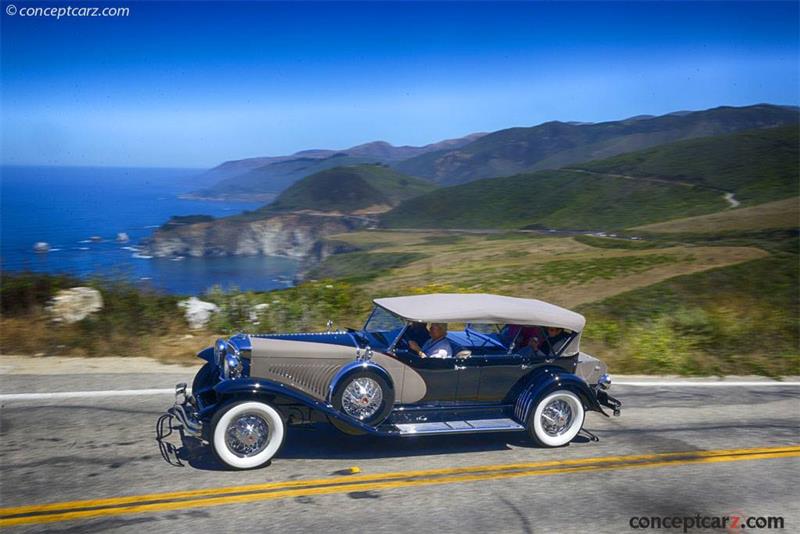
Image Left 1929 Model J MurphyImage Left 1929 Model JImage Left 1929 Model J ChassisImage Left 1929 Model J Skiff1931 Model J Murphy Image Right1931 Model J Image Right
 

1930 Duesenberg Model J news, pictures, and information
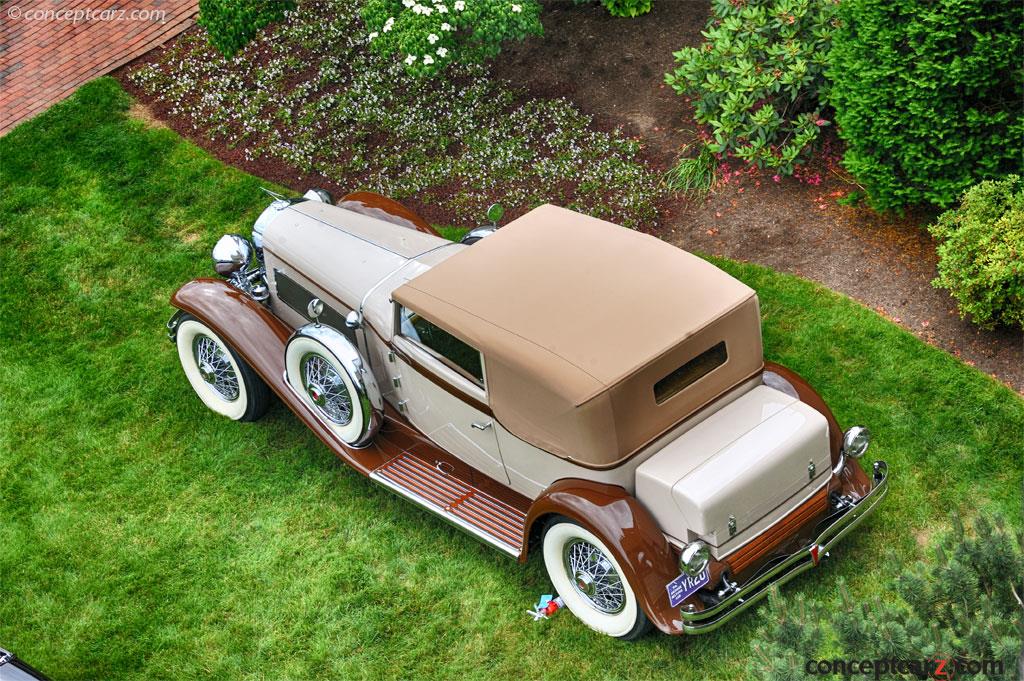
Convertible Victoria
Coachwork: Hibbard and Darrin
Chassis Num: 2300
Engine Num: J-277
 
This car was one of several Duesenbergs sold in France. The original owner was the wealthy American, Mrs. Honore Palmer who had residences in both Paris and Chicago. She kept the car in Paris until 1934 when she had it shipped to the United States.

Mrs. Palmer selected Hibbard and Darrin to create this special car for her. The closed coupled Victoria design on the long wheelbase chassis created a dramatic appearance. The body was built using Hibbard and Darrin's patented Silentlyte construction. This technique produced a stronger and lighter body and reduced the tendency for one-off bodies to develop squeaks as they aged.

Original features include the leather convertible top, chrome plated metal tire covers, additional tool boxes next to the running boards, cast aluminum molding attached to the hood tops, unique short steel gas tank cover and the unique 'Hibbard and Darrin' movable panel that allowed the rear seat passenger to convert the top from a blind quarter to an open quarter.

This car is a unique example of just 12 bodies produced by Hibbard and Darrin for Duesenberg. The car was built for a wealthy American woman with residences in Paris and Chicago. It was delivered in Paris and came to the United States in 1934. It was first restored in 1970 and a new body-off restoration was recently completed near the close of the 2000s.

The current owners added the car to their collection in 2003 and it has just finished a complete restoration in 2009.
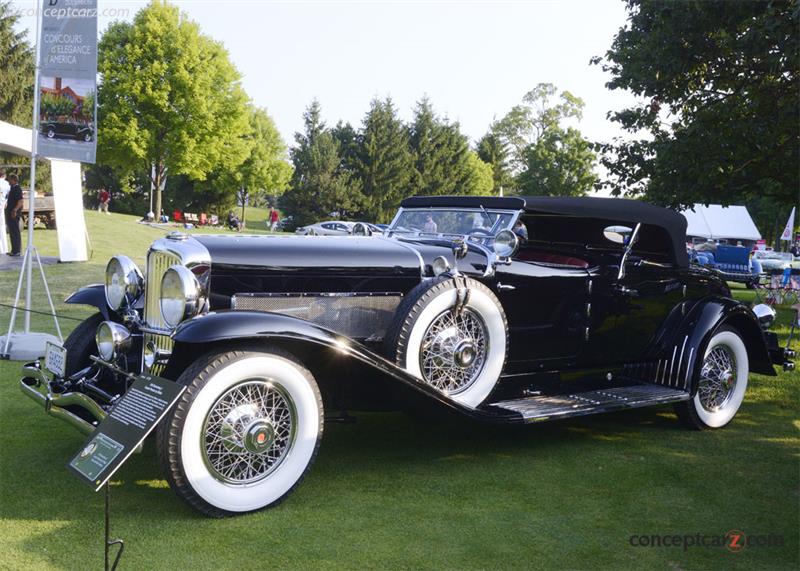
Legrande Torpedo Phaeton
Coachwork: Walker
Chassis Num: 2276
Engine Num: J-255
 
Sold for $698,500 at 2013 Bonhams.
This 1930 Duesenberg J Walker Legrande Torpedo Phaeton was offered for sale at the 2007 Blackhawk Collection Exhibit held at the Pebble Beach Concours. It carried a price tag of $750,000 and was quick to find a buyer.

It is formerly Of the Pacific Auto Rental Collection, then sold To Dave And Fred Webber Of St. Louis. Dave and Fred Commissioned Fran Roxas to build the Legrange Torpedo Phaeton Body. Fran Roxas is known as one ff The Finest Restorers And Custom Coachwork Builders Of Classic Cars In The World. Fran Is Best Known For His Duesenberg and Packard Bodies he has nuilt. His cars have won many concours awards around the country, even a Best of Show at the Meadowbrook Concours D'elegance. The body is on an original Duesenberg chassis and engine. The original body was a Judkins Limousine. The car was finished in 1990 and purchased by the Imperial Palace Auto Collection in 1991. One of the most beautiful Duesenberg's you will ever see!! Duesenbergs were in strong demand in Hollywood, and J255 became one of the most famous examples of the marque. During the car's 50 year tenure wîth Pacific Auto Rentals, it was used in dozens films, commercials, and photo shoots. The following is just a few of J255's film credits:
• 1940 – The Great McGinty, starring Brian Dunlevy.
• 1951 – A Pocket Full of Miracles, starring Betty Davis & Glenn Ford.
• 1961 – Photo shoot wîth Glenn Ford in Esquire magazine.
• 1977 – Howard Hughes – starring Tommie Lee Jones and Ed Flanders.
• 1981 – The Gangster Chronicles, starring Michael Noury and Joe Penny.
• 1984 – City Heat, starring Clint Eastwood and Burt Reynolds.

Source - Blackhawk Collection
Limousine
Coachwork: Judkins
 
This Model J Duesenberg wears coachwork by Judkins.
By Daniel Vaughan | Aug 2010
Convertible Coupe
Designer: Graber
Chassis Num: 2254
Engine Num: J-148
 
This Graber Convertible Victoria, chassis number 2254 and originally housing engine number J-246 but currently powered by J-148, was once part of the Harrah Collection. Prior to a restoration by the Harrah Collection, the car was painted black and silver. After the work was complete, it was colored olive and dark orange. Years later it was painted two-tone red; the current paint scheme is of blue and black.

What is currently a Graber bodied convertible coupe began life as a Murphy bodied Town Car built for Vera Montgomery of New York City, NY. The car was later sold to Vladimir de Radevsky of Paris, who (in 1935) tasked the coachbuilder Graber with re-bodying the car. The car's next owner was Heinz Boethge of Switzerland, prior to entering the Harrah Collection.

By Daniel Vaughan | Aug 2010
Dual Cowl Phaeton
Coachwork: LeBaron
Chassis Num: 2336
Engine Num: J487
 
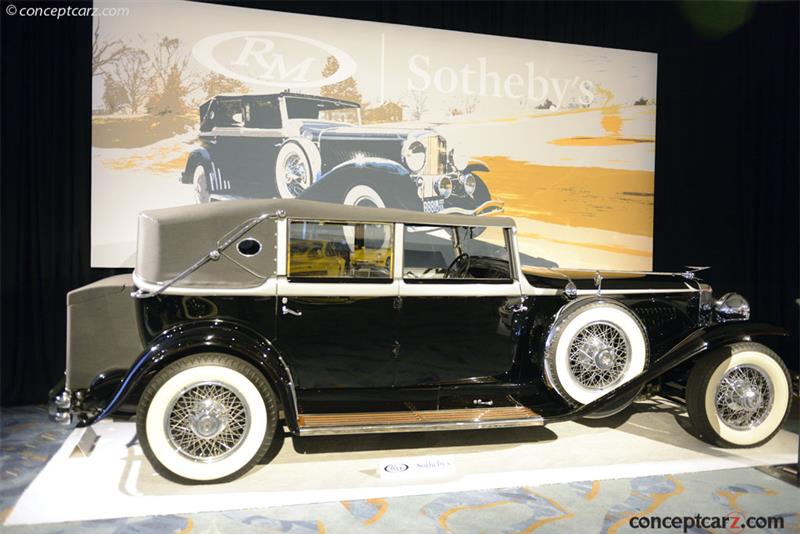
Sold for $880,000 at 2012 RM Auctions.
This 1930 Duesenberg Model J LWB Dual Cowl Phaeton by LeBaron is chassis number 2336 and is powered by engine J487. It was delivered new as J320/2336 to a Mr. J. Clarke Dean of Chicago, Illinois in 1930. This is the only long-wheelbase version of the LeBaron sweep panel phaeton ever built. The wheelbase measures 153.5-inchs, a fitting vehicle for Mr. Dean, who it is believed was a successful Chicago brokers well as a golfer and member of Chicago's Athletic and Racquet Clubs.

The car was in the hands of gas station owner in Grand Rapids, Michigan by 1948, at which point it was discovered that its original engine had been replaced by J487. It is not known why the switch was made.

Until the 1950s, the car remained in the Midwest, with owners in Michigan, before being sold to residents in West Virginia. From there, it made its way to Maryland, first into the ownership of T.J. (Tom) Blash, who owned drive-in theaters and was involved in chemical sales. Other owners included T.J. Cramblett and William Coverdale of Waynesville, Ohio. In November of 1964, the car was acquired by Tony Pascucci of Meriden, Connecticut for $16,600. Mr. Pascucci would become a long-term caretaker, installing the crankshaft from J467 and keeping the car until March 1984. At some point in the late-1980s, the car was sold to William G. Lassiter, Jr. of West Palm Beach, Florida, who showed it at the Gilmore Duesenberg show in June 1987 and the Meadow Brook Concours d'Elegance. Later in the vehicle's life, it entered the John O'Quinn collection.

In 2012, this vehicle was offered for sale at RM Auctions sale in Scottsdale, Arizona. It was estimated to sell for $900,000-$1,200,000. As bidding came to a close, the car had been sold for the sum of $880,000 inclusive of buyer's premium.

By Daniel Vaughan | Feb 2012
Limousine
Coachwork: Willoughby
Chassis Num: 2402
Engine Num: J-306
 
High bid of $350,000 at 2012 Mecum. (did not sell)
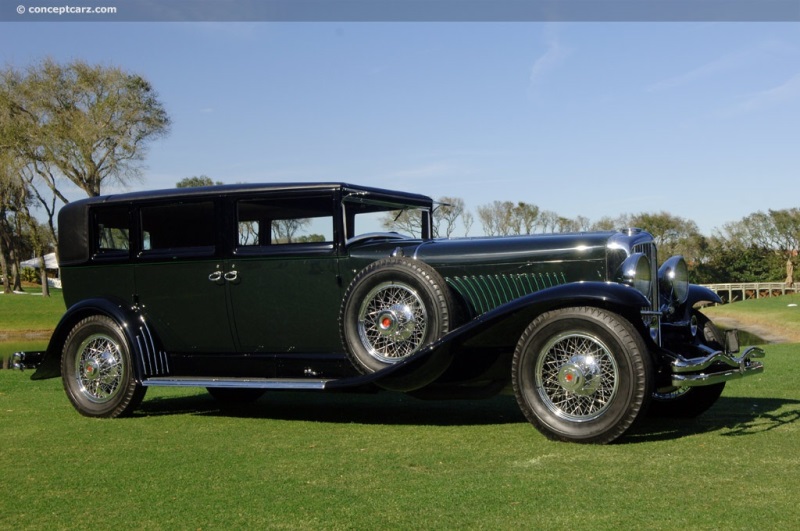
This 1930 Duesenberg Model J wears 7-passenger Limousine coachwork created by the Willoughby Body Company of Utica, New York. It has been certified by the Auburn-Cord-Duesenberg Club as a Category 1 Original. It has chassis number 2402 and original body number 2402. The original engine, J-383, was defective and replaced at the Duesenberg factory with its present engine, number J-306, which uses a Schebler Model S carburetor. The car is finished in dark green, has twin side-mount spares, louvered hood, articulated spotlight, and dual horns. Inside there is an opulent pleated Tan leather interior with full-length Persian-style rug carpeting.
By Daniel Vaughan | Oct 2012

Background

The Duesenberg Company produced high-end, luxury automobiles and racing cars from 1913 through 1937. It was created by the Duesenberg brothers, Fred and August, who formed the Duesenberg Automobile & Motors Company, Inc. in Des Moines, Iowa with the intent on building sports cars. Just like many of their time, they were mostly self-taught engineers and had only constructed experimental cars up to this point.

Duesenberg's place in history was officially solidified in 1914 when Eddie Richenbacker drove a Duesenberg to an astonishing 10th place finish at the Indianapolis 500. Duesenberg later went on to win the race, capturing overall victories in 1924, 1925, and 1927. A Duesenberg was used as a pace car for the Indianapolis 500 in 1923.

Starting with the companies first appearance at the Indianapolis 500 in 1913 and continuing for a consecutive 15 years, there were a total of 70 Duesenberg racing cars entered in the race. Thirty-two of the cars finished in the top ten. In 1922, eight of the top ten cars were Duesenberg-powered. Many great racing names, such as Eddie Rickenbacker, Rex Mays, Tommy Milton, Peter DePaolo, Albert Guyot, Ralph DePalma, Fred Frame, Stubby Stubblefield, Ab Jenkins, Ralph Mulford, Jimmy Murphy, Joe Russo, and Deacon Litz raced in a Duesenberg.

Duesenberg's racing pedigree was not just reserved for the United States; in 1921, Jimmy Murphy drove a Duesenberg to victory at the French Grand Prix at the LeMans racetrack. This made him the first American to win the French Grand Prix. It also made the Duesenberg the first vehicle to start a grand prix with hydraulic brakes.

The Duesenberg headquarters and factory was relocated in July of 1921 from New Jersey to Indianapolis. Part of the purpose for the move was to focus more on the production of passenger vehicles. The Company had a hard time selling their Model A car. This was a very advanced car with many features not available on other vehicles being offered at the time. The engine had dual overhead cams, four-valve cylinder heads and was the first passenger car to be equipped with hydraulic brakes.

The Duesenberg Company produced 667 examples of the Model A, making it their first mass-produced vehicle. The Model A was powered by a 183-cubic-inch single overhead camshaft inline eight-cylinder engine. The strain of racing, moving, and lack of selling automobiles sent the company into receivership in 1922. After a few years, it's debts had been resolved, thank in-part to an investor group. The company re-opened in 1925 as the Duesenberg Motors Company.

In 1926, Errett Lobban Cord purchased the Duesenberg Company. The company appealed to E.L. Cord, owner of the Cord and Auburn Automobile Company, because of its history, the engineering ingenuity of the products, brand name, and the skill of the Duesenberg Brothers. The purpose was to transform the company into a producer of luxury automobiles.

Duesenberg Model J and Model SJ

Fred Duesenberg was a master of creating engines and was a creative designer. He had a talent for conceiving new ideas and ways of doing things. The engines he constructed were beautiful, mechanically sound, and advanced. E.L. Cord gave him one task: 'Create the best car in the world.' This was a very tall order and came at a very difficult time in history. The onset of the Great Depression and the Stock Market crash was just around the corner. Competition in the luxury car segment was fierce and involved all facets of the automobile. The cylinder wars that began in the 1920s and continued into the 1930s had marque's trying to outdo each other on the bases of their engines output, number of cylinders, and the speed of their ultra-luxury automobiles. Styling continued to be very important and often outsourced to the greatest designers and coachbuilders of the time. Maruqee's such as Cadillac, Packard, Rolls-Royce, Hispano-Suiza, Isotta Fraschini, Bugatti, and others were all trying to out-do each other and continue in business during this difficult point in history.

The Duesenberg Model J was first unveiled to the public at the New York Car Show on December 1st of 1928. Only the chassis and engine were shown and it still impressed enough to make front page news. The wheelbase was 142-inches making it nearly 12 feet. The chassis had a six cross-members made it very sturdy and able to accommodate the heaviest of bodies. The engine had dual overhead camshafts and eight-cylinders with four valves per cylinder. It displaced 420 cubic-inches and produced an impressive 265 horsepower in un-supercharged form. The engine had been designed by Fred Duesenberg and constructed by the Lycoming Company, which had been recently acquired by E.L. Cord. There was a brilliant lubrication system which automatically lubricated various mechanical components after sixty to eighty miles. Two lights mounted on the dashboard indicated when the lubrication process was transpiring. After 750 miles, lights mounted on the dashboard would light-up indicating the oil required changing. After 1500 miles, the lights would illuminate indicating the battery should be inspected. Top speed was 119 mph and 94 mph in second gear. With the use of a supercharger, the top speed increased even further, to nearly 140 mph. Zero-to-sixty took around eight seconds with 100 mph being achieved in seventeen seconds.

Each chassis was driven at speed for 100 miles at Indianapolis before being delivered to the customer or coachbuilder.

The coachwork was left to the discretion of the buyer and the talents of the coachbuilders. Prominent coachbuilders from North American and Europe were selected to cloth the Model J and Model SJ in some of the grandest and elegant coachwork ever created.

The cost of a rolling chassis prior to 1932 was $8,00. The rolling chassis usually included all mechanical components, front fenders, radiator grille, bumpers, running boards, dashboard, and sometimes a swiveling spot-light. After 1932, the price was raised to $9,500. After the coachwork was completed, the base price was $13,500 with a top-of-the line model fetching as much as $25,000 or more. To put this in perspective, the entry level Ford Model T in the early 1930s cost around $435 with the most expensive version selling for about $650. Many individuals in very prominent careers, such as doctors, made around $3,000 annually. The Great Depression meant the number of individuals capable of affording an automobile of this caliber soon dwindled. Those who could afford one often bought modest vehicles to avoid public uprising and ridicule. The pool of marques who catered to the upper-class of society did all they could to attract buyers; prices were lowered and incentives were made just to attract another sale. Needless to say, competition was fierce.

After the New York Show, Duesenberg ordered enough components to build 500 Model Js. Specifications and drawings of the chassis had been sent to prominent coachbuilders six months prior to its unveiling at the New York Show. This had been done to guarantee that a wide variety of bodies were available after its launch. Duesenberg ordered bodies in small quantities and offered the completed cars to have on-hand incase the customer wanted to take delivery immediately. The first customer took delivery of their Model J in May of 1929. This was just five weeks before Black Tuesday.

The Model SJ, a supercharged version of the Model J, produced 320 horsepower. The supercharger was located beside the engine with the exhaust pipes beneath through the side panel of the hood through creased tubes. The name 'SJ' was never used by the Duesenberg Company to reference these models.

Even though the Model J had received much attention from the press and promotional material was well circulated, sales were disappointing. The Duesenberg Company had hoped to construct 500 examples per year; this figure was never matched with a total of 481 examples constructed throughout its lifespan. Duesenberg did find customers such as Gary Cooper, Clark Gable, Greta Garbo and James Cagney. Monarch, kings, queens, and the very wealthy accounted for the rest of the sales.

Production continued until the company ceased production in 1937. Little changed on the Model J over the years. The four-speed gearbox was replaced by a unsynchronized three-speed unit which was better suited to cope with the engines power. The last Model SJ's produced had ram-horn intakes and installed on two short-wheelbase chassis. Horsepower was reported to be as high as 400. These examples are commonly known as 'SSJ' in modern times.

In 1932, Fred Duesenberg was involved in a car accident which claimed his life. Development on the Model J had come to a halt which was not a problem at the time, but within a few years had become antiquated in comparison to the competition. An entirely new design and updated mechanical components were required for the Duesenberg name in 1937 in order to stay competitive. The cost and development time was too much for E.L. Cord to consider, and so he withdrew his financial support and the company dwindled.

August Duesenberg tried, unsuccessfully, to revive the Duesenberg name. Fritz Duesenberg tried again in the mid-1960s but again without success.

By Daniel Vaughan | Feb 2007
The Duesenberg Automobile & Motors Company, Inc was founded and operated by Fred and August brother's who began their company in 1913. From the start their company has been a US based luxury automobile company with a standard to build the very best hand-built vehicles during the time period. Duesenberg vehicles lived up to this standard until 1937 when the company closed.

Created to build sports cars, the Company began its life in Des Moines, Iowa by two men who were self-taught engineers that produced various experimental vehicles. Unfortunately the brothers did have much selling capability, and due to this the company claimed bankruptcy and closed in 1922.

Purchasing the Duesenberg Company in 1926, Errett Lobban Cord, the owner of Cord Automobile, Auburn Automobile and several other transportation companies acquired the Duesenberg Brothers' engineering skills along with a brand name. Setting out to produce the Model J, Cord hired Fred Duesenberg to design both the engine and the chassis that would eventually be the best in the world.

Displayed at the New York Car Show of 1928, the Model J (Judkins) Duesenberg was indeed impressive. While only the engine and chassis were put on display at the show, the body and interior of the vehicle would be eventually custom-made by an extremely experienced coachbuilder to the owner's specification. Coachbuilders in both Europe and North America were responsible for the extensive bodywork. The finished product was the grandest, largest and most beautiful vehicle ever before created. The base model cost around $13,500, while the top of the line model sold for an extreme $25,000.

With a lack of supercharged form, the Model J was renowned for it incredibly 265 horsepower, straight-8 engine, and dual overhead camshafts. Able to reach an impressive top speed of 119 mph, and 94 mph in 2nd gear, the Model J was a success.

While other top of the line vehicles of the time period could barely reach 100 mph, the Duesenberg models were definitely turning some heads. The 1932 SJ was estimated to reach 104 mph in 2nd gear, a top speed of 135-140 mph in 2rd, and turned around 0-60 in 8 seconds. The supercharged Model J came with 320 HP and the supercharger placed alongside the engine, with creased exhaust pipes to make room it. The SJ models were easily recognizable due to their shiny creased tubes, a trademark by E. L. Cord. Weighing around two and a half tons, due to the large array of custom coachwork available, the Duesenbergs were not any heavier than their fellow competition.

Rapidly becoming of the most popular vehicles in the world, the Duesenberg was a status symbol for the elite. Such famous owners of the Duesenberg were Clark Gable, the Duke of Windsor and Gary Cooper.

Advertised to be the ‘best car in the world', Duesenberg's have held up to their status for numerous years. Following world-beating performance along with high regard and standard for quality, the Duesenberg continued to hold the reputation for opulence.

A total of 481 Model Js and SJs were produced between 1928 and 1937. Following E. L. Cord's financial empire collapsing, Duesenberg ceased production in 1937. It is estimated that approximately 50% of these classic cars are still on the road today. Both Duesenberg Model J's and SJ's are among the most desired collectible classic cars in the world.

Jay Leno owns four Model J Duesenbergs.

By Jessica Donaldson
For more information and related vehicles, click here

American Classics Top RM's $6.8 Million Michigan Sale
A majestic 1930 Duesenberg Model SJ Convertible Victoria, J272, formerly owned by noted band leader Paul Whiteman of 'Rhapsody in Blue' fame, garnered top dollar at RM's Michigan sale yesterday, selling for a strong $957,000 before a packed house. One of just 16 examples bodied with convertible Victoria coachwork by Rollston, the stunning Duesenberg led a magnificent group of top-selling American classics at the single-day sale, held in conjunction with the famed Concours d'Elegance of Americ...[Read more...]
Final Countdown Underway to RM's Michigan Sale
RM Auctions, the official auction house of the Concours d'Elegance of America, has secured a wonderful selection of classic automobiles for its St. John's sale, July 28, in Plymouth, Michigan. Hosted on the beautiful grounds of the Inn at St. John's, the single-day sale is a mainstay on the auction concours circuit and boasts a reputation for including exceptional American classics. The upcoming sale, featuring more than 70 quality collector cars, presents nearly a century of American and Eu...[Read more...]
Cherished Classics From The Pettit Collection Will Be Offered Without Reserve
• The 1929 Duesenberg 'Blue J' and 11 collector cars from the William A. C. Pettit, III Collection will be sold at Gooding & Company's Pebble Beach Auctions
• Estate Proceeds will benefit the Shriners Hospital for Children®-Tampa
Gooding & Company, the acclaimed auction house celebrated for selling the world's most significant and valuable collector cars, is honored to present the finest automobiles of the William A.C. Pettit, III Collection at its Pebble Beach Auctions on Aug...[Read more...]
Auctions America 2012 Auburn Spring Auction Offers Full Range of Convertibles
Just in time for summer fun, Auctions America by RM will offer an array of open-air collector cars during its June 1-3 Auburn Spring auction,including a one-of-a-kind concept car that cost Ford Motor Co. more than a half-million dollars to produce. During the three-day event, more than 600 American muscle cars, Classics, foreign sports cars and hot rods will cross the block at the historic Auburn Auction Park, the company's national headquarters in Auburn, Indiana. 'It's that time of year wh...[Read more...]
Consignments now invited for RM St. John's
RM Auctions, the official auction house of the Concours d'Elegance of America, returns to the Inn at St. John's, July 28, 2012 for its firmly rooted Michigan sale. A featured attraction of the Concours weekend and a longstanding summer tradition for collectors, the single-day sale has established a reputation for offering outstanding American classics. In 2011, the sale enjoyed a very positive response to its new venue at The Inn at St. John's, realizing more than $7.6 million in sales with ...[Read more...]
Grand Prix Racers
Model A
Model J

Image Left 1929 Model J MurphyImage Left 1929 Model JImage Left 1929 Model J ChassisImage Left 1929 Model J Skiff1931 Model J Murphy Image Right1931 Model J Image Right
© 1998-2012. All rights reserved. The material may not be published, broadcast, rewritten, or redistributed.