|
|
|
|
|
|
|
|
|
|
|
|
|
|
|
|
|
|
|
|
|
|
|
|
|
|
|
|
|
|
1969 Chevrolet Camaro news, pictures, and information
![]() | ![]() | View more photos Hardtop Sport Coupe |
![]() | ![]() | View more photos Hardtop Sport Coupe Chassis Num: 124379N608879 |
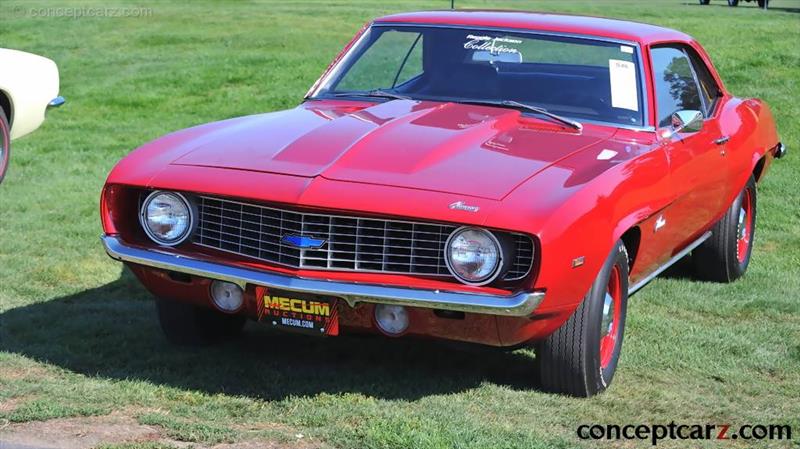
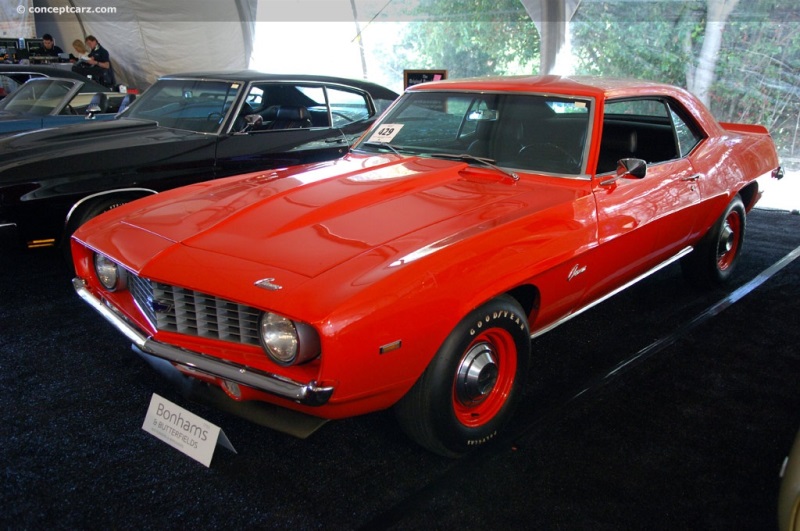
At a sticker price of $7200, the COPO Camaro was almost double the price of a 'standard' COPO Camaro with a cast-iron 427. As a result, Gibb returned most of the cars to the factory as most Chevrolet enthusiasts were not willing to pay this amount. The cars were then sent to other dealerships. In total there were 69 examples produced including the original 50 examples shipped to Gibb in 1968 and another 19 produced in 1969. Gibb was able to sell 13 of the original 50.
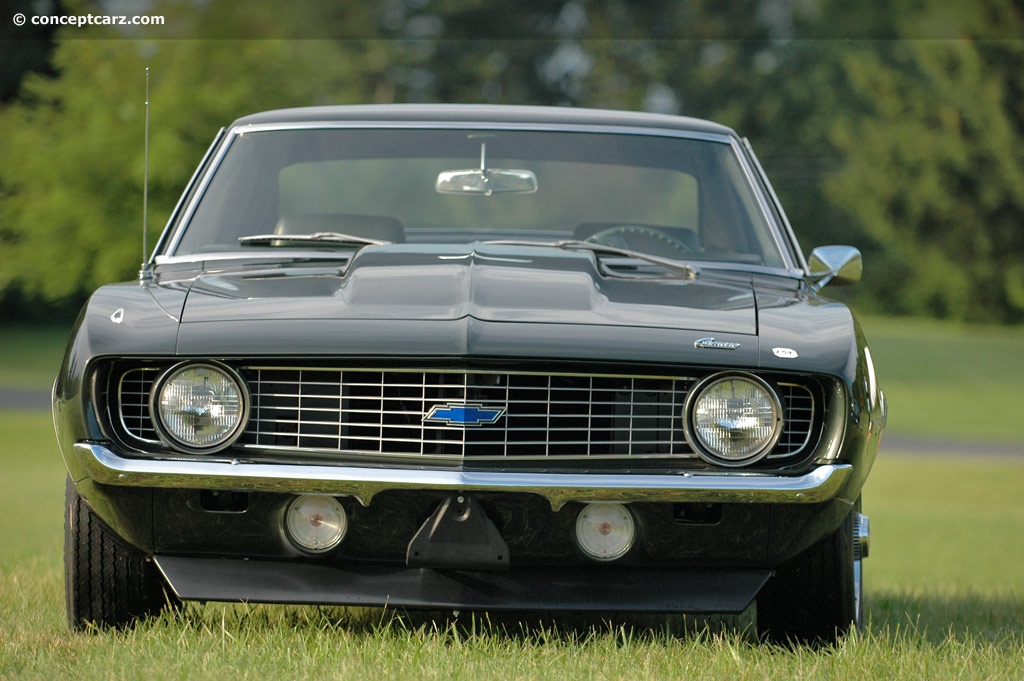
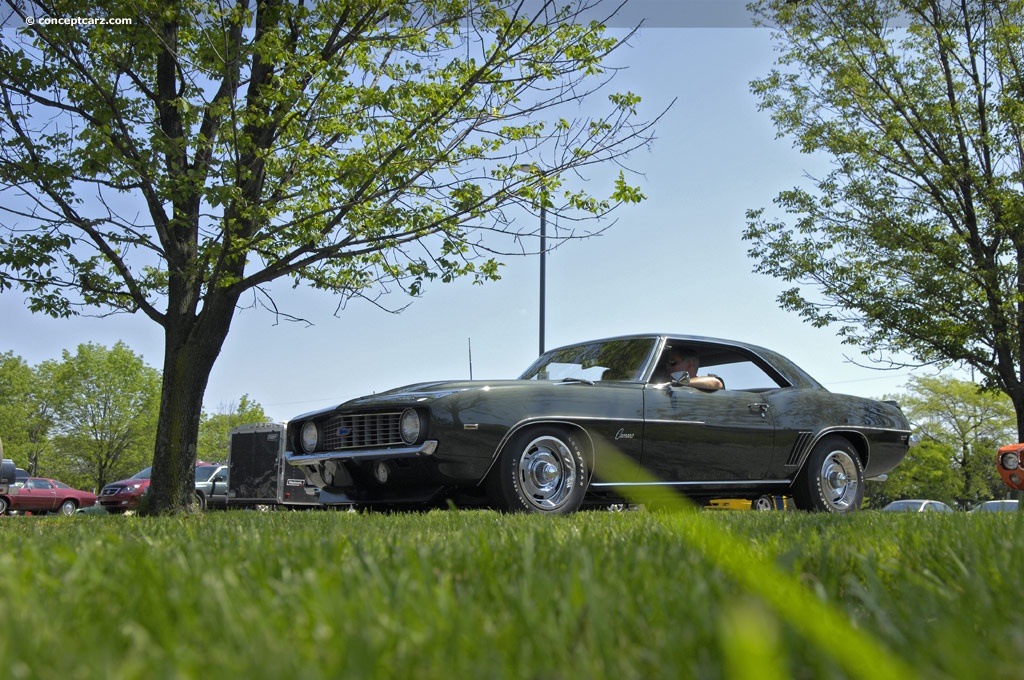
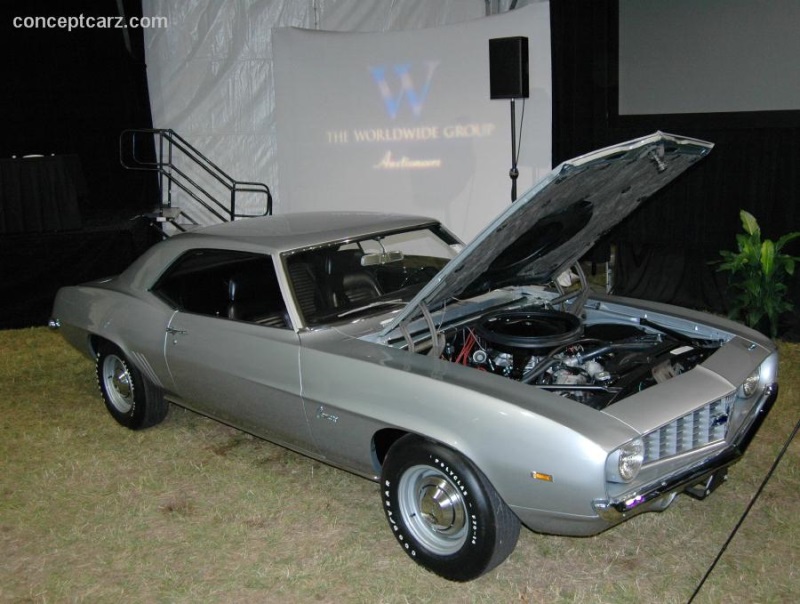
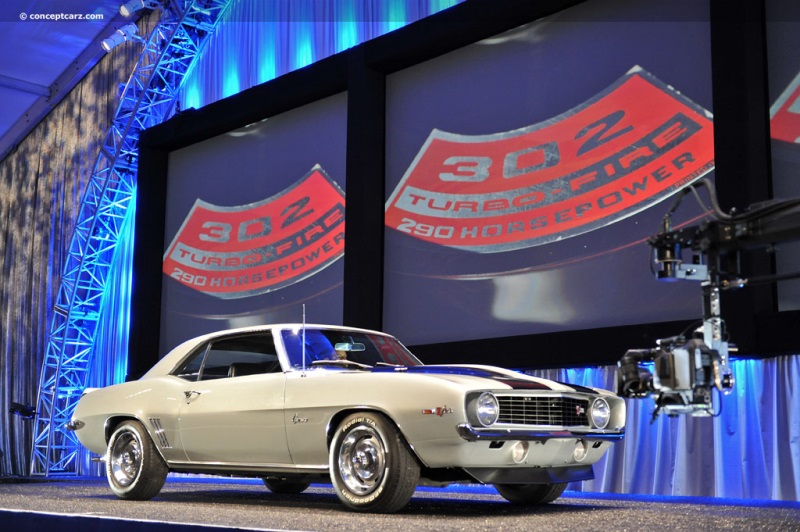
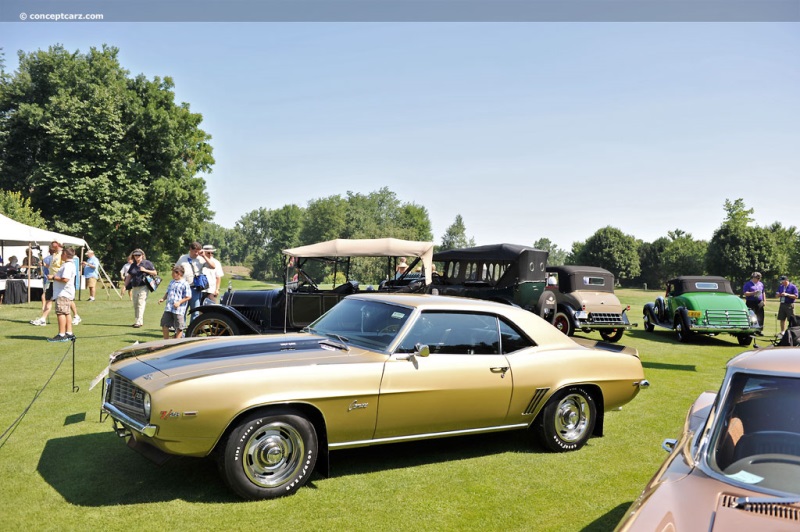
The 1969 Chevrolet Camaro ZL-1 427 Coupe finished in Cortez Silver paint was offered for sale at the 2006 Worldwide Group Auction held on Hilton Head Island. It is COPO Code 9560 order and one of the 13 cars sold by Fred Gibb Chevrolet. It's first owner was Tom Rose of Warren, Ohio who kept the car six months before selling it to Dick Harrell, also known as 'Mr. Chevrolet'. The engine was removed from the car and used in racing endeavors. At Bristol the original engine was destroyed in Dick's 1970 Pro Stock Camaro. Later, a replacement aluminum block engine was re-installed back into the Camaro and has since been re-certified by Ed Cunneen, president of the COPO Connection.
This car is equipped with disc brakes, M40 Turbo Hydramatic transmission, black interior, heavy duty radiator, electronic ignition, heavy duty suspension with 12 bolt rear with 4.10 gears, dual exhaust and cowl induction hood.
At the conclusion of the auction, this ultimate muscle car was left unsold.
![]() | ![]() | View more photos Hardtop Sport Coupe Chassis Num: 124379L508806 |
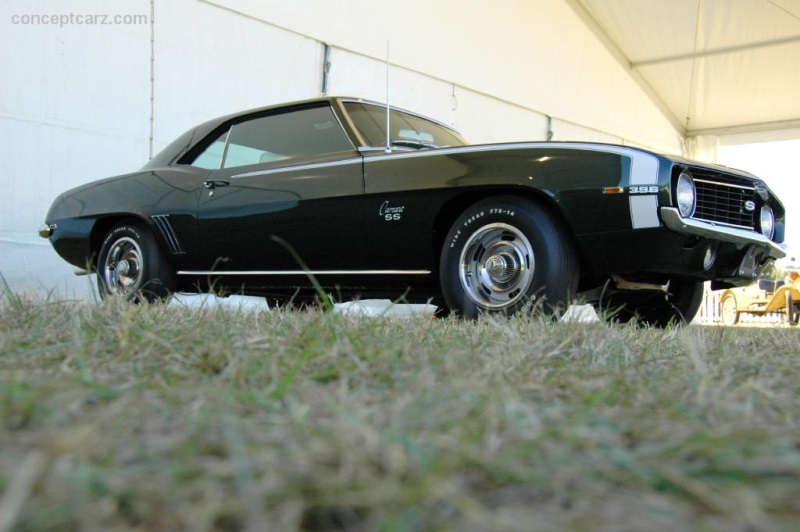
The success with the Camaro in SCCA Trans-Am racing inspired many enthusiasts to by the race-inspired Z/28 option package. In total, over 20,000 were sold. The Regular Production Order L78 option cost an additional $316 and just over 4,000 buyers purchased this option. The L78 '396 Turbo Jet' featured a Holley four-barrel carburetor and a high rise aluminum intake manifold which replaced the Rochester unit. The engine was rated at 375 horsepower and 415 foot-pounds of torque.
At the conclusion of the auction, the vehicle was left unsold.
For the 1970 Trans-Am series, the car was sold to Roy Woods of American Racing associates and itw as driven by Milt Minter.
![]() | ![]() | View more photos Hardtop Sport Coupe Chassis Num: 124379N607652 |
At auction, the car was sold, selling for $82,500.
![]() | ![]() | View more photos Hardtop Sport Coupe |
It is seen here at the 2007 Eastern Concours of the United States.
![]() | ![]() | Hardtop Sport Coupe |
Chevrolet introduced the Camaro in the fall of 1966 as a competitor to the Mustang, which had a 2.5-year head start. Previously, Chevrolet felt the Corvair would be the little runabout that would satisfy the need for a Mustang competitor, but they were proven wrong. The Camaro, like the Mustang, could be all things to all people.
The 1967 Camaro with the optional 302 engine (RPO Z28) was built to certify the engine for Trans Am racing. Visually, it could be identified by the two band-aid stripes along the top of the car. In its first year, only 602 people ordered this subtle package, but by 1968, over 7,000 people ordered one. In mid-year 1968, Chevrolet started to replace the 302 badges with Z/28 badges, proof that 'Z/28 performance package' had a certain ring to enthusiasts.
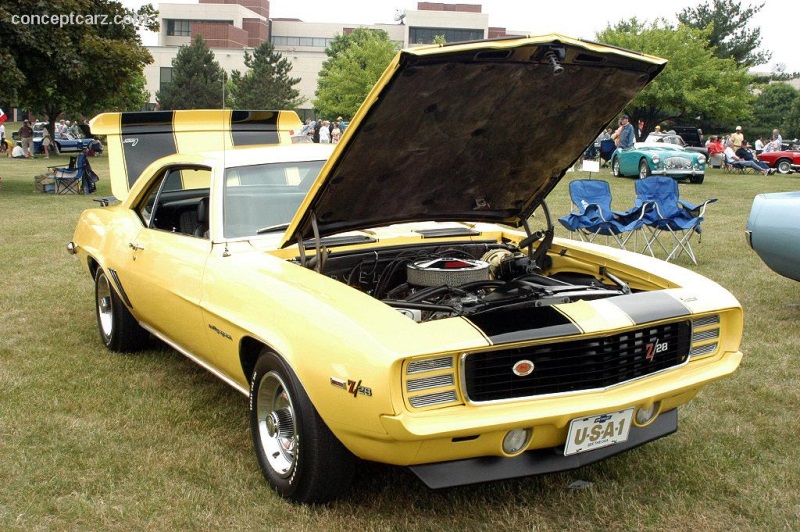
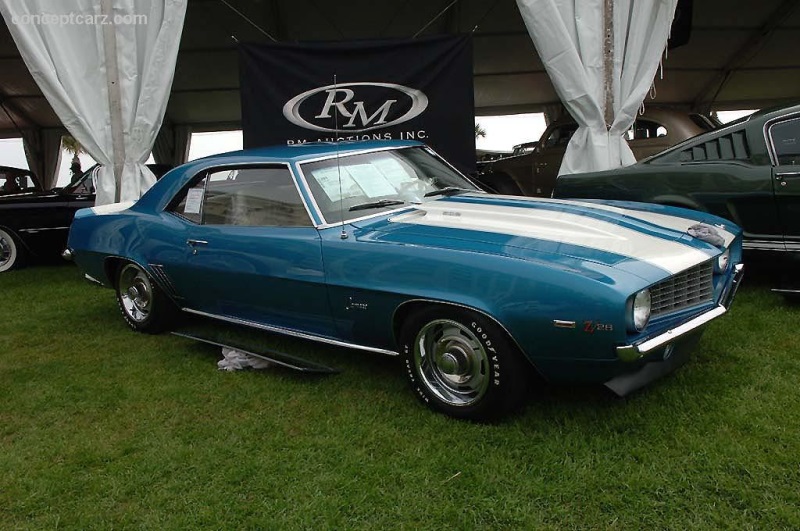
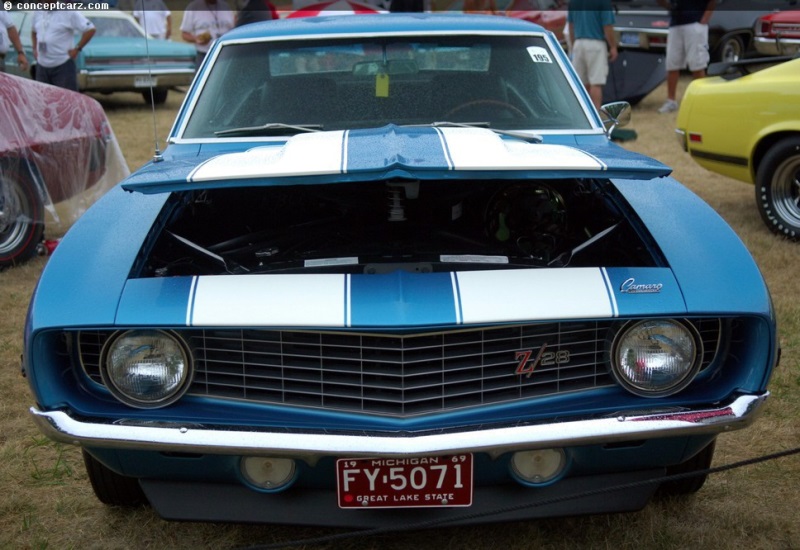
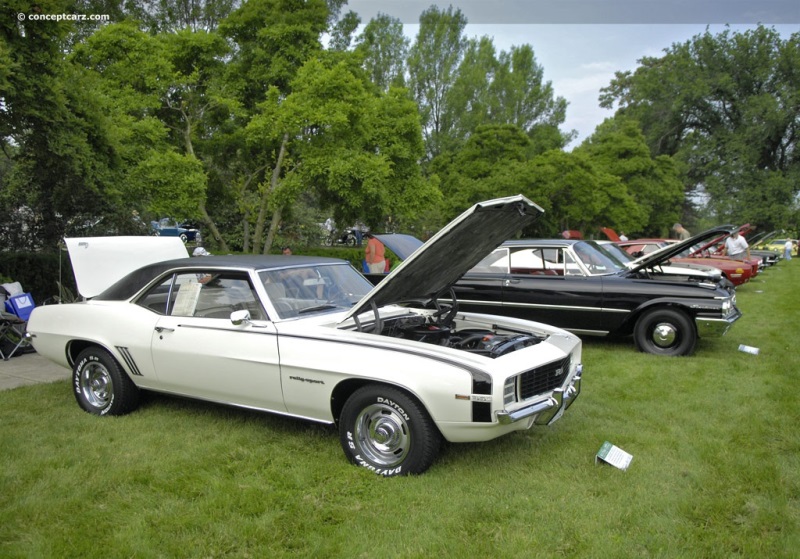
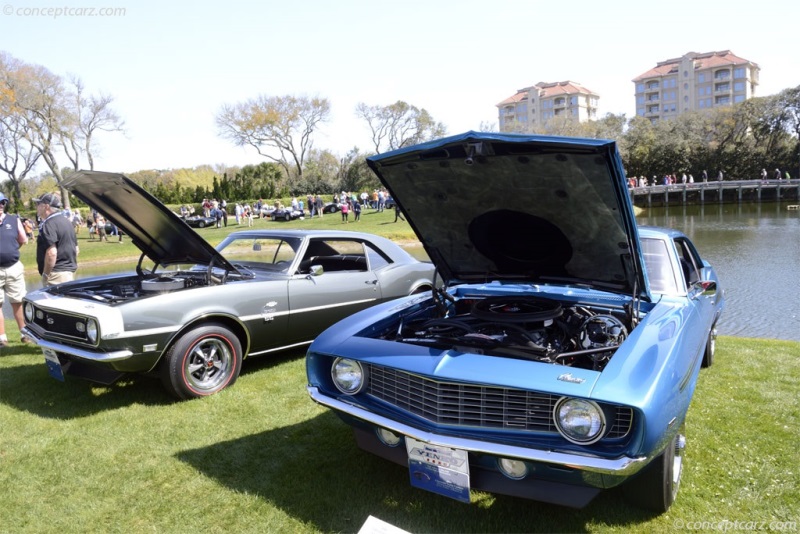
For 1969, Chevrolet sold over 20,000 Z/28's. It is also the most popular version of the car today. The Z/28 shown, owned by the same owner since 1985, is the desirable LeMans Blue with white stripes. It is equipped with the Rally Sport package, which most notably included hidden headlights. It also has the standard black interior, but it is optioned out with AM/FM radio, cowl induction hood, and rosewood steering wheel. It stickered for $4,146.60 when new.
![]() | ![]() | Hardtop Sport Coupe Chassis Num: 124379N594557 |
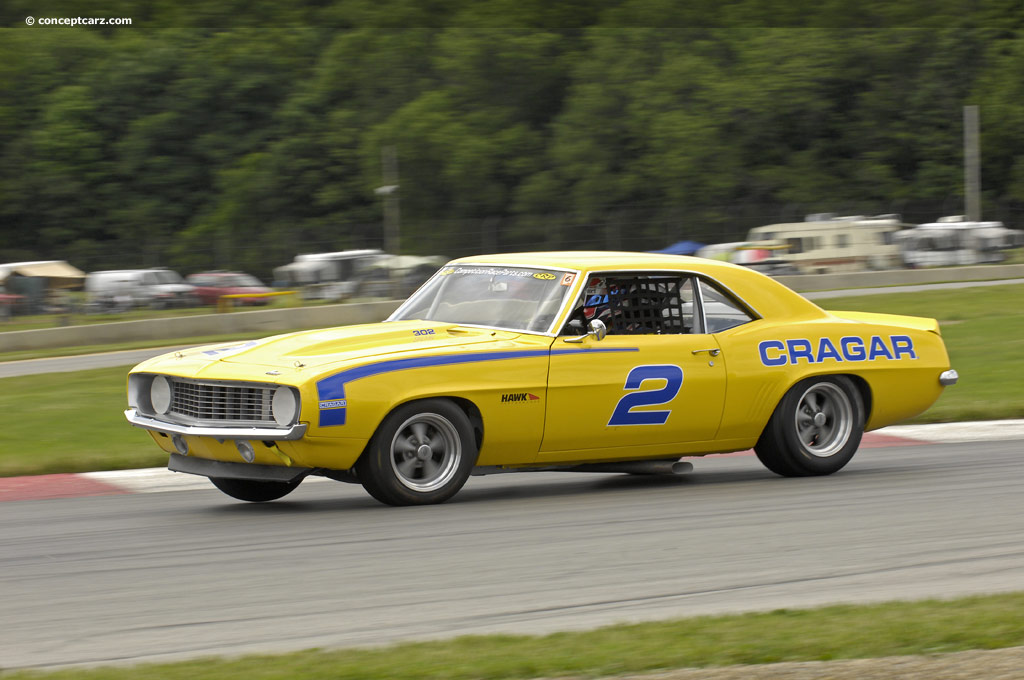
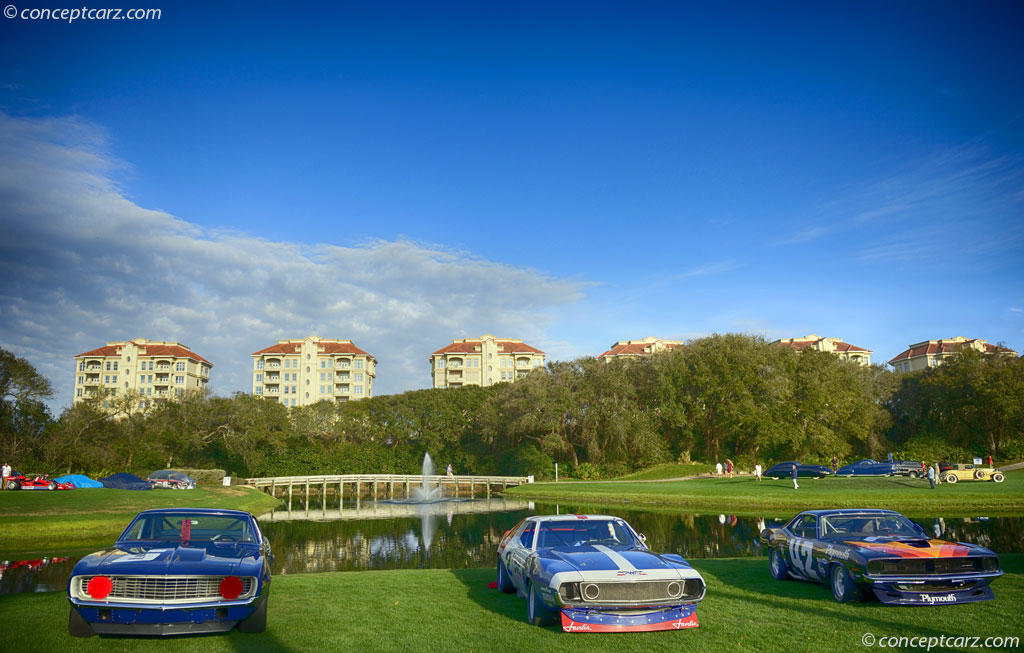
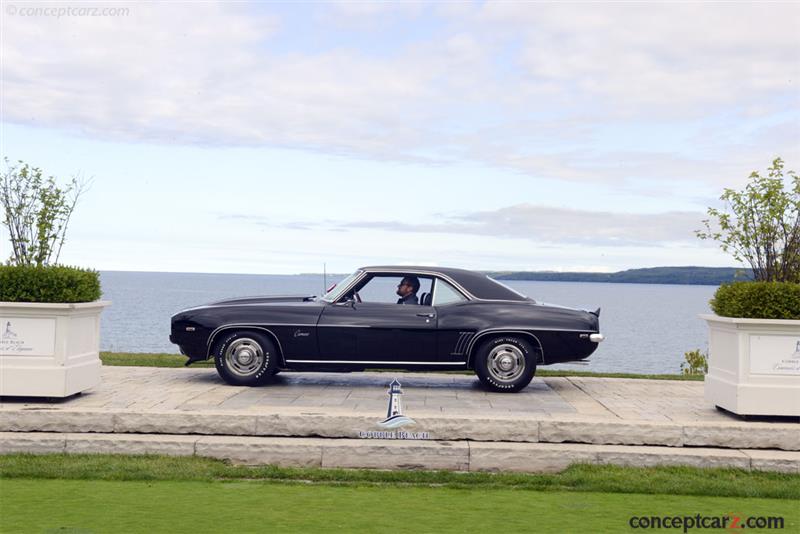
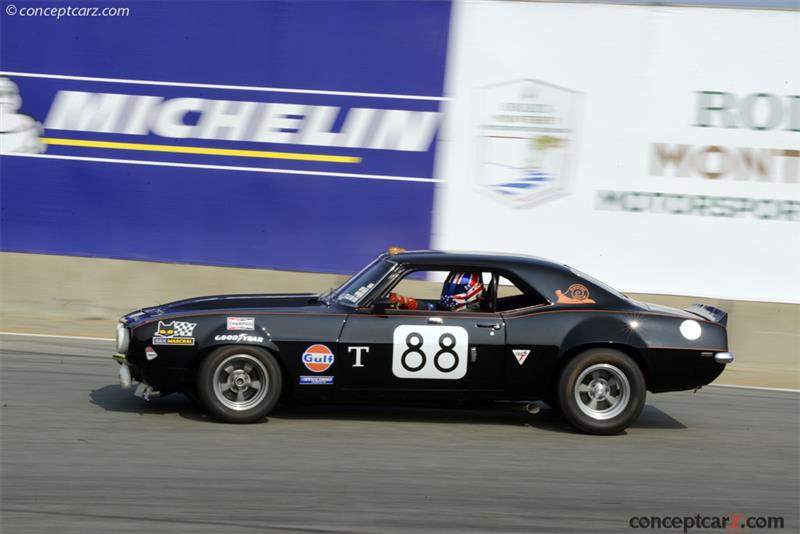
The Trans Am Series made famous racing greats, which made it a competitive racing series and one that was difficult for the average 'Joe' to compete with considerable amounts of success. In 1970, four Miami Region SCCA enthusiasts teamed up to battle these racing greats. The four individuals were auto parts salesman John Maynard, mechanic Pete Flanagan, office machine technician Ed O'Conner, and John Oliver who owned a 1969 Z28 Camaro.
Converting the Camaro into a FIA Group 4 racer took nearly a year and considerable amounts of financial resources. The car was given the required safety requirements, all of its street equipment removed, the engine tuned, a heavy duty suspension fitted, braking system improved, and various other necessary improvements.
The car was entered in the 24 Hours of Daytona where it qualified well and soon earned itself international fame. The fame was not intentional, as it was involved in the first crash of the race. A major media publication published the caption 'FIRST CRASH – A contact incident came early in the 24 Hours of Daytona when the No. 3 Martini & Rossi Porsche spun in the path of the Oliver/Maynard/Dobkin Camaro in Turn Two of the 3.81 mile circuit. Both cars continued but the Porsche had to stop for suspension repairs'. Twenty-three hours later, the S-CAR-GO was listed as 'not running' due to mechanical failure and listed as a mid-pack finisher.
The car was repaired, painted in black, riding on new magnesium racing wheels, and wearing the number 88. It was entered in the 12 Hours of Sebring and ran well for the first six hours of the race. It was running near the leaders in the Touring Class when the Franklin rear end disintegrated and forced a premature retirement. They had completed 131 laps and were given 35th overall, which was good enough to beat out Mario Andretti, Jackie Ickx, Sam Posey and Masten Gregory.
The Z-28 Camaro would return to regional SCCA competition as the cost of racing in the national spotlight was too much. The car was later sold to Roberto 'Cowboy' Gonzales who used it in Mexico in nearby SCCA 'A' Sedan events. The current owner purchased the car in 1999 and treated it to a thorough and authentic restoration back to its Daytona race livery and mechanical configuration. It was brought to the 2007 Monterey Sports & Classic Car Auction presented by RM Auctions, where it had an estimated value of $85,000 - $125,000. It was offered without reserve. As the gavel fell, the lot had been sold for $85,250 including buyer's premium.
![]() | ![]() | Hardtop Sport Coupe |
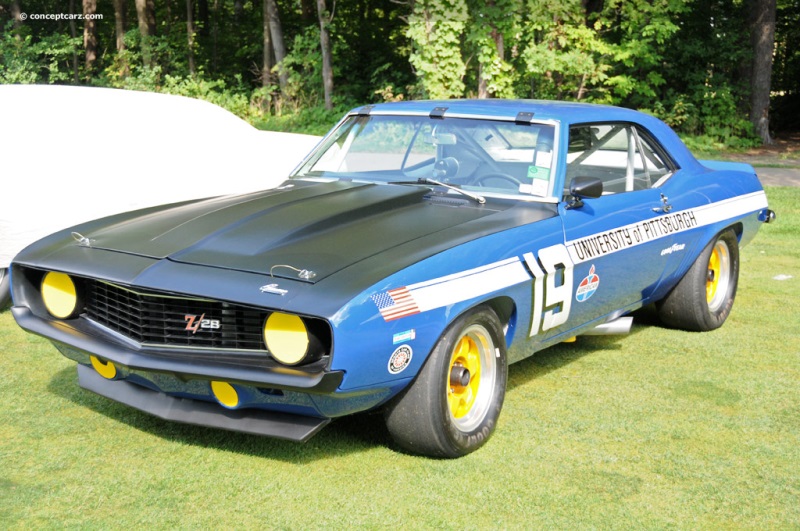
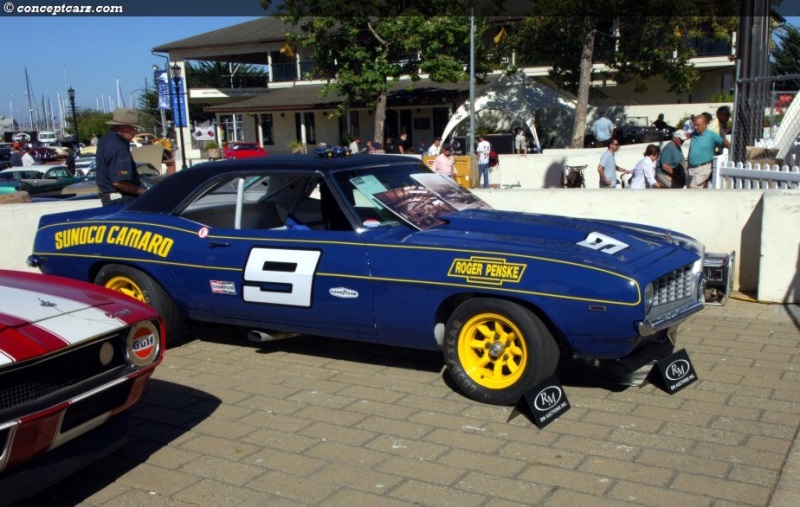
In 1969, the Sunoco-sponsored Roger Penske Camaro was driven by the legendary Mark Donohue and had a fantastic season winning eighteen out of twenty-five races.
This vehicle is a tribute, built to the same specifications as the original and created using the same techniques such as forming the body panels on an English wheel. It is finished in the authentic Sunoco/Penske racing blue with a black vinyl top and bright yellow racing wheels.
It was brought to the 2007 Monterey Sports & Classic Car Auction presented by RM Auctions, where it had an estimated value of $100,000-$150,000. It was offered without reserve and sold for $71,500 including buyer's premium.
![]() | ![]() | View more photos Hardtop Sport Coupe |
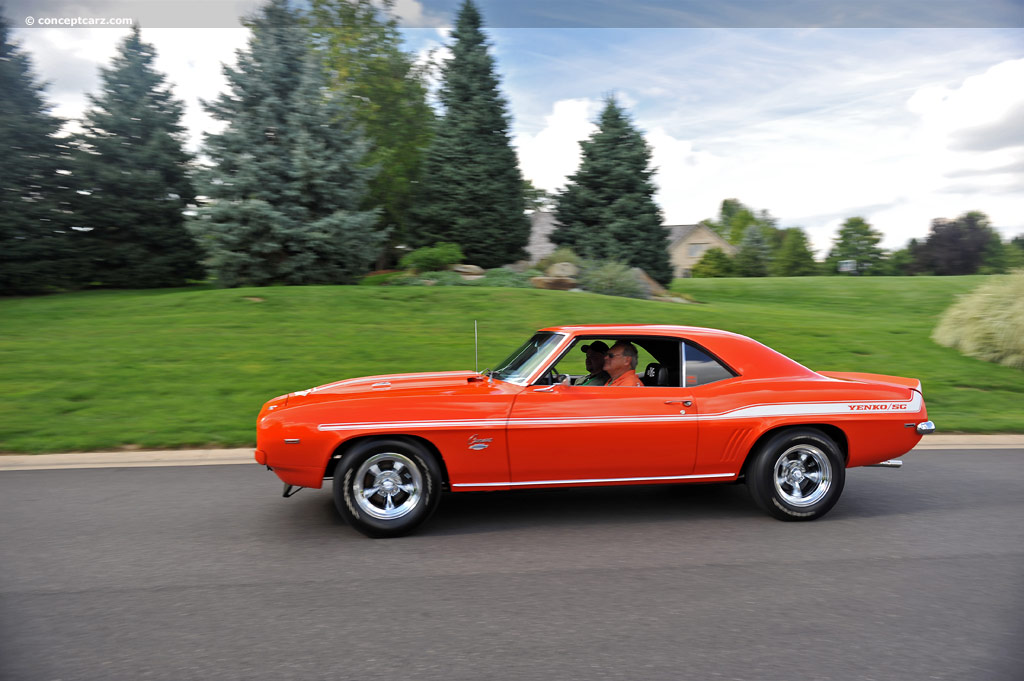
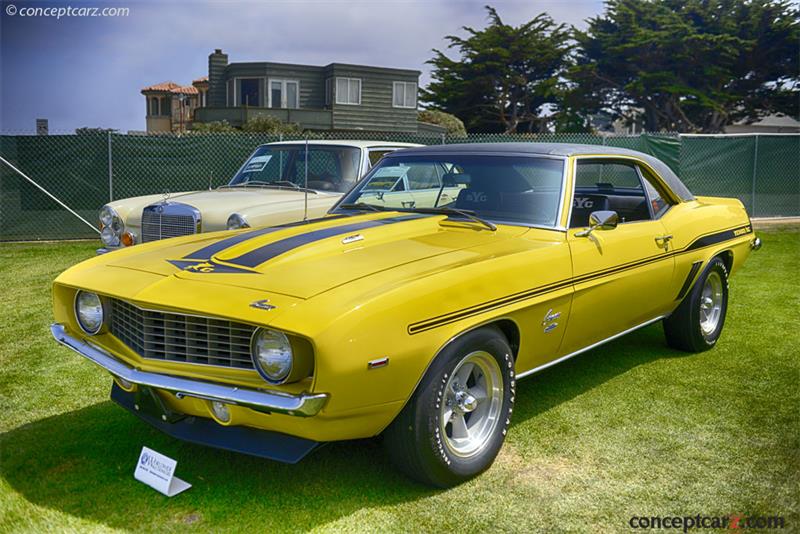
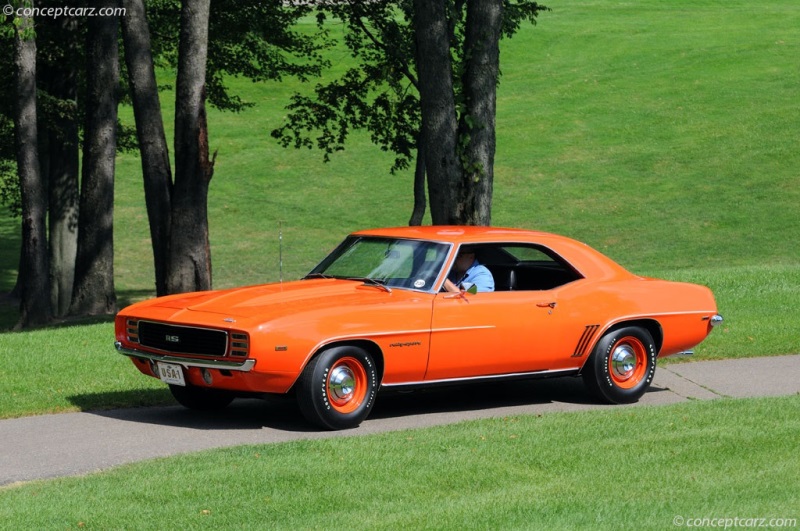
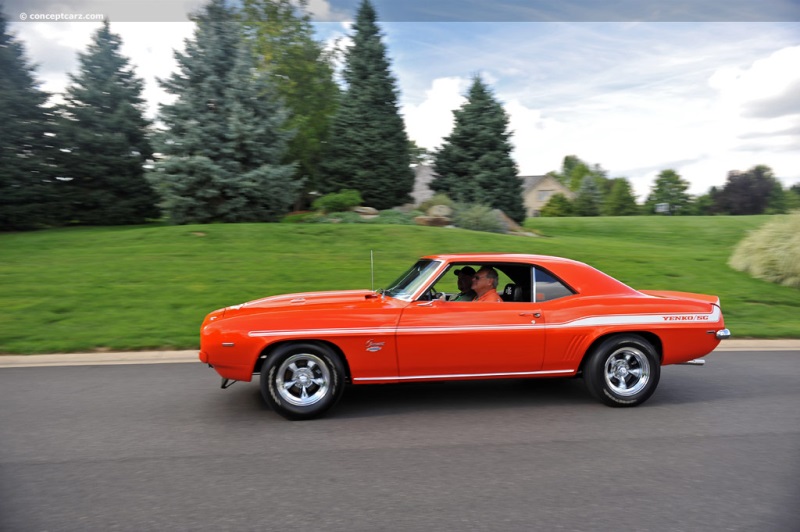
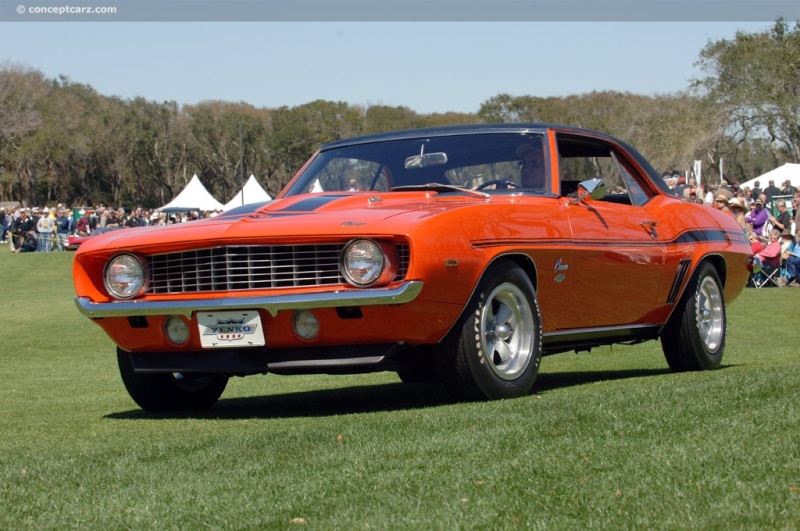
This car was sold directly by the Yenko Chevrolet dealership in Canonsburg, PA.
![]() | Hardtop Sport Coupe Chassis Num: 124379N554308 Engine Num: T2219MN |
In 2007 this Two-door hardtop was brought to Bonhams auction, An Important Sale of Collectors' Motorcars and Automobilia, at the Quail Lodge Resort & Golf Club in Carmel, California. It was offered without reserve and sold for $80,000 plus premium and taxes.
![]() | Hardtop Sport Coupe Chassis Num: 124379N657861 Engine Num: T0513MN |
The COPO program was intended for fleet orders, such as for police cars, low-powered strippers for meter readers, and fleets of taxi-cabs. They were non-standard cars with Regular Production Order parts. A few dealers used the COPO order system rather differently than for mere fleet cars - they saw an opportunity to offer high-performance machines to their customers.
The most common was the COPO 9561 which had the 427 cubic-inch, Mark IV, big-block, V8 engine. The biggest RPO engine was the L89 396/375 HP aluminum head big block. It is estimated that only 822 examples were built with 40speeds plus another 193 with automatics.
The COPO 9561 also included the ZL2 cowl induction hood, L78 cowl induction air cleaner, heavy duty springs, 12-bolt Positraction rear axle with 4.1:1 gears, heavy duty radiator, and no external markings.
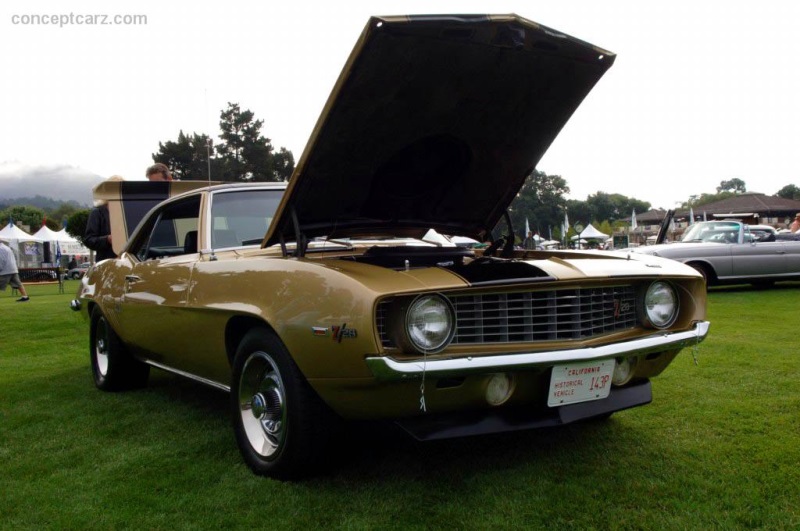
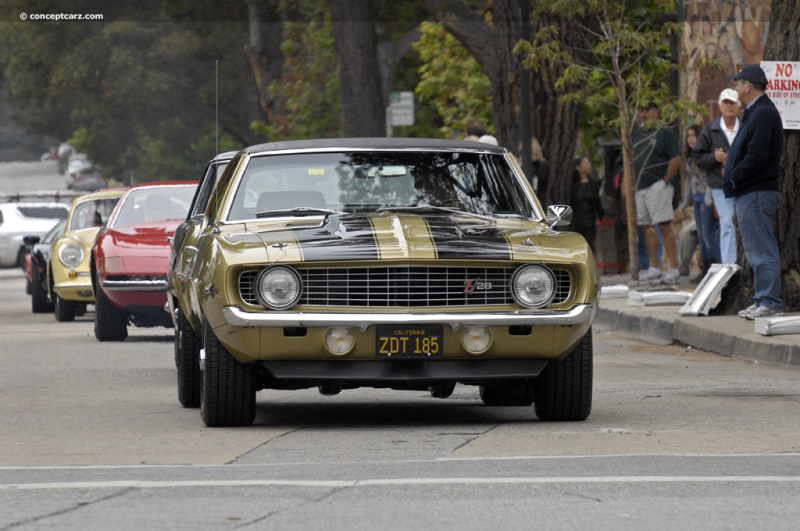
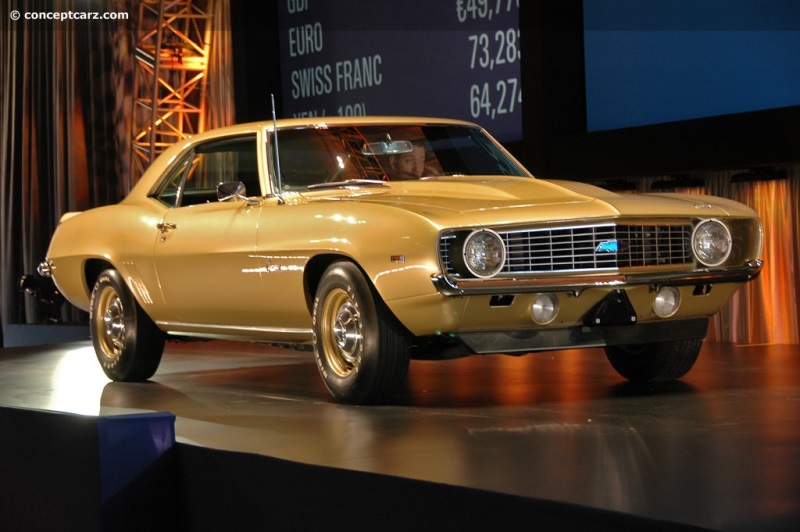
This car has the M21 close ratio four-speed gearbox, power disc brakes, radio, heater, and plain steel wheels with dog dish hubcaps. It is painted in Olympic Gold with Dark Green vinyl interior.
Clements, the original owner of this car, immediately bored out the engine by .030 to maximize the displacement. He used it as a drag racer and ran in the high 11s at Indianapolis. When he sold it in 1978, the car had traveled a mere 16,000 miles. The second owner was Barry Allen who removed the original engine and replaced it with a 427 crate motor. In 1982 he restored it and later sold it, with the crate engine installed and the original engine still boxed, to the third owner, Tony Begley of Northern Illinois Classic Auto Brokers in 1999. They quickly resold it to Steve Stange.
The current owner purchased the car in July of 2000 and performed mild restoration, detailing, and mechanical work.
In 2007 this Two-door hardtop was brought to Bonhams auction where it sold for $175,000 plus premium and taxes. There was another 427 Camaro of the same year, but it was not confirmed to be an original and it sold for around half the price of this car. Both were in great condition, the only differences being this one could be verified as an original COPO.
![]() | Convertible |
![]() | ![]() | View more photos Hardtop Sport Coupe |
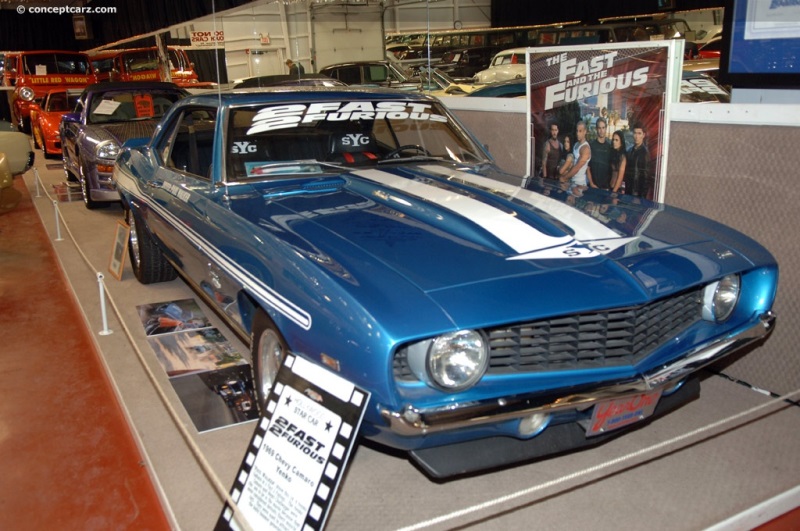
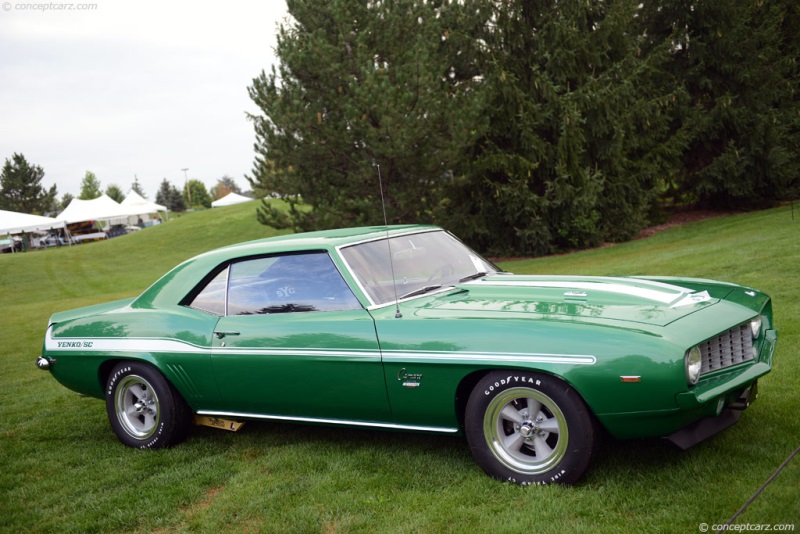
This 1969 Chevy Camaro Yenko was driven by Paul Walker in the movie '2 Fast 2 Furious.' The Yenko Camaro and Hemi Challenger were chosen to be in the movie because they were considered Detroit's finest muscle cars. They were used to attract the baby boomer generation.
![]() | ![]() | View more photos Convertible |
![]() | ![]() | Hardtop Sport Coupe |
A 427 was in the Chevy engine roster and could be ordered in the big Biscayne/Bel Air/Impala/Caprice and the Corvette. Bug GM's edict banning sponsorship of racing, as well as a policy limiting the hp/weight ratio for all cars except Corvettes, prevented the 427's installation in the Camaro. However, by 1969, fierce competition was slighting Chevy's reputation and sales. What to do? Enter the COPO System!
The Central Office Production Order system permitted small batches of specially equipped cars, such as those for local utilities, to be built. Someone figured out that it could also be used to produce cars that weren't normally allowed due to corporate restrictions - such as a 427-powered Camaro.
A special Corvette L88 427 with weight-saving cast-aluminum block was offered as a Camaro COPO. Coded ZL-1, the aluminum engine alone cost $4,000. As few racers could spend money on a car costing twice as much as the average muscle car - and with a less costly cast-iron COPO 425/427 also available, only 69 ZL-1 Camaros were built. All were 'base' Camaros; the plain exterior belies the car's true nature. The ZL-1 was rated at 430 horsepower, but headers raised output to a rumored 560 horsepower, making it the most powerful Camaro ever.
![]() | Convertible |
This car is one of eleven believed to have been built. It is one of five known to exist today. It has been kept in storage since the mid-1980s. It has its original matching number engine with correct date codes. It is the rarest of all production Camaros built and was treated to a 14 month frame-off restoration.
![]() | ![]() | Hardtop Sport Coupe Chassis Num: 124379N698336 |
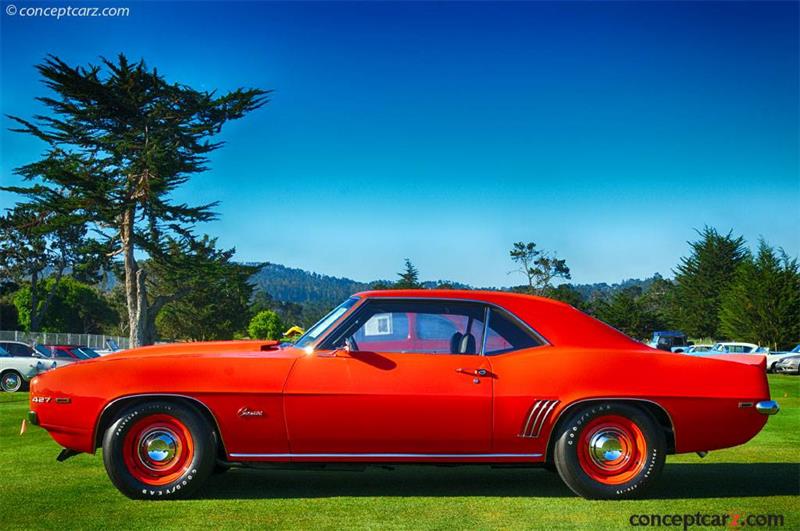
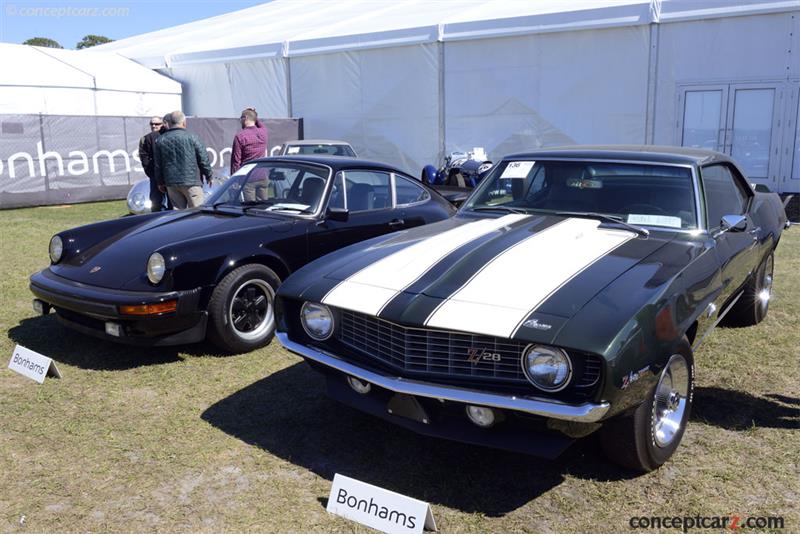
The Z28 package included a de-stroked 327 cubic-inch Chevy small-block engine, resulting in 302 cubic-inches of displacement. There were three cylinder heads and an aluminum intake manifold mounted a Holley four-barrel carburetor. The engine was rated at 290 horsepower, though in reality it was good for 350 to 400 horsepower. Other items in this option package included quicker steering, performance suspension, and power front disc brakes. A 'cross-ram' intake manifold was available which added an additional 50 horsepower to the engine.
By 1969, over 20,000 examples of the Z28 Camaro had been produced. 1969 was a big year for the Camaro, as it won the Trans-Am series and this would be the final year for hte first generation Camaro bodies.
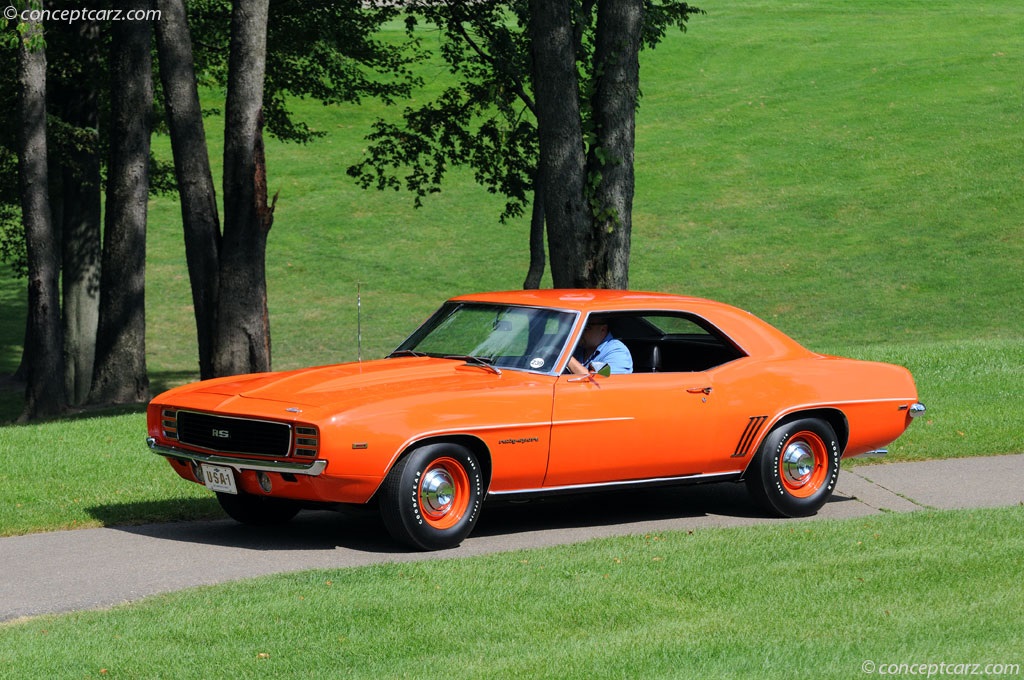
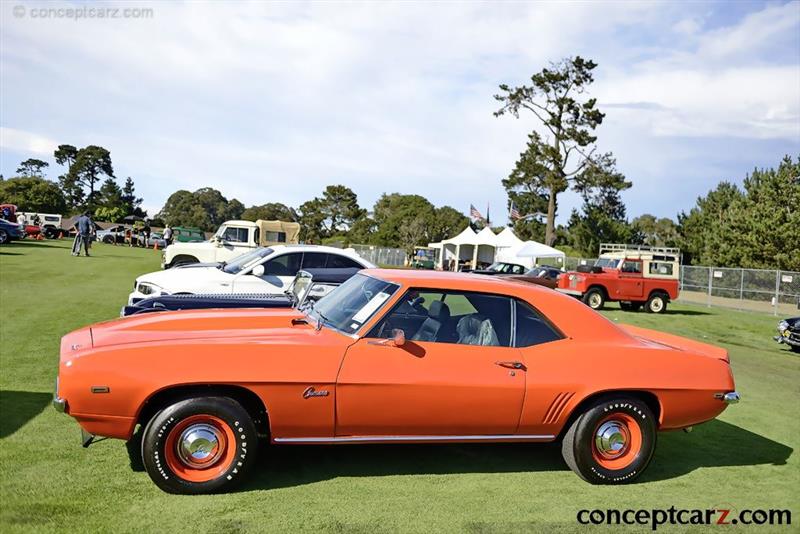
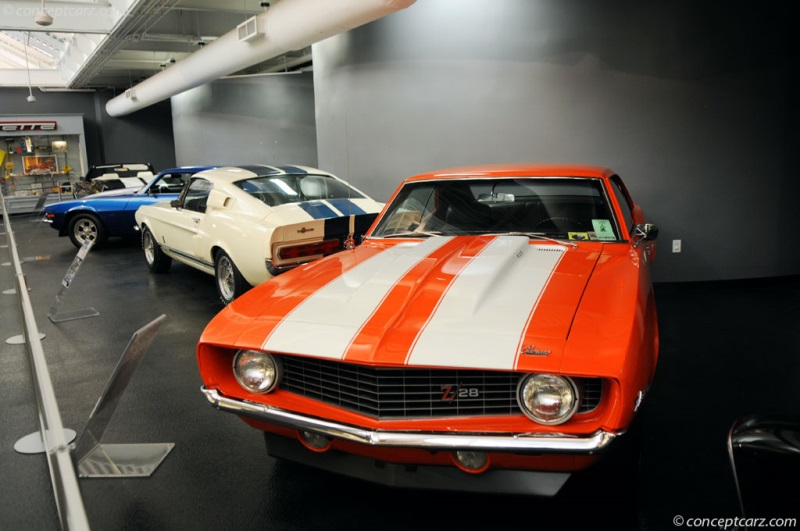
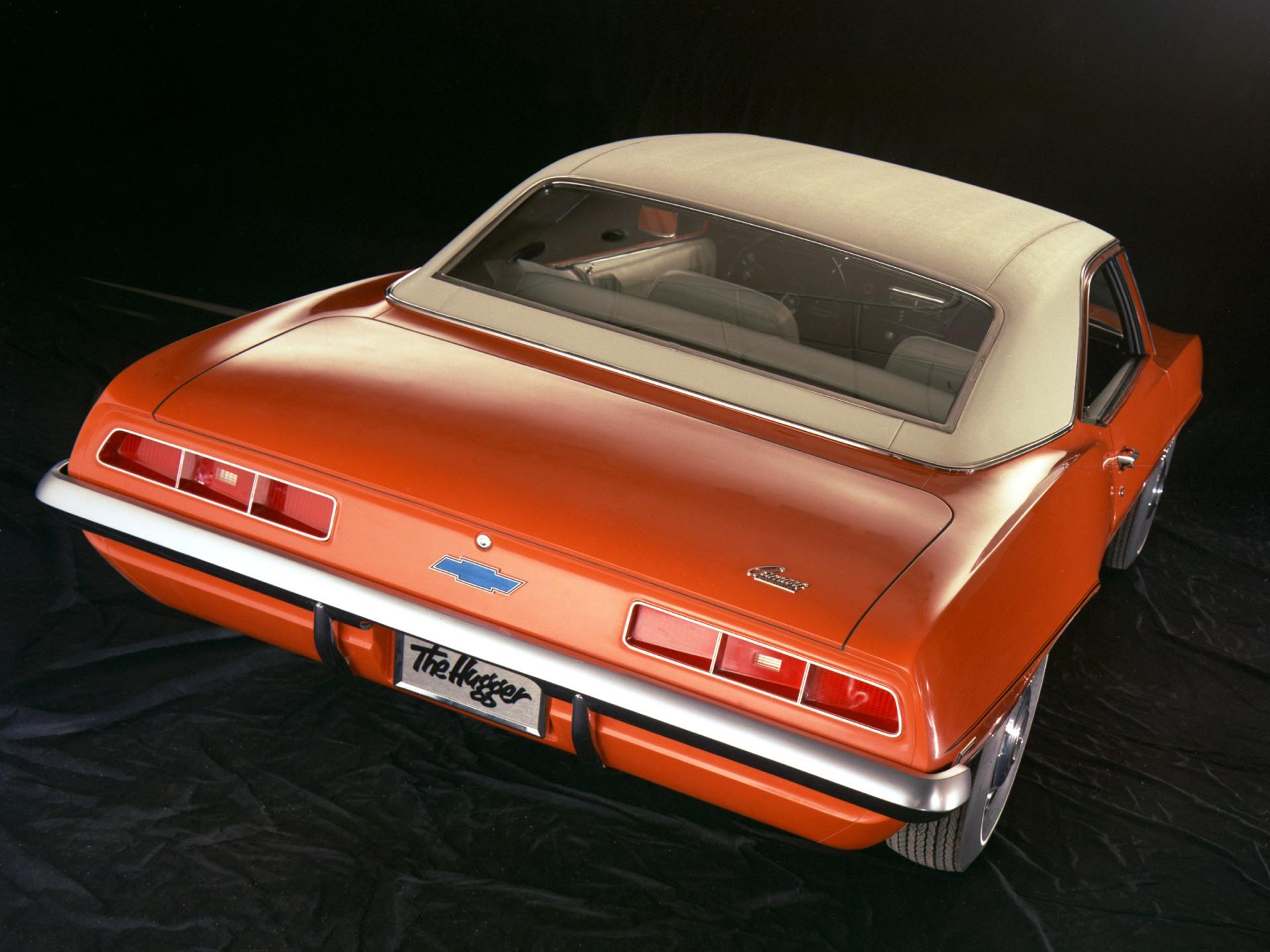
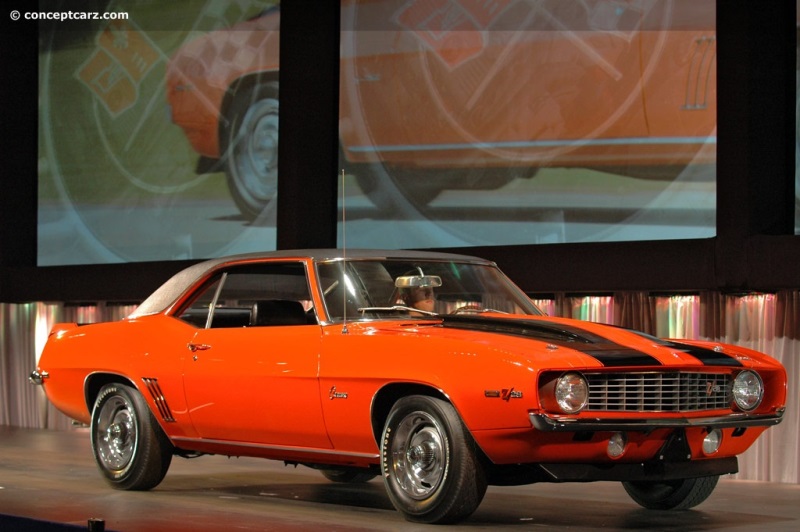
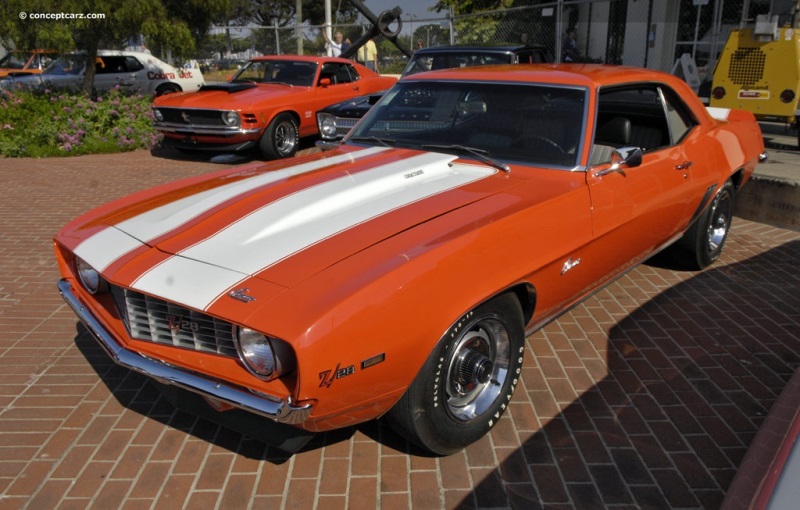
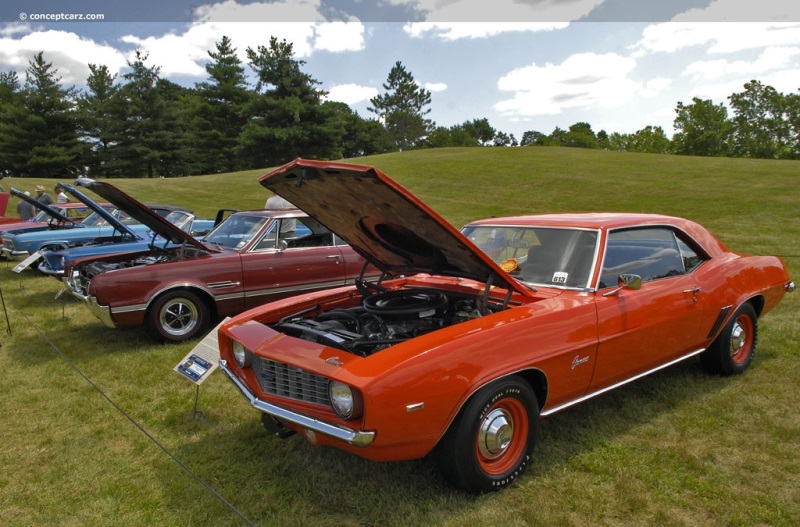
This particular 1969 Chevrolet Camaro Z28 has been given a complete, no expense spared restoration. It is painted in Hugger Orange with white stripes and there is a functional cowl induction hood and a rear spoiler. It was built at the Norwood, Ohio GM Assembly Plant and was fitted with many desirable performance options such as the DZ code 302 cubic-inch V8 engine with a cross-ram intake manifold. There is a Hurst-shifted close-ratio Muncie four-speed manual transmission. In the front there is a factory-equipped, lightweight fiberglass hood. The power from the engine is handled by a 12-bolt Posi-Traction rear end assembly, and sent to a set of period correct Goodyear Polyglas tires riding on rally wheels. To keep the car in the driver's control, there is a set of RPO JL8 rear disc brakes.
Inside there is hounds-tooth upholstery, black dash with wood grain trim, and a three-spoke steering wheel. Also, there is a power steering with tilt column, power brakes, an 8,000 RPM tachometer, floor console, and radio delete.
This Camaro Z28 has been featured on the July 2005 cover of Hot Rod magazine. In 2008, this vehicle was offered for sale at the 'Sports & Classics of Monterey' presented by RM Auctions. It had an estimated value of $40,000 - $60,000 and offered without reserve. The lot was sold for a high bid of $33,500, including buyer's premium.
![]() | ![]() | Hardtop Sport Coupe Chassis Num: 124379N644001 Engine Num: KM V4201DZ |
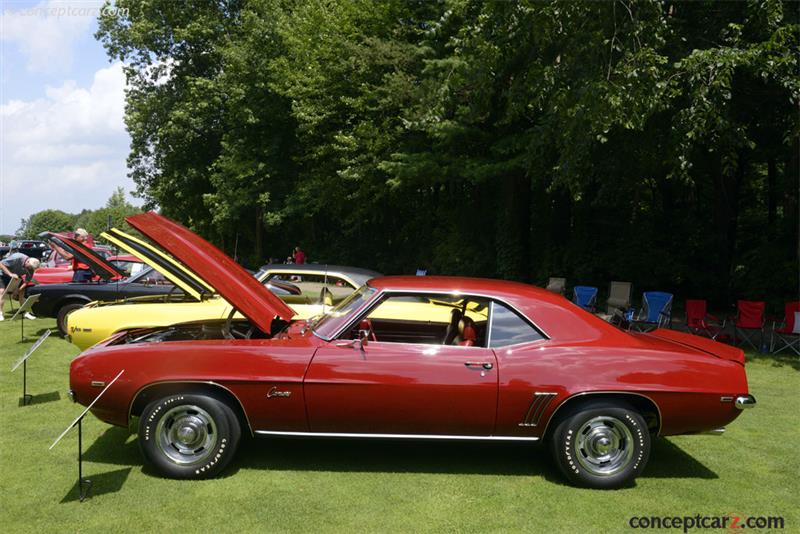
It is believed that just 56 customers ordered a Z/28 with the JL8 package that included Corvette two-piston calibers on the rear and rear, stronger axle shafts and bigger rear-axle bearings. This made the muscle car a car that could corner and stop in true performance fashion.
This Camaro Z/28 Sport Coupe was originally owned by Eliseo Lucarelli of Bradford, PA. It came equipped with the JL8 Package and the Cross Ram intake with dual quads, and lightweight fiberglass hood. It was later purchased by Ed Cuneen who later sold it to Otis Chandler. While in Chandler's collection, the car was featured in Randy Leffingwell's book American Muscle: Muscle Cars From The Otis Chandler Collection.
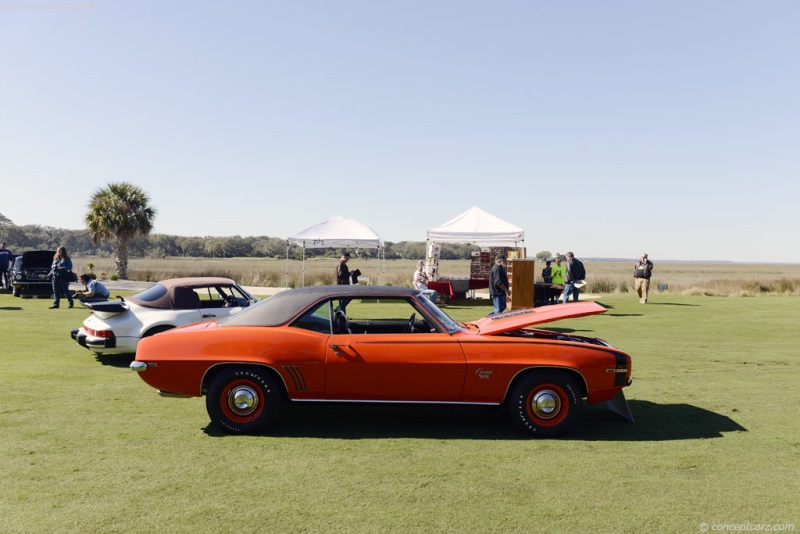
The next owner was Jay R. Miller and then Thomas Kunde before coming into the collection of the current owner. The car is currently finished in the classic combination of Hugger Orange with black racing stripes and vinyl top over a black interior. The car is still equipped with the original air-pump smog equipment, Rally wheels, console gauges, push-button radio and rare fiberglass hood. The odometer displays only 32,000 miles.
In 2009, this documented JL8, Cross-Ram, Dual-Quad Z/28 was offered for sale at the Gooding & Company auction in Scottsdale, Arizona where it was estimated to sell for $100,000 - $120,000. The lot was sold for the sum of $115,500 including buyer's premium.
![]() | ![]() | View more photos Hardtop Sport Coupe |
![]() | Hardtop Sport Coupe |
The Chevrolet Camaro was introduced in 1967 as a compact car specifically built to provide competition for the highly popular Ford Mustang. This pony car was built atop of the same F-Body platform as the Pontiac Firebird, which had a similar production lifespan of 1967 through 2002.
During the preproduction stages of the Chevrolet Camaro, General Motors codenamed the vehicle 'Panther'. The name 'Camaro' was decided upon before production began. The word 'Camaro' in French is slang for 'friend' but in pony-car slang, the name means 'Mustang killer'.
During its production lifespan, there were four generations produced. The first generation lasted from 1967 through 1969. The second generation lasted from 1972 through 1981. The third generation lasted from 1982 through 1992. The fourth generation lasted from 1993 through 2002. The fifth generation is believed to begin production in 2007; a concept was shown at the 2006 Detroit Auto Show.
When the car was introduced in 1967, it was available in two bodystyles, a coupe and convertible. It shared many mechanics with the Chevrolet Nova and built atop a unibody chassis. The base engine was a 3.7 liter inline-six cylinder capable of producing 140 horsepower. Power was sent to the rear wheels courtesy of a Saginaw three-speed manual gearbox. A Muncie four-speed manual and a two-speed PowerGlide automatic were offered as optional equipment. Near the end of 1967, a Turbo Hydra-Matic 350 became available on the SS396. In 1969 the TH350 was offered on the Camaro as optional equipment, in place of the PowerGlide which was no longer offered. 14 inch wheels were standard.
To compete in the pony-car arena, General Motors offered a 5.7 liter eight-cylinder engine in 1967 that produced nearly 300 horsepower.
The Camaro was highly customizable, with over seventy factory and forty dealer options available. the z28 option was not mentioned in the sales literature so many buyers were unaware of its existence. Due to the lack of press about the Z28 option, only 602 examples were produced. The package included many performance enhancements such as a 4.9 liter small-block engine, front disc brakes, Muncie 4-speed gearbox, suspension improvements, 15 inch Rallye wheels, and power steering. The aesthetics of the vehicle were segregated from the other Camaro's with racing stripes being placed on the hood. The Z28 package was offered by GM specifically to comply with the Sports Car Club of America (SCCA) Trans Am racing series that required an engine size of five-liters or less. Also, the vehicle must be sold to the general public.
The SS (Super Sport) package included many performance and aesthetic upgrades and was popular with more than 34400 examples created. Under the hood was a 5.7 liter eight-cylinder engine with a 6.5 liter big-block offered as optional equipment in 1968. On the grille, horn button, and gas cap were SS badging. Non-functional air-inlets adorned the front hood.
The RS (Rally Sport) package was basically a cosmetic upgrade. The headlights were hidden, the taillights received minor alterations, and the exterior rocker trim was revised. RS badging could be seen throughout the vehicle. This was the most popular option ordered in 1967 with over 64840 examples produced.
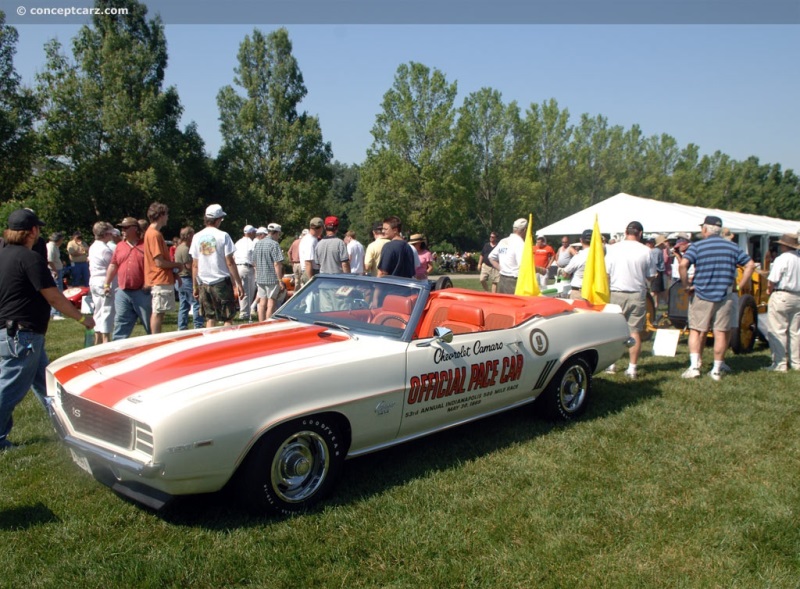
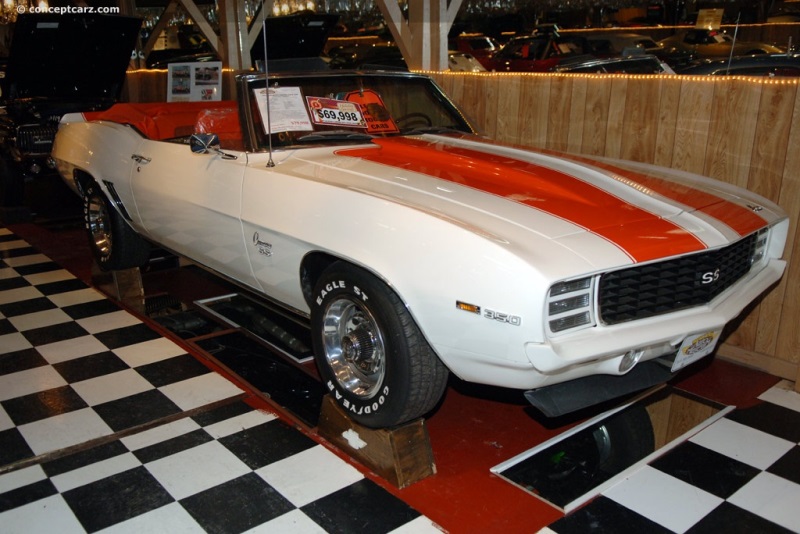
The RS and SS packages could be ordered together, creating the RS/SS Camaro. The combination included both the aesthetics of the RS and the performance of the SS. A Camaro RS/SS convertible with a 6.5 liter engine paced the Indianapolis 500 race in 1967.
With over 220900 examples produced in 1967, the Camaro proved to General Motors that the public was starved for small, performance, pony-cars.
In 1968 the Camaro received minor aesthetic and mechanical improvements. Side market lights were added, the grille became more pointed, and the taillights were now segregated. The side vent windows were removed. Performance was improved slightly by the staggering of the shock absorbers. On some of the models, the single-leafs were replaced by multi-leaf springs.
Buyers became aware of the Z28 package in 1968 and ordered nearly 72000 examples. The RS continued to be the most popular option with 40977 examples produced. The SS accounted for 27884 of the 235147 total Camaro's produced in 1968.
For 1969 the Camaro became safer and faster. General Motors mandated that the Camaro could not come from the factory with engines larger than 6.6 liters. To bypass this rule dealerships such as Yenko Chevrolet, Dana Chevrolet, and Nickey Chevrolet offered the Camaro with the 7 liter, big-block, L-27 corvette engine producing 425 horsepower. These performance options became so popular that in 1969 Chevrolet began offering two Central Office Production Orders (COPO) options, numbers 9560 and 9561. The COPO 9561 option included the L-72 Corvette engine. In total, there were 1015 Camaros equipped with the L-72 Corvette engine.
The COPO 9560 option included a 7-liter, big-block, ZL-1 engine. The engine was constructed of aluminum to help reduce the overall weight. The engine was reported to have produced around 430 gross horsepower but in reality it was closer to 550. With only 69 examples produced it is one of the rarest and fastest of all Chevrolet Camaros.
Most of the 1969 Chevrolet Camaro mechanics remained unchanged. The aesthetics was a different story. The grille was redesigned and the headlights now sat farther back adding to the aggressive features of the car. Newly reshaped door, rear quarter panel, and rear valence gave the 1969 Camaro a smooth, low, and wide stance. The production of the 1969 Camaro, which continued into December of 1969, was the final year for the first generation Camaro.
The second generation Camaro began production near the middle of 1970. The body had been redesigned and the suspension was greatly improved. The rest of the mechanics remained mostly unchanged from the prior years. The biggest change was the base engine, which was now a 4.1 liter inline-six capable of producing 155 horsepower. There was no convertible option offered, only a 2+2 coupe configuration.
The big-block eight-cylinder had been bored to 402 cubic-inches but still retained its 396 badging. The Rally Sport, Super Sport, and Z28 packages were still available. The Z28 now featured a 5.7 liter engine that produced 360 horsepower.
1972 was not a good year for the Camaro. For 174 days production ceased at GM's assembly plant in Ohio due to a UAW strike. This resulted in 1100 Camaro's failing to meet 1973 Federal bumper safety standards. In total, only 68,656 examples were production. Less than a thousand were the SS package so General Motors decided to no longer offer the package after 1972. This meant the big-block 396 cubic-inch engine was no longer offered.
The Camaro, much like the rest of the industry, had to adapt to new government and insurance safety and emission regulations. This meant new safety features like larger bumpers needed to be affixed to the car that could protect the vehicle and its occupants at certain speeds. Engines were detuned to comply with safety and emission concerns. The cars became safer but their performance was seriously crippled. This was true for the Camaro in 1973 when its highest producing engine was a 350 cubic-inch V-8 that produced 245 horsepower.
New for 1973 was an LT option which included impact-absorbing bumpers. The Camaro grew in size in 1974 due to a forward sloping grille and new aluminum bumpers. Rectangular bumpers replaced the round taillight designs. Sales of the Z28 package continued to decline so the decision was made to discontinue the option after 1974.
Horsepower was measured in NET rather than gross rating beginning in 1975. This meant that the reported horsepower was much lower than in prior years. The 350 cubic-inch V8 was now rated at about 155 horsepower.
In 1977 the Z28 was re-introduced in an effort to revitalize the muscle-car persona of the Camaro. The base Camaro's were outfitted with air-conditioning and an automatic transmission. A Borg-Warner Super T-10 four-speed manual gearbox could be ordered as optional equipment.
1978 marked the first year for the T-top option on a Camaro. The Camaro was given larger taillights and new bumpers.
As vehicles became safer, they became slower. The public shifted from wanting performance to luxury. Oil embargos and rising fuel costs had made the engines smaller but more fuel efficient. For 1979 the LT package was replaced with a luxurious Berlinetta that included special wheels, paint, emblems, and interior.
1979 was a very strong year for Camaro sales with 282,571 examples being sold.
1980 and 1981 saw very few changes. The hood scope on the Z-28 was revised to help siphon air to the engine.
In 1981 sales were down considerable to just over 126,000. This would be the final year for the second generation Camaro.
In 1982 General Motors introduced the third generation of the Camaro. The vehicle was stylish and versatile, earning the coveted Motor Trend magazine's Car of the Year. Both aesthetically and mechanically, the vehicle was improved. The suspension was upgraded making it more capable in the corners and at speed.
This was the first year the Camaro was equipped with a factory fuel-injected engine. A four-speed automatic gearbox replaced the three-speed unit. A five-speed manual gearbox was also available. Due to rising concerns of oil shortage, a four-cylinder engine was offered for part of 1982.
6000 examples of the Z28 Camaro were sold to commemorate the return of the pony-car to the Indianapolis 500. The special-edition vehicles were painted in two-tone silver and blue paint with orange pin-striping.
To honor the International Race of Champions, Chevrolet introduced the IROC-Z in 1985. The package included an improved suspension, decal package, and a 305 cubic-inch L98 Tuned Port Injection system borrowed from the Corvette. The IROC-Z was featured on Car and Driver magazine's Ten Best List for 1985.
The L69 small-block engine was offered from 1983 through 1986. The LB9 small-block was introduced in 1985; the L98 small-block was introduced in 1987; the LO3 was introduced in 1988. The LB9, L98, and LO3 stayed in production until 1992.
1992 was the final year for the third generation Camaro. 1993 marked the beginning of the fourth generation which persisted until 2002.
New technology and material made the fourth generation greatly improved over the prior years. Weight was reduced with the use of plastic body panels sitting atop a steel space frame. Performance was increased thanks in part to a better suspension system. In 1993 Chevrolet offered the LT1 eight-cylinder engine, which had been in production for a year on the Corvette, on the Camaro. A six-speed manual gearbox was offered with the LT1 engine.
The Camaro returned to the Indianapolis 500 as the honorary pace car in 1993. To commemorate this historic accomplishment, Chevrolet offered a limited quantity of special edition Camaro's, painted in a black and white color scheme.
The design and mechanics remained mostly unchanged over the next few years. Minor revisions were made to comply with newly introduced emission standards. Mechanical changes were made to correct problems that had been found throughout the years.
In 1996 the RS package and the SS package were re-introduced. The RS was an appearance option for the six-cylinder Camaro's while the SS was both an appearance and performance package for the eight-cylinder cars.
1997 marked the 30th anniversary of the Camaro. A 30th Anniversary Package was offered to honor this accomplishment. The vehicles were painted white with orange stripes. 100 of the Anniversary Camaros were given the LT4 engine with 330 horsepower; a thirty-eight thousand dollar price tag accompanied the vehicle.
The interior of the Camaro was modernized in 1997 and again in 1998, although the 1998 improvements were minor in comparison to what transpired the prior year.
The body design was drastically changed in 1998, mainly in the front. Round headlights replaced the square design. The headlights were flush, inline with the rest of the body. A new grille and bumper were used, both positioned a little differently to mimic the headlight changes. A new powerful, lightweight, all-aluminum LS1 power-plant retired the LT1 unit. The OHV LS1 was borrowed from the Corvette and slightly detuned to produce just over 300 horsepower. To handle this extra power, the disc brakes were enlarged and the suspension was upgraded.
Total production for 1998 was 48490. This was disappointing for General Motors, especially with the newly revised body and powerful options. The lowest production year for the Camaro occurred in 2001 with just over 29000 examples being produced. This was due to low sales and production ceasing early to begin work on the 35th Anniversary 2002 cars.
2002 marked the final year for production of the fifth generation Camaro. The styling and mechanics were unmodified, carrying the same design from 1999.
A special 35th Anniversary Edition was offered and could be ordered on all trim levels and packages. The 35th Anniversary SS Camaro could only be ordered as a convertible or with T-Tops. Around 3000 examples of the 35th Anniversary Edition were created. Total production for the year was just over 42,000.
On August 27th, 2002 production ceased. The Camaro had accomplished its goal, to provide competition for the Ford Mustang and other compact, low-priced, sports cars. Outfitted with large, Corvette engines, matted to effective gearboxes and given great suspension and brakes, the Camaro was truly a performance machine that was capable and fun to drive. It was fairly practical with room for more than two passengers. It was economical with sticker-prices in the range that many could afford. The production of the Camaro has ceased, but its future has not yet been written. Expect to see this legendary vehicle on the roadways in the near future.
For more information and related vehicles, click here© 1998-2009. All rights reserved. This material may not be published, broadcast, rewritten, or redistributed.
During the preproduction stages of the Chevrolet Camaro, General Motors codenamed the vehicle 'Panther'. The name 'Camaro' was decided upon before production began. The word 'Camaro' in French is slang for 'friend' but in pony-car slang, the name means 'Mustang killer'.
During its production lifespan, there were four generations produced. The first generation lasted from 1967 through 1969. The second generation lasted from 1972 through 1981. The third generation lasted from 1982 through 1992. The fourth generation lasted from 1993 through 2002. The fifth generation is believed to begin production in 2007; a concept was shown at the 2006 Detroit Auto Show.
When the car was introduced in 1967, it was available in two bodystyles, a coupe and convertible. It shared many mechanics with the Chevrolet Nova and built atop a unibody chassis. The base engine was a 3.7 liter inline-six cylinder capable of producing 140 horsepower. Power was sent to the rear wheels courtesy of a Saginaw three-speed manual gearbox. A Muncie four-speed manual and a two-speed PowerGlide automatic were offered as optional equipment. Near the end of 1967, a Turbo Hydra-Matic 350 became available on the SS396. In 1969 the TH350 was offered on the Camaro as optional equipment, in place of the PowerGlide which was no longer offered. 14 inch wheels were standard.
To compete in the pony-car arena, General Motors offered a 5.7 liter eight-cylinder engine in 1967 that produced nearly 300 horsepower.
The Camaro was highly customizable, with over seventy factory and forty dealer options available. the z28 option was not mentioned in the sales literature so many buyers were unaware of its existence. Due to the lack of press about the Z28 option, only 602 examples were produced. The package included many performance enhancements such as a 4.9 liter small-block engine, front disc brakes, Muncie 4-speed gearbox, suspension improvements, 15 inch Rallye wheels, and power steering. The aesthetics of the vehicle were segregated from the other Camaro's with racing stripes being placed on the hood. The Z28 package was offered by GM specifically to comply with the Sports Car Club of America (SCCA) Trans Am racing series that required an engine size of five-liters or less. Also, the vehicle must be sold to the general public.
The SS (Super Sport) package included many performance and aesthetic upgrades and was popular with more than 34400 examples created. Under the hood was a 5.7 liter eight-cylinder engine with a 6.5 liter big-block offered as optional equipment in 1968. On the grille, horn button, and gas cap were SS badging. Non-functional air-inlets adorned the front hood.
The RS (Rally Sport) package was basically a cosmetic upgrade. The headlights were hidden, the taillights received minor alterations, and the exterior rocker trim was revised. RS badging could be seen throughout the vehicle. This was the most popular option ordered in 1967 with over 64840 examples produced.
The RS and SS packages could be ordered together, creating the RS/SS Camaro. The combination included both the aesthetics of the RS and the performance of the SS. A Camaro RS/SS convertible with a 6.5 liter engine paced the Indianapolis 500 race in 1967.
With over 220900 examples produced in 1967, the Camaro proved to General Motors that the public was starved for small, performance, pony-cars.
In 1968 the Camaro received minor aesthetic and mechanical improvements. Side market lights were added, the grille became more pointed, and the taillights were now segregated. The side vent windows were removed. Performance was improved slightly by the staggering of the shock absorbers. On some of the models, the single-leafs were replaced by multi-leaf springs.
Buyers became aware of the Z28 package in 1968 and ordered nearly 72000 examples. The RS continued to be the most popular option with 40977 examples produced. The SS accounted for 27884 of the 235147 total Camaro's produced in 1968.
For 1969 the Camaro became safer and faster. General Motors mandated that the Camaro could not come from the factory with engines larger than 6.6 liters. To bypass this rule dealerships such as Yenko Chevrolet, Dana Chevrolet, and Nickey Chevrolet offered the Camaro with the 7 liter, big-block, L-27 corvette engine producing 425 horsepower. These performance options became so popular that in 1969 Chevrolet began offering two Central Office Production Orders (COPO) options, numbers 9560 and 9561. The COPO 9561 option included the L-72 Corvette engine. In total, there were 1015 Camaros equipped with the L-72 Corvette engine.
The COPO 9560 option included a 7-liter, big-block, ZL-1 engine. The engine was constructed of aluminum to help reduce the overall weight. The engine was reported to have produced around 430 gross horsepower but in reality it was closer to 550. With only 69 examples produced it is one of the rarest and fastest of all Chevrolet Camaros.
Most of the 1969 Chevrolet Camaro mechanics remained unchanged. The aesthetics was a different story. The grille was redesigned and the headlights now sat farther back adding to the aggressive features of the car. Newly reshaped door, rear quarter panel, and rear valence gave the 1969 Camaro a smooth, low, and wide stance. The production of the 1969 Camaro, which continued into December of 1969, was the final year for the first generation Camaro.
The second generation Camaro began production near the middle of 1970. The body had been redesigned and the suspension was greatly improved. The rest of the mechanics remained mostly unchanged from the prior years. The biggest change was the base engine, which was now a 4.1 liter inline-six capable of producing 155 horsepower. There was no convertible option offered, only a 2+2 coupe configuration.
The big-block eight-cylinder had been bored to 402 cubic-inches but still retained its 396 badging. The Rally Sport, Super Sport, and Z28 packages were still available. The Z28 now featured a 5.7 liter engine that produced 360 horsepower.
1972 was not a good year for the Camaro. For 174 days production ceased at GM's assembly plant in Ohio due to a UAW strike. This resulted in 1100 Camaro's failing to meet 1973 Federal bumper safety standards. In total, only 68,656 examples were production. Less than a thousand were the SS package so General Motors decided to no longer offer the package after 1972. This meant the big-block 396 cubic-inch engine was no longer offered.
The Camaro, much like the rest of the industry, had to adapt to new government and insurance safety and emission regulations. This meant new safety features like larger bumpers needed to be affixed to the car that could protect the vehicle and its occupants at certain speeds. Engines were detuned to comply with safety and emission concerns. The cars became safer but their performance was seriously crippled. This was true for the Camaro in 1973 when its highest producing engine was a 350 cubic-inch V-8 that produced 245 horsepower.
New for 1973 was an LT option which included impact-absorbing bumpers. The Camaro grew in size in 1974 due to a forward sloping grille and new aluminum bumpers. Rectangular bumpers replaced the round taillight designs. Sales of the Z28 package continued to decline so the decision was made to discontinue the option after 1974.
Horsepower was measured in NET rather than gross rating beginning in 1975. This meant that the reported horsepower was much lower than in prior years. The 350 cubic-inch V8 was now rated at about 155 horsepower.
In 1977 the Z28 was re-introduced in an effort to revitalize the muscle-car persona of the Camaro. The base Camaro's were outfitted with air-conditioning and an automatic transmission. A Borg-Warner Super T-10 four-speed manual gearbox could be ordered as optional equipment.
1978 marked the first year for the T-top option on a Camaro. The Camaro was given larger taillights and new bumpers.
As vehicles became safer, they became slower. The public shifted from wanting performance to luxury. Oil embargos and rising fuel costs had made the engines smaller but more fuel efficient. For 1979 the LT package was replaced with a luxurious Berlinetta that included special wheels, paint, emblems, and interior.
1979 was a very strong year for Camaro sales with 282,571 examples being sold.
1980 and 1981 saw very few changes. The hood scope on the Z-28 was revised to help siphon air to the engine.
In 1981 sales were down considerable to just over 126,000. This would be the final year for the second generation Camaro.
In 1982 General Motors introduced the third generation of the Camaro. The vehicle was stylish and versatile, earning the coveted Motor Trend magazine's Car of the Year. Both aesthetically and mechanically, the vehicle was improved. The suspension was upgraded making it more capable in the corners and at speed.
This was the first year the Camaro was equipped with a factory fuel-injected engine. A four-speed automatic gearbox replaced the three-speed unit. A five-speed manual gearbox was also available. Due to rising concerns of oil shortage, a four-cylinder engine was offered for part of 1982.
6000 examples of the Z28 Camaro were sold to commemorate the return of the pony-car to the Indianapolis 500. The special-edition vehicles were painted in two-tone silver and blue paint with orange pin-striping.
To honor the International Race of Champions, Chevrolet introduced the IROC-Z in 1985. The package included an improved suspension, decal package, and a 305 cubic-inch L98 Tuned Port Injection system borrowed from the Corvette. The IROC-Z was featured on Car and Driver magazine's Ten Best List for 1985.
The L69 small-block engine was offered from 1983 through 1986. The LB9 small-block was introduced in 1985; the L98 small-block was introduced in 1987; the LO3 was introduced in 1988. The LB9, L98, and LO3 stayed in production until 1992.
1992 was the final year for the third generation Camaro. 1993 marked the beginning of the fourth generation which persisted until 2002.
New technology and material made the fourth generation greatly improved over the prior years. Weight was reduced with the use of plastic body panels sitting atop a steel space frame. Performance was increased thanks in part to a better suspension system. In 1993 Chevrolet offered the LT1 eight-cylinder engine, which had been in production for a year on the Corvette, on the Camaro. A six-speed manual gearbox was offered with the LT1 engine.
The Camaro returned to the Indianapolis 500 as the honorary pace car in 1993. To commemorate this historic accomplishment, Chevrolet offered a limited quantity of special edition Camaro's, painted in a black and white color scheme.
The design and mechanics remained mostly unchanged over the next few years. Minor revisions were made to comply with newly introduced emission standards. Mechanical changes were made to correct problems that had been found throughout the years.
In 1996 the RS package and the SS package were re-introduced. The RS was an appearance option for the six-cylinder Camaro's while the SS was both an appearance and performance package for the eight-cylinder cars.
1997 marked the 30th anniversary of the Camaro. A 30th Anniversary Package was offered to honor this accomplishment. The vehicles were painted white with orange stripes. 100 of the Anniversary Camaros were given the LT4 engine with 330 horsepower; a thirty-eight thousand dollar price tag accompanied the vehicle.
The interior of the Camaro was modernized in 1997 and again in 1998, although the 1998 improvements were minor in comparison to what transpired the prior year.
The body design was drastically changed in 1998, mainly in the front. Round headlights replaced the square design. The headlights were flush, inline with the rest of the body. A new grille and bumper were used, both positioned a little differently to mimic the headlight changes. A new powerful, lightweight, all-aluminum LS1 power-plant retired the LT1 unit. The OHV LS1 was borrowed from the Corvette and slightly detuned to produce just over 300 horsepower. To handle this extra power, the disc brakes were enlarged and the suspension was upgraded.
Total production for 1998 was 48490. This was disappointing for General Motors, especially with the newly revised body and powerful options. The lowest production year for the Camaro occurred in 2001 with just over 29000 examples being produced. This was due to low sales and production ceasing early to begin work on the 35th Anniversary 2002 cars.
2002 marked the final year for production of the fifth generation Camaro. The styling and mechanics were unmodified, carrying the same design from 1999.
A special 35th Anniversary Edition was offered and could be ordered on all trim levels and packages. The 35th Anniversary SS Camaro could only be ordered as a convertible or with T-Tops. Around 3000 examples of the 35th Anniversary Edition were created. Total production for the year was just over 42,000.
On August 27th, 2002 production ceased. The Camaro had accomplished its goal, to provide competition for the Ford Mustang and other compact, low-priced, sports cars. Outfitted with large, Corvette engines, matted to effective gearboxes and given great suspension and brakes, the Camaro was truly a performance machine that was capable and fun to drive. It was fairly practical with room for more than two passengers. It was economical with sticker-prices in the range that many could afford. The production of the Camaro has ceased, but its future has not yet been written. Expect to see this legendary vehicle on the roadways in the near future.
| Vehicle Spotlight |
![]() | ![]() | ![]() | ![]() | ![]() | ![]() |
![]() | ![]() | ![]() | ![]() | ![]() | ![]() |
![]() | ![]() | ![]() | ![]() | ![]() | ![]() |
| Chevrolet: 1961-1970 |
| Similar Automakers |
| Chevrolet History |
| Manufacturer Website |
| Other models by Chevrolet |
![]() |