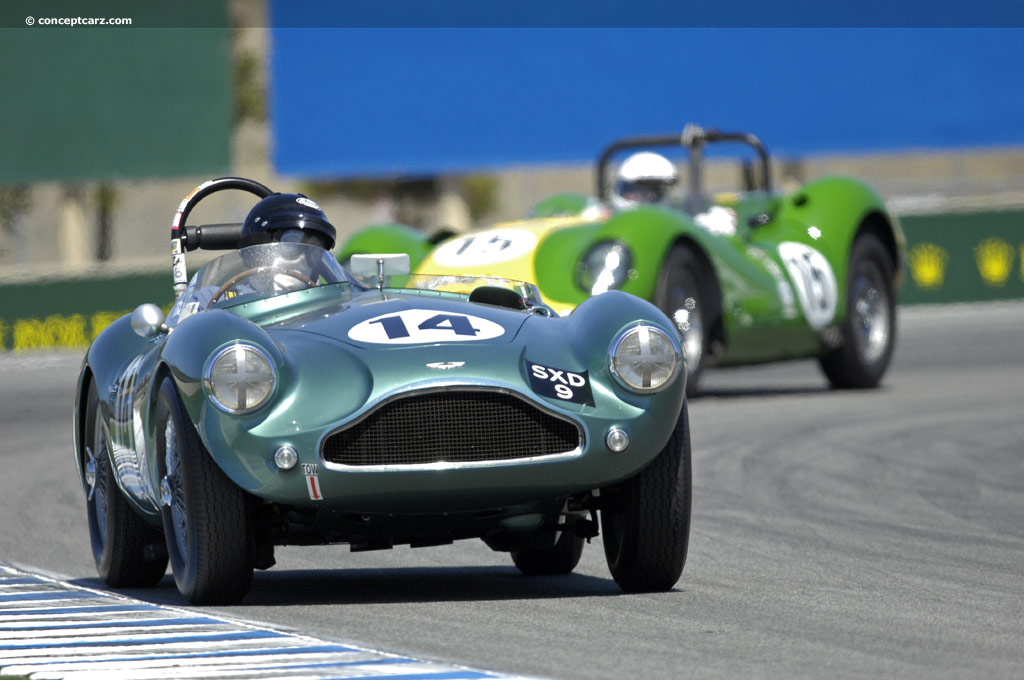
1955 Aston Martin DB3S
1955 Aston Martin DB3S Navigation
History
The DB3 was not as successful as Aston Martin had intended so they tasked Watson to design and engineer a new car. The result was the DB3S, a design that was based on its predecessor but featured a smaller wheelbase and a lighter chassis. The DB3S were built in two series, the first being numbered one through ten, from 1953 through 1956, and built primarily for the works team. The second series was produced from 1954 through 1956. The coupe bodies benefited from a lower drag coefficient which resulted in greater top speeds, unfortunately, there was excessive lift causing the vehicles to become very unstable at speed. The designs and mechanics were changed throughout the years to compensate for aerodynamic and performance limitations.
During its production run, lasting from 1953 through 1957, 31 examples were produced. Eleven were used by the factory for their racing endeavors.
The DB3s were campaigned by Aston Martin at many international racing events where it was met with mixed results, some victories and some disappointments. Arguably the most prestigious and challenging race, the grueling 24 Hour of LeMans, is a true test of a vehicles capabilities. The DB3S was entered in 1953 where it failed to achieve the success it had accumulated throughout the season.
In 1954, two 225 horsepower coupe versions of the DB3S were created to compete at Silversone. More power was needed, especially to be competitive at LeMans. By applying a supercharger, the car developed 240 horsepower. It was entered in LeMans but it was a Ferrari that would capture the overall victory. Due to the high speed and instability of the design, the DB3S coupes crashed.
In 1955 the coupes were rebodied as open cars. The DB3S captured victory at Silverstone and a second place finish at LeMans. In 1956, the DB3S repeated its prior year performance at LeMans, finishing with a second place.
Through design, development, and testing, the DB3S was able to achieve higher success than the DB3. Though never capturing an overall victory at LeMans, they were able to capture many prestigious victories and successes.
By Daniel Vaughan | Jun 2006
During its production run, lasting from 1953 through 1957, 31 examples were produced. Eleven were used by the factory for their racing endeavors.
The DB3s were campaigned by Aston Martin at many international racing events where it was met with mixed results, some victories and some disappointments. Arguably the most prestigious and challenging race, the grueling 24 Hour of LeMans, is a true test of a vehicles capabilities. The DB3S was entered in 1953 where it failed to achieve the success it had accumulated throughout the season.
In 1954, two 225 horsepower coupe versions of the DB3S were created to compete at Silversone. More power was needed, especially to be competitive at LeMans. By applying a supercharger, the car developed 240 horsepower. It was entered in LeMans but it was a Ferrari that would capture the overall victory. Due to the high speed and instability of the design, the DB3S coupes crashed.
In 1955 the coupes were rebodied as open cars. The DB3S captured victory at Silverstone and a second place finish at LeMans. In 1956, the DB3S repeated its prior year performance at LeMans, finishing with a second place.
Through design, development, and testing, the DB3S was able to achieve higher success than the DB3. Though never capturing an overall victory at LeMans, they were able to capture many prestigious victories and successes.
By Daniel Vaughan | Jun 2006
David Brown, who later became Sir David, purchased the Aston Martin and Lagonda company's from receivership in 1948. The Lagonda Company appealed to Mr. Brown for its W.O. Bentley-designed twin-cam, 2.6-liter six-cylinder engine. The Aston martin company had a modern chassis, a solid reputation, and a sporting heritage. From the purchase, David was committed to motorsport competition. One of the earliest endeavors was at the 1948 Spa 24 Hours with a post-war Astons. DB2s were entered at LeMans in 1949. Within just two years, DB2s finished First, Second and Third in class at the 1951 LeMans 24 Hours, and Third overall against a very competitive field. David Brown would field a factory team at LeMans each year from1 1950 through 1959. His greatest success was with the iconic DBR1, which finished First and Second at LeMans and the World Sportscar Championship.
The Aston Martin DB3 was a sports racer that was introduced in 1952. It was developed by Eberan von Eberhorst, a former Auto Union racing engineer, who designed an all-new, tubular chassis with a DeDion rear setup and slab-sided body.
The DB3 suffered from reliability issues, so Brown commissioned A.G. 'William' Watons to engineer an improved version of the car. A prototype appeared at Charterhill, UK in May of 1953, called the DB3S. The prototype introduced many new improvements including a lighter chassis and a reduced wheelbase. The Salisbury hypoid-bevel final drive was replaced with a David Brown spiral-bevel version. This was an important replacement, as the hypoid spiral drive had retired two DB3s at LeMans in 1952. The rear suspension geometry was re-worked and a new aluminum body designed by Frank Feeley, was added. The body was elegant and refined, featured the classic cutaway section behind the front wheels and a 'humped oval' grille theme in the front. The new grille design became the trademark identifier of Aston Martin production cars through the present day.
The DB3S made its racing debut at Charterhill, where it was driven by Reg Parnell to an overall victory, defeating an Ecurie Escosse C-Type. A short time later, three DB3Ss raced at LeMans but with little success. This would be the only race Aston Martin would lose in 1953.
In 1954, Aston Martin introduced a new 12-cylinder sports racer, bearing the Lagonda name. The Watson developed engine displaced 4.5-liters and was basically two standard VB6J Aston engines combined and mated to a common crankshaft. Both the block and crankcase were made from aluminum, to counterbalance the weight penalty. The engine endured many teething problems, and became a distraction from the development of the parallel DB3S program. Finally, the Lagonda sports racer program was abandoned in 1955 to focus on the DB3S.
By 1955, racing regulations had changed, dictating a 3-liter limitation on the engine capacity in the sports car championship. The DB3S would continue to win races and managed a second place at LeMans, driven by Peter Collins and Paul Frere. It would repeat its accomplishment at LeMans in 1956, with a Second place overall in the hands of Stirling Moss and Peter Collins.
By this point in history, ten Works examples of the DB3S had been completed by the factory. Production of customer cars continued as demand continued to be strong. The 'customer' cars were identifiable by their three-digit chassis numbers. They were fitted with an upgraded version of the production VB6J engine with a high compression head featuring larger valves and competition camshafts, with the addition of triple, dual-throat side-draft Weber carburetors. The connection rods were competition spec and the main bearing housings were of solid type. In this guise, the engine was named the VB6K. In total, 20 customer cars were produced.
By Daniel Vaughan | Dec 2009
The Aston Martin DB3 was a sports racer that was introduced in 1952. It was developed by Eberan von Eberhorst, a former Auto Union racing engineer, who designed an all-new, tubular chassis with a DeDion rear setup and slab-sided body.
The DB3 suffered from reliability issues, so Brown commissioned A.G. 'William' Watons to engineer an improved version of the car. A prototype appeared at Charterhill, UK in May of 1953, called the DB3S. The prototype introduced many new improvements including a lighter chassis and a reduced wheelbase. The Salisbury hypoid-bevel final drive was replaced with a David Brown spiral-bevel version. This was an important replacement, as the hypoid spiral drive had retired two DB3s at LeMans in 1952. The rear suspension geometry was re-worked and a new aluminum body designed by Frank Feeley, was added. The body was elegant and refined, featured the classic cutaway section behind the front wheels and a 'humped oval' grille theme in the front. The new grille design became the trademark identifier of Aston Martin production cars through the present day.
The DB3S made its racing debut at Charterhill, where it was driven by Reg Parnell to an overall victory, defeating an Ecurie Escosse C-Type. A short time later, three DB3Ss raced at LeMans but with little success. This would be the only race Aston Martin would lose in 1953.
In 1954, Aston Martin introduced a new 12-cylinder sports racer, bearing the Lagonda name. The Watson developed engine displaced 4.5-liters and was basically two standard VB6J Aston engines combined and mated to a common crankshaft. Both the block and crankcase were made from aluminum, to counterbalance the weight penalty. The engine endured many teething problems, and became a distraction from the development of the parallel DB3S program. Finally, the Lagonda sports racer program was abandoned in 1955 to focus on the DB3S.
By 1955, racing regulations had changed, dictating a 3-liter limitation on the engine capacity in the sports car championship. The DB3S would continue to win races and managed a second place at LeMans, driven by Peter Collins and Paul Frere. It would repeat its accomplishment at LeMans in 1956, with a Second place overall in the hands of Stirling Moss and Peter Collins.
By this point in history, ten Works examples of the DB3S had been completed by the factory. Production of customer cars continued as demand continued to be strong. The 'customer' cars were identifiable by their three-digit chassis numbers. They were fitted with an upgraded version of the production VB6J engine with a high compression head featuring larger valves and competition camshafts, with the addition of triple, dual-throat side-draft Weber carburetors. The connection rods were competition spec and the main bearing housings were of solid type. In this guise, the engine was named the VB6K. In total, 20 customer cars were produced.
By Daniel Vaughan | Dec 2009
- 1955 Aston Martin DB3S Menu
- Article
- Image gallery
- Valuation
- Specifications
- Profiles
- Production figures
Aston Martin
Similar Automakers
Similarly Sized Vehicles
from 1955


1955 Aston Martin DB3S Vehicle Profiles


Recent Vehicle Additions


Related Automotive News

ASTON MARTIN DB3S TO HEADLINE BONHAMS ASTON MARTIN AUCTION
17th specialist auction to take place on Saturday 21 May at Aston Martin Works, Newport Pagnell
11 May, 2016, Gaydon The expected star of the show at the forthcoming Bonhams Aston Martin auction is a 1953 Aston Martin DB3S, raced by Sir St...

The 1954 Aston Martin DB3S: Car Of The Silver Screen Raced By The Great Stirling Moss
A rare Aston Martin Works team car – chassis number DB3S5 – which was campaigned in period by such legendary racing drivers as Sir Stirling Moss, Peter Collins and Roy Salvadori, and latterly went on to co-star with Terry-Thomas in 1960s movie classic...

WeatherTech Raceway Laguna Seca celebrates 70th Anniversary of the Pebble Beach Road Races
Rolex Monterey Motorsports Reunion to feature display with Del Monte Trophy winners
The Rolex Monterey Motorsports Reunion is an event which features the rarest of race cars, and the 2021 edition will showcase five of the most extraordinary machines...

The catalogue for Worldwide's 14th Annual Auburn Auction is now online
The countdown to Worldwides 14th annual Auburn Auction is officially on, with a heavyweight line of exceptional pre-war automobiles, racecars, sports, classics and select American muscle cars now available for online viewing in the digital catalogue....

Worldwide's 14th Annual Auburn Auction showcases a heavyweight offering of significant pre-war automobiles, racecars, sports and classics
Worldwide Auctioneers is promising a heavyweight line-up of significant pre-war automobiles, racecars, sports, classics and select American muscle at its 14th annual Auburn Auction in September. Among the carefully curated offering of outstanding pre-war...

Automobiles with Exceptional Provenance Highlight Gooding & Company's Pebble Beach Auctions
SANTA MONICA, Calif. (July 10, 2014) – Gooding %26 Company, celebrated for its world-class automotive auctions and record-breaking results, will begin its second decade as the official auction house of the Pebble Beach Concours dElegance® on August...

Looks, Rarity, Performance: The Ultimate Connoisseur's Ferrari at RM Monterey...
LOOKS, RARITY, PERFORMANCE THE ULTIMATE CONNOISSEURS FERRARI, 275 GTBC SPECIALE HEADLINES RM AUCTIONS FLAGSHIP MONTEREY SALE
RM Auctions offers the first of only three 1964 Ferrari 275 GTBC Speciales, chassis 06701, at its flagship Mon...