History
A win on Sunday meant strong sales on Monday. This was a motto many manufacturers believed in and thus, many automakers actively raced their cars to promote its capabilities. Pierce-Arrow did the same; to prove the car's durability and reliability, the mighty Pierce-Arrow was entered in the famed Glidden Tours. From 1905 through 1909, it won all five events and, except for one outing, earned perfect scores in all of them. The company handled all aspects of construction, including the coachwork, for their vehicles. This was highly unusual for the time, but Pierce-Arrow wanted to ensure high quality and maintain high standards on all facets of construction and assembly. They worked closely with their Buffalo, New York neighbor Aluminum Company of America to perfect casting techniques that produced cast-aluminum body panels as thin as 1/8-inch. This made them lightweight yet very strong.
Pierce-Arrow established its own Art Department, long before GM recruited Harley Earl to create their 'Art and Colour Department.' Herbert Dawley designed the bodies for the Pierce-Arrow automobiles and worked closely with the clientele to ensure proper colors, materials, and accessories were fitted to the vehicles.
Another venue the company explored for promoting its business was 'image.' They sought the business of prominent figures, including the White House where ever presidents from William Howard Taft through Franklin Delano Roosevelt rode in a Pierce-Arrow. Many famous movie stars of the time preferred the Pierce-Arrow, such as Mary Pickford, Tom Mix, and Gloria Swanson. This publicity generated a wealth of business for the company and its reputation continued to soar.
In 1906, Pierce-Arrow constructed an integrated factory in Buffalo that covered 1.5 million square feet on the site of the 1901 Pan-American Exposition.
In 1913, the Pierce-Arrow Company patented the design of 'headlights faired into the tops of the front fenders.' This improved the effectiveness of the headlamps and was first seen on a Model 48-B2.
The Model 48 was available in two versions, the B and D. The D versions were equipped with a Disco acetylene self-starting system.
The Pierce-Arrow Model 48 was powered by a 515 cubic-inch, T-head, inline six-cylinder, side-valve engine that produced 48.6 calculated ALAM horsepower. Its cylinders were cast in three pairs and featured two vertical plugs per cylinder. Half of the plugs were connected to a coil while the other six were connected to a magnet. A switch gave the driver the ability to select either or both. The engine did not have a hand crank; there was an air-starting device that used compressed air stored in a tank to operate a small piston engine geared to the flywheel. Once the engine was started, the driver would reverse the valve, and the air-engine became a pump that recharged the tank.
During the production lifespan of the Model 48B, a total of 825 examples were created, and each carried a price tag that ranged from $4,850 - $6,300 depending on body style and coachwork. There were more examples of the Model 48B produced than their lower-priced companion car, the Model 38C, by 209 units.
The Model 48 rested on a platform that had a wheelbase that measured nearly 12 feet. Braking was a mechanical system that took some force to operate. Wooden artillery-style wheels were at all four corners and wooden running boards were on either side of the car. The instrumentation inside was rather bare. The two more important gauges were the mile-o-meter and the drum-action Warner speedometer.
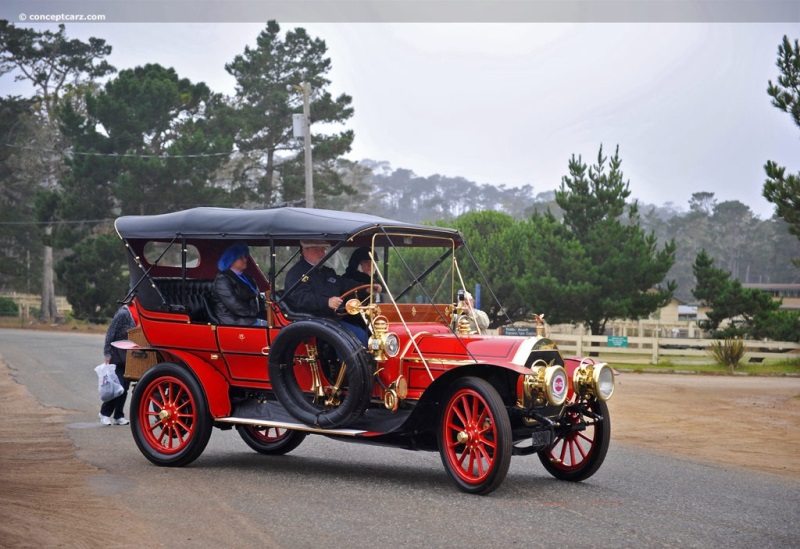
The most popular body style for the Model 48 was the Tourer which had a canvas top and had seating for around 7 individuals.
The Model 48 was a very stately and impressive car that had an awe-inspiring presence and a powerplant capable of carrying the load. These were mechanical masterpieces and truly exceptional examples of the quality and caliber the Pierce-Arrow Company was capable of producing.
By Daniel Vaughan | Dec 2008
Pierce-Arrow established its own Art Department, long before GM recruited Harley Earl to create their 'Art and Colour Department.' Herbert Dawley designed the bodies for the Pierce-Arrow automobiles and worked closely with the clientele to ensure proper colors, materials, and accessories were fitted to the vehicles.
Another venue the company explored for promoting its business was 'image.' They sought the business of prominent figures, including the White House where ever presidents from William Howard Taft through Franklin Delano Roosevelt rode in a Pierce-Arrow. Many famous movie stars of the time preferred the Pierce-Arrow, such as Mary Pickford, Tom Mix, and Gloria Swanson. This publicity generated a wealth of business for the company and its reputation continued to soar.
In 1906, Pierce-Arrow constructed an integrated factory in Buffalo that covered 1.5 million square feet on the site of the 1901 Pan-American Exposition.
In 1913, the Pierce-Arrow Company patented the design of 'headlights faired into the tops of the front fenders.' This improved the effectiveness of the headlamps and was first seen on a Model 48-B2.
The Model 48 was available in two versions, the B and D. The D versions were equipped with a Disco acetylene self-starting system.
The Pierce-Arrow Model 48 was powered by a 515 cubic-inch, T-head, inline six-cylinder, side-valve engine that produced 48.6 calculated ALAM horsepower. Its cylinders were cast in three pairs and featured two vertical plugs per cylinder. Half of the plugs were connected to a coil while the other six were connected to a magnet. A switch gave the driver the ability to select either or both. The engine did not have a hand crank; there was an air-starting device that used compressed air stored in a tank to operate a small piston engine geared to the flywheel. Once the engine was started, the driver would reverse the valve, and the air-engine became a pump that recharged the tank.
During the production lifespan of the Model 48B, a total of 825 examples were created, and each carried a price tag that ranged from $4,850 - $6,300 depending on body style and coachwork. There were more examples of the Model 48B produced than their lower-priced companion car, the Model 38C, by 209 units.
The Model 48 rested on a platform that had a wheelbase that measured nearly 12 feet. Braking was a mechanical system that took some force to operate. Wooden artillery-style wheels were at all four corners and wooden running boards were on either side of the car. The instrumentation inside was rather bare. The two more important gauges were the mile-o-meter and the drum-action Warner speedometer.
The most popular body style for the Model 48 was the Tourer which had a canvas top and had seating for around 7 individuals.
The Model 48 was a very stately and impressive car that had an awe-inspiring presence and a powerplant capable of carrying the load. These were mechanical masterpieces and truly exceptional examples of the quality and caliber the Pierce-Arrow Company was capable of producing.
By Daniel Vaughan | Dec 2008
Similar Automakers
Similarly Priced Vehicles
Thomas Flyer K6-70 ($6,000-$7,500)
White Model O ($4,000-$5,000)
Austin Model 60 ($5,000-$6,000)
Pierce-Arrow Model 36 ($3,700-$4,700)
Peerless Model 19 ($4,300-$5,800)
Pierce-Arrow Model 40 ($4,120-$5,550)
Locomobile Model 40 ($4,500-$5,900)
Peerless Model 25 ($6,000-$7,000)
Packard Model Thirty ($4,200-$5,600)
Alco 40 HP ($5,000-$5,000)
Average Auction Sale: $409,750
White Model O ($4,000-$5,000)
Austin Model 60 ($5,000-$6,000)
Pierce-Arrow Model 36 ($3,700-$4,700)
Peerless Model 19 ($4,300-$5,800)
Pierce-Arrow Model 40 ($4,120-$5,550)
Locomobile Model 40 ($4,500-$5,900)
Peerless Model 25 ($6,000-$7,000)
Packard Model Thirty ($4,200-$5,600)
Alco 40 HP ($5,000-$5,000)
Average Auction Sale: $409,750


1909 Pierce-Arrow Model 48 Vehicle Profiles

Recent Vehicle Additions


Performance and Specification Comparison
Price Comparison
$3,050 - $4,050
$3,700 - $4,700
$4,120 - $5,550
Model 48 Specification Comparison by Year
Year
Production
Wheelbase
Engine
Prices
Related Automotive News

Worldwide counts down to Enthusiast Car Week in Auburn, Indiana, with a diverse offering of 150 great enthusiast cars and a one-of-a-kind Midwest driving tour
Auburn, Indiana. April 2024. Worldwide Auctioneers is gearing up for its annual Enthusiast Auction at home in Auburn, Indiana this month, welcoming passionate collectors back to town for Enthusiast Car Week. Scheduled for April 26 -27,...

Best in Show at The Greenbrier Concours d'Elegance
The fifth annual edition of The Greenbrier Concours dElegance at Americas Resort, The Greenbrier, attracted a curated list of nearly one-hundred exquisite vehicles to the luxury mountain resort located in the Allegheny Mountains in White Sulphur...

Collectible Continental Convertibles Lead Bonhams 10th Anniversary Scottsdale Auction
A 1959 BMW 507 Series II, estimate US%241,900,00 – 2,300,000, arguably the most collectible and coveted BMW to date, will lead a Teutonic trio of newly consigned collectors convertibles crossing the block at the forthcoming 10th anniversary Bonhams Scottsdale...

RM Auctions to Present The Merrick Auto Museum Collection at 13th Annual Hershey Sale
OVER 100 BRASS ERA CARS AND SELECTION OF MEMORABILIA OFFERED ENTIRELY WITHOUT RESERVE
RM Auctions set to offer the Merrick Auto Museum Collection at Hershey auction, 10-11 October in Pennsylvania
Offered entirely without reserve, the multi...

Beatle John Lennon's personal 1965 Mercedes-Benz 230SL to go under the hammer at Worldwide's Scottsdale Auction
Auburn, Indiana. December 7th, 2016. Worldwide Auctioneers has confirmed today that Beatle John Lennons personal 1965 Mercedes-Benz 230SL will go under the hammer at its inaugural Scottsdale sale on Wednesday, January 18th. We are thrilled to...