1951 Buick XP-300 Concept
1951 Buick XP-300 Concept Navigation
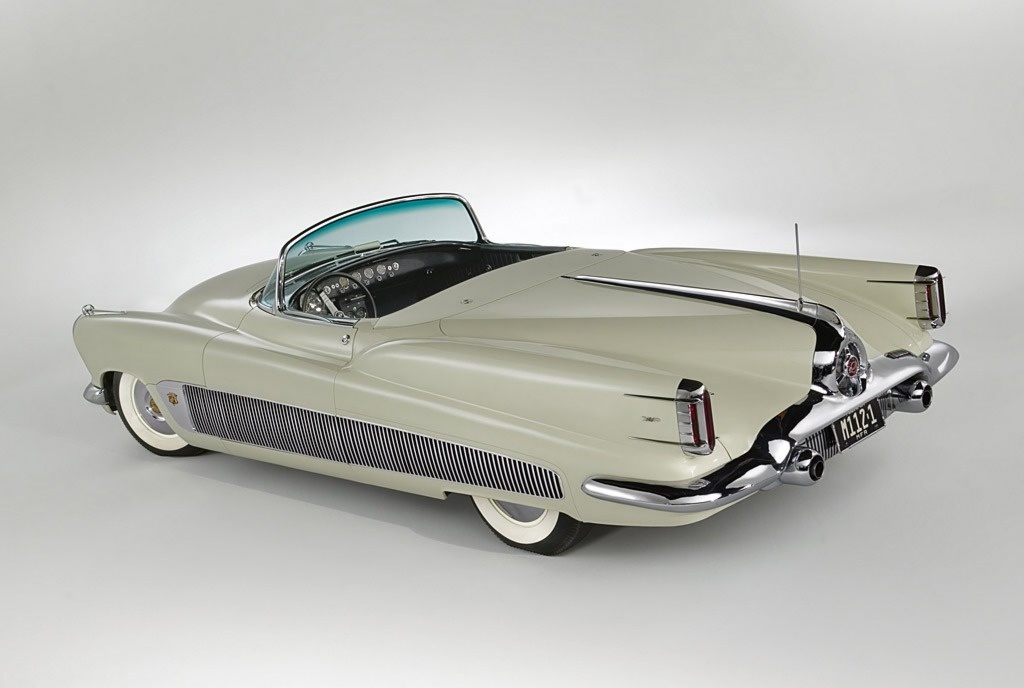
The collaboration between Earl and Chayne on the Buick Y-Job soon produced other imaginative Buick concept cars. In 1951, the pair created two new dream cars, LeSabre and XP-300. These vehicles were the result of a long-term cooperative venture between GM Styling and Buick Engineering. LeSabre was Earl's project while Chayne, then the head of GM Engineering, took the lead on XP-300.
The two cars had many mechanical components in common, including supercharged 335-hp V-8 engines that burned methanol/gasoline fuel, push-button seats and windows (including convertible rear windows) and power jacks that were operated from the driver's seat.
While the two cars shared similar underpinnings, the styling of their aluminum bodies clearly distinguished LeSabre and XP-300. XP-300 has the clean design of a sports car, and the dramatically sculptured LeSabre has the look of a jet plane. LeSabre's styling cues clearly suggest its namesake, the F86 Sabre jet fighter.Source - GM
The two cars had many mechanical components in common, including supercharged 335-hp V-8 engines that burned methanol/gasoline fuel, push-button seats and windows (including convertible rear windows) and power jacks that were operated from the driver's seat.
While the two cars shared similar underpinnings, the styling of their aluminum bodies clearly distinguished LeSabre and XP-300. XP-300 has the clean design of a sports car, and the dramatically sculptured LeSabre has the look of a jet plane. LeSabre's styling cues clearly suggest its namesake, the F86 Sabre jet fighter.Source - GM
The XP-300 was the brainchild of Charles Chayne, GM's vice-president in charge of engineering. Its name is derived from the name 'experimental (XP)' and the fact that it is powered by a 300 hp supercharged V8 engine. Chayne reported that he attained a top speed of 140 miles per hour in the car.The exterior of the car is typical of the 'long and low' style that many GM stylist tried to promote in the 1950s. Over 16 feet in length, the XP-300 has only 6 and 1/2 inches of ground clearance. The body panes are made of heat-treated aluminum, which reduces the overall weight of the car to 3,100 pounds. The body and frame structure are welded into a solid unit. Wide brake drums allow for a double set of brake shoes.
- 1951 Buick XP-300 Concept Menu
- Article
- Image gallery
- Specifications
Buick
Similar Vehicles

Similarly Sized Vehicles
from 1951


Recent Vehicle Additions


Performance and Specification Comparison
Related Automotive News

BUICK TURNS 110: 11 HIGHLIGHTS OF 11 DECADES
Buick vehicles today are built in state-of-the-art facilities around the world. The Enclave luxury crossovers Lansing Delta Township plant was the industrys first LEED Gold-certified manufacturing facility. The brand has evolved in many ways since...

Legendary Bentley Sets £4.5 Million Auction Record
Tim Birkins 4 ½ Litre Supercharged Blower Bentley single seater sets new world best for a Bentley at Bonhams Goodwood auction
Beautiful Brooklands racing machine underlines enduring appeal of the Bentley Boy racing spirit
(Crewe and Goo...

Lost Mercedes - Surfaces At Bonhams
One owner, unrestored, supercharged S Type Mercedes to be sold by Bonhams at Goodwood Revival this autumn
One of the greatest and most important motor car finds of the last decade, the Lost Mercedes is to be offered at Bonhams Goodwood Revival...

Keels & Wheels Concours d'Elegance
Nearly 12,000 people gathered on the lush grounds of Lakewood Yacht Club to get an up close look at some of the most pristine, classic automobiles and vintage wooden boats in the United States at the 17th Annual Keels %26 Wheels Concours dElegance. The...

Bentley Ready For Classic Thousand Mile Challenge
Iconic Bentley Blowers ready for great Mille Miglia adventure
Bentley Continental W12 and V8 models join historic cars in Italy
(Crewe, England %26 Brescia, Italy. 16 May, 2012) W.O. Bentleys gift for creating cars that combined the speed o...

JAGUAR EXPANDS POWERTRAIN CHOICE WITH TWO ADDITIONAL FORCED-INDUCTION PETROL ENGINES
As Jaguar expands its product offer in key global markets it is introducing two additional petrol units to its range to enhance customer choice the new 3.0-litre V6 Supercharged Petrol, and the 2.0-litre I4 Turbocharged Petrol.
Adrian Hallmark, Global...