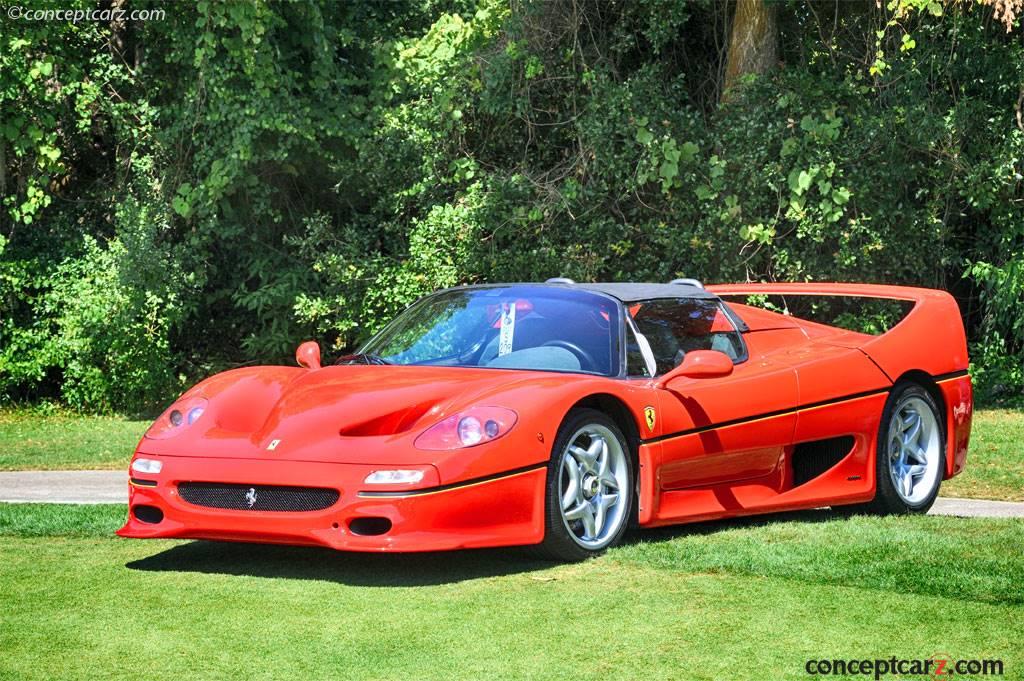
1995 Ferrari F50 1995 Ferrari F50 1995 Ferrari F50 1995 Ferrari F50
1995 Ferrari F50
1995 Ferrari F50 1995 Ferrari F50 1995 Ferrari F50 1995 Ferrari F50
1995 Ferrari F50 1995 Ferrari F50
More Photographs    Wallpaper    Engine Photos   
Image credits: Ferrari

View more photos
Designer: Pininfarina
 
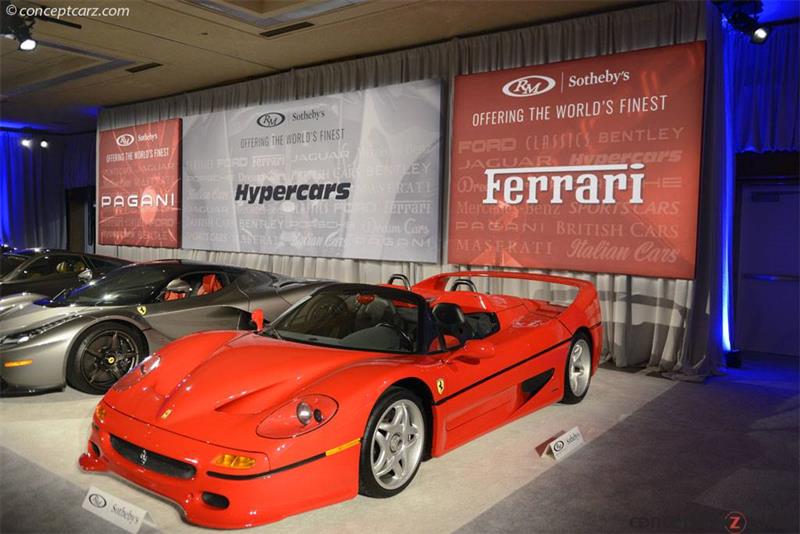
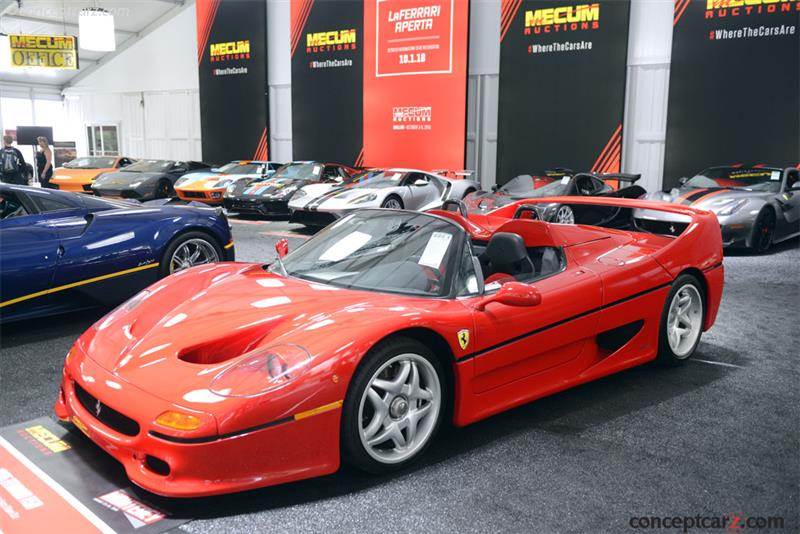
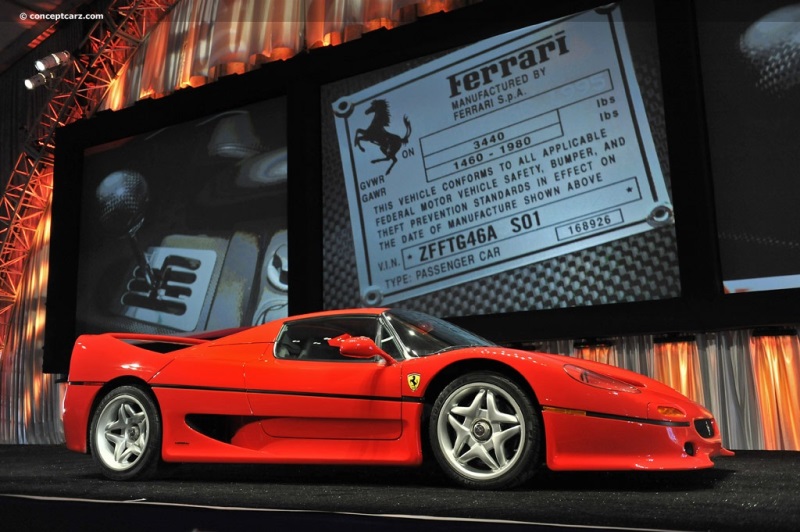
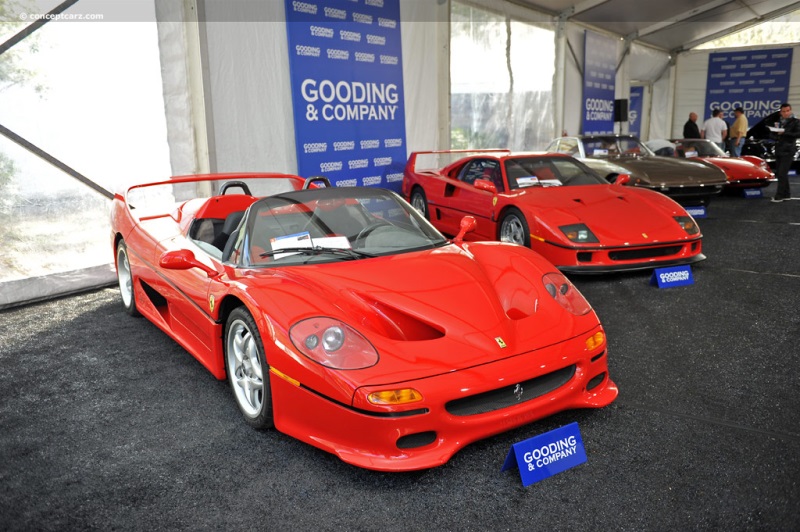
Originally owned by the Sultan of Brunai, this Pininfarina coach built automobile, with carbon fiber body construction, is one of 359 cars produced to celebrate the Ferraris 50th Anniversary. The cost per automobile was approximately $569,690.00

The 12-cylidner, 4-75-liter, rear-mounted engine produces an astonishing 520 horsepower, allowing the automobile to accelerate from zero-to-sixty miles per hour in 3.7 seconds and taking the automobile to a top speed of 203 mph.
1996 marked the 50th Anniversary of Ferrari, and with it came the revolutionary F50. The smooth contours and sleek body became an instant hit. Ferrari had begun designing cars that could be both streetwise and racetrack worthy.
50 years of know-how was integrated into the design of this vehicle. 'It will be impossible to do it again,' said Luca di Montezemolo, Ferrari president.
Designed with huge forward air intakes, low-slung with sleek lines leading to the rear airfoil, the F50 is a 12-cylinder, 4.75-liter engine. With the ability to achieve from 0 to 60 miles in 3.7 seconds, the F50 banks a top speed of 203 mph.
Based on a Formula One engine, the F50 was built and designed in Ferrari's factory in Maranello, Italy. Only 349 models were built, though studies clearly showed a market for 350 such vehicles. Considering it a challenge that would appeal to only the most devoted die-hard Ferrari fans, the F50 had to be difficult to find, and a challenge to own.
Only 50 models were sold in Italy, Germany and the United States. The rest were sold in Asia and other parts of Europe. Available by lease only, the F50 was leased ONLY to factory approved individuals for a $240,000 down payment, monthly payments of $5,600 for 2 years and with a final payment of $150,000. This price did not include the $1350 freight tax, sales tax, $36,240 luxury tax, and $7,700 gas guzzler expense.
The F50 is a supercar, like its predecessor the nearly $1,000,000 F40 (designed to commemorate the 40th anniversary of Ferrari and the last model introduced personally by Enzo Ferrari).
Goodyear manufactured the tires for the F50, the exclusive Goodyear Eagle F1 GS-Fiorano. Handling the most difficult responsibility of the vehicle, the tires' superior handling is a direct result of the 1.1g+ grip.

Designed and built by Speedline, the wheels consist of magnesium alloy that features a single nut central attachment.

With no Antilock brake system, engineers felt that size of the brakes compensated for the lack of this standard equipment found on lower priced cars. With no servo assist, trained drivers were dependent on their ability to effectively control braking without any type of electronic assist.
The styling and design of the F50 is credited to Pininafarini in the traditional Italian way.
The F50 had no sound system, the most obvious reason for this design being the level of noise inside the vehicle, at full acceleration measurement is taken at extreme 104 dBA. There is no airbag, and the glass side windows are manual.

Jessica Vaughan
In its early days, over 50 years ago, Ferrari built cars which could be used, with only a few minor alterations, for Formula 1 or Sportscar events or everyday on the street. However, as Formula 1 cars evolved, it became impossible for someone who was not a team driver or a collector capable of passing a series of private tests on the track, to take the wheel of a racing Ferrari. Ferrari decided to again give all its clients the chance for this experience. The F50 was the response to this technological challenge. Thanks to the research made possible by Ferrari's vast experience in this field, producing over 45 racing models and over 120 GT and Sports models, the F50 was built to the same tolerances and with the same integrity as a Formula 1 car. The carbonfiber monocoque that enclosed the aeronautical rubber fuel tank, the V12 engine that acted as a load-bearing structure for the transaxle-rear suspension assembly, the pushrod suspension, and separate hand-braking system are formed on the basic principles of a racing car projected into the dimension of normal, safe use in all situations. The result was a car with a specific power output of 109 HP/litre and an extraordinary chassis that combined unbeatable performance with exact handling and ultimate safety even in unexpected or extraordinary circumstances.
Design

The F50 was designed solely for its purpose: there was no styling in the normal sense of the word. The surfaces enveloped the mechanicals in a single sweep from the front air intake to the rear spoiler, volumes were kept to the minimum required by the project. Pininfarina succeeded in designing shapes that recalled the great prototype racers.

Aerodynamics played an important role from the beginning of the F50 project because: it was a highly advanced car in terms of performance; there was a link between the internal aerodynamic components (cross-flows) and surface layer flows; there needed to be a balance between aerodynamic loads in the dual configuration (Berlinetta and Barchetta) because of the high performance.

The body was built entirely from composite materials with carbon fiber, Kevlar and Nomex honeycomb molded in one of five available colours: red, red Barchetta, yellow, black and grey Nurburgring. On the Berlinetta version, the function of the integral hard top was to complement the structural elements. On the Barchetta version, the bodywork element incorporated the anchor points for two roll hoops. The engine was visible through part of the transparent, vented engine cover.

The chassis of the F50 was made entirely of carbon fibre, weighing 225 lbs and offering a torsional rigidity of 25,677 lbs-ft/°. Like a Formula 1 car, occupants sat in the central tub formed by the chassis, and the aeronautical rubber fuel cell was located in a protected position between the passenger tub and the engine and rear suspension. The result was in advanced driving position, with a front to rear weight distribution of 42:58. A load-bearing element, the F50's engine acted as a support for the suspension, rear bumper and bodywork elements. To guarantee perfect suspension operation, the engine-transaxle assembly was rigidly attached to the chassis.

The suspension and engine-gearbox assembly were mounted via low-fatigue light alloy inserts co-polymerized to the chassis. To optimize the structure that made up the fulcrum of the entire system, even from the safety viewpoint, finite element calculation techniques were employed, using programmes that included sandwich elements and multi-ply shells, typical of laminated composite structures. Engineers and designers had to solve problems of the long-term stability of dimensional and structural elements. Tests were carried out on computerized vibration benches.

Drivetrain

In keeping with its brief as a Formula 1 car for the street, the F50 employed a naturally aspirated 4.7 liter narrow V12. The block was in nodular cast iron with Nikasil-coated liners. The seven main tri-metallic-bearing crank shaft was propelled by Mahle-forged aluminun pistons via titanium Ti6al4V alloy connecting rods. Lubrication was dry sump with water cooling. The Bosch Motronic 2.7 engine management system combineed electronic injection and static ignition.

The cylinder head had five radial valves per cylinder. This is an ideal solution for engines capable of high speeds that close valves pneumatically. The five valves (three intake and two exhaust) were smaller and therefore the flutter speed was raised above 10,000 rpm. A five-valve arrangement makes it possible to achieve a high degree of permeability of the intake ducts. The valves were driven by four overhead camshafts. The intake system was of the variable geometry type. The F50 was fitted with an insulated stainless steel exhaust system. A throttle valve driven by the Motronic control unit made two exhaust system lengths available, one was tuned to achieve the best torque values, the other was tuned for better performance at top speed and full load by reducing the back pressure on the exhaust.

The 6-speed longitudunal Ferrari gearbox was designed for short stroke rapid engagement. The synchronizers were ZF twin cone. The gearbox had a manual control with lever, selector fork and rod, and rigid shaft fitted on sliding couplings. The knob was in composite material.

The differential was of the limited-slip type, with a differentiated lock percentage in drive and release. The hydraulic actuated clutch was of the dry twin plate type with self-centering thrust bearing. A water-oil heat exchanger kept oil temperature constant. The gearbox housing was made of magnesium alloy.

Suspension

The length of the locating arms was chosen to keep track and camber changes to a minimum. The front and rear suspension had wishbones and reaction arms that act on spring and damper by way of a push-rod system. The dampers were specially developed by Bilstein. To guarantee the setup and maximum precision in wheel movement over the ground, all the joints linking the suspension to the chassis were rigid, as they are on racing cars. On the rear axle, the suspension arms were fixed to an intermediate element between the engine and the gearbox which acts as an oil tank, as it does in Formula 1. The length of the arms improved the contact between the wheels and the ground, considerably reducing sweep and improving roadholding. The hub carriers were made of a special hot-forged aluminum alloy, which increases rigidity and significantly reduces weight.

The front track was wider than the rear to promote understeer. The spring and damper control mechanism was linked to an electronic damper control system, managed by ECU based on lateral acceleration, the steering angle and longitudinal acceleration. Great care went into the definition of performance in terms of soft and hard handling. The damping control software processed the information received from a series of sensors mounted in the car. This resulted in the best damping in all conditions to optimize contact between wheel and ground, reducing the variations in ground load. Variations due to acceleration were also controlled by the system that reduced bodyshell movement to stabilize the aerodynamic efficiency and guarantee directional stability. Damping was also varied according to speed, independently of this system, making for greater comfort and improving performance at higher speeds.

Cast entirely in aluminum alloy, the steering box of the F50 was the fruit of many years' cooperation with TRW.

Racing achieved its most extraordinary progress in the field of braking. The F50 offered the braking of a racing car with a system designed in cooperation with Brembo to incorporate four cast iron discs splined directly on the aluminum hub. The calipers were in alumimium with four large ground cylinders, like those used on Formula 1. The braking system was sized so that it would not need servo-assistance or ABS. Cooling was guaranteed by dynamic air intakes front and rear.

The rear wheel assembly, including Titanium hubs, incorporated a Ferrari Formula 1 patent. This system reduces the number and weight of components, and allows extension of the axle shaft reducing power absorption.

The F50's single-piece Speedline wheels were made of a special magnesium alloy with single-nut central attachment. The choice of a size of 18'x81/2' at the front and 18'x13' at the rear, was dictated by the choice of large brake discs and low profile tires. Goodyear designed a special racing-based 'Fiorano' tire specifically for the F50 in 245/35ZR18 front, 355/30ZR18 rear.

Interior

The interior was designed with efficient functionality, ergonomics, and safety in mind. The multi-sized composite seats were upholstered in Connolly leather and special 'transpiring' material. The driving position was fully adjustable, including the pedals - the control pads adjusted to the driver's shoe size - with an F1-type heelrest. The gear shift was the classic Ferrari unit, with gated selector, lever, and knob all in composite. The rearview mirror was shaped to improve visibility in both roof configurations. All controls were specially designed to guarantee ergonomy, and the environmentally-friendly climate control unit was designed for maximum comfort even when the car is open.

For racing use, the car has an FIA standard roll bar and 4-point seat belt attachments. The straight forward instrumentation emulated the system designed for contemporary F1. The instruments were managed entirely by an 8-bit microcomputer. The main LCD display had 130 elements and was lit by electro-luminescent bulbs. The major functions were the rev-counter and mileage counter. A panel of tell-tales was positioned to one side, with numerous ideograms representing various alarm signals. It also included a statistics bank incorporating a crash record that memorizes the various use and mission profile parameters of the car, a function that is similar to the concept of telemetric techniques. The gear engaged was calculated by matching engine rpm to the car speed, and is displayed on the panel.

Source - Ferrari

Photos grouped by event

Ault Park Concours d'Elegance

2005 Scarsdale Concours, New York

2005 Palm Beach Cavallino Classic

2005 Palm Beach Cavallino Classic

1995 Ferrari F50

Year1995
MakeFerrari
ModelF50
Engine LocationMid
Drive TypeRear Wheel
Body / ChassisCarbon Fibre
Production Years for Series1995 - 1997
Body DesignerPininfarina
Price$480,000.00
Weight1320 kg | 2910.6 lbs
Combined MPG0.00
Introduced At1995 Geneva Motor Show

Performance
0-60 mph3.7 seconds.
1/4 Mile12.1 seconds.
Top Speed202 mph | 325 km/h Similar top speeds

Engine  
Engine ConfigurationV
Cylinders12
Aspiration/InductionNormal
Displacement4700.00 cc | 286.8 cu in. | 4.7 L.
Valves60 valves.
5 valves per cylinder.
ValvetrainDOHC
Horsepower510.00 BHP (375.4 KW) @ 8500.00 RPM
Torque350.00 Ft-Lbs (474.6 NM)
HP to Weight Ratio5.7 LB / HP (Vehicles with similar ratio)
HP / Liter108.5 BHP / Liter
Vehicles with similar horsepower and weight

Transmission Information
Gears6
TransmissionManual
Final Drive3.70:1


Similar Automakers
Add Review
View Reviews (3)
Other models by Ferrari
View Specifications
AddThis Social Bookmark Button

Vehicle Ratings
StylingVehicle Styling Rating: 93.832%
PerformanceVehicle Performance Rating: 94.58%
InteriorVehicle Interior Rating: 93.584%
QualityVehicle Quality Rating: 93.962%
OverallVehicle Overall Rating: 94.018%
No. of Votes: 107
Rate the Vehicle
Add Review
View Reviews (3)

Articles and Event Coverage
Ault Park Concours d'Elegance
2005 Scarsdale Concours, New York
2005 Palm Beach Cavallino Classic

Additional Resources and Links
Palm Beach Cavallino Classic Official Website
Scarsdale Concours, New York Official Website
Concours d'Elegance at Ault Park Official Website

Topics
f50

Replies: 3
Friday, September 24, 2004

1995 Ferrari models
348 GTS
F355
F512M

Other Model Years
1999 F50
1998 F50 GT
1997 F50
Recent Vehicle News
Porsche 911 Turbo Type 930Ferrari 246 Dino GTVolkswagen 1200 Deluxe
Bugatti Veyron Sang NoirShelby Commemorative GT40Weber Sportscar
BMW M1 Homage ConceptAlpina B6 GT3Maserati Quattroporte Bellagio Fastback
Edo Competition 630 ScuderiaWiesmann GT MF 5Buick Invicta Concept
Porsche Cayenne Turbo SOpel InsigniaMansory McLaren SLR Renovatio
Chevrolet Corvette C6 Coupe CompetitionPontiac Solstice CoupeSaleen S5S Raptor Concept
Scion Hako ConceptSuzuki Kizashi 3 Concept2010 Pontiac G8 Sport Truck
Bugatti Veyron Fbg par Hermès