1967 Triumph TR4A

1967 Triumph TR4A Navigation
Standard-Triumph introduced a prototype Triumph 20TS sports car in October of 1952 at the London Motor Show, and only a single example was ever built. Its basic design and configuration were used for the TR2 sports car that was produced from 1953 and 1955, produced solely as a roadster. It was equipped with a 121 cubic-inch four-cylinder Standard wet linter inline-four engine from the Vanguard and its suspension was independent at the front with coil springs and a live rear axle with leaf springs. The transmission was a four-speed manual unit, with optional top gear overdrive, brakes were Lockheed drums, and either wire or disc wheels could be fitted. Before it was replaced in 1955 by the TR3, Triumph produced 8,636 examples of the TR2.Production of the TR3 lasted from 1955 through 1962 and was similar to its predecessor but with improved braking and a more powerful engine. The 1,991cc straight-four with overhead valves produced 95 horsepower, and later versions received a 'high port' cylinder head and enlarged manifold, which brought power to 100 bhp at 5,000 RPM. The four-speed manual gearbox could be supplemented by an overdrive unit on the top three ratios, electrically operated and controlled by a switch on the dashboard. The drums were replaced by discs in 1956, making the TR3 the first British series production to be so equipped. The Triumph TR3A (although never badged as such) of 1957 brought a full-width radiator grill, a full tool kit, a lockable boot handle, and exterior door handles. The Triumph TR3B (another unofficial name) was built from 1962 alongside the TR4, which started production in 1961. These were produced for only a short period of time and constructed due to dealer concerns that the buying public might not welcome the TR4. Five hundred thirty examples were built with a commission number preceded by TSF (the final 29 examples were built as Triumph Italia models), and 2,804 examples with commission numbers preceded by TCF. Triumph had built 13,377 examples of the TR3 and 58,236 of the so-called 'TR3A.' The total production was approximately 74,947 units.Triumph TR4
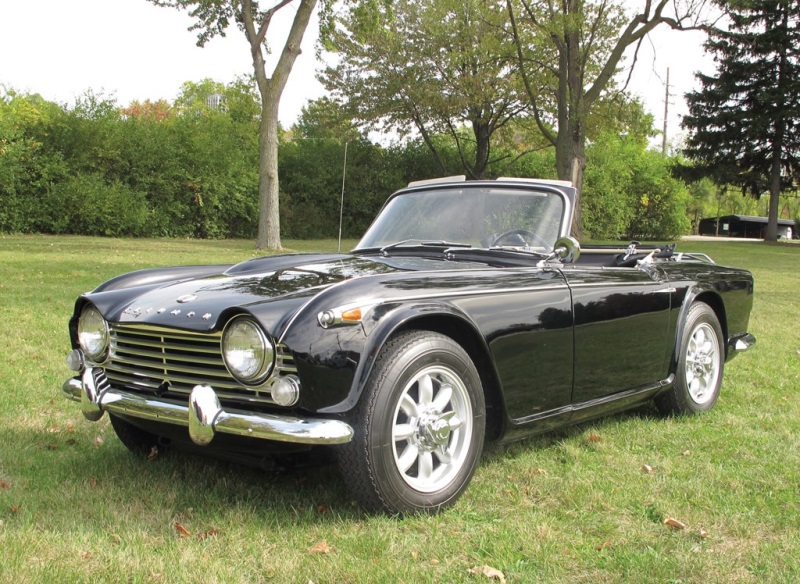
The Triumph TR2 and TR3 had been true roadsters with cutaway door designs, utilitarian side-curtains, and limited boot storage. The TR4 used the chassis and drivetrain of its TR predecessors but wore a modern body designed by Giovanni Michelotti, one of the most influential and prolific designers of sports cars during the 20th century. Michelotti was an accomplished designer who worked for many coachbuilders, including Ghia-Aigle, Bertone, Ghia, Allemano, Vignale, Stabilimenti Farina, OSI, Fissore, Viotti, Scioneri, and Monterosa. He opened his own design studio in 1959 and collaborated on numerous projects for Fiat, Nardi, Moretti, Siata, Lombardi, and others. The Michelotti-designed TR4 lacked the cutaway door design of the previous TRs, replaced by a straight design that could wind down windows, and the angular rear end allowed for a rather substantial boot capacity. A hardtop top with a fixed glass rear window was optional, with an integrated roll bar and a detachable steel center panel. This roof system was the first of its kind, predating the Porsche 911/912 Targa by five years. The hardtop added to the versatility of the TR4, making it even more useable and attractive to the import U.S. buyer, where the vast majority of TR4s were eventually sold. The TR4 was available with two different roof designs, the Hardtop Top kit or the 'Surrey Top,' a folded top with a vinyl insert and support frame. Triumph had a well-established dealer network, and with the introduction of the dramatically different TR4, many were concerned about a decrease in sales. Therefore, Triumph continued to produce the TR3As (commonly called the TR3B) between 1961 and 1962, giving dealers and buyers ample time to 'warm up' to the new TR4.
Convertible CoupeThe Triumph TR4 employed the same engine used in its predecessors, however, its displacement was increased from 1,991cc to 2,138cc due to the larger bore size. The smaller displacement engine was still available to customers who raced in the under-two-liter class category, and a few examples received vane-type superchargers which offered more horsepower and torque at lower revolutions which reduced the likelihood of damaging the engine. With the supercharger and other performance enhancements, the 2.2-liter engine could produce in excess of 200 horsepower at the flywheel. The standard engine produced 100 bhp (SAE).The Triumph TR2 and TR3 used an 88-inch wheelbase, a length of 151 inches, and a height of 50 inches. The TR4 had an 88.1-inch wheelbase, a length of 156 inches, and a height of 50 inches. It had a wider front and rear track than the TR3, a rack and pinion steering, and a fully synchromesh transmission on all forward gears. A Laycock de Normanville electrically operated overdrive was optional and could now be selected for second and third gears as well as fourth. The 15 x 4.5-inch disc wheels were standard, and 48-lace wire wheels were optional and could be painted the same color as the bodywork. They could also be painted in matte or polished chrome finishes or stove-enameled with matte silver with chrome spinners being the most common. The body-colored option was rarely selected. The wheels were commonly wrapped with 590-15 bias ply or optional radial tires. Triumph TR4A
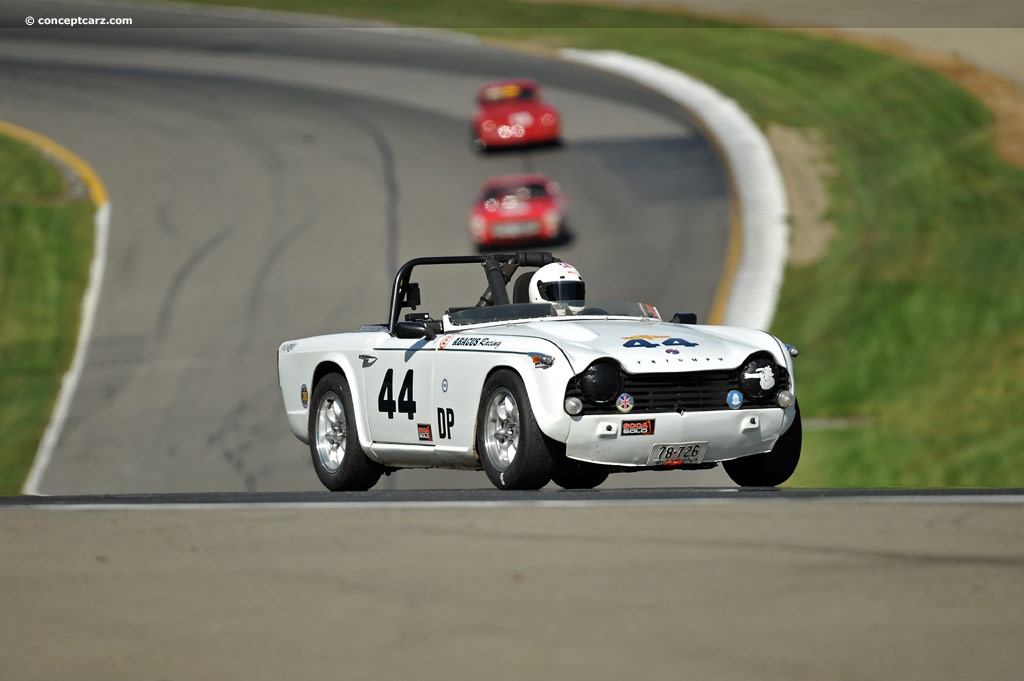
In 1965, the Triumph TR4 gained an independent rear suspension system (IRS) with trailing arms and a differential bolted to the redesigned chassis frame. Along with several minor styling and mechanical refinements, these TR4A models were similar to their TR4 siblings. Although the IRS was one of the primary distinguishable features of the TR4A, it is estimated that twenty-five percent of the TR4As received a live axle design of the TR4 and adapted to fit the new chassis.
Convertible CoupeThe TR4 and TR4A were praised for their superior handling thanks to the wider track and precise rack-and-pinion steering. They were popular in the salesroom and at the track. The addition of the independent rear suspension increased the vehicle's predictable handling and improved the ride. At the Sebring 12 Hours in 1966, the IRS-equipped TR4As achieved a remarkable 1-2-3 class victory. By the time production came to a close in 1968, approximately 28,450 examples of the TR4A models had been sold, with the vast majority being sent to the American market. The total production of TR4 models during its five-year production lifespan was 40,253 units. In 1968 the TR4A was replaced by the 6-cylinder TR5 model with fuel injection.
by Daniel Vaughan | Mar 2021
The Triumph TR2 and TR3 had been true roadsters with cutaway door designs, utilitarian side-curtains, and limited boot storage. The TR4 used the chassis and drivetrain of its TR predecessors but wore a modern body designed by Giovanni Michelotti, one of the most influential and prolific designers of sports cars during the 20th century. Michelotti was an accomplished designer who worked for many coachbuilders, including Ghia-Aigle, Bertone, Ghia, Allemano, Vignale, Stabilimenti Farina, OSI, Fissore, Viotti, Scioneri, and Monterosa. He opened his own design studio in 1959 and collaborated on numerous projects for Fiat, Nardi, Moretti, Siata, Lombardi, and others. The Michelotti-designed TR4 lacked the cutaway door design of the previous TRs, replaced by a straight design that could wind down windows, and the angular rear end allowed for a rather substantial boot capacity. A hardtop top with a fixed glass rear window was optional, with an integrated roll bar and a detachable steel center panel. This roof system was the first of its kind, predating the Porsche 911/912 Targa by five years. The hardtop added to the versatility of the TR4, making it even more useable and attractive to the import U.S. buyer, where the vast majority of TR4s were eventually sold. The TR4 was available with two different roof designs, the Hardtop Top kit or the 'Surrey Top,' a folded top with a vinyl insert and support frame. Triumph had a well-established dealer network, and with the introduction of the dramatically different TR4, many were concerned about a decrease in sales. Therefore, Triumph continued to produce the TR3As (commonly called the TR3B) between 1961 and 1962, giving dealers and buyers ample time to 'warm up' to the new TR4.
Convertible Coupe
In 1965, the Triumph TR4 gained an independent rear suspension system (IRS) with trailing arms and a differential bolted to the redesigned chassis frame. Along with several minor styling and mechanical refinements, these TR4A models were similar to their TR4 siblings. Although the IRS was one of the primary distinguishable features of the TR4A, it is estimated that twenty-five percent of the TR4As received a live axle design of the TR4 and adapted to fit the new chassis.

Convertible Coupe
by Daniel Vaughan | Mar 2021
Related Reading : Triumph TR History
The Triumph TR4 was introduced in 1961. The body had been given a modern and updated appearance by Michelotti, but its drive-train and chassis were based on its TR predecessors. Production lasted until 1965, when it was replaced by the TR4A. Prior to its release and while under development, the car was referred to by its codename, Zest. The TR Series was a popular sports car but had drawbacks....
Continue Reading >>
Continue Reading >>
Related Reading : Triumph TR History
An extremely successful sports car, the Triumph TR4 was produced in the U.K. by the Standard Triumph Motor Company from 1961. With a top speed of 110 mph, and costing around £1095, the TR4 became one of Triumphs best-loved cars thanks to its low cost of entry and capable open-top sports capabilities. The TR4 was stylistically quite a departure from its predecessor the TR3 and seemed to be just the....
Continue Reading >>
Continue Reading >>
- 1967 Triumph TR4A Menu
- Article
- Image gallery
- Valuation
- Specifications
- Profiles
Triumph
Similar Automakers
Similarly Sized Vehicles
from 1967
- Citroen 2CV Charleston
Datsun 1600
Datsun 2000
MG MGB MKII
NSU 1200 TT
NSU Prinz 1000 TT
Simca 1000
Toyota Sports 800
Triumph TR250
Similarly Priced Vehicles
- Plymouth Satellite ($2,745-$2,990)
- Oldsmobile Cutlass Supreme ($2,640-$3,065)
- Pontiac Tempest GTO ($2,870-$3,160)
- Chevrolet Chevelle SS Series ($2,800-$3,000)
- Dodge Coronet ($2,360-$3,200)
- Pontiac Firebird ($2,670-$2,900)
- Chevrolet Impala Series ($2,700-$3,300)
- Triumph GT6 MKI ($2,890-$2,890)
- Buick Skylark ($2,733-$3,345)
Average Auction Sale: $25,228


1967 Triumph TR4A Vehicle Profiles

Recent Vehicle Additions


Performance and Specification Comparison
Price Comparison
$2,200 - $2,345
$2,890
$3,395
TR4A Specification Comparison by Year
Year
Production
Wheelbase
Engine
Prices
Related Automotive News

Geneva show cars to reclaim limelight at next month's Salon Privé Concours
Three rare pre-series Geneva show cars from the 1950s and 60s to be presented at Blenheim Palace
1951 Mercedes-Benz 300 S Cabriolet A show car represented the pinnacle of Stuttgarts production car range
1960 Maserati 3500 GT Spyder show car dis...

Mille Miglia links Italian sporting legends in Salon Privé's pre- & post-war classes next month
Salon Privé Concours dElégance presented by Aviva bookends pre- and post-war eras with Italian performance duo, each with links to famous road race
#1 – Sole-surviving Graber-bodied Alfa Romeo 6C 2300 B Mille Miglia, one of only four convertible 6...
Britain's Automotive Greats to be Celebrated at London Concours in 2022
Rarest and most significant pre-war British cars to be savoured at Londons Honourable Artillery Company later this month.
Examples from this countrys great marques – from Rolls-Royce to Bentley - will be united at the capitals leading concours d...

Alpine Passion Through The Years At Retromobile
Retromobile set to play host to six classic Alpine models
The Alpine Vision show car will also be on display as a symbolic bridge between the brands past and future
Groupe Renault is pleased to confirm Alpines participation in the 42nd Retromobi...

Refined Maseratis Add Italian Flair to The Pebble Beach Auctions Presented by Gooding & Company
Selections include - five Maseratis from a single renowned collection, a 1957 Maserati A6G54 Spyder, a 1971 Maserati Ghibli 4.9 SS Spider, a 1963 Maserati Sebring Series I and a 1960 Maserati 3500 GT
SANTA MONICA, Calif. (July 8, 2016) –...