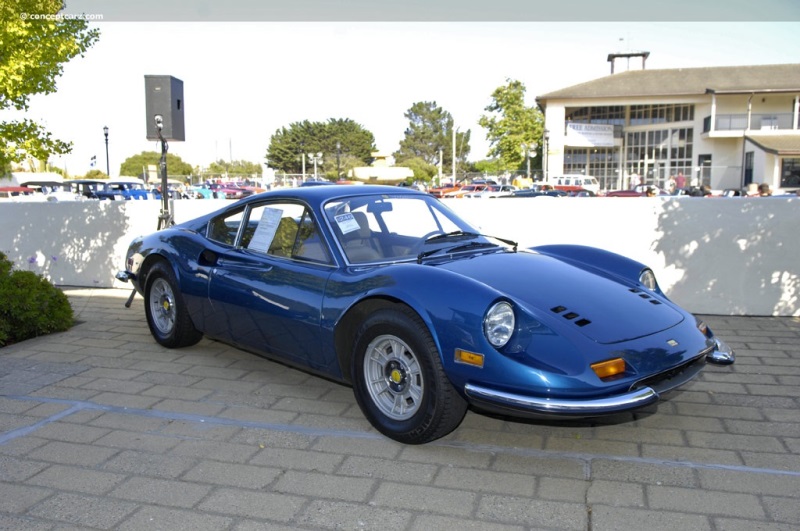
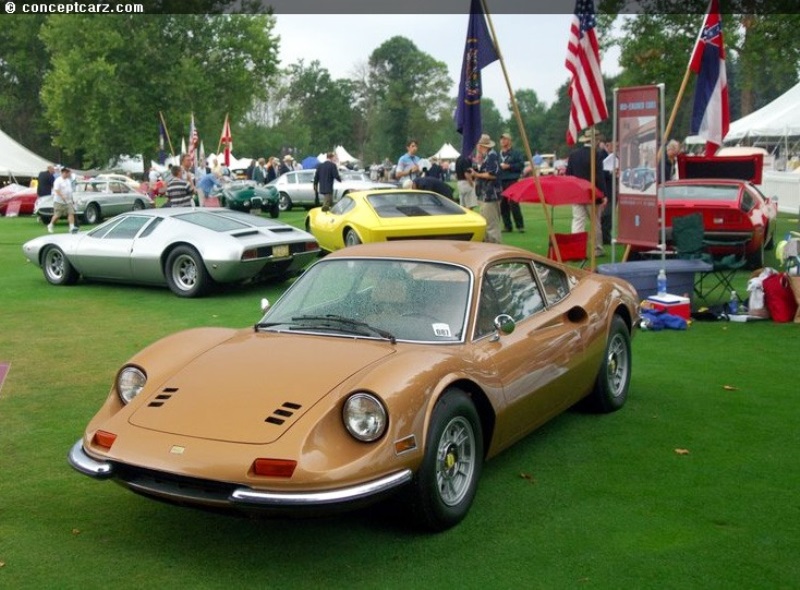
1971 Dino 246 | 1973 246 Dino ![]() |
1972 Ferrari 246 Dino news, pictures, and information | ||
| Tweet | ||
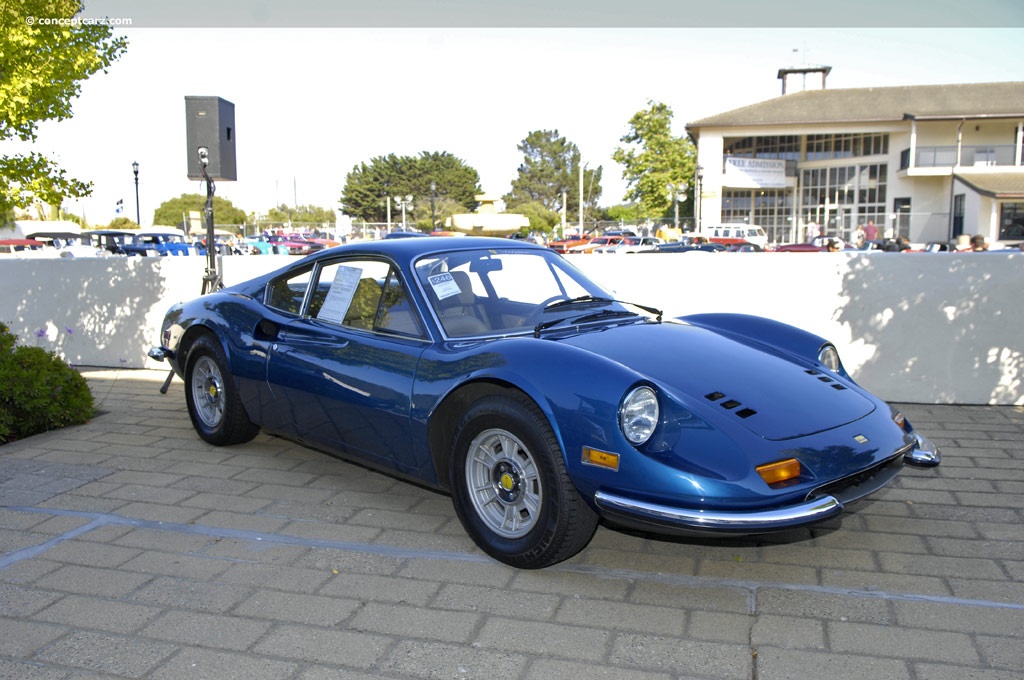
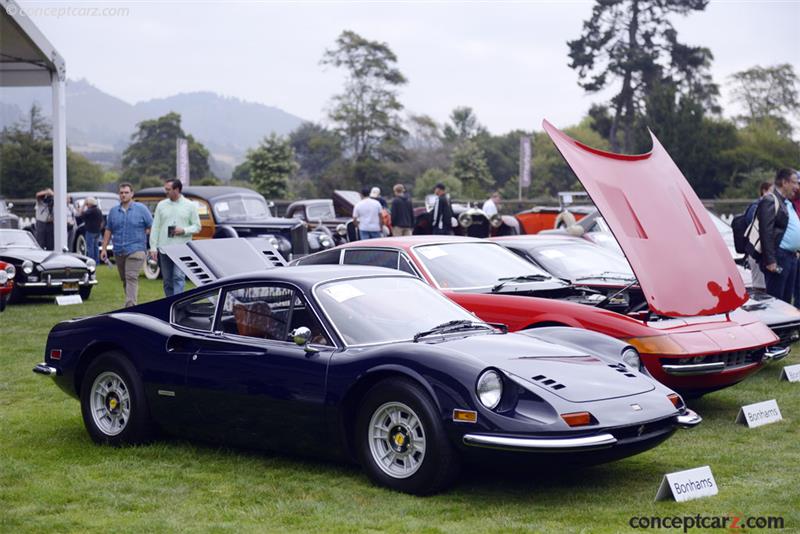
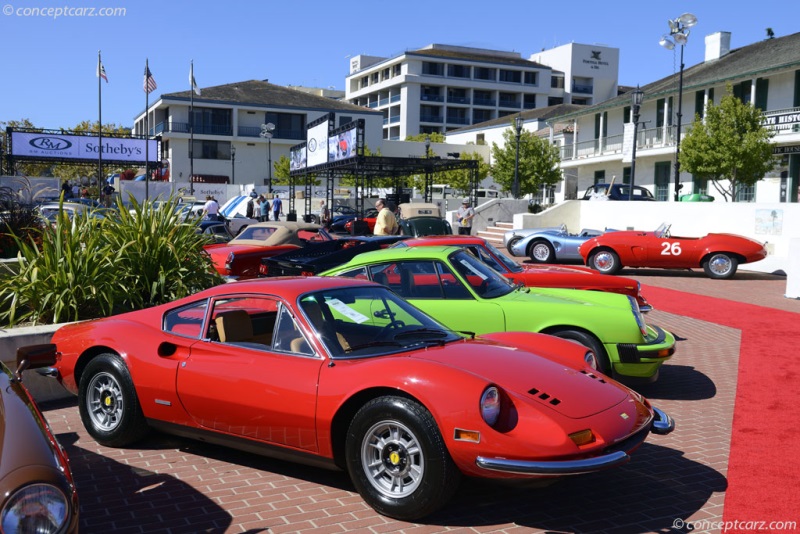
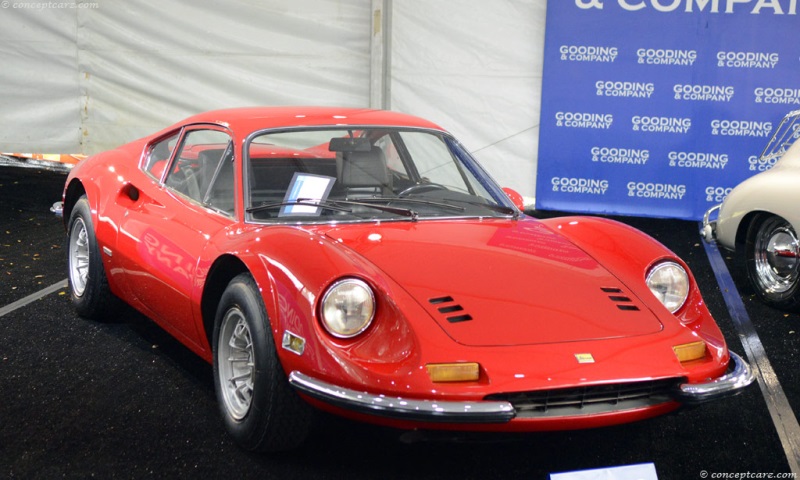
The prototype for the 246 appeared in the early part of 1969 with the production version being rolled out only months later. Production continued until 1973. A total of 2,487 246's were produced.
Scaglietti built the vehicle while the Ferrari designed engine was built by Fiat.
The Dino 246 was almost identical to the 206. Just like the 206, it did not wear any Ferrari logos or badges. There were a few aesthetic changes and a larger wheelbase (2.1 inch increase). Under the hood, however, they were differences. The 246 had a more reliable and larger V-6 engine that was capable of almost 200 hp (European version). The American version had a slightly lower horsepower rating.
Scaglietti built the vehicle while the Ferrari designed engine was built by Fiat.
The Dino 246 was almost identical to the 206. Just like the 206, it did not wear any Ferrari logos or badges. There were a few aesthetic changes and a larger wheelbase (2.1 inch increase). Under the hood, however, they were differences. The 246 had a more reliable and larger V-6 engine that was capable of almost 200 hp (European version). The American version had a slightly lower horsepower rating.
![]() | ![]() | ![]() | Coupe Designer: Scaglietti |
Enzo Ferrari named the road-going Dino, his first attempt at a mid-engine production street car, as a tribute to his son Alfredino Ferrari, who died in 1965. The first production Dino 206 hit the road in 1967 with a 2.0-liter Transversely mounted dual-overhead-camshaft aluminum V-6 engine and a Scaglietti-built aluminum body. Later models wore easier-to-build and less-expensive steel bodies. The Dino's name was changed to 246 GT for 1970 when its engine was enlarged to 2.4 liters. Fed by a trio of twin-barrel downdraft Weber carburetors, it pumped out a healthy 195 horsepower.
Known more of voluptuous design and perfect dynamic balance than for speed, the Dino's commercial success led to further development of mid-engine Ferraris up to the modern supercars enjoyed by affluent enthusiasts today. A total of around 3,600 Dinos were produced, very few in this color.
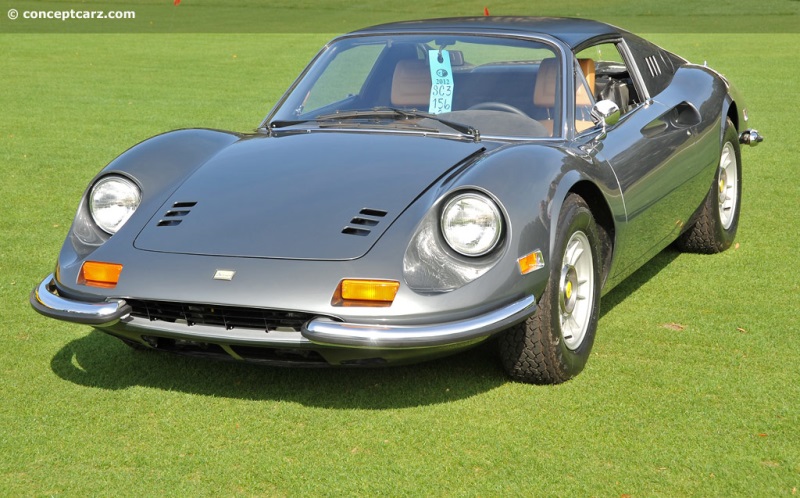
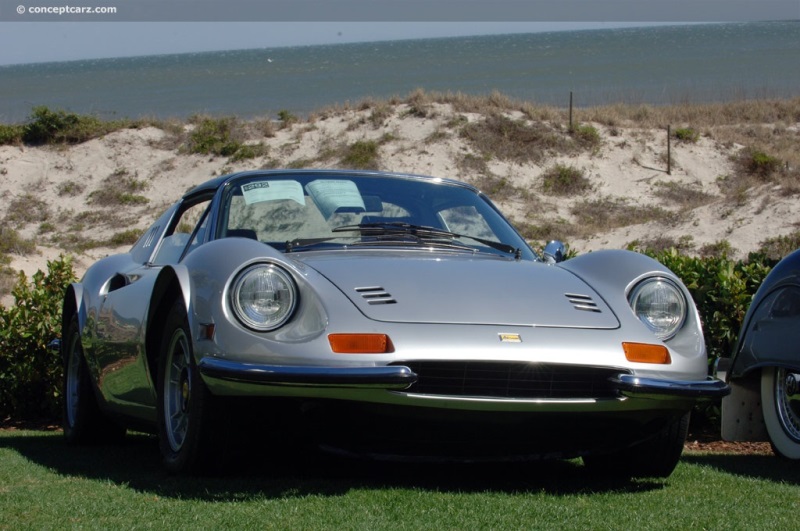
![]() | GTS Spyder Designer: Scaglietti Chassis Num: 03128 | |
| Sold for $156,750 at 2008 RM Auctions. Sold for $159,500 at 2009 RM Auctions. | ||
The Dino 206S was powered by the V6 engine. A Dino Berlinetta GT version was later shown at the 1966 Turin Show. The V6 engine displaced 1986cc and produced 180 horsepower. It was placed mid-ship and became Ferrari's first mid-engine production car.
The Dino car was devoid of any Ferrari badging. During this time in history, Ferrari and Fiat had formed a relationship. Fiat produced the engine and in return, was able to use it in their front-engined coupe and spyder, and later in the Lancia Stratos.
In 1969 the V6 engine was enlarged to 2418cc and power reached nearly 200 horsepower. The GTS featured a targa-roof which allowed for open-air driving while offering the true benefits of a sports car. More versions of the coupe were produced, leaving the GTS a very sought-after commodity in modern times. Some have had their coupe's converted into Targas. That is what happened to this car, bearing chassis number 03128. It is a matching numbers example that has traveled a mere 29,000 miles during its existence. It is finished in metallic silver with deep red Daytona style seats with black inserts. It is equipped with power windows and factory air conditioning. It was the subject of a professional three-year restoration that was done to the highest of standards.
In 2008 this 1972 Ferrari Dino 246 GT Spyder Conversion was brought to the Automobiles of Amelia presented by RM Auctions where it had an estimated value of $150,000 - $157,000. When bidding had subsided, the lot had been sold for a high bid of $156,750.
By Daniel Vaughan | Apr 2008
![]() | ![]() | ![]() | Coupe Designer: Scaglietti Chassis Num: 03656 |
| Sold for $118,250 at 2008 RM Auctions. | |||
This 1972 Ferrari Dino 246GT has had just three owners since new and remains original and un-restored. In the early 1980s, the car was apparently repainted as the original factory paint had begun to fade. The interior is reported to be entirely original, including the Becker radio, seats, dash, and carpets.
In 2008, this vehicle was offered for sale at the 'Sports & Classics in Monterey' presented by RM Auctions where it was estimated to sell for $125,000 - $150,000. It was offered without reserve and sold for $118,250.
By Daniel Vaughan | Jan 2009
![]() | ![]() | ![]() | GTS Spyder Designer: Scaglietti Chassis Num: 04370 |
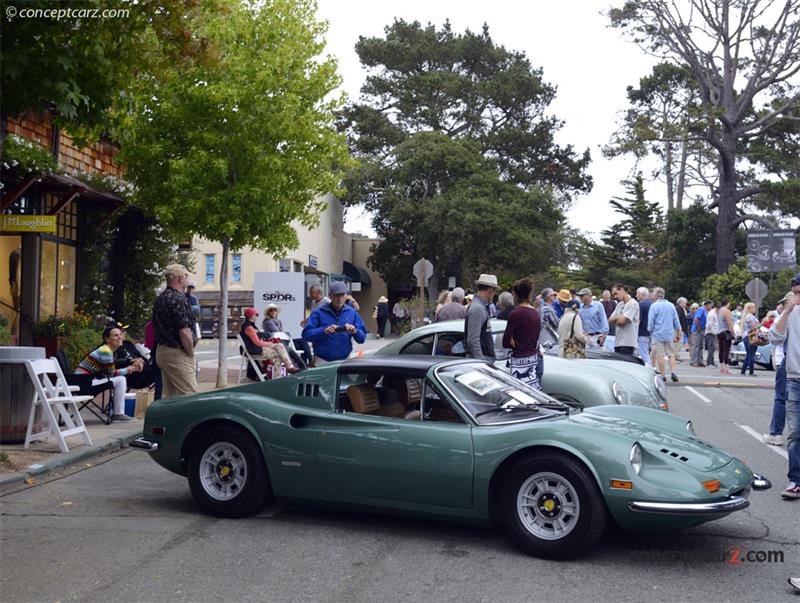
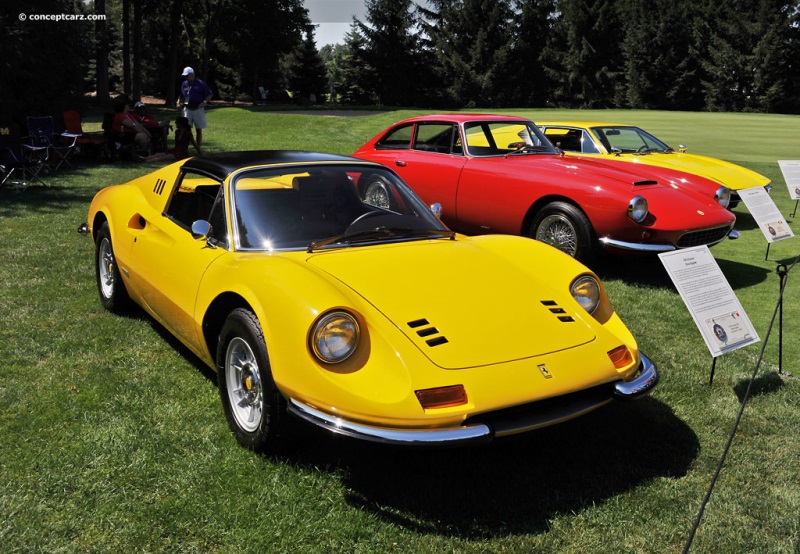
In 1972 the 246 GTS was unveiled. This featured a removable targa roof panel without the small rear side windows.
The 246 model continued until 1973. In total, 2,732 GT's and 1,180 GTS's were produced.
It is interesting to note that none of the 246's were sold with the Ferrari badge.
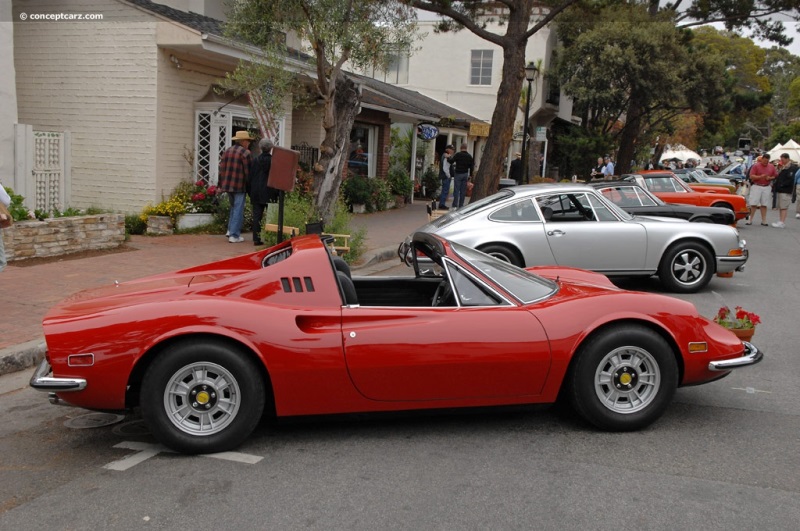
This 1972 Dino GTS has been owned by its current owner for almost 30 years, and after a number of competition events, the car is now 'retired.' As a younger car this 246 GTS raced at Sears Point, competed for 10 years at the Virginia City Hill Climb, and ran at club track days at Laguna Seca. The 246 GTS, with its removable top panel, arrived with the advent of the Series III V6 Dinos. Aside from the new Spyder configuration, these cars featured minor changes over the earlier ones, such as new gear ratios and a revised fuel system.
![]() | GTS Spyder Designer: Scaglietti |
Ferrari built passenger cars to support his racing team. For many years the cars were street versions of his road racing cars. As tastes changed and private owners expected more amenities, the road cars became more refined. The gasoline crisis in the early 1970's brought a demand for smaller more efficient sports cars. Maserati responded with the Merak, Lamborghini with Urraco and Ferrari with Dino.
The car was named after Enzo's son Alfredino, who died from muscular dystrophy in 1956. The 6 cylinder double overhead cam engine was a project Alfredino had been working on. This was Ferrari's first V-6 engine. Enzo did not call the car a Ferrari, because as he had previously stated a Ferrari must have 12 cylinders. The body was designed and built by Pininfarina. It is one of the best interpretations of the 2-passenger mid-engine sports car.
This example is the only 246 Dino with fuel injection. It set the lap record at Riverside Raceway in 1977 with a lap of 1:48.6. Paul Newman drove the car at Willow Springs Race Track in 1977.
![]() | ![]() | ![]() | Coupe Designer: Scaglietti |
The 246 GT models were steel bodied and carried a larger 2.4 liter engine. The engine is fed by a trio of twin-barreled Weber carburetors, and produces approximately 195 horsepower.
Dinos are known more for their excellent dynamic balance, rather than their outright speed. However, their commercial success (3,600 were built), led to the further development of Ferrari mid-engine designs. So the Dino can be referred to as the father of today's modern mid-engine Italian super car.
The 206 Dino was built by Enzo Ferrari as a tribute to his son who passed away in 1956 at the age of 24 due to kidney disease. Alfredo Ferrari, more commonly known as Dino, was Enzo Ferrari's only son (Alfredo was also Enzo's brother and fathers' name). Afredo had been trained in Switzerland as an engineer, after which he returned to the family business and received tutoring from his father. It was Enzo's dream to one-day hand over the keys to the company to his son. Sadly, that never transpired.
The 206S first debuted in 1965 at the Paris Salon. The Dino Berlinetta GT Prototype was debuted later in 1966 at the Turin Show and again in 1967 at the same show but this time as a production model. The Dino Berlinetta was Ferrari's first transverse-mounted mid-engine vehicle.
The design was done by Pininfarina and built by Scaglietti at the Maranello assembly facility. The body was alloy and the frame was steel.
The Dino 206 did not receive any Ferrari marque. It was void of the signature 'horse' logo, making it never officially a Ferrari. Rather, it was marketed as a separate marque.
The Dino was also built to compete against the Porsche 911. In order to meet the Formula Two racing regulations, over 500 production units had to be made. Ferrari was not capable of producing such numbers. So Ferrari relied on other resources. The engine was supplied by Fiat with half the number of cylinders that Ferrari was accustomed to working with. It was an all-alloy 2-liter, quad-cam, V-6 engine capable of producing between 140 and 180 horsepower. Side vents were located on the car which helped with cooling the engine.
Production continued until the end of 1969.
By Daniel Vaughan | Jun 2006
For more information and related vehicles, click hereThe 206S first debuted in 1965 at the Paris Salon. The Dino Berlinetta GT Prototype was debuted later in 1966 at the Turin Show and again in 1967 at the same show but this time as a production model. The Dino Berlinetta was Ferrari's first transverse-mounted mid-engine vehicle.
The design was done by Pininfarina and built by Scaglietti at the Maranello assembly facility. The body was alloy and the frame was steel.
The Dino 206 did not receive any Ferrari marque. It was void of the signature 'horse' logo, making it never officially a Ferrari. Rather, it was marketed as a separate marque.
The Dino was also built to compete against the Porsche 911. In order to meet the Formula Two racing regulations, over 500 production units had to be made. Ferrari was not capable of producing such numbers. So Ferrari relied on other resources. The engine was supplied by Fiat with half the number of cylinders that Ferrari was accustomed to working with. It was an all-alloy 2-liter, quad-cam, V-6 engine capable of producing between 140 and 180 horsepower. Side vents were located on the car which helped with cooling the engine.
Production continued until the end of 1969.
By Daniel Vaughan | Jun 2006
| MERCEDES-AMG HELPS TO ENSURE SAFETY IN FORMULA 1 | |
![]() | In the new 2013 Formula 1® season, Mercedes-AMG will once again help to ensure safety at all Formula 1® races forming part of the FIA Formula One World Championship™. For the 18th year the performance brand of Mercedes-Benz is providing the Official F1® Safety Car and the Official F1® Medical Car. The SLS AMG GT with 435 kW (591 hp) and the C 63 AMG Estate with 358 kW (487 hp) will be deployed at the direction of Race Control officials usually when weather or incidents are considered to impact o...[Read more...] |
| Final Countdown Underway To South Florida's Premier Collector Car Auction | |
![]() | • Auctions America kicks off its 2013 auction season, March 22-24 with its highly anticipated Fort Lauderdale Collector Car Auction • Celebrating its 11th year, the multi-day auction features more than 550 quality collector cars • Latest feature attractions include an outstanding 1963 Shelby Cobra and a 1974 Ferrari Dino 246 GTS • Digital catalog now available for download at auctionsamerica.com AUBURN, Indiana (February 27, 2013) – With the final countdown underway to its highly an...[Read more...] |
| Six Decades Of Ferrari At Mecum's Daytime Auction | |
![]() | 1954 Ferrari 750 Monza Headlines Select Offering of Italian Illuminati Mecum Auctions will present its 4th annual Monterey Daytime Auction, Aug. 16-18, 2012 at the Hyatt Regency Monterey Hotel and Spa on Del Monte Golf course, featuring some of finest machines Ferrari has ever produced headlined by a 1954 750 Monza Spyder Scaglietti. By turns part of the Engelbert Stieger, Brando Wang, Walter Burani and Roberto Crippa collections, 1954 Ferrari 750 Monza Spyder Scaglietti S/N 0462MD...[Read more...] |
| 1984 Brazilian Grand Prix: An Overshadowed Overachievement | |
![]() | In 1983, a little-known Belgian driver by the name of Thierry Boutsen would buy his way into a drive with the Arrows Racing Team in time to take part in the Belgian Grand Prix. Though he would retire early in the race, he would follow the performance up with two-straight near misses of the points, beating his teammate in the process. He had been close with a car that was already overreaching. One year later, competing with an older and underdeveloped car, championship points couldn't have seemed...[Read more...] |
| A Monaco story: When Nico met Mika | |
![]() | It's a scene that happens hundreds of thousands of times a day around the world: two people meet in a lift, greet each other and begin to chat about work and life. The twist in this particular story, though, is that the elevator is in Monte-Carlo; the two men are resident in the same apartment building, separated by little more than a few floors; and both have written their own chapters in the very exclusive grand prix racing history of Mercedes-Benz. Mika Hakkinen was the first Mercedes-Ben...[Read more...] |
| Similar Automakers | |
| Aston Martin | Bentley |
| Bugatti | Devon |
| GTA | Koenigsegg |
| Lamborghini | Lotus |
| Maserati | Maybach |
| McLaren | Porsche |
| Rolls-Royce | Spyker |
| Tesla | |
| Similarly Sized Vehicles from 1972 |
| BMW 2000 |
| BMW Turbo Concept |
| Datsun 240Z |
| Fiat 124 |
| Ford Pinto |
| Jaguar XKE E-Type |
| Lancia Stratos HF |
| Peugeot 504 |
| Porsche 911E |
| Porsche 911S |
| Ferrari: 1971-1980 |
| Similar Automakers |
| Other models by Ferrari |
1971 Dino 246 | 1973 246 Dino ![]() |


1971 Dino 246


1972