DeSoto, a division of Chrysler Corporation, was in production from 1928 to 1961. Styling was often cutting edge, with the waterfall grills of the 1930s Airflow and the excessive use of chrome trim and tall tail fins of the 1950s. The Adventurer model, introduced in 1956, was DeSoto's high-performance option, complementing the 300B from Chrysler, Plymouth's Fury, and Dodge's D-500, adopting the same low-production specialty model concept as its sister divisions. It was named after two concept cars built by Ghia for DeSoto, the first was designed by Virgil Exner in 1952 and powered by DeSoto's 276 cubic inch Hemi-head V-8. After completing its time on the show circuit, Exner adopted it as his personal car for several years, even racing it on occasion. The second Adventurer followed in 1954, wearing a design by Luigi Segre and Giovanni Savonuzzi at Ghia.
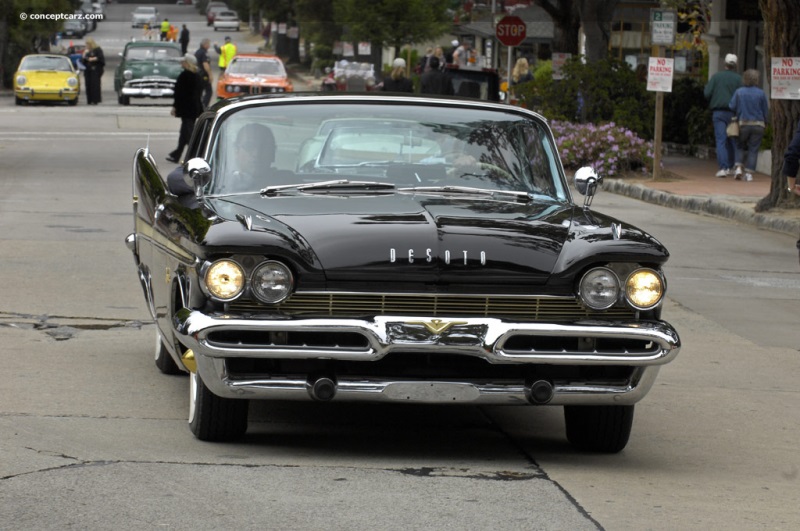
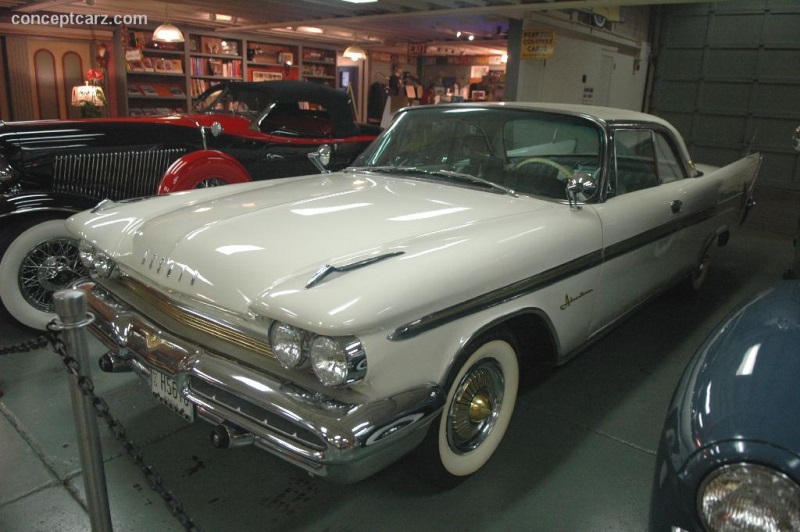
SportsmanRejuvenated by the introduction of Virgil Exner's 'Forward Look' styling regime and the addition of fins in 1957, the Adventurer increased in both price and power, becoming one of the first production cars rated at one horsepower per cubic inch. It became more similar in design and features to the Chrysler during its production lifespan before the defunct DeSoto brand ceased production in 1961.In 1959, the models were restyled with much of the bodywork shared with Chrysler's 300, and just like in previous years, were offered in a choice of either Black or Pearl White, both with Gold accented exterior trim, wheel covers and badging. Demonstrating Exner's iconic Forward look design program, the Adventurer received many over-the-top details, exaggerated proportions, fins, and futuristic touches inspired by the burgeoning jet age. They were large, flashy, and exaggerated, with copious amounts of chrome trim and gold, elaborate interiors, and towering tail fins. Engine displacement grew from 361 to 383 cubic inches and was aided by dual four-barrel carburetion, a special cam and valvetrain, and a modified distributor.1959 DeSoto models included the Firesweep resting on a 122-inch wheelbase and powered by a 361 CID V8 with 295 horsepower. All other models had a 126-inch wheelbase and a 383 CID V8. The Firedome used a Carter two-barrel carburetor to produce 305 horsepower, while the Fireflite was equipped with a four-barrel Carter carburetor with 325 horsepower. Among the body styles common to the Firesweep, Firedome, and Fireflite were a sedan, two- and four-door sportsman, and convertible coupe. Firesweep and Fireflite were also available as station wagons with 6- and 9-passenger seating. Prices ranged from $2,900 to $4,360.
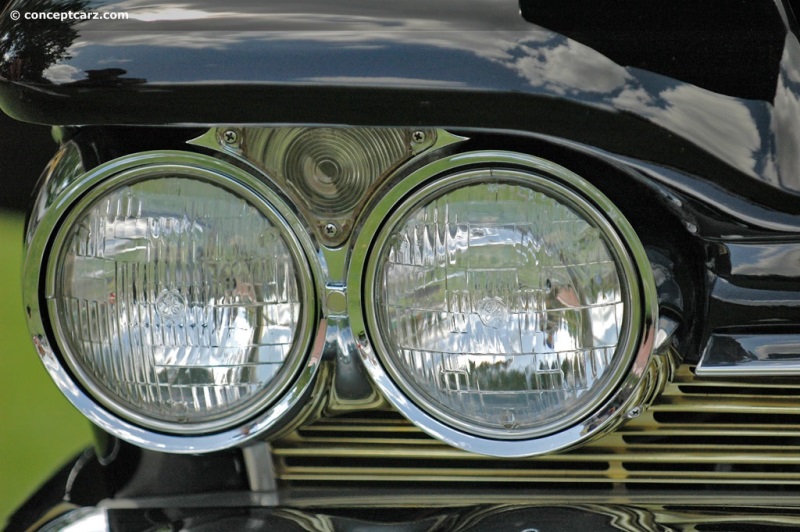
SportsmanThe Adventurer was priced at $4,430 for the sportsman and $4,750 for the convertible coupe. The 383 CID V8 had hydraulic valve lifters, five main bearings, two Carter four-barrel carburetors, and delivered 350 horsepower at 5,000 RPM. It had power brakes, power steering, dual exhaust, dual rear radio antennas, dual outside rearview mirrors, and white sidewall Rayon tires measuring 8.50 x 14. The interiors had a swivel front driver's seat, and the two-door hardtop had a simulated Scotch-grain leather finish for the roof. There were deck lid moldings, wheel cutout moldings, and gold color sweep inserts, and the grille was finished in gold. Just 590 examples of the two-door Sportsman and 97 of the convertible coupe were built in 1959.
by Daniel Vaughan | Dec 2018
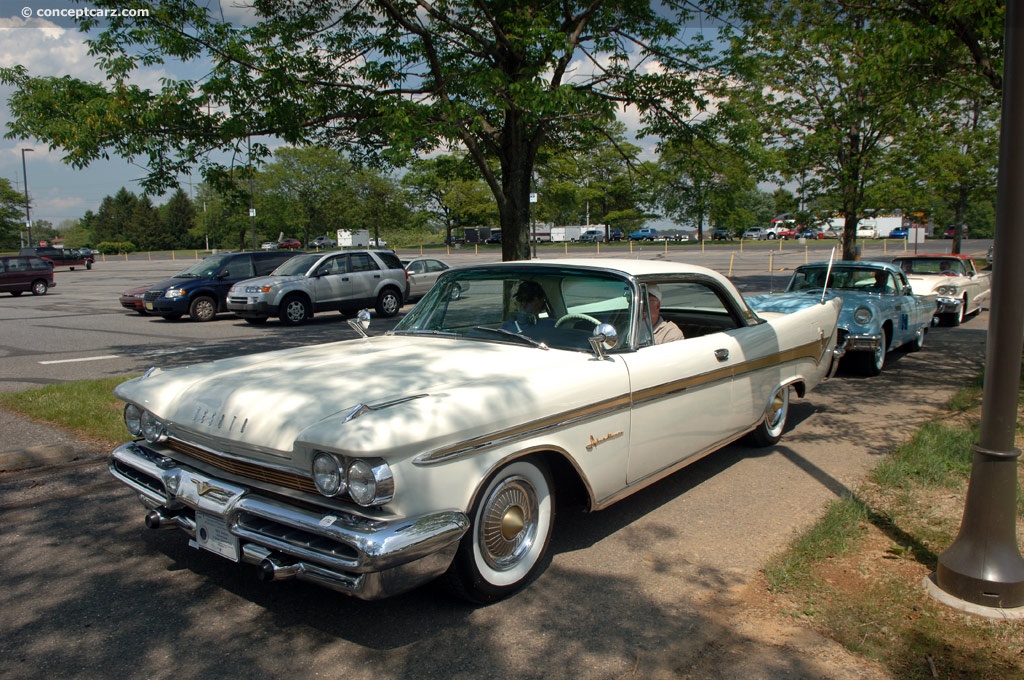
Sportsman
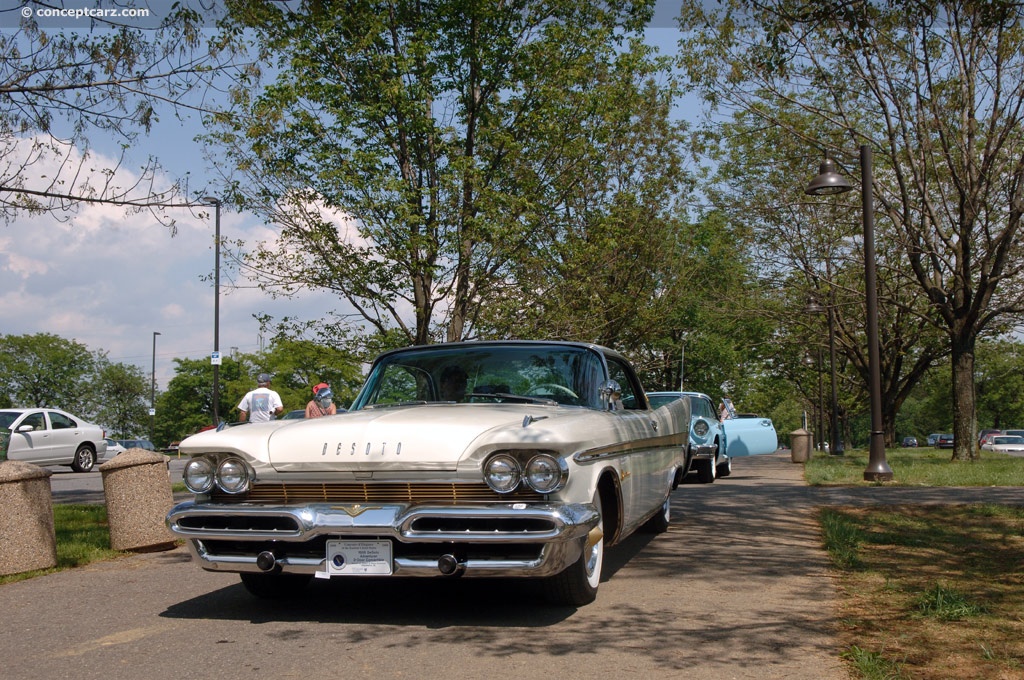
Sportsman
by Daniel Vaughan | Dec 2018
Related Reading : DeSoto Adventurer History
The DeSoto was introduced in 1956 and produced through 1960. The two-door hardtop Adventurer had received its name from a DeSoto concept car. During its production lifespan, the car would endure both good and bad times. There were many reasons for the final demise of the vehicle. At the close of the 1950s, the country was experiencing economic turmoil which was causing the sales of most automobiles....
Continue Reading >>
Continue Reading >>
Similarly Sized Vehicles
from 1959
Similarly Priced Vehicles


1959 DeSoto Adventurer Vehicle Profiles



Recent Vehicle Additions


Performance and Specification Comparison
Price Comparison
$2,900 - $3,500
$3,230 - $3,650
Adventurer Specification Comparison by Year
Year
Production
Wheelbase
Engine
Prices
Related Automotive News

CHRYSLER BRAND CELEBRATES 90 YEARS OF STYLE, ENGINEERING INNOVATION AND GROUNDBREAKING PRODUCTS
September 22, 2015 , Auburn Hills, Mich. - Chrysler Six, Airflow, Imperial, New Yorker, 300 and Town %26 Country are just some of the nameplates that mark the rich history of the Chrysler brand.
2015 marks the 90th anniversary of Chrysler, which...

FOUR ENGINES, EIGHT-SPEEDS AND UP TO 707 HORSEPOWER: DODGE ANNOUNCES PRICING FOR ITS NEW 2015 CHALLENGER MODEL LINEUP
Starting later in the third-quarter, Dodge is unleashing the Most Powerful and Fastest Muscle Car ever, along with the most capable and technologically advanced Challenger lineup ever – with a starting U.S. Manufacturers Suggested Retail Price (MSRP)...

Concours d'Elegance of America at St. John's : Class Previews
Here is a little preview of two of our special classes for St. Johns upcoming show.
Featured Designer Virgil Exner
The 2014 Concours dElegance of America will honor the work of famed chief designer Virgil Exner with an unprecedented display...

RARE REUNION: CHRYSLER CONCEPT CARS GATHER AT AMELIA, 2014
Nine rare and important Chrysler Concept Cars from the forties, fifties and sixties will be presented together for the first time at the 19th annual Amelia Island Concours dElegance on March 9, 2014.
From the two-seat Chrysler Thunderbolt roadster...

Joe Bortz to Host Historic Dream Car Discussion Panel
Dream car collector and historian Joe Bortz has prepared a special treat for participants at the 40th Annual Pontiac-Oakland Club International Convention in St. Charles Illinois, this coming July 17-21. In addition to bringing his four historic...